
Free ACCUPLACER Practice Test 2026
200 questions across reading, writing, arithmetic, quantitative reasoning and algebra, and advanced algebra and functions. Tuned for mobile. No account needed.
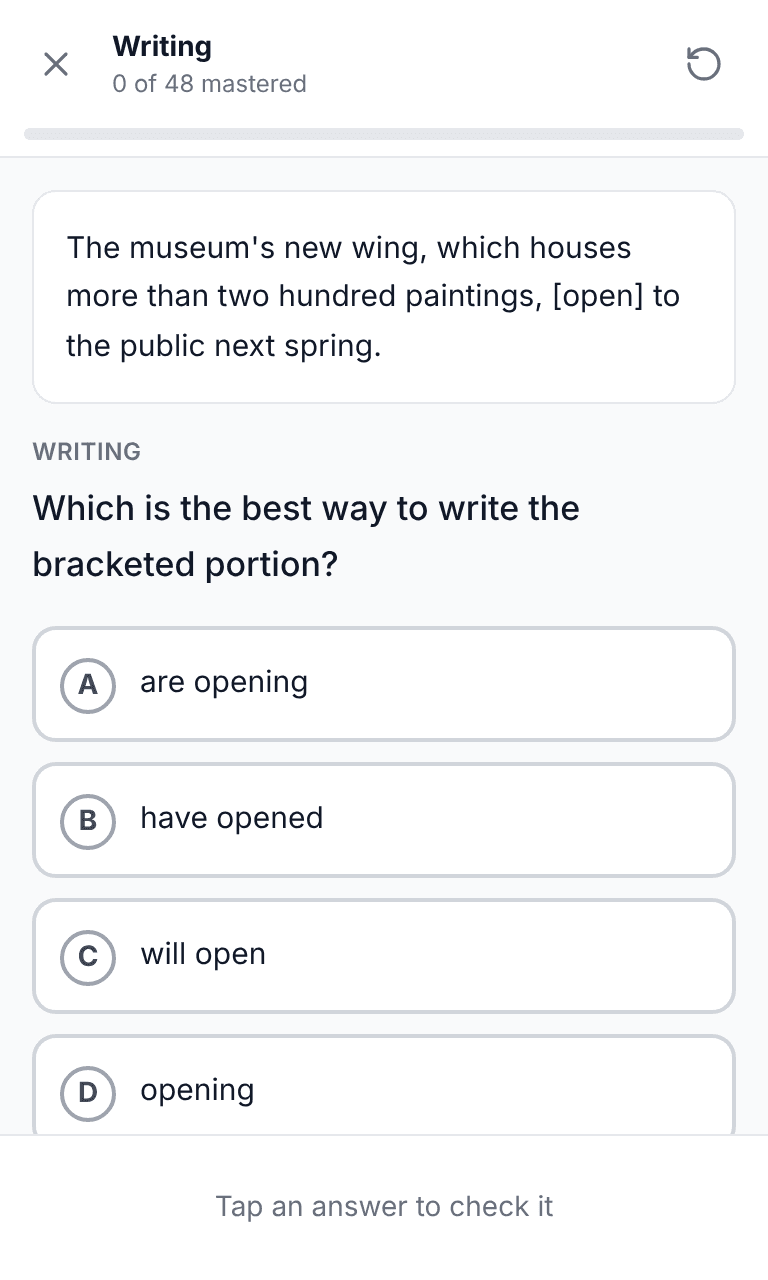
Train on mobile
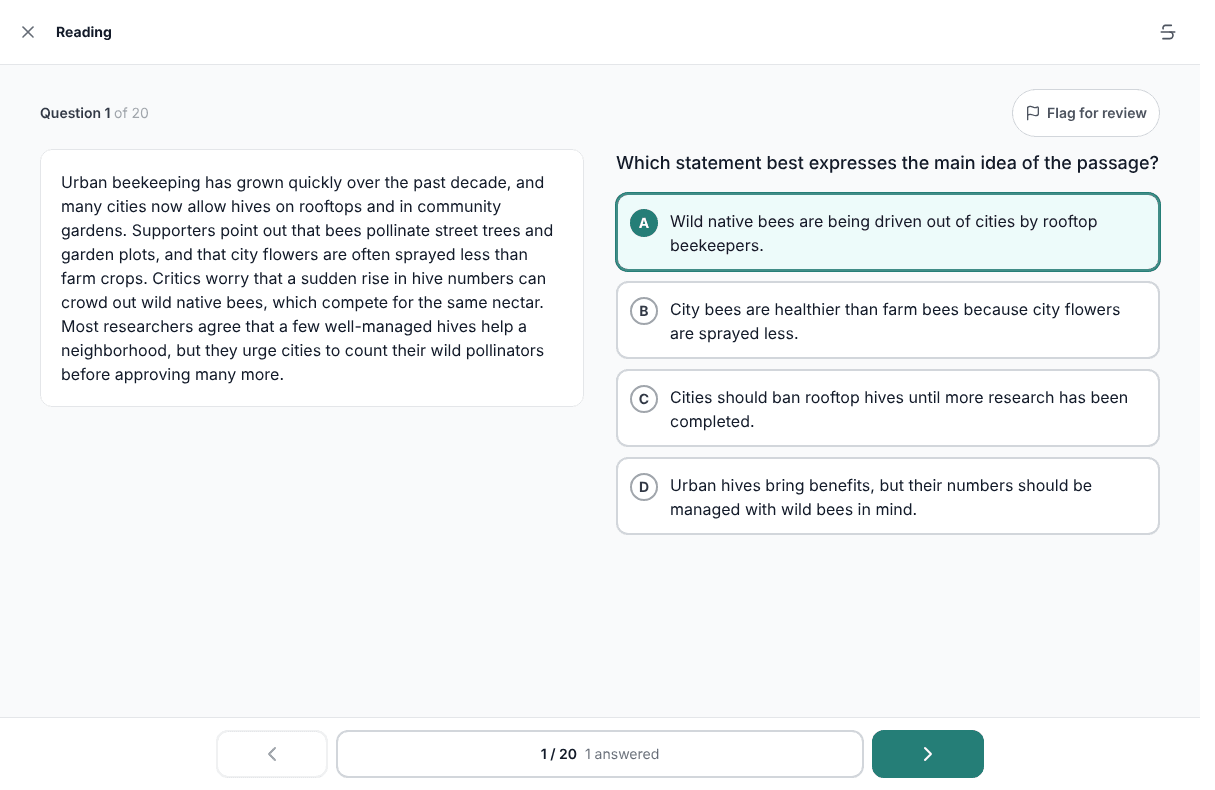
Test on desktop
How It Works
Section Drills on Your Phone
Five drills, one per section: reading passages beside the question, writing items with the sentence or paragraph to revise shown above the choices, and arithmetic, quantitative reasoning and advanced algebra with every step shown. Every miss comes back until you have mastered it.
Practice Tests
Two practice tests with 20 questions per section (10 for Advanced Algebra and Functions), untimed like the real ACCUPLACER, scored on the 200 to 300 scale. Finish with a score per section against the cut scores your college publishes, and a plan for what to drill next.
Built on the Next-Generation ACCUPLACER Sections
The College Board's ACCUPLACER places you into college courses rather than passing or failing you. The practice tests here give reading and writing the most weight because nearly every student takes them, and they split the math across all three levels so you can see which one you are ready for.

We Just Launched!
The ACCUPLACER practice test is brand new. If a question looks wrong or your college tests a section differently, tell us.
Send Us FeedbackHow to Place Higher on the ACCUPLACER
1. Find out which sections your college uses
Ask the testing center or advising office before you study. Most students take Reading and Writing plus one math section, and the math section you are assigned decides whether you should be reviewing fractions and percents or quadratics and functions. Ask for the cut scores too, so you know what you are aiming for.
2. Do the arithmetic by hand
The on-screen calculator shows up for only some math questions, so fractions, decimals, percents and order of operations need to be automatic. Work every practice problem on paper, then check the key step in the explanation. Most placement points are lost on arithmetic slips, not on hard algebra.
3. Read the question before the passage
Reading items ask one thing: the main idea, a detail, an inference, a word's meaning in context, or how two paired passages relate. Know what you are hunting for, then read. For writing items, read the whole passage first so the transition or verb tense you choose fits the sentences around it.
4. Treat every question as if it counts
The real test is adaptive and untimed, and you cannot go back to a question once you answer it. Early answers shape which questions come next, so slow down rather than guessing. TigerTest tracks your accuracy by section; aim to clear 70 percent on each set before test day, and retake the set you miss most.
ACCUPLACER Frequently Asked Questions
What is on the ACCUPLACER?
The Next-Generation ACCUPLACER has five multiple-choice sections: Reading, Writing, Arithmetic, Quantitative Reasoning, Algebra and Statistics (QAS), and Advanced Algebra and Functions (AAF). Many colleges also give the WritePlacer essay, which is not included here. Your college decides which sections you take; most students take Reading, Writing and one or two of the math sections.
Can you fail the ACCUPLACER?
No. It is a placement test, not a pass or fail exam. Each section is scored from 200 to 300, and each college sets its own cut scores that decide whether you start in a credit-bearing course or a developmental one. A higher score can save you a semester and the tuition for courses that do not count toward your degree.
How long is the test and can I use a calculator?
The multiple-choice sections are untimed and computer-adaptive, so the questions get harder or easier based on your answers, and most sections have 20 questions. You cannot bring your own calculator. An on-screen calculator appears for some math questions only, so you should be comfortable with arithmetic, fractions and percents by hand.
Which math section will I take?
Your college assigns it, often based on your intended major or a short placement questionnaire. Arithmetic covers whole numbers, fractions, decimals, percents and ratios. QAS adds linear equations, inequalities, exponents, probability and statistics, and geometry. AAF covers quadratics, polynomials, functions, radicals, exponentials and basic trigonometry for students heading into calculus. Many students take QAS, and some are routed to AAF based on their QAS score.
Is the TigerTest ACCUPLACER practice test free?
Yes. Both practice tests and all five drills are free, with no account required. Create a free account to keep your progress in step between your phone and your computer. TigerTest is not affiliated with the College Board.
Related practice tests
Every test on TigerTest is free and needs no account to start.