
Free AP Computer Science Principles Practice Test
200 original computing questions. Five topic drills and two full-length MCQ tests, all free with no account needed. Prepare Create separately.
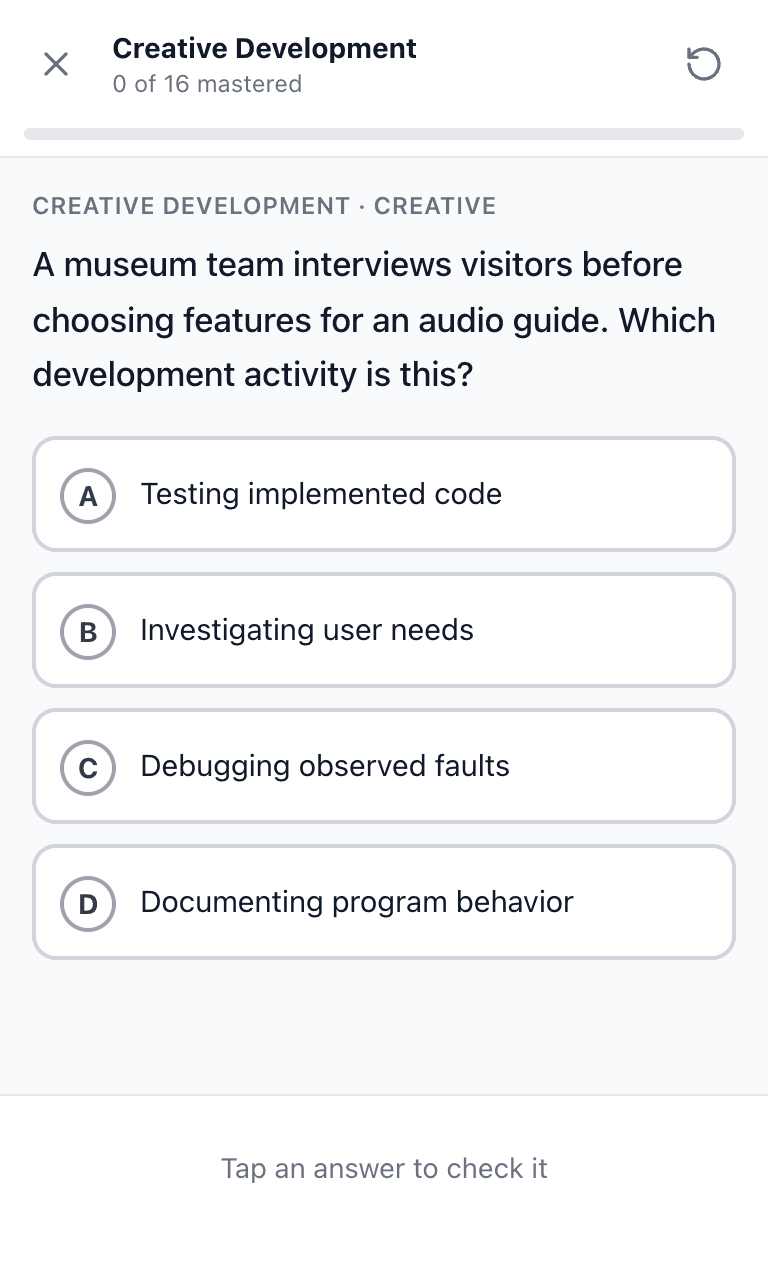
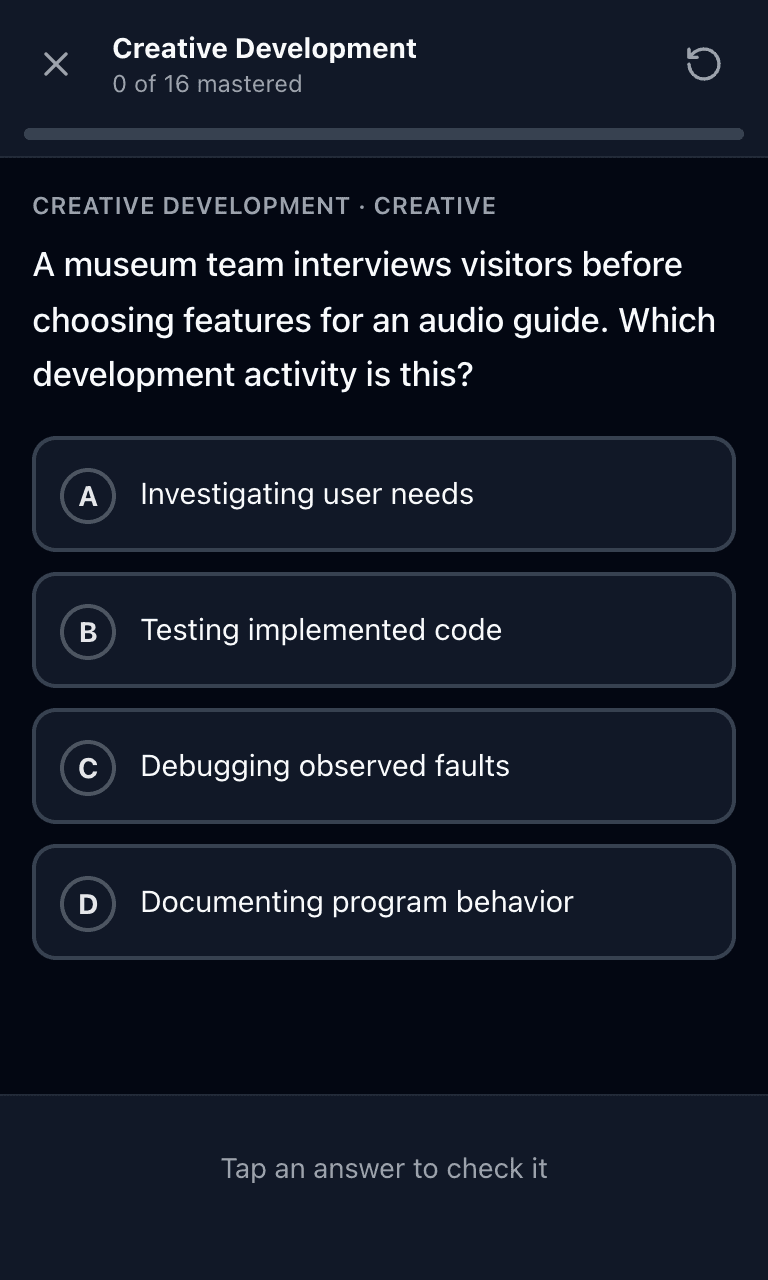
Train on mobile
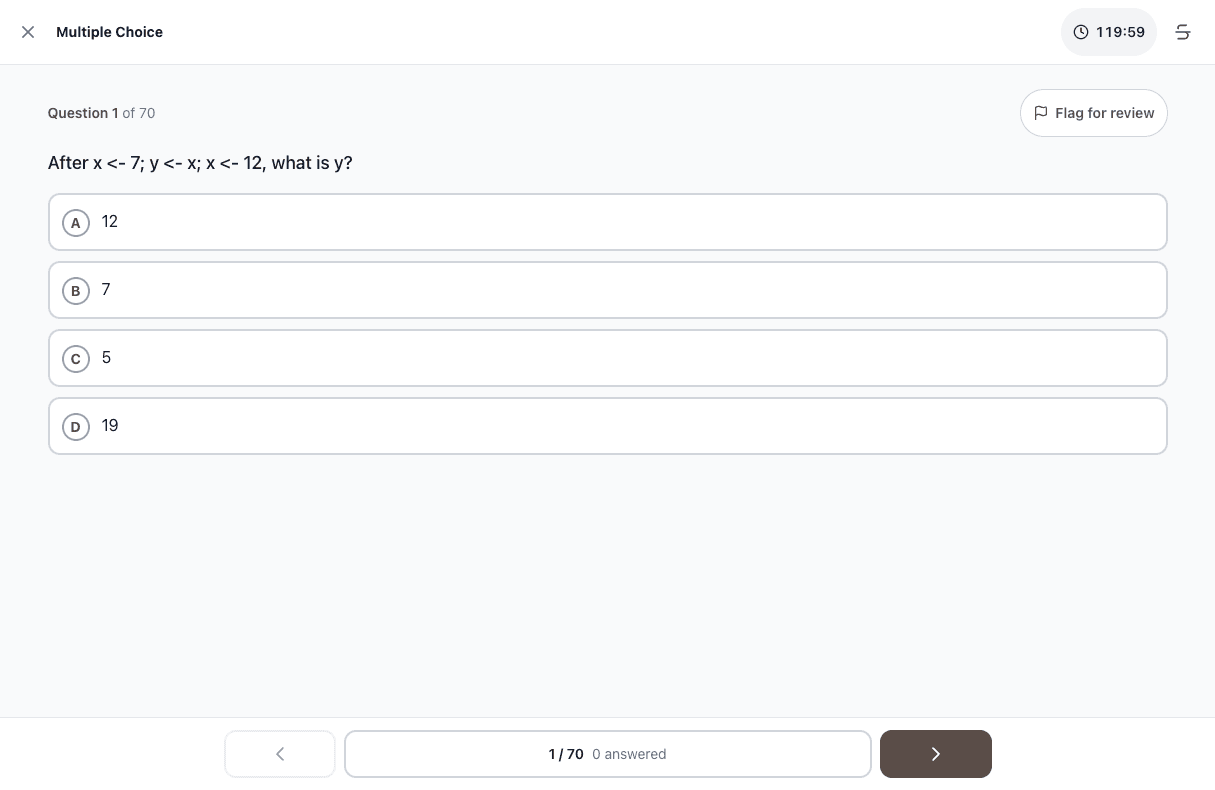
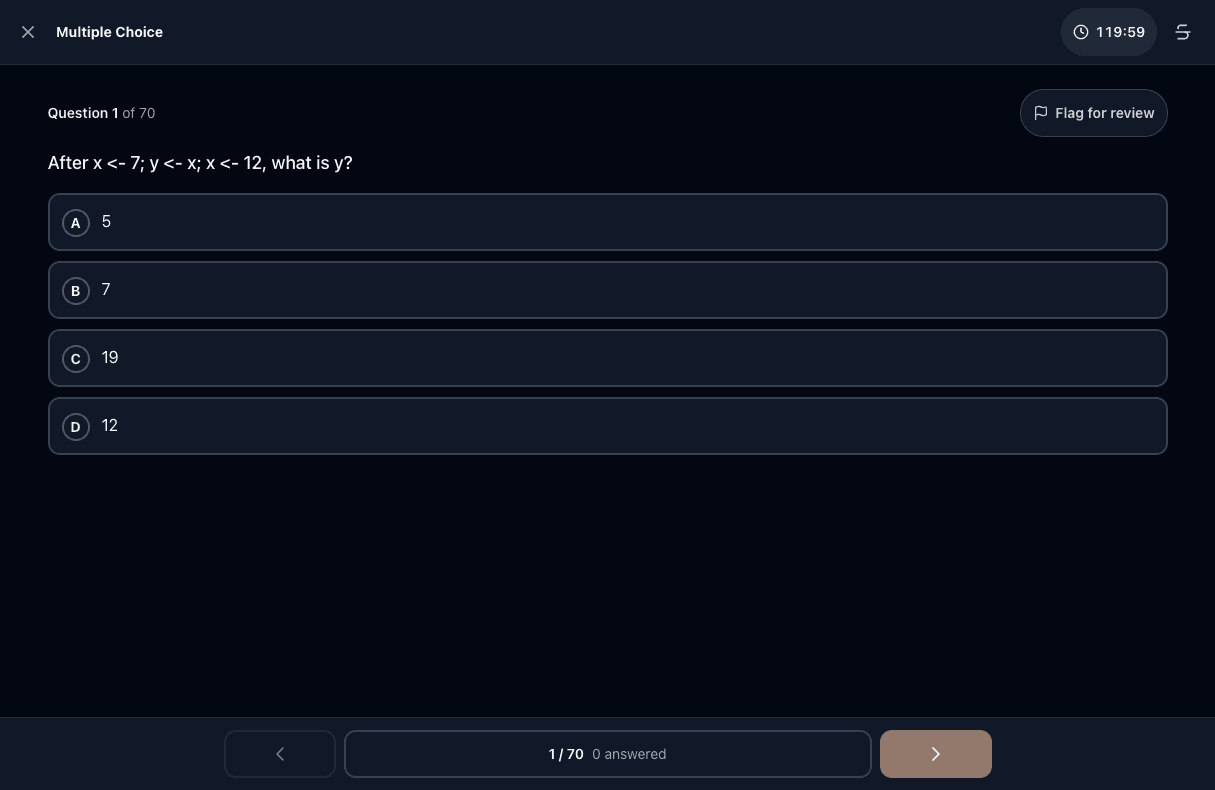
Test on desktop
The AP Computer Science Principles exam at a glance
AP Computer Science Principles introduces computing, data, algorithms, networks and computing impacts. Its current multiple-choice section has 70 questions in 120 minutes and contributes 70% of the AP score. Create and its written responses contribute 30%. Tigertest provides 200 original MCQ questions, five drills and two full-length MCQ tests; it does not assess Create or AP Computer Science A.
Tigertest has 200 AP Computer Science Principles practice questions with explanations, all free with no account required.
- Multiple choice
- 70 questions in 120 minutes; 70% of AP score
- Question types
- 57 standalone single-answer, 5 passage single-answer, 8 choose-two
- Create and written response
- 30% of AP score; not covered here
- Practice score
- Percentage correct; no AP 1–5 conversion
- Practice bank
- 200 originals, five drills, two 70-question tests
- Price
- All drills and both tests are free
Updated by the Tigertest team. Practice questions follow College Board CSP CED effective Fall 2023 and current exam page, checked 17 November 2026. A redesign is announced for the 2027–28 school year; this bank follows the current framework. Exam rules change, so confirm current details with College Board AP CSP exam.
How It Works
Five Topic Drills
Trace code, interpret data and reason about computing scenarios, one big idea at a time. Questions you miss come back until you have mastered them, with an explanation for every answer.
Practice Tests
Two 70-question tests in 120 minutes, including choose-two and reading-passage items. Practice Test 2 is held out of the drills. Your percentage measures this practice, not your complete AP readiness.
Built on the Five Big Ideas
Every practice test follows the course framework in the College Board's current Course and Exam Description, effective Fall 2023. The big-idea counts fall within the official weighting ranges: user needs and testing, binary data and compression, original pseudocode with lists and procedures, packets and fault tolerance, and bias, privacy and security.

Help Make Tigertest Better
Have an idea, a topic you'd like covered, or a question that could be clearer? We read every message and use it to improve every test.
Share FeedbackHow to Prepare for AP CSP Multiple Choice
1. Trace every variable
Write down variable values after each statement, especially inside loops, before you look at the options.
2. Mind the reference syntax
Lists are indexed from 1, and RANDOM includes both of its endpoints. Read those details carefully in every code question.
3. Check every option on choose-two questions
Both correct choices are required, so test each option against the scenario instead of stopping at the first good one.
4. Keep working on Create
The multiple-choice section is 70% of the AP score. Keep preparing your Create task and written responses alongside MCQ practice.
AP Computer Science Principles Frequently Asked Questions
What does this AP Computer Science Principles practice cover?
It covers the current five big ideas: Creative Development, Data, Algorithms and Programming, Computer Systems and Networks, and Impact of Computing. There are 200 original questions, five topic drills and two 70-question multiple-choice tests. Code, passages and data are original. Diagrams are described in text.
Does this include the Create performance task?
No. The real multiple-choice section contributes 70% of the AP score; Create and its written responses contribute the other 30%. This app does not assess your program, video, Personalized Project Reference or written responses. Prepare those with your course and current College Board guidance.
How closely do the practice tests match the MCQ format?
Each test has 70 questions in 120 minutes: 57 standalone single-answer questions, five single-answer questions with an original computing-innovation passage, and eight choose-two questions. There are four options per question. The five big-idea counts fall within College Board's current weighting ranges. This is practice in Tigertest, not a reproduction of Bluebook.
Is this AP Computer Science A?
No. AP Computer Science Principles is a separate course covering a broad range of computing ideas. These questions use Principles-style pseudocode, not an AP Computer Science A Java curriculum. Choose the exam that matches your course.
Can my percentage predict an AP score?
No. The score is the percentage of these MCQ items fully correct, with both correct choices required on choose-two items. It excludes Create and written responses. Practice goals are study targets, not official AP cutoffs or a conversion to the AP 1 to 5 scale.
Are all the tests and drills free?
Yes. All 200 questions, both timed tests and all five drills are free, with no account required. The second test stays out of drills for a fresh check. AP is a College Board trademark; College Board is not affiliated with and does not endorse Tigertest.
I teach AP Computer Science Principles. Can my students use Tigertest?
Yes, for free. Make a class at tigertest.io/teach, post one link, and students join with just their name. You see who practiced, their test scores and the topics your class misses most.
AP Computer Science Principles sample questions and answers
5 of the 200 practice questions, one from each topic, with the answer explained.
- 1.
A queue model draws customer arrivals at random and repeats the experiment to estimate waiting-time variation. What description applies?
- A.
Simulation
- B.
Brute-force search
- C.
Undecidable problem
- D.
Sorting algorithm
Answer: A.Modelling a process with random values and repeating the trials is a simulation.
- A.
- 2.
A function returns the smallest item in a nonempty list. Tests use [2,5,9] and [4,7,8], but an implementation that returns the first item passes both. Which additional case detects that implementation?
- A.
[0,4,6]
- B.
[7,2,5]
- C.
[1,6,8]
- D.
[3,3,9]
Answer: B.In [7,2,5], the smallest value is not first. The other proposed cases still have a minimum in the first position.
- A.
- 3.
A small file grows after a lossless compressor adds a dictionary larger than the saved repeated text. What explains the growth?
- A.
The compressor discarded data
- B.
Lossless compression always enlarges files
- C.
The file had no patterns at all
- D.
Its overhead was bigger than the reduction
Answer: D.The dictionary is overhead. When it takes more space than the shortening saves, the file gets bigger. Lossless compression usually shrinks files with repeated patterns.
- A.
- 4.
A team knows overall model accuracy but wants to detect whether one demographic group experiences more mistakes. What analysis directly addresses that goal?
- A.
Retrain on more data overall
- B.
Report the overall accuracy again
- C.
Remove the demographic field
- D.
Compute error rates per subgroup
Answer: D.Error rates for each subgroup show differences that a single overall figure can hide.
- A.
- 5.
Several laboratories process separate image batches on their own computers and send back results. What arrangement is illustrated?
- A.
Sequential processing on one machine
- B.
Single point of failure
- C.
Lossless compression of images
- D.
Distributed system
Answer: D.Several networked devices each doing part of the work is distributed computing.
- A.
Related practice tests
Every test on Tigertest is free to start, with no account needed.
- AP Psychology Practice TestCollege Board · AP Psychology, 2024 course framework
- AP US History Practice TestCollege Board · AP U.S. History, CED effective fall 2026
- AP US Government Practice TestCollege Board · AP U.S. Government and Politics, CED effective fall 2026
- AP World History Practice TestCollege Board · AP World History: Modern, CED effective fall 2026
- AP Human Geography Practice TestCollege Board · AP Human Geography, course framework effective fall 2020
- AP English Language Practice TestCollege Board · AP English Language and Composition, CED effective fall 2024
Build Your Computing Skills
Start with a topic drill, then take a timed multiple-choice test. Free, no account required.
Start practicing