
Free Canadian Firearms Safety Course Practice Test 2026
200 questions for the PAL written test: ACTS and PROVE, actions, ammunition, safe handling, storage and transport rules, and Canadian firearms law, with the real 80% pass mark. Tuned for mobile. No account needed.
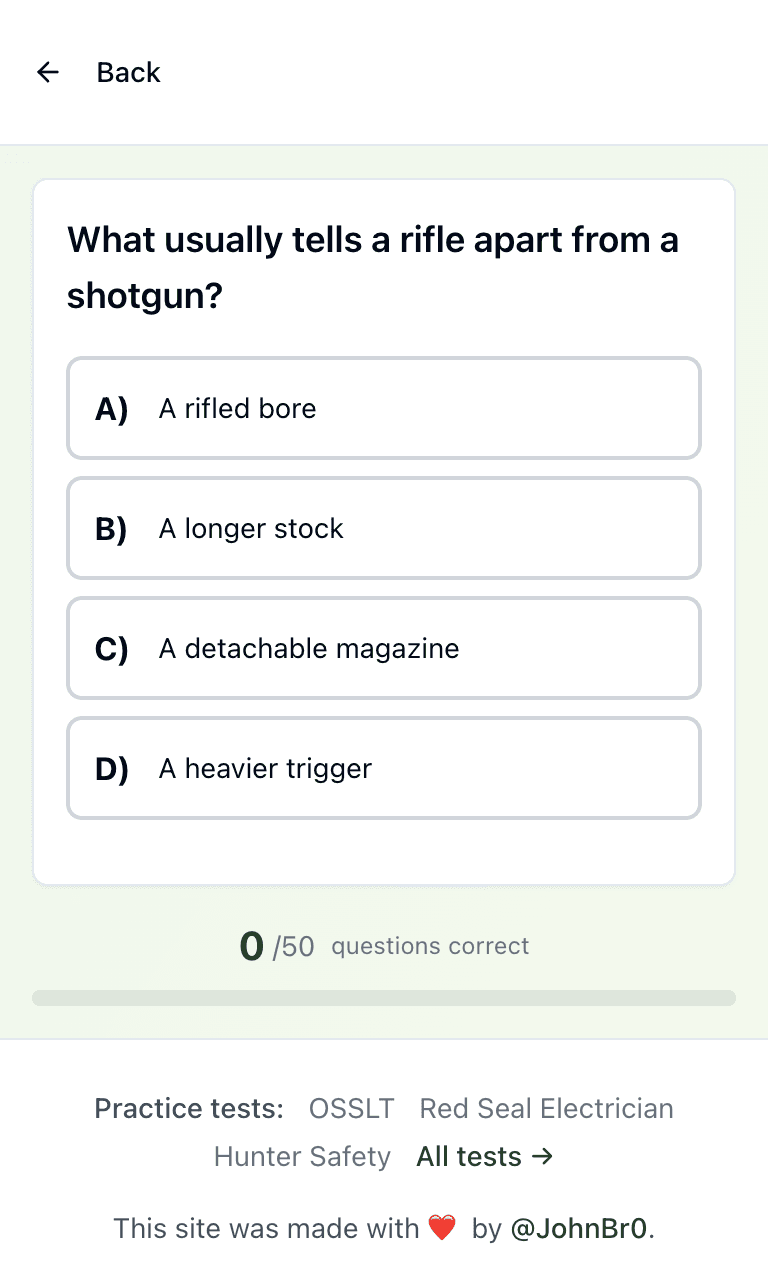
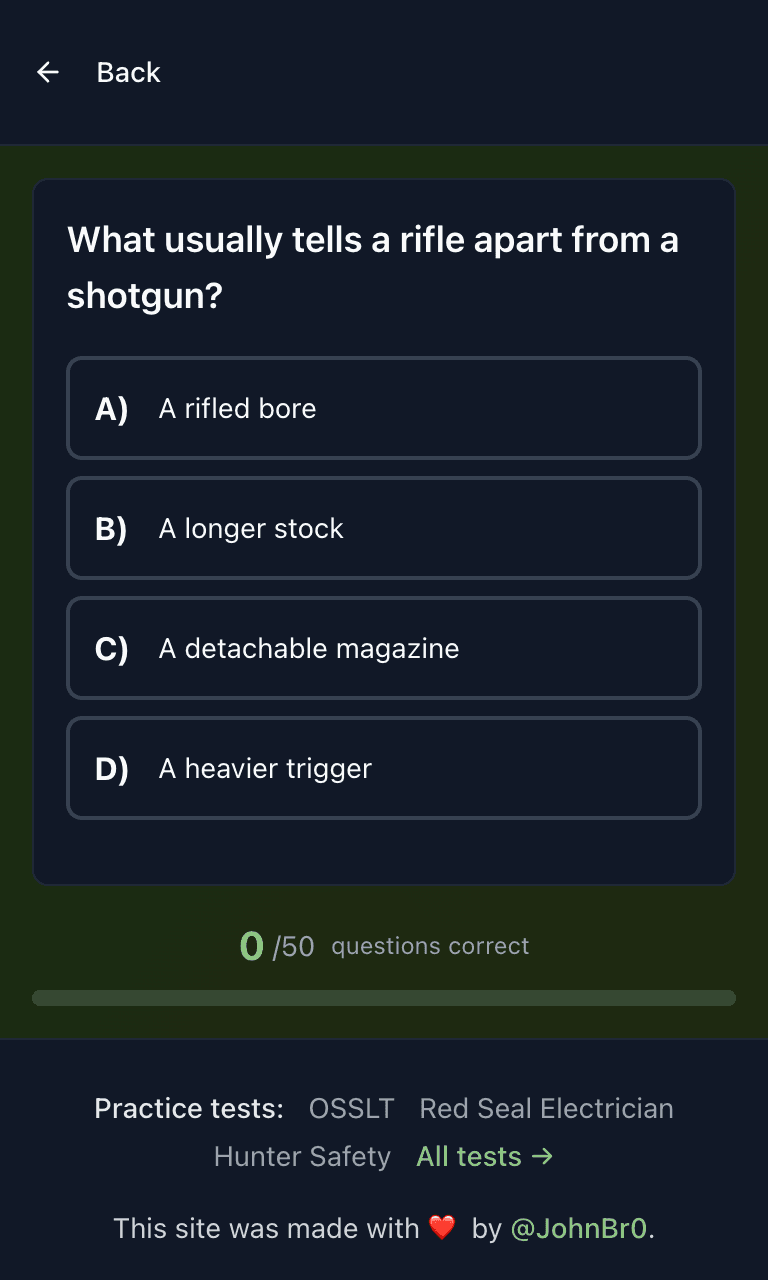
Train on mobile
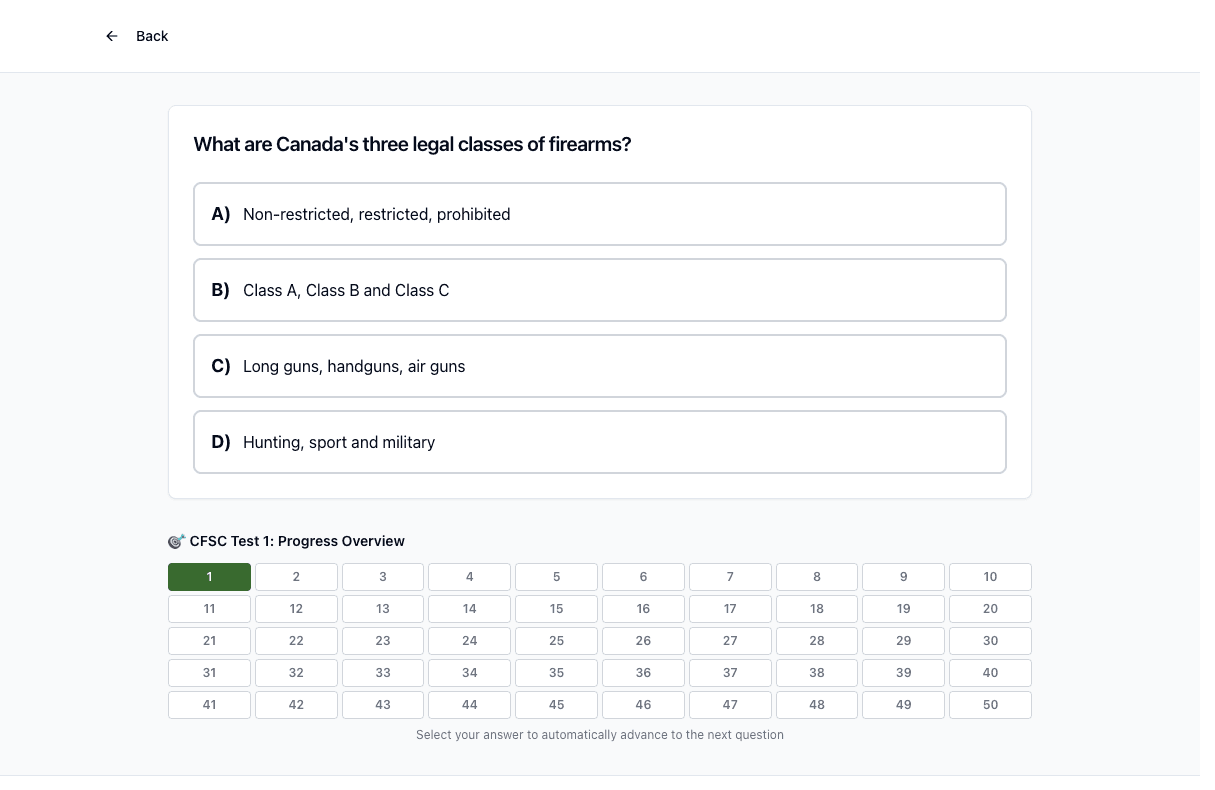
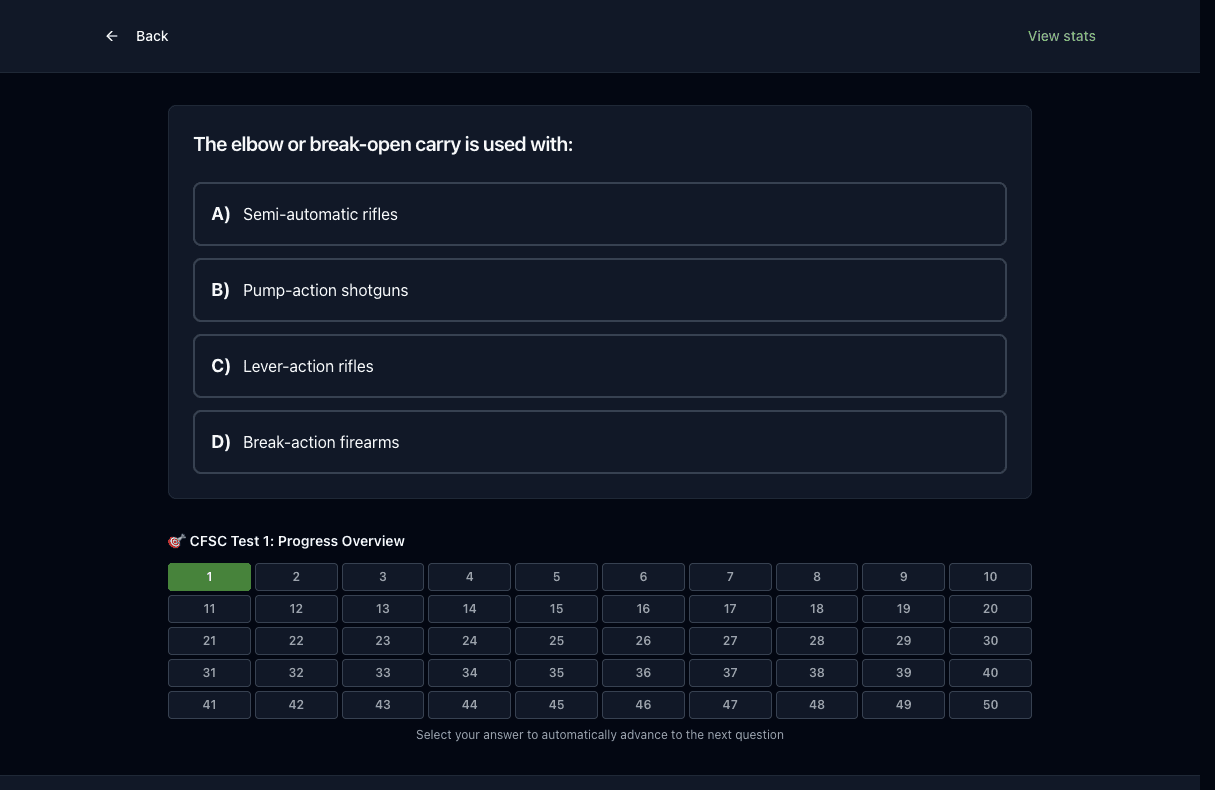
Test on desktop
The CFSC exam at a glance
The Canadian Firearms Safety Course (CFSC) is the RCMP course you must pass before applying for a Possession and Acquisition Licence (PAL) for non-restricted firearms. After classroom instruction from a provincially designated instructor you take a written test, usually 50 questions and mostly multiple choice, and a practical handling test, and you need 80% on each. Anyone 12 or older can take it; the PAL itself is for adults 18 and over and lasts 5 years.
Tigertest has 200 CFSC practice questions with explanations, all free with no account required.
- Written test
- Usually 50 questions, mostly multiple choice
- Practical test
- Handling and PROVE on common actions
- Pass mark
- 80% on each test
- Course delivered by
- Instructors designated by each province's Chief Firearms Officer
- Minimum age
- 12 for the course, 18 for a PAL
- Licence
- PAL, valid 5 years; 28-day minimum wait for new applicants
- Restricted firearms
- Separate CRFSC course
Updated by the Tigertest team. Practice questions follow the RCMP Canadian Firearms Program course requirements and federal firearms law, checked October 2026. Exam rules change, so confirm current details with RCMP: Firearms safety courses.
How It Works
Train, Then Test
Four training sets, one per practice test: Set 1 holds exactly the 50 questions of Test 1, and so on. Master Set 1, take Test 1, then move on. Questions you miss come back until you have mastered them.
Practice Tests
Four 50-question practice tests with the same 80 percent pass mark as the course's written test, and an explanation of the right answer on every question.
Built on the CFSC Course Topics
The RCMP lists the topics the course must teach but does not publish how many test questions each one gets. The practice tests here follow the order of the student handbook and lean on what the course leans on: the Vital Four ACTS and PROVE, safe handling, and the storage, transport and licensing rules. Every question is original and checked against the federal regulations current in October 2026.

For Firearms Safety Instructors
Teach the CFSC? Make a free class at tigertest.io/teach, share one link before or after the classroom day, and see who practised, their test scores and the topics your group misses most. It is extra practice for the written test, never a substitute for your course or the practical evaluation.
Set Up a ClassHow to Pass the CFSC Written Test
1. Know ACTS and PROVE word for word
Assume every firearm is loaded, Control the muzzle direction, keep your Trigger finger off the trigger and out of the guard, See that it is unloaded. Then Point it safely, Remove all cartridges, Observe the chamber, Verify the feeding path and Examine the bore. Many questions, and the whole practical test, come back to these nine steps.
2. Learn the storage and transport rules as a checklist
Stored: unloaded, plus a locking device, the bolt removed or a locked container, with ammunition not readily accessible unless it is locked up. Transported: unloaded, and in a locked trunk or out of sight in a locked vehicle when you leave it. Displayed: unloaded, locked and never next to its ammunition.
3. Match the carry to the people around you
The two-hand carry gives the best control. Trail carry is out when someone is ahead, shoulder carry when someone is behind and the cradle carry when someone is on the muzzle side. Crossing fences, climbing and getting into vehicles all start with unloading.
4. Fix your misses, then retest
Tigertest tracks your accuracy by topic. Aim for 45 or more out of 50 on all four practice tests so you have room above the 40 you need, then drill the questions you missed. Practise the actions with your instructor; no app replaces hands-on handling.
CFSC Frequently Asked Questions
What is the pass mark for the Canadian Firearms Safety Course?
You need 80 percent on the written test and 80 percent on the practical handling test, and you must pass both. The written test is usually 50 questions, mostly multiple choice with some true or false, so 40 correct answers is a pass. On the practical test the instructor watches you handle and PROVE common action types, and unsafe muzzle direction or trigger finger mistakes cost marks.
What does the CFSC cover?
The course follows the RCMP student handbook: how firearms evolved, their major parts, types and actions, ammunition, the Vital Four ACTS and PROVE, operating actions, safe handling and carries, firing techniques, care, the storage, display and transport rules for non-restricted firearms, and the law on licences, firearm classes and owners' responsibilities. The practice tests here group those into nine categories.
Who can take the course, and what comes after it?
Anyone 12 or older can take the CFSC with a provincially designated instructor. Passing it lets you apply for a Possession and Acquisition Licence at 18, or a minor's licence from 12 to 17. A PAL is valid for five years, and first-time applicants wait at least 28 days while checks are done. Course fees and schedules vary by province and instructor.
Is this the official RCMP test, and is it up to date?
No. Every question is written by Tigertest from the published course topics and the current federal law, without copying the RCMP handbook or its test. It reflects the law as of October 2026, including the 2022 handgun freeze and Bill C-21, which received Royal Assent in December 2023. Firearms rules keep changing, so check the Canadian Firearms Program for the latest before you buy, sell or travel.
Does this cover restricted firearms or hunting?
No. It covers the non-restricted CFSC only. Restricted firearms need the separate Canadian Restricted Firearms Safety Course, and hunting needs a provincial or territorial hunting licence, often with its own hunter education course. Where provinces differ, the questions say so rather than picking one.
I teach the Canadian Firearms Safety Course. Can my students use Tigertest?
Yes, for free. Make a class at tigertest.io/teach, post one link, and students join with just their name. You see who practiced, their test scores and the topics your class misses most.
Related practice tests
Every test on Tigertest is free and needs no account to start.
- Red Seal Electrician Practice TestRed Seal interprovincial exam · provincial apprenticeship authorities
- WHMIS Practice TestHealth Canada HPR · WHMIS 2015 workplace training
- Ontario Security Guard Practice TestOntario Ministry of the Solicitor General (PSISB)
- Red Seal Automotive Service Technician Practice TestRed Seal interprovincial exam · 2023 RSOS, 310S
- Red Seal Plumber Practice TestRed Seal interprovincial exam · 2023 RSOS, 306A
- Red Seal Carpenter Practice TestRed Seal interprovincial exam · 2022 RSOS, 403A
Ready to Pass Your CFSC?
Free to start. No account required. 200 questions across every course topic.
Start practicing