
Free CAT Mock Test
193 original questions in VARC, DILR and QA, with 40-minute sectional timing in the real order. Tuned for mobile. Free to start, no account needed.
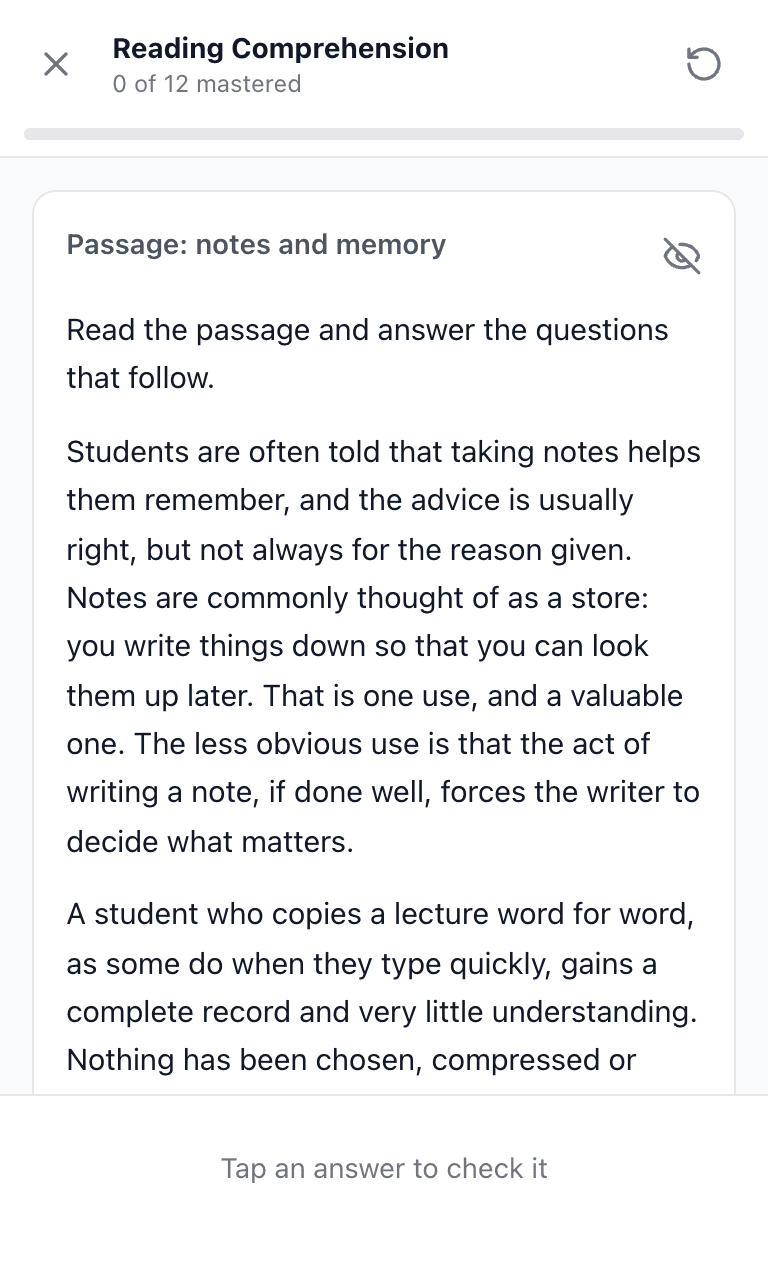
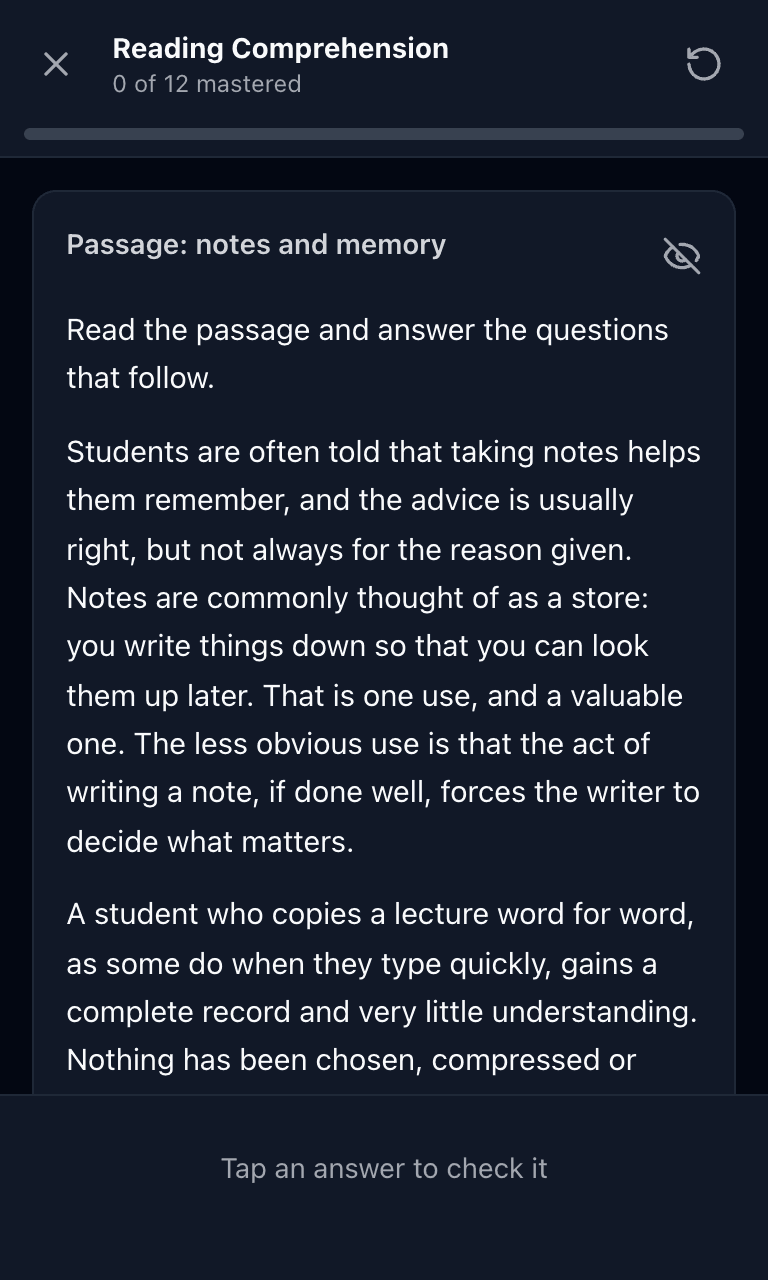
Train on mobile
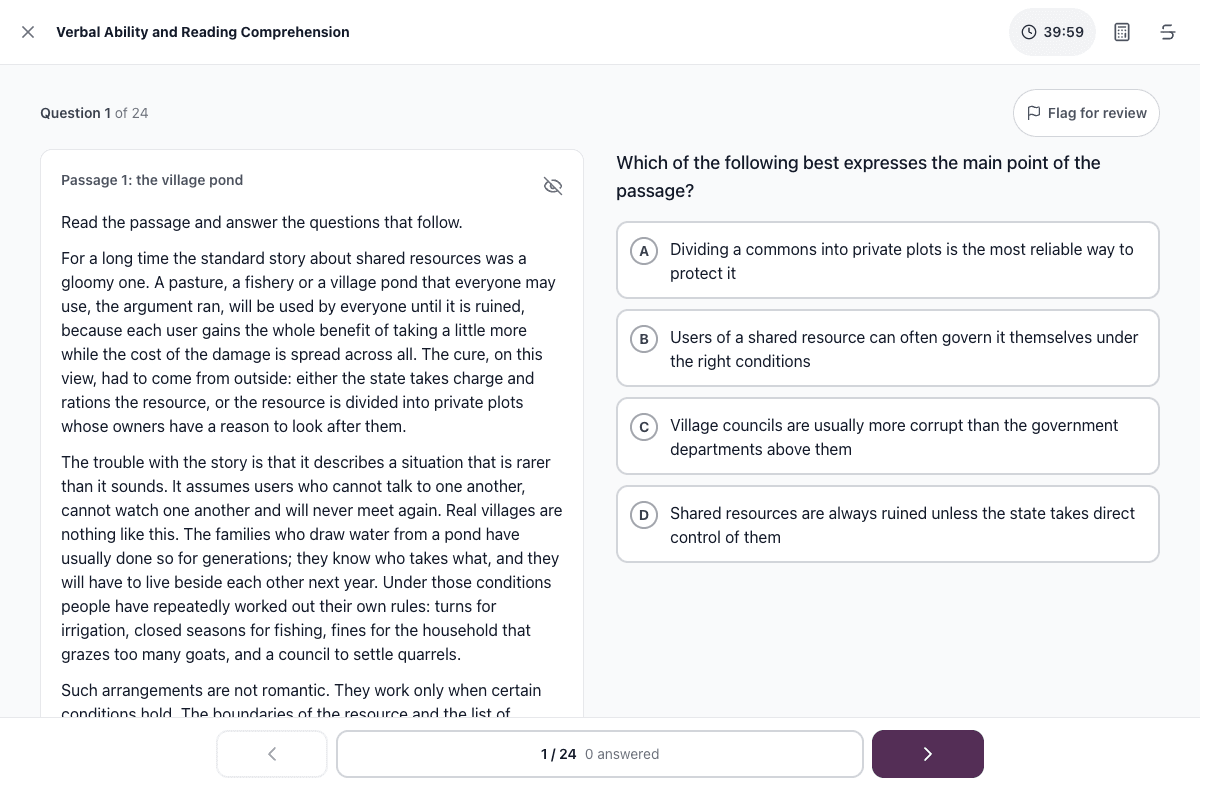
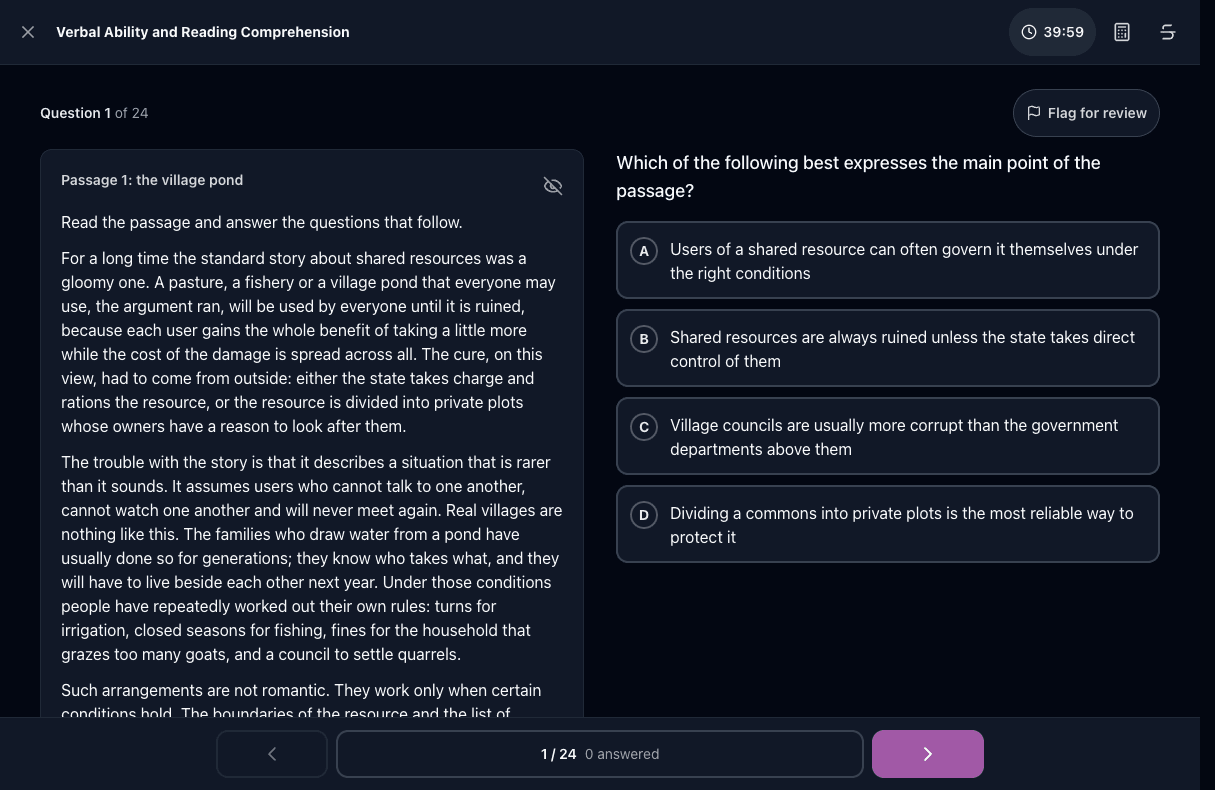
Test on desktop
The CAT exam at a glance
CAT 2026, the Common Admission Test of the Indian Institutes of Management, is a 120-minute computer-based test held on Sunday, 29 November 2026 in three sessions, convened this year by IIM Indore. It has three sections in a fixed order, Verbal Ability and Reading Comprehension, Data Interpretation and Logical Reasoning, and Quantitative Ability, with exactly 40 minutes for each and no switching between sections. A correct answer earns 3 marks; a wrong multiple-choice answer loses 1 mark, while non-MCQ questions, where you type the answer, carry no penalty. An on-screen calculator is available, CAT has no defined syllabus, and the IIMs do not publish the number of questions. The score is valid until 31 December 2027, and each IIM sets its own cut-offs and selection process.
Tigertest has 193 CAT practice questions with explanations, free to start with no account required.
- Duration
- 120 minutes
- Sections
- VARC, DILR and QA, in a fixed order, 40 minutes each
- Question types
- Multiple choice, and non-MCQ items where you type the answer
- Marking
- +3 correct; -1 for a wrong MCQ; 0 for a wrong non-MCQ or a skipped question
- Calculator
- On-screen calculator only
- Test date
- 29 November 2026, three sessions, about 170 cities
- Fee
- Rs 2,700; Rs 1,350 for SC, ST and PwBD candidates
- Score valid
- Until 31 December 2027
Updated by the Tigertest team. Practice questions follow the CAT 2026 press release of IIM Indore (26 July 2026), the CAT 2026 Information Bulletin and the CAT 2026 FAQs on iimcat.ac.in. Exam rules change, so confirm current details with CAT 2026 official website.
How It Works
Drills by Question Type
Eight drills: reading comprehension and verbal ability; data interpretation and logical reasoning; arithmetic, algebra, geometry and number system. Questions you miss come back until you have mastered them.
Full Mock Tests
Two 66-question mock tests in two hours, each section on its own 40-minute clock in the real order with no going back, like the real CAT. Mock Test 2 is held out of the drills, so it measures how ready you are.
Built on the CAT Pattern
Every mock test has the real CAT's three sections in the real order, with 40 minutes for each and an on-screen calculator. The IIMs do not publish how many questions each section has, so the counts below are Tigertest's model. Para-jumbles, odd sentence out and many DILR and QA questions are typed answers (TITA), as non-MCQ questions are on the real exam; multiple-choice questions have four options. The real CAT takes a mark off for a wrong multiple-choice answer; Tigertest shows your percent score so you can see where guessing would have cost you.

Help Make Tigertest Better
Have an idea, a topic you'd like covered, or a question that could be clearer? We read every message and use it to improve every test.
Share FeedbackHow to Prepare for CAT
1. Plan each 40 minutes
Time cannot move between sections, so treat each as its own test. In VARC, read every passage once with care rather than skimming twice. In DILR, look at all the sets in the first few minutes and start with the one whose data you understand fastest. In QA, take the questions you can solve in a minute or two first and come back to the long ones.
2. Read for the argument
Reading comprehension questions ask what the author argues, not what you already believe. Before the questions, say in one line what the passage claims and how each paragraph serves it. Wrong options are often true in general or go further than the passage does; the right one is the one the text supports.
3. Attempt every typed answer
A wrong multiple-choice answer costs a mark, but a wrong typed (TITA) answer costs nothing. Skip a multiple-choice question you can only guess at, but always type your best answer to a TITA question, even an estimate. For para-jumbles, find the opening sentence and the pairs linked by a pronoun or a word like "however" before ordering the rest.
4. Solve a DILR set once, fully
Each set gives four questions from one piece of data. Spend the time to lay it out completely, a seating diagram, a schedule or a table of totals, and the questions usually take seconds each. Half-solving several sets costs more time than finishing one. Tigertest tracks your accuracy by question type; retake the drill you miss most until it is as solid as your best one.
CAT Frequently Asked Questions
What is the CAT 2026 exam pattern?
CAT 2026 is a 120-minute computer-based test with three sections in a fixed order: Verbal Ability and Reading Comprehension (VARC), Data Interpretation and Logical Reasoning (DILR), and Quantitative Ability (QA). Each section gets exactly 40 minutes, and you cannot switch to another section while answering one. It is held on Sunday, 29 November 2026 in three sessions, convened this year by IIM Indore. The IIMs do not publish the number of questions; Tigertest's mock tests use 24, 20 and 22, which is our model, not an official figure.
Is there negative marking in CAT?
Yes, for multiple-choice questions only. A correct answer earns 3 marks and a wrong multiple-choice answer loses 1 mark. Non-MCQ questions, where you type the answer (often called TITA, type in the answer), carry the same 3 marks but no penalty for a wrong answer. Skipped questions score nothing either way. Tigertest mock tests show a percent score without deductions, so count your wrong multiple-choice answers yourself to see what the penalty would have cost.
Is there a syllabus for CAT?
No. The official CAT FAQs say the exam has no defined syllabus and point candidates to the official mock test to learn the pattern. In practice VARC tests reading comprehension and verbal ability such as para-jumbles and summaries, DILR tests reasoning with tables, charts and puzzles, and QA tests arithmetic, algebra, geometry and number system at school level. Tigertest's drills follow those question types.
Can I use a calculator in CAT?
Only the on-screen calculator. The official FAQs say candidates may not bring a calculator to the test centre, but an on-screen calculator is available throughout the exam. Tigertest's mock tests and drills give you an on-screen calculator in every section too. A scribble pad and pen are given at the centre for rough work.
Are these the real CAT questions?
No. These are original practice questions written to the CAT pattern, not questions from the IIMs, the official mock test or past papers. They follow the real question types: reading comprehension, para-jumbles, odd sentence out and para summaries; data interpretation and logical reasoning sets; and arithmetic, algebra, geometry and number system. Multiple-choice items have four options. It is free to start, with no account required. Mock Test 1 and every drill but the last two are free; the last two drills and Mock Test 2 are part of Tigertest Premium, one payment with no subscription.
I teach CAT coaching. Can my students use Tigertest?
Yes, for free. Make a class at tigertest.io/teach, post one link, and students join with just their name. You see who practiced, their test scores and the topics your class misses most.
CAT sample questions and answers
5 of the 193 practice questions, one from each topic, with the answer explained.
- 1.
The passage below is followed by four summaries. Choose the one that best captures the essence of the passage.
"A team that never disagrees is not necessarily a team that agrees. Its members may simply have learned that raising doubts is unwelcome. Silence of this kind hides problems until they are too large to ignore."
- A.
Silence can hide problems instead of showing agreement.
- B.
Teams should argue constantly so that every idea is tested.
- C.
Teams that agree on everything always make poor decisions.
- D.
Members who raise doubts are usually ignored by their leaders.
Answer: A.The passage warns that silence may come from fear of raising doubts and so hides problems. It does not call for constant argument.
- A.
- 2.
A invests Rs 40,000 for 12 months and B invests Rs 60,000 for 8 months in a business. Out of a profit of Rs 36,000, what is A's share?
- A.
Rs 14,400
- B.
Rs 18,000
- C.
Rs 21,600
- D.
Rs 24,000
Answer: B.Shares follow money x time: 40,000 x 12 = 4,80,000 and 60,000 x 8 = 4,80,000, a ratio of 1 : 1, so A gets half, Rs 18,000. Splitting by the amounts alone (2 : 3) gives Rs 14,400.
- A.
- 3.
What is the sum to infinity of the series 18 + 6 + 2 + ... ?
- A.
24
- B.
27
- C.
30
- D.
36
Answer: B.The common ratio is 1/3, so the sum is 18 / (1 - 1/3) = 18 x 3/2 = 27.
- A.
- 4.
A cube has a volume of 216 cubic cm. What is its total surface area in sq cm?
- A.
144
- B.
196
- C.
216
- D.
256
Answer: C.The side is the cube root of 216, which is 6 cm. Total surface area = 6 x 6^2 = 216 sq cm. Four faces only (the lateral area) give 144.
- A.
- 5.
A committee of 3 is to be chosen from 6 men and 4 women. In how many ways can it be formed with exactly 2 women?
- A.
24
- B.
36
- C.
48
- D.
60
Answer: B.Choose 2 of the 4 women in 6 ways and 1 of the 6 men in 6 ways: 6 x 6 = 36.
- A.
Related practice tests
Every test on Tigertest is free to start, with no account needed.
- JEE Main Mock TestNational Testing Agency · JEE (Main) Paper 1 (B.E./B.Tech.)
- NEET Mock TestNational Testing Agency · NEET (UG), MBBS and BDS entrance
- MHT-CET Mock TestState CET Cell, Maharashtra · MHT-CET PCM group
- CUET General Test Practice TestNational Testing Agency · CUET (UG) General Aptitude Test
Ready for the CAT?
Start for free. No account required. 193 questions across all three sections. Not affiliated with the Indian Institutes of Management.
Start practicing