
Free CompTIA PenTest+ Practice Test 2026
204 original questions weighted to the PT0-003 exam objectives, with scoping, log and scan excerpts, matching and ordering items. Tuned for mobile. Free to start, no account needed.
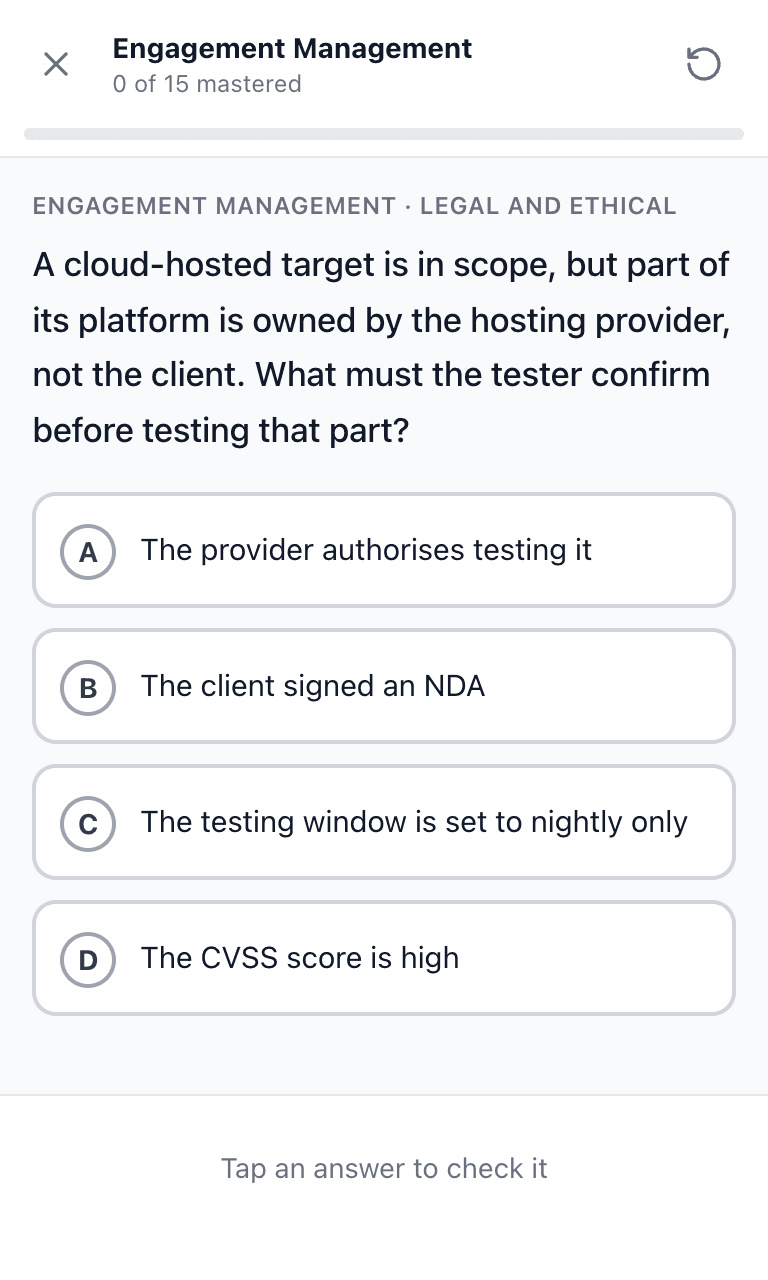
Train on mobile
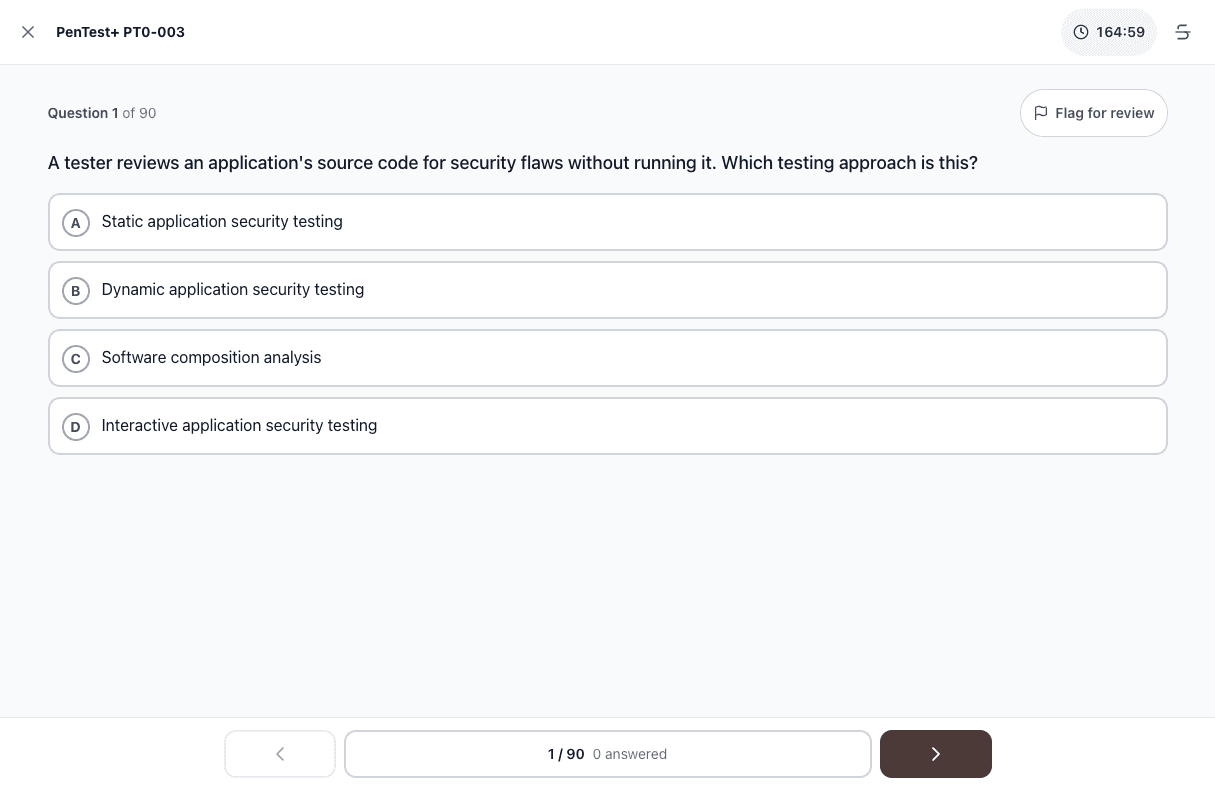
Test on desktop
The PenTest+ exam at a glance
The CompTIA PenTest+ exam (PT0-003) has a maximum of 90 questions in 165 minutes, multiple choice and performance-based, and you need 750 on a 100 to 900 scale to pass. It covers Engagement Management 13%, Reconnaissance and Enumeration 21%, Vulnerability Discovery and Analysis 17%, Attacks and Exploits 35% and Post-exploitation and Lateral Movement 14%. PT0-003 launched on December 17, 2024 and replaced PT0-002, which retired on June 17, 2025.
Tigertest has 204 PenTest+ practice questions with explanations, free to start with no account required.
- Questions
- Up to 90
- Time
- 165 minutes
- Passing score
- 750 on a 100 to 900 scale
- Exam code
- PT0-003 (replaced PT0-002)
- Valid for
- 3 years
- Given by
- CompTIA, at Pearson VUE or online
Updated by the Tigertest team. Practice questions follow the CompTIA PenTest+ PT0-003 exam objectives (Document Version 5.0). Exam rules change, so confirm current details with CompTIA.
How It Works
Eight Drills
One drill per topic: engagement management, reconnaissance and OSINT, enumeration and scripting, vulnerability discovery, network and authentication attacks, host and web attacks, cloud, wireless and social engineering, and post-exploitation. Questions you miss come back until you have mastered them.
Practice Tests
Two 90-question tests in 165 minutes with flagging and review, like the real exam. Read logs and scan output, match tools to tasks and put response steps in order. Practice Test 2 is held out of the drills, so it measures readiness.
Built on the PT0-003 Objectives
CompTIA publishes the domain weighting for PenTest+. Every practice test follows it, covering the full engagement from scoping and reconnaissance through exploitation, post-exploitation and the written report.

Help Make Tigertest Better
Have an idea, a topic you'd like covered, or a question that could be clearer? We read every message and use it to improve every test.
Share FeedbackHow to Pass PenTest+
1. Start with the engagement, not the exploit
A large share of PenTest+ is scoping, rules of engagement, agreement types and the written report. Know the difference between an NDA, MSA, SoW and ToS, when an authorization letter matters, and which control category each remediation belongs to.
2. Read output, not just definitions
Many questions give you a DNS record, a scan result, a log line or a process listing and ask what it shows or what to do next. Practice spotting hosting on a third party, an unquoted service path, a failed SPF check or a public storage bucket quickly.
3. Learn the tools by their job
The attacks and exploits domain is the largest. Know which tool fits which task: an intercepting proxy for web apps, a credential tool for Windows memory, a wireless suite for handshakes, a cloud auditor for misconfigurations. Match the technique to the phase.
4. Drill your weak area, then sit a full test
Tigertest tracks your accuracy by area. Retake the drill you miss most until you clear 80 percent, then take Practice Test 2 cold. On the real exam, flag the performance-based questions and come back to them once the multiple choice is done.
PenTest+ Frequently Asked Questions
How many questions are on the PenTest+ exam?
The CompTIA PenTest+ PT0-003 exam has a maximum of 90 questions in 165 minutes. Most are multiple choice, plus performance-based questions where you work with logs, scan output, scripts or a simulated environment.
What is the passing score for PenTest+?
You need 750 on a scale of 100 to 900. The score is scaled, so it is not a fixed percentage of questions. Aim for 80 percent or better on these practice tests before you book.
What is on the PenTest+ PT0-003 exam?
Five domains: Engagement Management 13 percent, Reconnaissance and Enumeration 21 percent, Vulnerability Discovery and Analysis 17 percent, Attacks and Exploits 35 percent, and Post-exploitation and Lateral Movement 14 percent.
Is PT0-003 the current PenTest+ exam?
Yes. PT0-003 launched on December 17, 2024 and replaced PT0-002, which retired on June 17, 2025. CompTIA has not announced a successor, so PT0-003 is the version to study for.
Is this practice test the same format as the real exam?
Each practice test is 90 questions in 165 minutes with free navigation and flagging, like the real exam. Log and scan excerpts, choose-two, matching and ordering items stand in for the performance-based questions. Every item is written around authorised, scoped testing, and no working exploit payloads are shown.
Is the Tigertest PenTest+ practice test free?
It is free to start, with no account required. Practice Test 1 and every drill but the last two are free; the last two drills (Cloud, Wireless and Social, and Post-exploitation) and the final practice test are part of Tigertest Premium, one payment with no subscription. Create a free account if you want your progress saved across devices.
I teach this course. Can my students use Tigertest?
Yes, for free. Make a class at tigertest.io/teach, post one link, and students join with just their name. You see who practiced, their test scores and the topics your class misses most.
PenTest+ sample questions and answers
6 of the 204 practice questions, one from each topic, with the answer explained.
- 1.
A client runs applications on a cloud provider's infrastructure-as-a-service platform. Under the shared responsibility model, who is responsible for patching the guest operating system on those instances?
- A.
The penetration tester
- B.
The customer
- C.
A third-party auditor
- D.
The hosting provider
Answer: B.In IaaS the provider secures the physical and virtualisation layer, and the customer patches and configures the guest OS and everything above it. The tester reports gaps but owns no production control.
- A.
- 2.
A tester queries WHOIS for a target domain. What information does this primarily return?
- A.
Open TCP ports
- B.
Domain registration details
- C.
The server's running processes
- D.
Cached web pages
Answer: B.WHOIS returns registration data such as the registrar, registration dates and sometimes contacts or name servers. Open ports come from a port scan, not WHOIS.
- A.
- 3.
A tester writes a short script that repeats an action for each IP in a list. Which programming construct performs the repetition?
- A.
A conditional
- B.
A Boolean operator
- C.
A loop
- D.
A string operator
Answer: C.A loop repeats a block for each item in a list. A conditional chooses whether to run a block, and a Boolean operator combines true or false values.
- A.
- 4.
Having confirmed a service's exact version is vulnerable, a tester searches for a matching proof-of-concept to use in the next phase. What must the tester weigh before using a public exploit?
- A.
The age of the tester's laptop
- B.
The colour of its documentation
- C.
Its download count on social media sites
- D.
Its reliability and risk to the target
Answer: D.A public exploit must be judged for reliability and the chance it could crash or damage the in-scope system before use. Popularity on social media is not a safety measure.
- A.
- 5.
An attacker reuses username and password pairs leaked from an unrelated breach, hoping users reused them here. What is this called?
- A.
A password spraying attack
- B.
A mask attack
- C.
Credential stuffing
- D.
An on-path attack
Answer: C.Replaying breached credential pairs against a new service is credential stuffing, which works because of password reuse. Password spraying uses one guessed password across accounts, not leaked pairs.
- A.
- 6.
To stop the SQL injection a tester found, which fix should the report recommend first?
- A.
A longer session timeout
- B.
A stronger Wi-Fi password
- C.
More frequent reboots
- D.
Parameterised queries
Answer: D.Parameterised (prepared) queries separate code from data and are the primary defence against SQL injection. Session timeouts and Wi-Fi passwords do not address query injection.
- A.
Related practice tests
Every test on Tigertest is free to start, with no account needed.
- CompTIA Security+ Practice TestCompTIA SY0-701
- CompTIA CySA+ Practice TestCompTIA CS0-004
- Fortinet NSE 1 (FCF) Practice TestFortinet Training Institute · NSE 1 Cybersecurity and Cloud Fundamentals (formerly FCF)
- CISSP Practice TestISC2 · CISSP exam outline, April 2024
- CompTIA Network+ Practice TestCompTIA N10-009
- CompTIA A+ Practice TestCompTIA 220-1201 / 220-1202
Ready to Pass PenTest+?
Start for free. No account required. 204 questions across all five domains.
Start practicing