
Free CPA TCP Practice Test 2026
200 original multiple-choice questions on the AICPA's 2026 TCP blueprint: individual tax planning, gift tax and financial planning, C and S corporations, partnerships and trusts, entity planning and property transactions. Four 50-question mock tests. Tuned for mobile. Free to start, no account needed.
Try one now
Pick an answer
Lena exercises incentive stock options to buy 1,000 shares at $12 a share when the stock is worth $30. She keeps the shares. For regular tax in the year of exercise she reports:
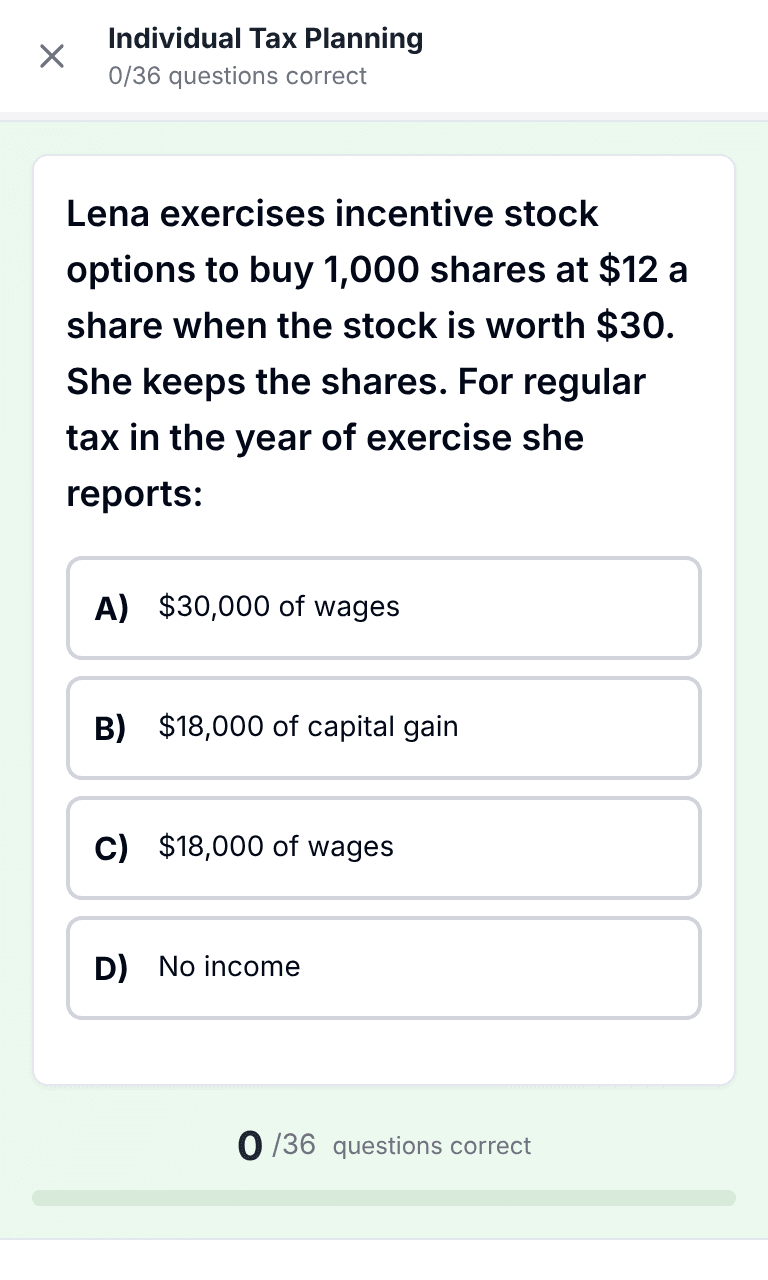
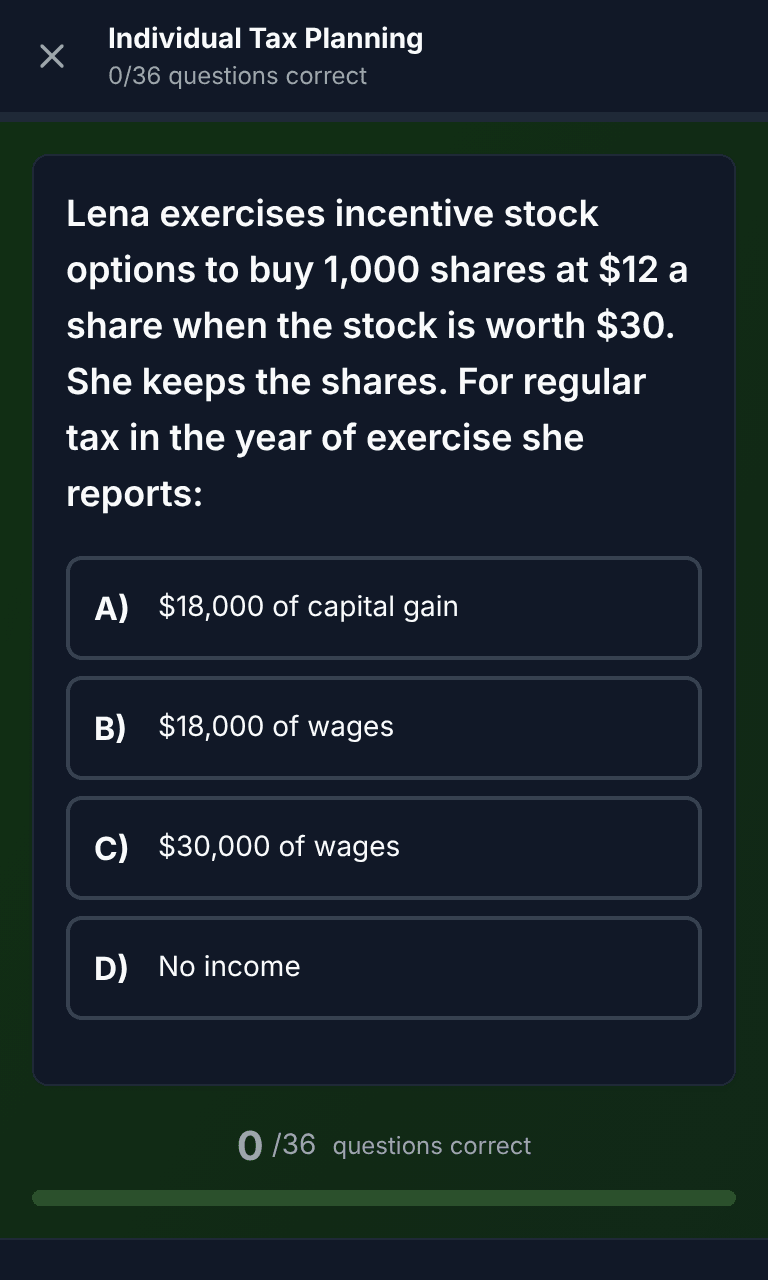
Train on mobile
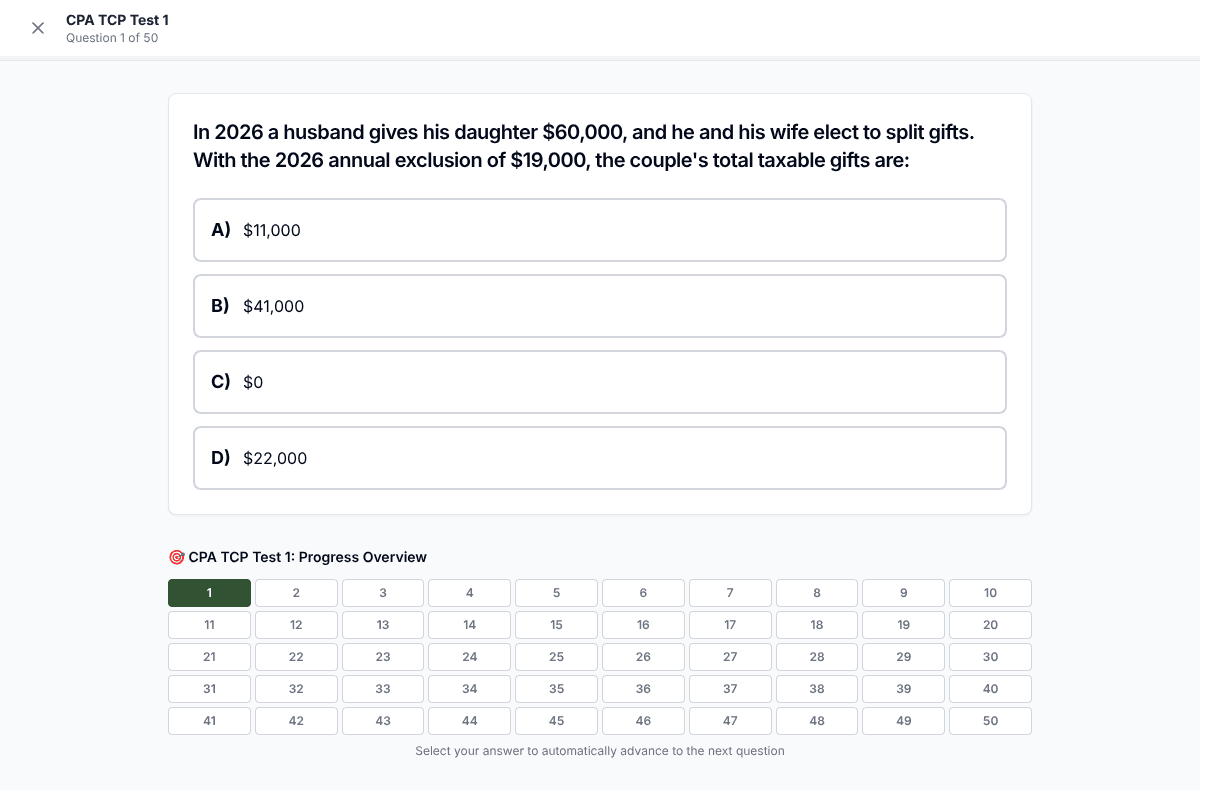
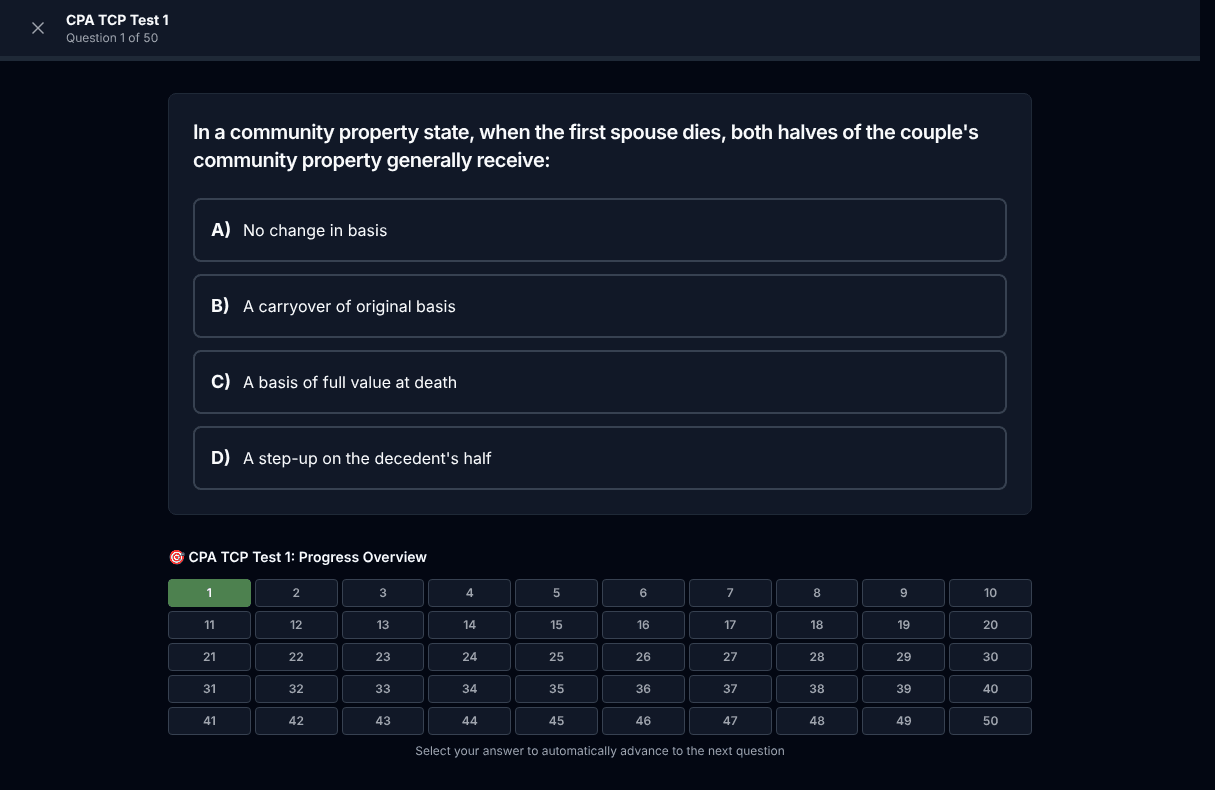
Test on desktop
The CPA TCP exam at a glance
TCP, Tax Compliance and Planning, is one of the three Discipline sections of the Uniform CPA Examination; candidates take the three Core sections and one Discipline section of their choice. TCP runs 4 hours with 68 multiple-choice questions and 7 task-based simulations, each worth half the score, and scores are reported from 0 to 99 with 75 to pass. Under the AICPA's blueprint effective January 2026, unchanged for 2027, it covers tax compliance and planning for individuals and personal financial planning (30 to 40%), entity tax compliance (30 to 40%), entity tax planning (10 to 20%) and property transactions (10 to 20%). Candidates are not tested on tax amounts indexed to inflation.
Tigertest has 200 CPA TCP practice questions with explanations, free to start with no account required.
- Section time
- 4 hours
- Multiple-choice questions
- 68, in two testlets of 34
- Task-based simulations
- 7
- Score weighting
- 50% MCQ, 50% simulations
- Passing score
- 75 on a 0 to 99 scale
- Largest areas
- Individuals and personal financial planning, and entity compliance, 30 to 40% each
- Run by
- AICPA, with NASBA and state boards of accountancy
Updated by the Tigertest team. Practice questions follow the AICPA's Uniform CPA Examination Blueprints effective January 2026, its summary of 2027 changes and NASBA's score information, checked November 2026. Exam rules change, so confirm current details with AICPA: Learn what is tested on the CPA Exam.
How It Works
Train by Topic
Six training sets: individual tax planning, gift tax and financial planning, C corporations, trusts and exempt organizations, S corporations and partnerships, entity tax planning, and property transactions. Questions you miss come back until you have mastered them.
Weighted Mock Tests
Four mock tests of 50 multiple-choice questions in the blueprint's proportions, with a 75% target. No question appears in more than one test, and every calculation is worked through in the explanation.
Built on the AICPA's TCP Blueprint
The AICPA's 2026 blueprint gives each of TCP's four content areas a range, and the 2027 blueprint leaves TCP unchanged. Each mock test here sits at the middle of those ranges, so individuals and entity compliance make up 35 of every 50 questions. Task-based simulations are not modelled.

Help Make Tigertest Better
Have an idea, a topic you'd like covered, or a question that could be clearer? We read every message and use it to improve every test.
Share FeedbackHow to Pass CPA TCP
1. Master basis in every entity
Section 351 transfers, partnership contributions with debt, S corporation stock and debt basis, distributions and liquidations all come down to basis. Write the starting basis, the increases and the decreases in the order the rules require before you look at the choices.
2. Compare entities side by side
Planning questions ask what happens to the same facts in a C corporation, an S corporation and a partnership. Know where gain is taxed once or twice, which entity lets debt count in basis, and when a distribution of appreciated property triggers gain.
3. Learn the property transaction steps
Realized gain, recognized gain, deferred gain and the new basis follow the same pattern in like-kind exchanges and involuntary conversions. Then sort the recognized gain into section 1245, unrecaptured 1250 and 1231 amounts.
4. Practice the multiple choice, then the simulations
Multiple choice is half the score, and the task-based simulations build on the same rules. Aim for 80% or better on every mock test here, then work through simulations with the AICPA's sample tests before you sit the section.
CPA TCP Frequently Asked Questions
What is on the CPA TCP section?
Tax Compliance and Planning (TCP) is one of the three Discipline sections of the Uniform CPA Examination, and you take one Discipline section along with the three Core sections. The AICPA's 2026 blueprint splits TCP into four content areas: tax compliance and planning for individuals and personal financial planning (30 to 40%), entity tax compliance (30 to 40%), entity tax planning (10 to 20%) and property transactions (10 to 20%). The AICPA's summary of 2027 changes lists no revisions to TCP.
How many questions are on TCP and what score do I need?
TCP is a 4-hour section with 68 multiple-choice questions in two testlets of 34 and 7 task-based simulations, each half of the score. Scores are reported from 0 to 99 and 75 passes, but 75 is a scaled score, not 75 percent correct. The mock tests here use a 75 percent target as a readiness line.
How is TCP different from REG?
REG is the Core tax section: basis, gross income, deductions, credits and the basic rules for corporations and flow-through entities. TCP goes further into nonroutine and planning work: equity compensation, passive and at-risk losses, gift tax, retirement and education planning, section 351 transfers, liquidations, consolidated returns, partnership elections and distributions, built-in gains, trusts, like-kind exchanges, recapture and related parties. The questions here are written to build on REG without repeating it.
Does this practice test cover task-based simulations or tax amounts that change each year?
No. Every question here is multiple choice, which is half of your TCP score; task-based simulations and research tasks are not modelled. The AICPA blueprint says candidates are not tested on rates, amounts or limits indexed to inflation, so the questions use rules that stay put. The few that need a yearly figure, such as the 2026 gift tax annual exclusion, give it in the question.
Are these real CPA Exam questions?
No. Every question is original, written by Tigertest from the AICPA's published TCP blueprint and the Internal Revenue Code and Treasury Regulations it lists as references. It is practice, not affiliated with the AICPA, NASBA or any state board of accountancy, and it does not replace a full review course.
CPA TCP sample questions and answers
6 of the 200 practice questions, one from each topic, with the answer explained.
1. A foreign corporation with no U.S. trade or business receives $200,000 of U.S.-source dividends, and no treaty applies. The tax withheld at source is:
- A.$0
- B.$60,000
- C.$42,000
- D.$20,000
Answer: B. Fixed or determinable income of a foreign corporation not connected with a U.S. business is subject to 30% withholding (sections 881 and 1442): 30% x $200,000.
2. The installment method cannot be used to report gain from a sale of:
- A.Rental real estate
- B.A vacant lot held for investment
- C.A closely held business
- D.Publicly traded stock
Answer: D. Section 453(k)(2) denies the installment method for stock or securities traded on an established market, and section 453(b)(2) excludes dealer sales and inventory.
3. A partnership agreement gives one partner 90% of depreciation deductions while profits are split equally. Which form allows this kind of special allocation?
- A.An LLC taxed as a partnership
- B.An S corporation
- C.A C corporation
- D.A sole proprietorship
Answer: A. Partnerships may make special allocations with substantial economic effect (section 704(b)). S corporations must allocate items per share, per day.
4. A trust gives each beneficiary a 30-day right to withdraw each new contribution. The main reason for this power is to let gifts to the trust:
- A.Avoid generation-skipping tax
- B.Count as marital gifts
- C.Qualify for the annual exclusion
- D.Escape income tax
Answer: C. A current withdrawal (Crummey) power turns what would be a future interest into a present interest, so contributions qualify for the annual exclusion.
5. Raul expects this year's tax to be $40,000, with $22,000 withheld. Last year's tax was $50,000. To avoid the underpayment penalty with the least cash, his estimated payments should total:
- A.$28,000
- B.$36,000
- C.$14,000
- D.$18,000
Answer: C. The required annual payment is the lesser of 90% of this year's tax, $36,000, and the prior-year amount, at least $50,000. $36,000 - $22,000 withheld = $14,000.
6. Which disposition of property is nontaxable?
- A.Reinvesting fire insurance in kind
- B.Selling land for cash
- C.Swapping inventory for land
- D.Trading a dealer's lots for land
Answer: A. Reinvesting involuntary conversion proceeds in similar property can defer gain under section 1033. Property held for sale, such as inventory or a dealer's lots, cannot be exchanged tax-free.
Related practice tests
Every test on Tigertest is free to start, with no account needed.
- CPA FAR Practice TestAICPA and NASBA · Uniform CPA Examination, FAR Core section
- CPA REG Practice TestAICPA and NASBA · Uniform CPA Examination, REG Core section
- CPA AUD Practice TestAICPA and NASBA · Uniform CPA Examination, AUD Core section
- ACCA FA Practice TestACCA · Applied Knowledge exam, Financial Accounting (FA/FFA)
- AAT Level 2 Practice TestAAT (Association of Accounting Technicians) · Level 2 Certificate in Accounting, Q2022
- CeMAP 1 Practice TestLIBF (Walbrook Institute London) · CeMAP Module 1, FSRE units FRE1 and FRE2
Ready to Pass CPA TCP?
Start for free. No account required. 200 questions across every area of the AICPA's TCP blueprint.
Start practicing