
Free Food Safety Supervisor Practice Test 2026
200 questions on Standard 3.2.2A, the 5°C and 60°C rules, cooling, the 2-hour/4-hour rule, hygiene, cleaning and allergens, written to the Food Standards Code. Tuned for mobile. No account needed.
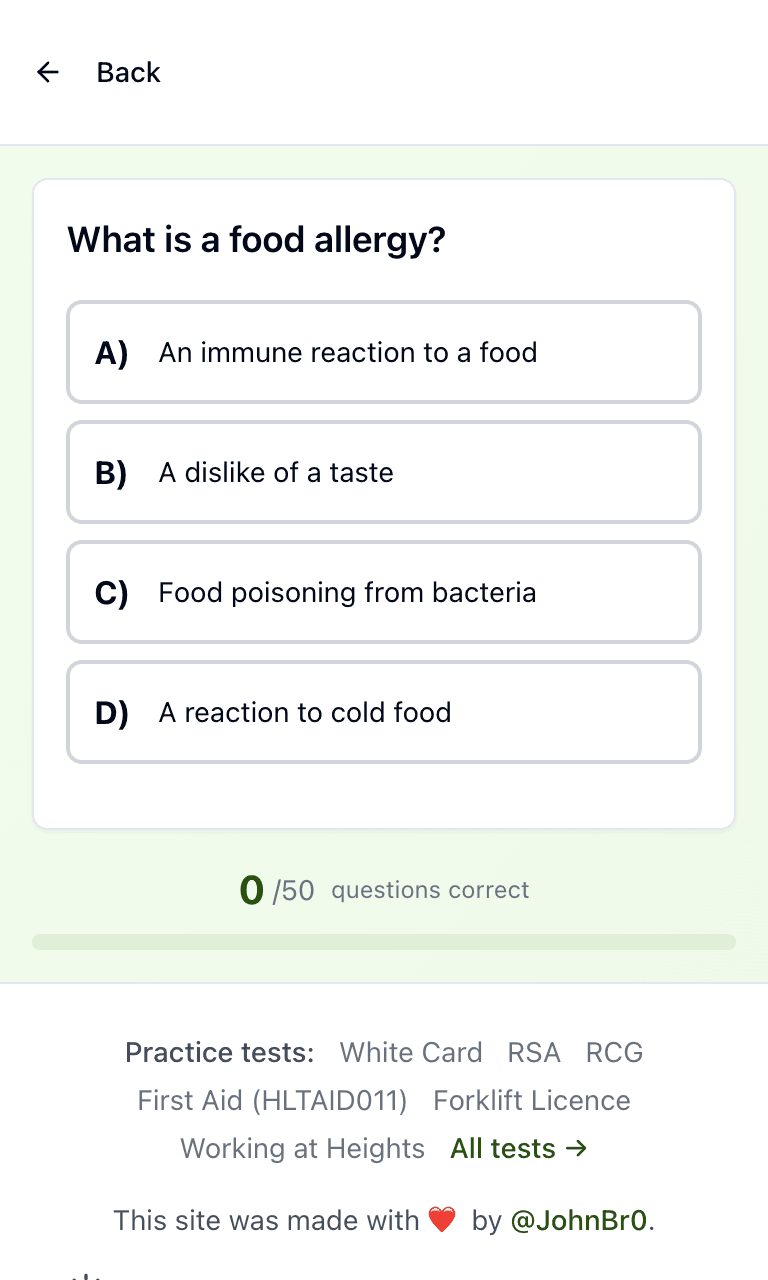
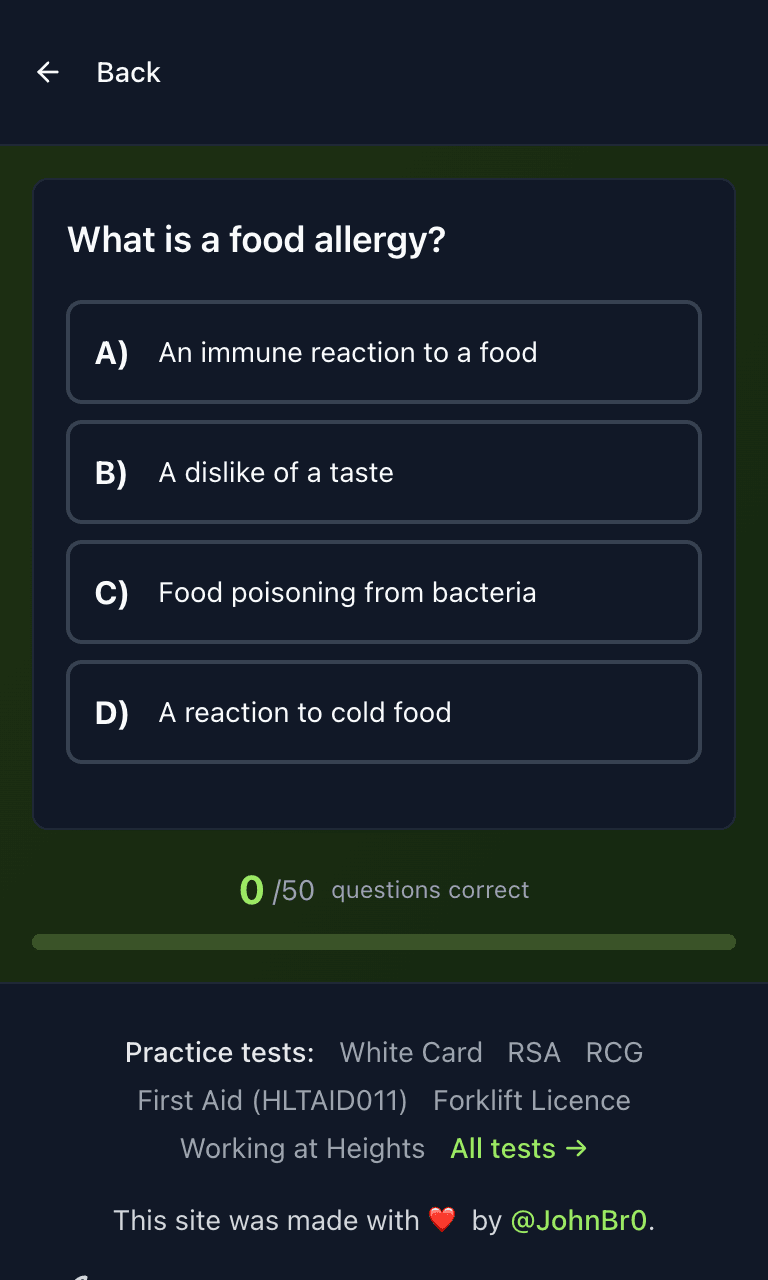
Train on mobile
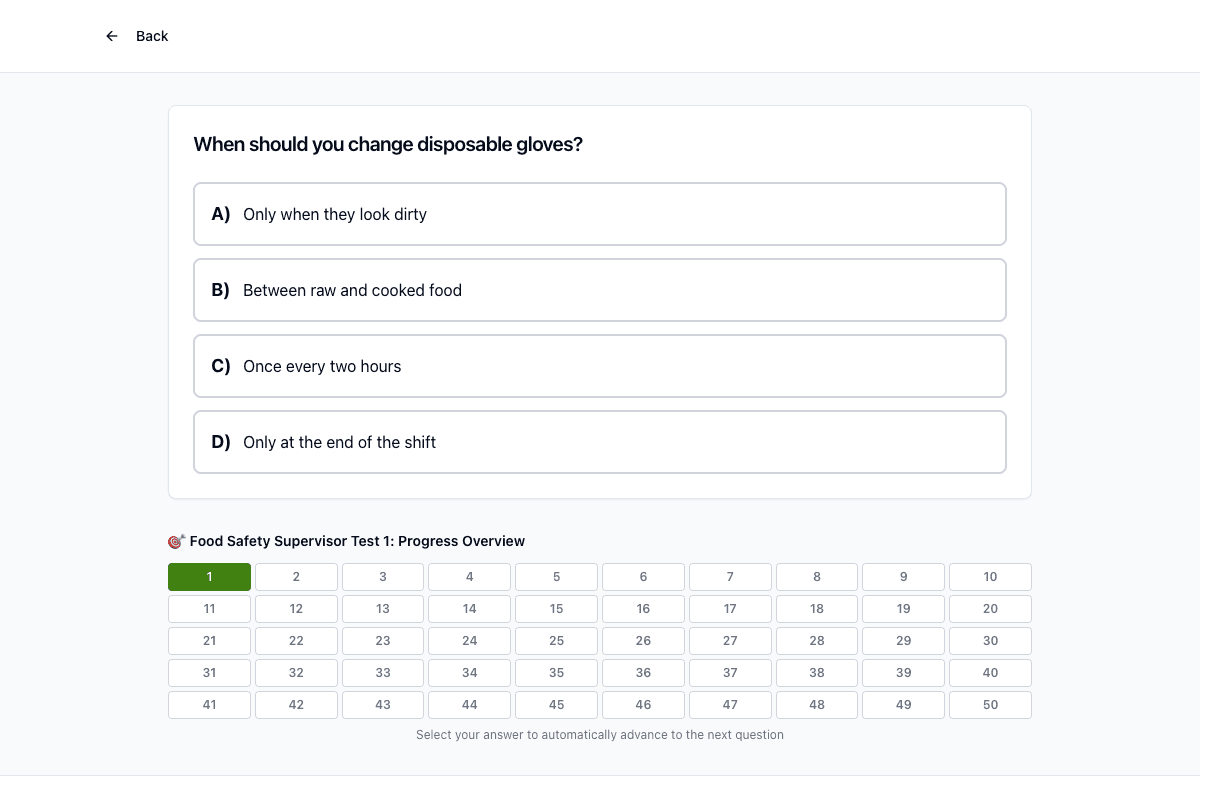
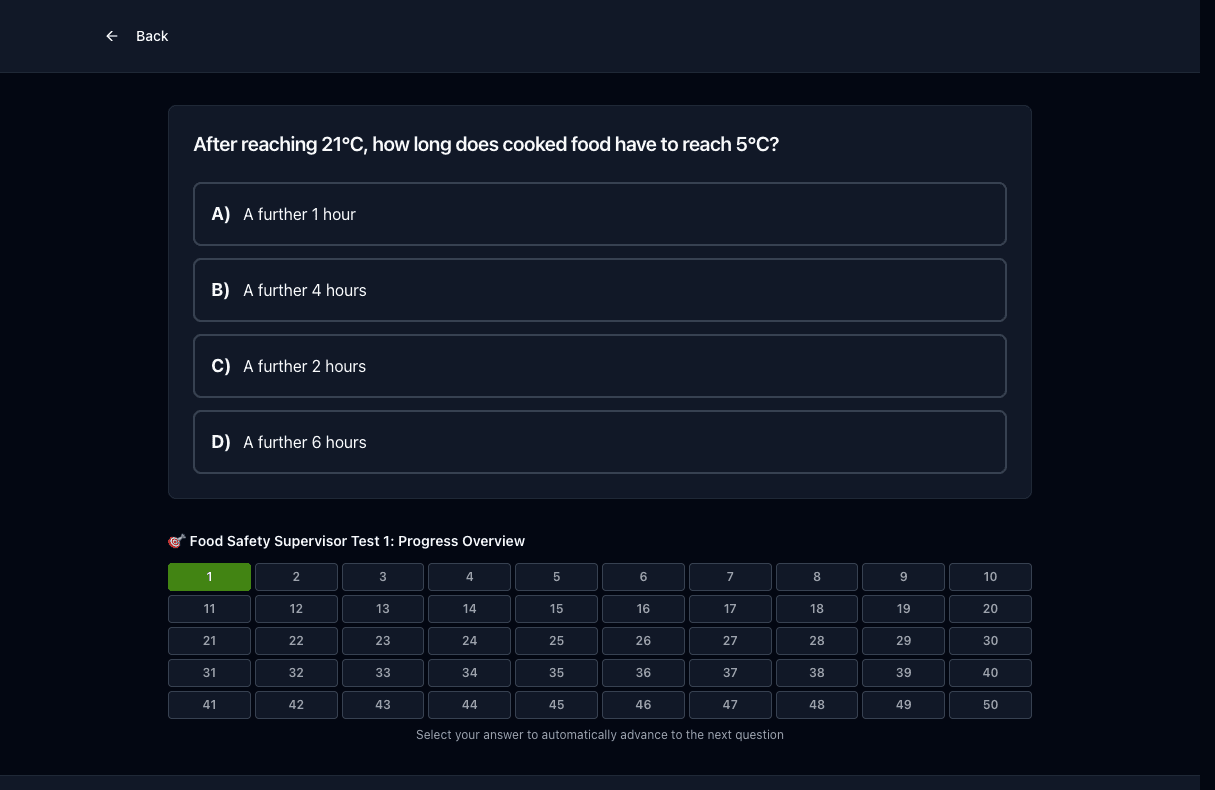
Test on desktop
The Food Safety Supervisor exam at a glance
A food safety supervisor (FSS) is the certified person that Australian caterers, food service and related retail businesses must appoint under Standard 3.2.2A of the Food Standards Code, which has applied since December 2023. The certificate comes from a registered training organisation, usually for units SITXFSA005 and SITXFSA006 in hospitality, and must have been obtained within the past five years. Assessment is competency based, with knowledge questions and practical tasks and no fixed pass mark. NSW adds its own key focus areas.
Tigertest has 200 Food Safety Supervisor practice questions with explanations, all free with no account required.
- Who needs one
- Category one and two food businesses
- Units (hospitality)
- SITXFSA005 and SITXFSA006
- Assessment
- Competency based, no pass mark
- Certificate valid
- Obtained within the past 5 years
- Key temperatures
- 5°C or below, 60°C or above
- Cooling
- 60°C to 21°C in 2 h, to 5°C in 4 more
- Records (category one)
- Kept at least 3 months
- NSW extras
- Allergens, eggs, cleaning, Food Act offences
Updated by the Tigertest team. Practice questions follow FSANZ Standards 3.2.2 and 3.2.2A and the SITXFSA005 and SITXFSA006 units, checked October 2026. Exam rules change, so confirm current details with FSANZ: Food safety supervisor.
How It Works
Train, Then Test
Four training sets, one per mock test: Set 1 holds exactly the 50 questions of Test 1, and so on. Master Set 1, take Test 1, then move on. Questions you miss come back until you have mastered them.
Mock Tests
Four 50-question mock tests covering both units and Standard 3.2.2A, with an 80 percent readiness line (the real course is competency based, with no pass mark) and an explanation of the right answer on every question.
Built on SITXFSA005, SITXFSA006 and Standard 3.2.2A
The two hospitality units cover hygiene, health reporting and hand washing (SITXFSA005) and the food safety program, storage, preparation, single-use items, cleaning and disposal (SITXFSA006). Standard 3.2.2A adds the supervisor, food handler training and record keeping, and NSW adds allergens, eggs, cleaning and Food Act offences. No one publishes question weights, so the mock tests give the most to temperature control, where most of the numbers sit. RTOs, TAFEs and trainers who run the course can set Tigertest as practice at tigertest.io/teach and see which topics the group misses most.

Help Make Tigertest Better
Have an idea, a topic you'd like covered, or a question that could be clearer? We read every message and use it to improve every test.
Share FeedbackHow to Pass Your Food Safety Supervisor Course
1. Learn the numbers by heart
5°C or below and 60°C or above, with the danger zone in between; cooling from 60°C to 21°C within 2 hours and to 5°C within a further 4 hours; reheating rapidly to 60°C; 75°C at the core as the usual cooking guide; a thermometer accurate to within 1°C; supervisor certificates within 5 years; and records kept for at least 3 months.
2. Get the 2-hour/4-hour rule exactly right
Count the total time ready-to-eat food has spent between 5°C and 60°C. Under 2 hours: use it or put it back in the fridge. Between 2 and 4 hours: use it, but do not refrigerate it. Over 4 hours: throw it out. Chilling never resets the clock.
3. Know which business needs which tool
Category one businesses, which cook or prepare high-risk food and serve it, need a certified supervisor, trained food handlers and records. Category two businesses, which only slice, weigh, repack or hold ready-to-eat food made elsewhere, need the supervisor and trained handlers but not the records.
4. Fix your misses, then retest
Tigertest tracks your accuracy by topic. Aim for 40 or more out of 50 on all four mock tests before your assessment. After each test, drill the questions you missed and retrain that test's set.
Food Safety Supervisor Frequently Asked Questions
What is a food safety supervisor in Australia?
A food safety supervisor is a person in a food business who holds a food safety supervisor certificate from a registered training organisation or a body the regulator recognises, obtained within the past five years. They supervise food handling, coach staff and help prevent or correct food safety problems. Under Standard 3.2.2A of the Food Standards Code, caterers, food service and related retail businesses that handle unpackaged, ready-to-eat, potentially hazardous food must appoint one, and the supervisor must be reasonably available while that food is handled.
Which units of competency does the food safety supervisor course cover?
For hospitality and retail food service it is usually SITXFSA005 Use hygienic practices for food safety and SITXFSA006 Participate in safe food handling practices, together the food safety supervision skill set. Health, community and other sectors use their own units, and the accepted units vary by state. In NSW the course must also cover the Food Authority's key focus areas: allergen management, safe egg handling, cleaning and sanitising, and Food Act offences.
How is the course assessed, and is there a pass mark?
It is competency based, so there is no national pass mark. Your training organisation sets written or online knowledge questions and practical tasks, such as probing food and cleaning and sanitising equipment, and you resubmit anything you get wrong until you are judged competent. The mock tests here use an 80 percent readiness line so you go into the assessment knowing the material well.
Which temperatures and times do food safety supervisors need to know?
Keep potentially hazardous food at 5 degrees Celsius or below, or 60 degrees or above. Cool cooked food from 60 to 21 degrees within 2 hours, then to 5 degrees within a further 4 hours. Reheat food that will be held hot rapidly to 60 degrees or above. Under the 2-hour/4-hour rule, ready-to-eat food out of temperature control for under 2 hours can be used or refrigerated, 2 to 4 hours must be used and not refrigerated, and over 4 hours must be thrown away. Thermometers must be accurate to within 1 degree.
Is this an official course or certificate?
No. Every question is written by Tigertest from the Food Standards Code, FSANZ guidance and the published units of competency, so it tests the same knowledge without copying any training organisation's assessment. It is free practice for the course, not a certificate, and it does not replace the training and certificate your state requires. Rules such as notifying the council of your supervisor and renewing the certificate vary by state.
I teach food safety supervisor courses. Can my students use Tigertest?
Yes, for free. Make a class at tigertest.io/teach, post one link, and students join with just their name. You see who practiced, their test scores and the topics your class misses most.
Related practice tests
Every test on Tigertest is free and needs no account to start.
- White Card Practice TestCPCWHS1001 · general construction induction (RTO course)
- RSA Practice TestSITHFAB021 · national RSA unit, Australia
- RCG Practice TestSITHGAM022 · RCG / RSG, all states
- HLTAID011 Provide First Aid Practice TestHLTAID011 · Australian Resuscitation Council guidelines
- Forklift Licence Practice Test (Australia)TLILIC0003 · high risk work licence LF, Australia
- Working at Heights Practice TestRIIWHS204 (formerly RIIWHS204E), nationally recognised unit
Ready for Your Food Safety Supervisor Course?
Free to start. No account required. 200 questions across both units and Standard 3.2.2A.
Start practicing