
Free GMAT Practice Test 2026
169 original Quant, Verbal and Data Insights questions in the GMAT Focus format. Tuned for mobile. No account needed.
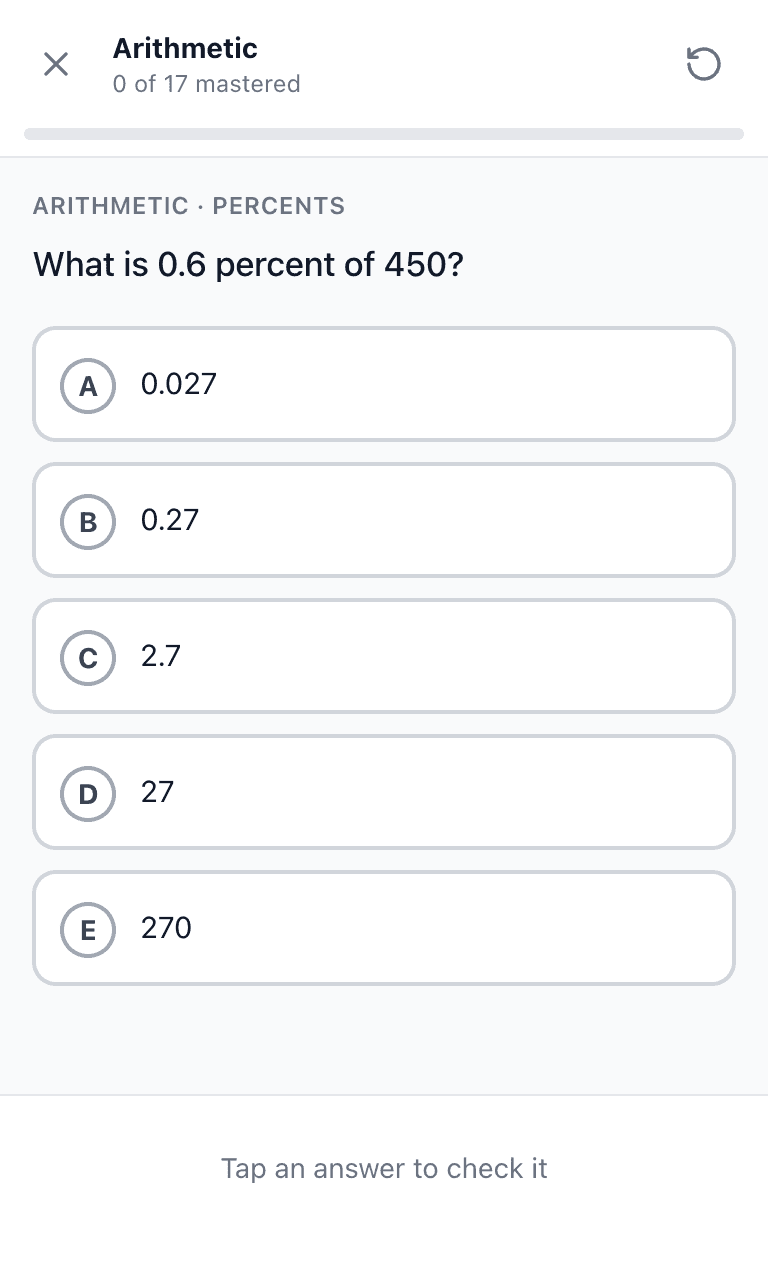
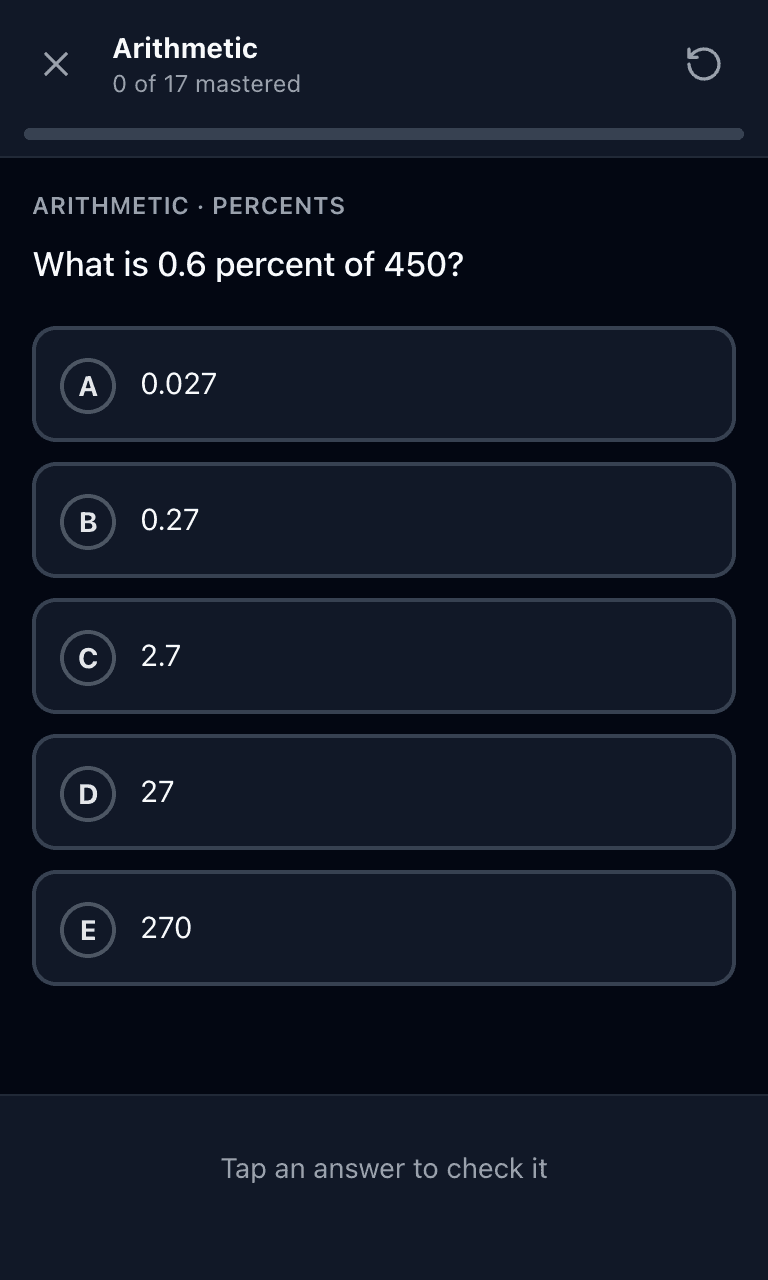
Train on mobile
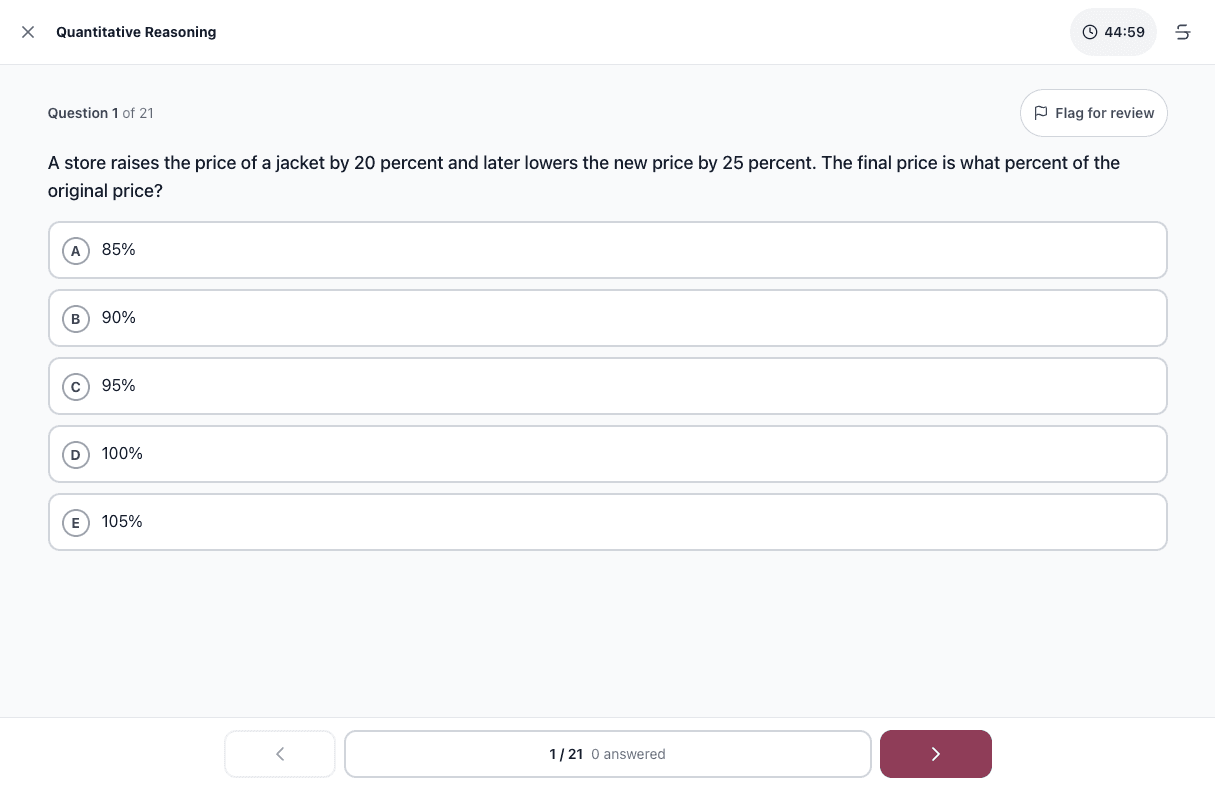
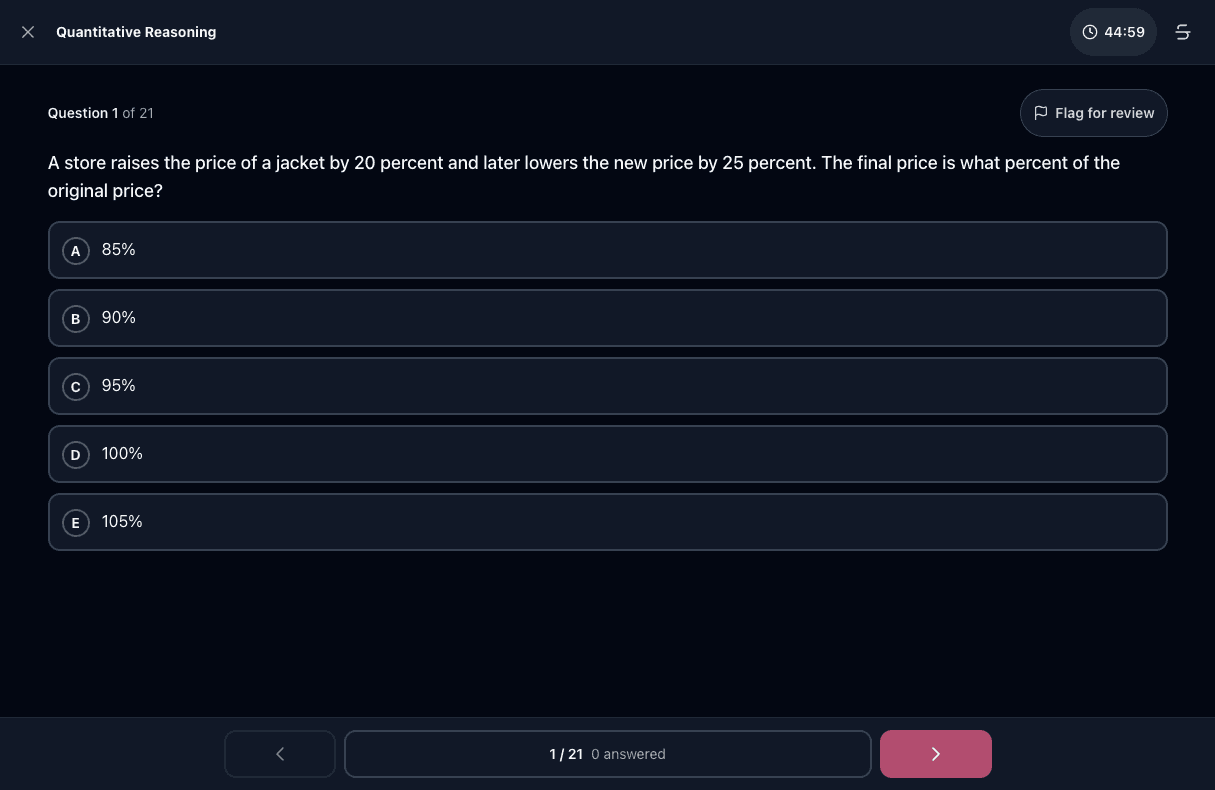
Test on desktop
The GMAT exam at a glance
The GMAT Focus Edition has 64 questions in 2 hours 15 minutes: Quantitative Reasoning (21 questions), Verbal Reasoning (23) and Data Insights (20), 45 minutes each, in any order you choose, with one optional 10-minute break. Each section is scored 60 to 90 and the total runs from 205 to 805; the exam is computer adaptive, and you may review and change up to three answers per section. There is no essay, no geometry and no sentence correction; an on-screen calculator is allowed only in Data Insights.
Tigertest has 169 GMAT practice questions with explanations, all free with no account required.
- Questions
- 64: Quant 21, Verbal 23, Data Insights 20
- Time
- 2 hr 15 min, 45 minutes per section
- Break
- One optional 10-minute break
- Score
- 205 to 805 total; 60 to 90 per section
- Calculator
- Data Insights only
- Format
- Computer adaptive; up to 3 answer changes per section
- Given by
- GMAC, at test centers or online
Updated by the Tigertest team. Practice questions follow GMAC's GMAT Focus Edition exam structure (as of October 2026). Exam rules change, so confirm current details with GMAC (mba.com).
How It Works
Drills by Question Type
Seven drills, one for each question family: arithmetic, algebra, critical reasoning, reading comprehension, data sufficiency, tables and graphs, and two-part and multi-source questions. Questions you miss come back until you have mastered them.
Practice Tests
Two full tests with the real sections and timing: Quant 21, Verbal 23 and Data Insights 20, 45 minutes each, with the calculator only in Data Insights. You get estimated section scores and a total from 205 to 805. Practice Test 2 is held out of the drills, so it measures readiness.
Built on the GMAT Focus Format
The GMAT Focus Edition has three equally weighted sections. Every practice test here matches their question counts and time limits and mixes question types the way the real exam does: problem solving in Quant, reading and argument questions in Verbal, and all five Data Insights types.

Help Make Tigertest Better
Have an idea, a topic you'd like covered, or a question that could be clearer? We read every message and use it to improve every test.
Share FeedbackHow to Prepare for the GMAT
1. Rebuild your mental math
Quantitative Reasoning has no calculator and no geometry. It is arithmetic and algebra: percents and successive changes, ratios, number properties, averages, counting and probability, equations, inequalities and word problems. Speed comes from quick, exact arithmetic and from spotting when testing an answer choice is faster than solving.
2. Learn the Data Sufficiency method
The five Data Sufficiency choices never change, so learn them cold. Judge statement (1) alone, then statement (2) alone, and only then the two together. You rarely need the final number, only whether a single answer is forced; try two quick cases that fit a statement and see if they give different answers.
3. Read arguments for their gaps
In Critical Reasoning, find the conclusion and the evidence first, then ask what the argument takes for granted: another cause, a comparison that is not fair, a cost it ignores. Strengthen, weaken, assumption and evaluate questions all turn on that gap. In Reading Comprehension, note the purpose of each paragraph so that main idea and function questions are quick.
4. Practice under the clock, then drill your weakest type
Each section gives you about two minutes a question, and multi-source sets and long passages eat time. Take a full timed test, then use the score breakdown to pick the drill that costs you the most points, and retake it until you have mastered it.
GMAT Frequently Asked Questions
How many questions are on the GMAT?
The GMAT Focus Edition has 64 questions in 2 hours 15 minutes: Quantitative Reasoning 21, Verbal Reasoning 23 and Data Insights 20, with 45 minutes for each section. You choose the order of the sections and may take one optional 10-minute break. There is no essay, no geometry and no sentence correction.
How is the GMAT scored?
Each section is scored from 60 to 90, and the total score runs from 205 to 805 in 10-point steps, with all three sections counting equally. The exam is computer adaptive, so your score reflects both how many questions you get right and how hard they were. Tigertest estimates section and total scores from the share you get right on its fixed practice tests, so treat them as a guide, not an official score.
What is on the Data Insights section?
Data Insights has five question types: Data Sufficiency, Table Analysis, Graphics Interpretation, Two-Part Analysis and Multi-Source Reasoning. They test whether you can read tables and charts, combine sources and judge whether information is enough to answer a question. It is the only section with an on-screen calculator.
Is this practice test the same format as the real GMAT?
It follows the real structure: the same three sections, question counts and 45-minute limits, five answer choices, the fixed Data Sufficiency choices, a calculator only in Data Insights, and the optional break. Two things differ. The practice tests are fixed forms rather than adaptive, and you can change any answer, while the real exam lets you change up to three per section. All questions are original, not taken from GMAC or the Official Guide.
Is the Tigertest GMAT practice test free?
Yes. Both full practice tests and all seven drills are free, with no account required. Create a free account if you want your progress saved across your phone and computer.
I teach GMAT prep. Can my students use Tigertest?
Yes, for free. Make a class at tigertest.io/teach, post one link, and students join with just their name. You see who practiced, their test scores and the topics your class misses most.
Related practice tests
Every test on Tigertest is free and needs no account to start.
Ready to Take On the GMAT?
Free to start. No account required. 169 questions across all three sections.
Start practicing