
Free Google Cloud Professional Cloud Architect Practice Test 2026
200 scenario questions and four original case studies, weighted to the current exam guide. Tuned for mobile. No account needed.
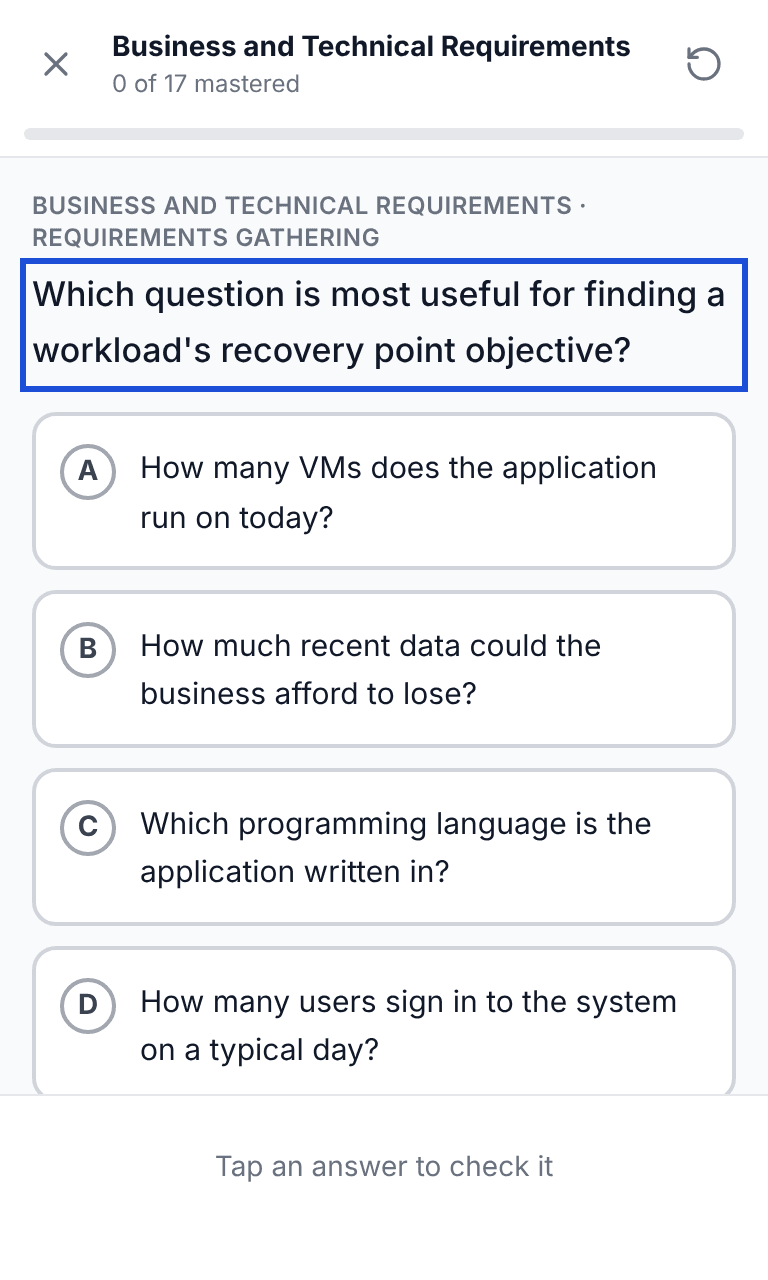
Train on mobile
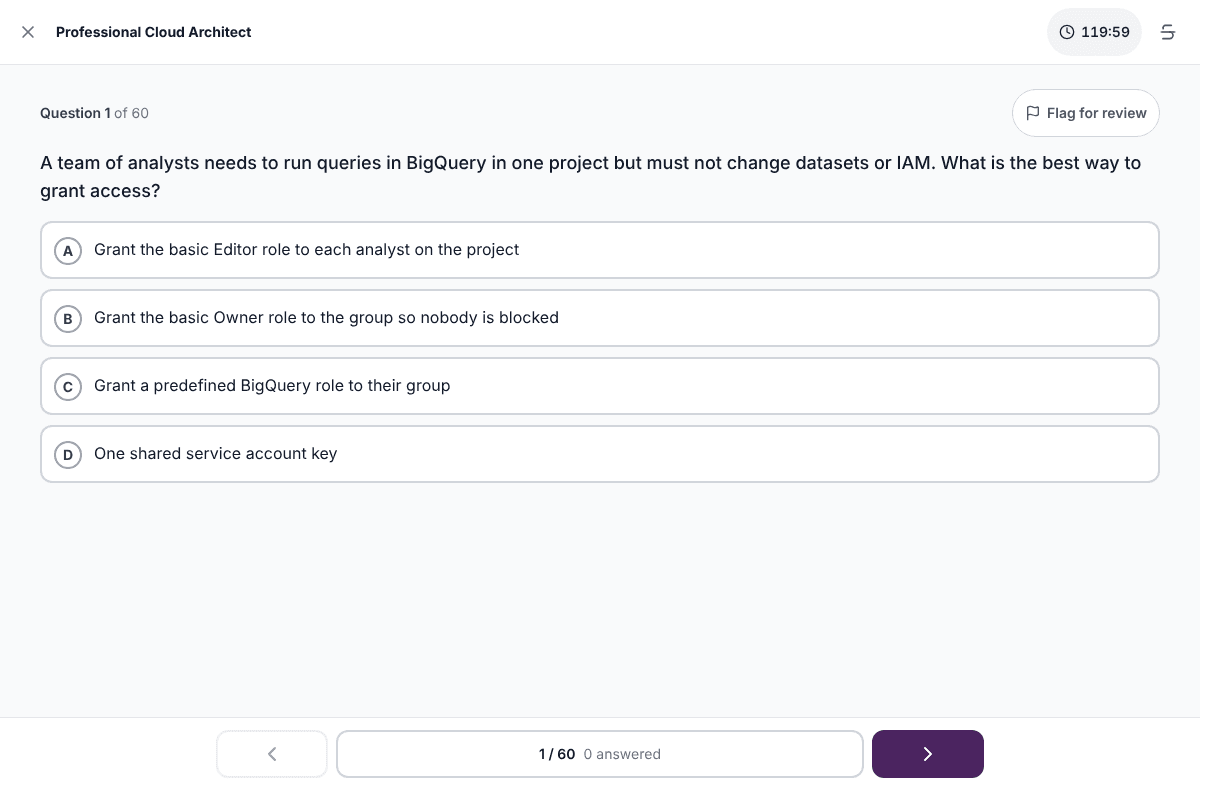
Test on desktop
The Google PCA exam at a glance
The Google Cloud Professional Cloud Architect exam has 50 to 60 multiple choice and multiple select questions in 2 hours and costs 200 USD. Each exam includes 2 case studies, and case study questions make up 20 to 30 percent of the exam. Google reports pass or fail and does not publish a passing score. The exam guide weights Designing and planning a cloud solution architecture at about 25 percent, Managing and provisioning a solution infrastructure and Designing for security and compliance at about 17.5 percent each, Analyzing and optimizing technical and business processes at about 15 percent, and Managing implementation and Ensuring solution and operations excellence at about 12.5 percent each.
Tigertest has 200 Google PCA practice questions with explanations, free to start with no account required.
- Questions
- 50 to 60, multiple choice and multiple select
- Time
- 2 hours
- Case studies
- 2 per exam, 20 to 30% of questions
- Passing score
- Pass or fail; no published cut score
- Fee
- 200 USD
- Languages
- English, Japanese
- Valid for
- 2 years
- Given by
- Google Cloud, online or at a test center
Updated by the Tigertest team. Practice questions follow the Professional Cloud Architect exam guide and certification page, checked November 2026. Exam rules change, so confirm current details with Google Cloud.
How It Works
Eight Focused Drills
One drill for each part of the exam guide: requirements, network and compute design, provisioning, AI with Agent Platform, security and compliance, processes, implementation, and operations. Questions you miss come back until you have mastered them.
Practice Tests with Case Studies
Two 60-question tests in 2 hours, each with two case studies that open beside their questions, as on the real exam. Practice Test 2 is held out of the drills, so it measures readiness.
Built on the Current Exam Guide
Google publishes the section weighting for the Professional Cloud Architect exam. Every practice test here follows it and uses current product names, such as Gemini Enterprise Agent Platform, Agent Platform Pipelines and Cloud Run functions.

Help Make Tigertest Better
Have an idea, a topic you'd like covered, or a question that could be clearer? We read every message and use it to improve every test.
Share FeedbackHow to Pass the Professional Cloud Architect Exam
1. Read Google's case studies before exam day
The guide lists the four case studies the exam may use. Read each one and note its business and technical requirements and its executive statement. On the day, the right answer is the one that meets the stated requirements, not the most impressive design.
2. Learn the trade-offs, not just the products
Most questions offer several workable designs. Pick the one that meets the requirement with the least cost and complexity: a regional instance group for a zone failure, not a second region; Spot VMs only for work that can restart; VPC Service Controls for data exfiltration, not firewall rules.
3. Know security and the Well-Architected Framework well
Security and compliance is a sixth of the exam, and the Well-Architected Framework runs through all of it: least privilege, the resource hierarchy, organization policies, customer-managed keys, SLOs, error budgets and safe releases.
4. Drill your weak section
Tigertest tracks your accuracy by section. Google does not publish a passing score, so retake the drill you missed most until you clear 80 percent with room to spare, then take Practice Test 2 cold.
Professional Cloud Architect Frequently Asked Questions
How many questions are on the Google Cloud Professional Cloud Architect exam?
50 to 60 multiple choice and multiple select questions in 2 hours. The exam costs 200 USD, is offered in English and Japanese, online or at a test center, and the certification is valid for two years. Google reports pass or fail and does not publish a passing score.
How do the case studies work on the Professional Cloud Architect exam?
Each exam includes 2 case studies, and case study questions make up 20 to 30 percent of the exam. Each case describes a fictitious company, its solution concept, its existing environment and its business and technical requirements, and you can view it on a split screen while you answer. The exam guide lists four case studies that may be used: Altostrat Media, Cymbal Retail, EHR Healthcare and KnightMotives Automotive. Read those on Google's site; the case studies in Tigertest's practice tests are our own, written in the same style so you practise the skill without memorizing answers.
What is on the Professional Cloud Architect exam?
The exam guide has six sections: designing and planning a cloud solution architecture (about 25 percent), managing and provisioning a solution infrastructure (about 17.5 percent), designing for security and compliance (about 17.5 percent), analyzing and optimizing technical and business processes (about 15 percent), managing implementation (about 12.5 percent) and ensuring solution and operations excellence (about 12.5 percent). It expects familiarity with the Google Cloud Well-Architected Framework and now covers Gemini Enterprise Agent Platform, Model Garden and the AI Hypercomputer.
Is this practice test the same format as the real exam?
Each practice test is 60 questions in 2 hours with flagging and review, mixing single-answer items with choose-two items, weighted to the six sections of the guide, with two case studies of seven questions each. These are original practice questions, not real exam questions. Scores here are percent correct; aim for 80 percent before you book.
Is the Tigertest Professional Cloud Architect practice test free?
It is free to start, with no account required. Practice Test 1 and every drill but the last are free; the final drill and the final practice test are part of Tigertest Premium, one payment with no subscription. Create a free account if you want your progress saved across devices.
I teach a cloud architecture course. Can my students use Tigertest?
Yes, for free. Make a class at tigertest.io/teach, post one link, and students join with just their name. You see who practiced, their test scores and the topics your class misses most.
Google PCA sample questions and answers
6 of the 200 practice questions, one from each topic, with the answer explained.
- 1.
Leadership asks how it will know a migration to Google Cloud was worth it. Which measure is the best primary KPI to agree before the project starts?
- A.
Cost and release frequency against a baseline
- B.
The count of Google Cloud products the teams have tried so far
- C.
The first month's cloud bill
- D.
The number of VMs moved to Google Cloud each week of the project
Answer: A.Success measures should tie to business outcomes and be compared with a baseline measured before the change, such as cost per transaction and how often teams can ship. VM counts track activity, not value, and a single month's bill ignores the migration overlap.
- A.
- 2.
A company wants an inventory of its 2,000 on-premises servers, their utilization and a cost estimate for running them on Google Cloud before it commits to a plan. Which tool should it start with?
- A.
Database Migration Service
- B.
Migration Center
- C.
Cloud Deploy
- D.
Storage Transfer Service
Answer: B.Migration Center discovers and assesses existing servers, collects utilization data, and produces cost estimates and recommendations for the migration. Database Migration Service and Storage Transfer Service move databases and files once the plan exists, and Cloud Deploy releases applications.
- A.
- 3.
A team runs a GKE cluster where some workloads are fault-tolerant batch jobs and others are customer-facing APIs. How should it place them to save money safely?
- A.
Batch jobs on Spot VM nodes, APIs on standard nodes
- B.
APIs on Spot VM nodes, batch jobs on standard nodes
- C.
Every workload on Spot VM nodes for the lowest price
- D.
Every workload on standard nodes with no commitments
Answer: A.Spot VM node pools are much cheaper but nodes can be reclaimed at any time, which suits work that can retry. Customer-facing APIs belong on standard nodes. Node selectors, taints and tolerations keep each workload on the right pool.
- A.
- 4.
A data science team retrains a model by hand each month: it pulls data, trains, evaluates and deploys, and steps are sometimes skipped. What should the architect recommend?
- A.
Write the steps in a shared document for each person to follow
- B.
Train the model once and never retrain it after that
- C.
Run each step from a different person's laptop to share work
- D.
Automate the steps as an Agent Platform Pipelines workflow
Answer: D.Agent Platform Pipelines (formerly Vertex AI Pipelines) runs the ML lifecycle as a repeatable, versioned workflow with tracked inputs and outputs, so no step is skipped and each run can be audited. A checklist is still manual, and never retraining lets the model drift as data changes.
- A.
- 5.
A company wants GKE to run only container images that were built by its own pipeline and passed vulnerability checks. What should the architect configure?
- A.
A firewall rule that blocks image downloads from the internet
- B.
Binary Authorization with attestations from the build pipeline
- C.
A larger node pool so scanning finishes faster on each node
- D.
Public read access on Artifact Registry so anyone can check images
Answer: B.Binary Authorization enforces deploy-time policy so that only images with the required attestations, such as "built by our pipeline" and "passed scanning", can run on GKE or Cloud Run. Firewalls and node sizes do not check image provenance, and public registries weaken security.
- A.
- 6.
A large retailer's store managers resist a new cloud-based stock system that changes how they order goods. What is the best first step?
- A.
Ask head office to issue an order that managers use the new system
- B.
Run both systems forever
- C.
Involve the managers early and explain the benefits
- D.
Switch the old system off on a fixed date with no notice to stores
Answer: C.Organizational change succeeds when affected people are involved early, understand why the change helps them and see their concerns addressed, followed by training and support. Forced cutovers and mandates without engagement build resistance.
- A.
Related practice tests
Every test on Tigertest is free to start, with no account needed.
Ready to Pass the Professional Cloud Architect?
Start for free. No account required. 200 questions across all six sections.
Start practicing