
Free HK Nursing Licensing Exam Practice Test 2026
200 original questions on the multiple-choice topics of the Nursing Council of Hong Kong Licensing Examination for registered nurses (general): nursing care, body systems, anatomy, microbiology, pharmacology, first aid and ethics. Four 50-question practice tests. Tuned for mobile. Free to start, no account needed.
Try one now
Pick an answer
Which pulse rate is normal for a resting adult?
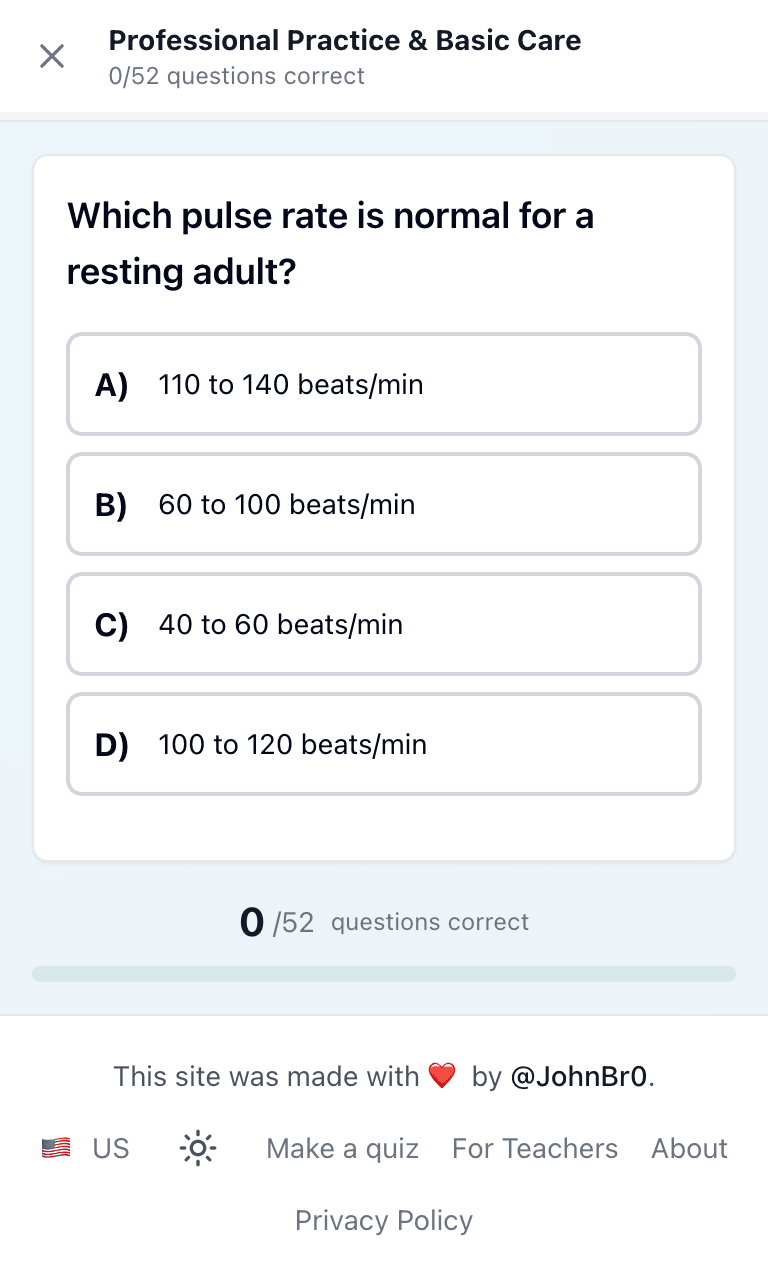
Train on mobile
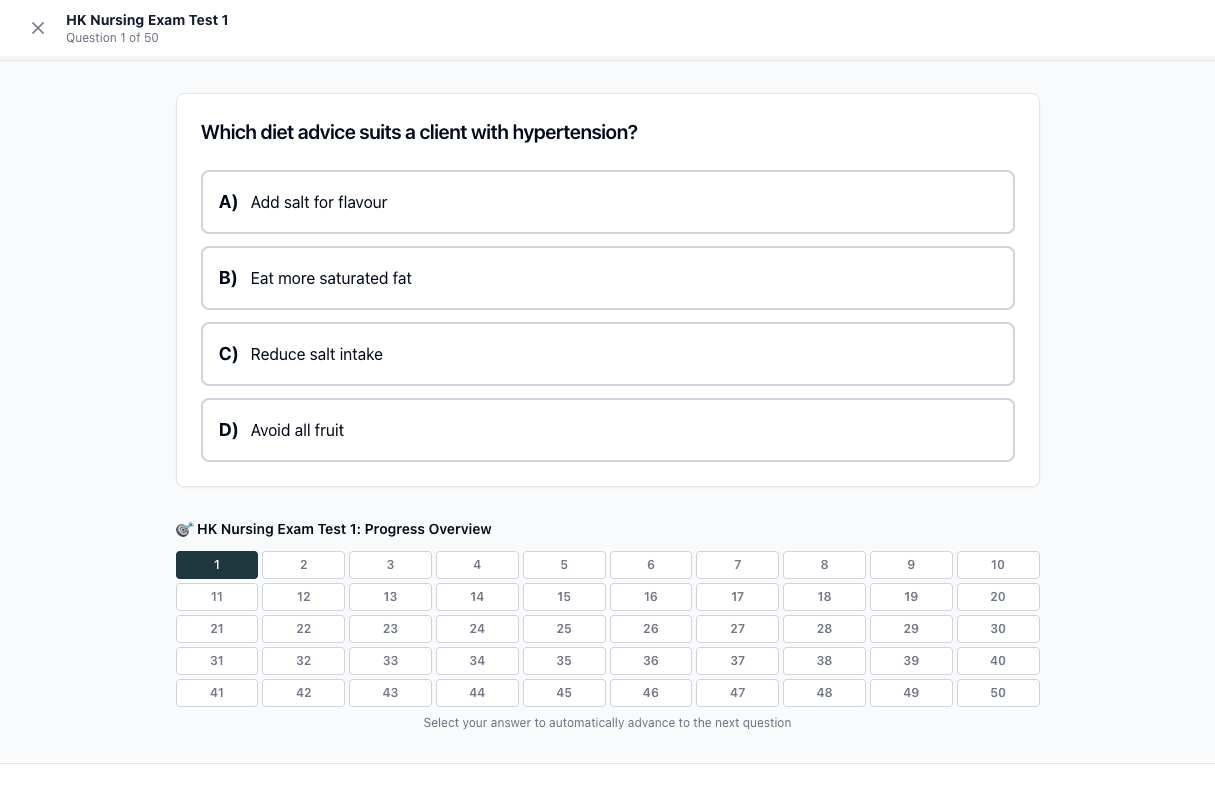
Test on desktop
The HK Nursing Exam exam at a glance
The Nursing Council of Hong Kong can require nurses trained outside Hong Kong to pass its Licensing Examination before they register as registered nurses (general) under the Nurses Registration Ordinance. It has a written part and a practical part, with no exemption for either, and the written part must be passed first. The Council's Candidates' Handbook (September 2018) describes the written part as 200 marks over one day with a passing mark of 100, and both Paper A (Medical English) and Paper B must be passed. Paper B's multiple-choice marks cover psychology, basic nursing care and system nursing care, then anatomy and physiology, food and nutrition, primary health care, personal and communal health, microbiology, first aid and pharmacology. Tigertest practises those multiple-choice topics only.
Tigertest has 200 HK Nursing Exam practice questions with explanations, free to start with no account required.
- Written part
- 200 marks, passing mark 100, one day
- Papers
- Medical English, multiple choice, essay and specialty questions
- Both papers
- Paper A and Paper B must each be passed
- Languages
- Chinese or English
- Then
- Practical part: health assessment, medication, aseptic technique
- Run by
- Nursing Council of Hong Kong
Updated by the Tigertest team. Practice questions follow The Council's Candidates' Handbook for Nursing Council Licensing Examinations (September 2018) and its 2025 RN(G) syllabus, checked November 2026. Exam rules change, so confirm current details with Nursing Council of Hong Kong: Candidates' Handbook.
How It Works
Train One Topic at a Time
Four training sets: professional practice and basic care, body systems and medical-surgical care, peri-operative, life-span and first aid, and the sciences with pharmacology and public health. Questions you miss come back until you have mastered them.
Four Practice Tests
Four tests of 50 questions, each drawing on all fourteen topics with a 60% readiness line. No question appears in more than one test, and every answer explains the reason behind it.
Built on the Council's Syllabus
The Council names the subject areas of its multiple-choice papers but publishes no topic counts, so each practice test here uses Tigertest's own split of 50 questions:

Help Make Tigertest Better
Have an idea, a topic you'd like covered, or a question that could be clearer? We read every message and use it to improve every test.
Share FeedbackHow to Prepare for the Written Part
1. Read the Council's documents first
The Council's Candidates' Handbook, its syllabus for Registered Nurse (General) and its Code of Ethics and Professional Conduct are on its website. Check the current notice for your sitting before you plan your study.
2. Anchor each system to its normal values
Normal vital signs, blood pH, glucose targets and drug calculations come up across topics. Learn the normal range first, then the signs that depart from it and the first nursing action.
3. Know the legal and ethical basics
Be ready on consent, confidentiality, negligence, vicarious liability and the four domains of the Council's Code, and on the Hong Kong ordinances the syllabus names.
4. Practise the other papers separately
The written part also has Medical English, essay and specialty questions that Tigertest does not cover. Finish every training set here, then aim for 80% or better on each practice test before you spend time on those papers.
HK Nursing Licensing Exam Frequently Asked Questions
What is the Nursing Council of Hong Kong Licensing Examination?
Nurses trained outside Hong Kong who apply to register with the Nursing Council of Hong Kong can be required to prove their competence by examination under the Nurses Registration Ordinance. The Licensing Examination for Part I (General) Registration has a written part and a practical part, and there is no exemption for either. The practical part (health assessment, administration of medication and aseptic technique) can be taken only after the written part is passed, and both must be passed before registration.
What is in the written part and what is the pass mark?
The Council's Candidates' Handbook (September 2018) describes a one-day written part of 200 marks with a passing mark of 100, and says candidates must pass both Paper A and Paper B. Paper A is a Proficiency Test in Medical English (40 marks). Paper B(I) is 60 marks of multiple choice on psychology, basic nursing care and system nursing care. Paper B(II) has 40 marks of multiple choice on anatomy and physiology, food and nutrition, primary health care, personal and communal health, microbiology, first aid and pharmacology, plus essay and specialty nursing questions. Candidates may take it in Chinese or English. The handbook is the Council's latest published format, so check the Council's current notice for your sitting.
What does Tigertest cover?
Tigertest covers the multiple-choice subject areas: the topics of the Council's 2025 syllabus for Registered Nurse (General) that those papers draw on. It does not cover Paper A (Medical English), the essay questions, the specialty nursing choice or the practical part.
How are the practice tests built?
Each practice test has 50 questions across all fourteen topics: 3 psychology, 3 law and ethics, 7 basic nursing care, 4 cardiovascular and respiratory, 4 digestive, renal and endocrine, 4 neurological, musculoskeletal and sensory, 3 peri-operative and palliative, 4 life-span and mental health, 3 first aid, 4 anatomy and physiology, 2 nutrition, 3 public health, 3 microbiology and 3 pharmacology. The Council publishes no per-topic counts for its multiple-choice papers, so this split is Tigertest's own, and the 60% readiness line sits above the real 100 of 200 pass mark.
Are these the real Nursing Council questions?
No. Every question is original, written by Tigertest from the topics in the Council's syllabus and its Code of Ethics and Professional Conduct, using standard nursing knowledge and SI units. It is free practice and does not replace your course, the Council's sample papers or its official notices. It is not affiliated with the Nursing Council of Hong Kong.
I teach a nursing licensing exam preparation class. Can my students use Tigertest?
Yes, for free. Make a class at tigertest.io/teach, post one link, and students join with just their name. You see who practiced, their test scores and the topics your class misses most.
HK Nursing Exam sample questions and answers
6 of the 200 practice questions, one from each topic, with the answer explained.
1. Which gland is often called the master gland?
- A.Parathyroid gland
- B.Pituitary gland
- C.Thyroid gland
- D.Adrenal gland
Answer: B. The pituitary releases hormones that control other endocrine glands, under the control of the hypothalamus.
2. What reading does a blood pressure cuff that is too small give?
- A.A falsely low reading
- B.An accurate reading
- C.A reading with no change
- D.A falsely high reading
Answer: D. A narrow cuff needs more pressure to compress the artery, so the reading is falsely high.
3. How should a client take a glyceryl trinitrate tablet for angina?
- A.Sitting, under the tongue
- B.Swallowed whole with water
- C.Chewed while standing up
- D.Dissolved in a hot drink
Answer: A. Under-tongue use gives quick absorption. The drug can lower blood pressure, so the client sits to avoid fainting.
4. Which pigment builds up in the blood in jaundice?
- A.Melanin
- B.Creatinine
- C.Bilirubin
- D.Haemoglobin
Answer: C. Jaundice is yellowing of skin and eyes caused by raised bilirubin.
5. What must be done before an AED delivers a shock?
- A.Check the pulse for a full minute
- B.Stop compressions two minutes before analysis
- C.Make sure nobody touches them
- D.Give two rescue breaths first
Answer: C. Everyone stands clear so that the shock passes through the casualty only.
6. A competent adult refuses a life-sustaining treatment after a full explanation. Which principle guides the nurse?
- A.Respect for autonomy
- B.Beneficence (doing good)
- C.Distributive justice
- D.Veracity (truthfulness)
Answer: A. Autonomy is the right to make informed decisions about one's own care, including refusal, even when others disagree.
Related practice tests
Every test on Tigertest is free to start, with no account needed.
Ready to Practise for the Licensing Exam?
Start for free. No account required. 200 questions across all fourteen topics.
Start practicing