
Free MAP Growth Practice Test
Math, Reading and Language Usage for grades 2 to 5, on NWEA's own blueprint and untimed like the real test, plus ten drills that teach the basics first. Everything is free, no account needed.
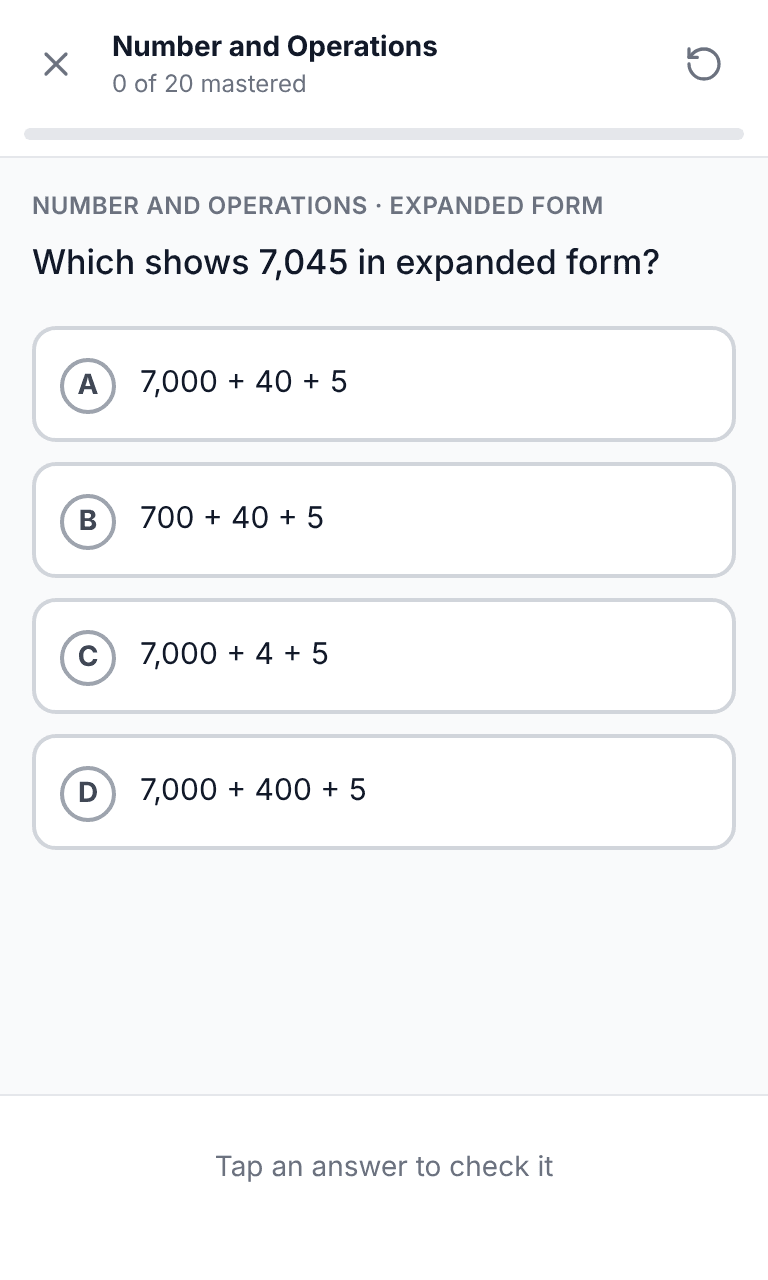
Train on mobile
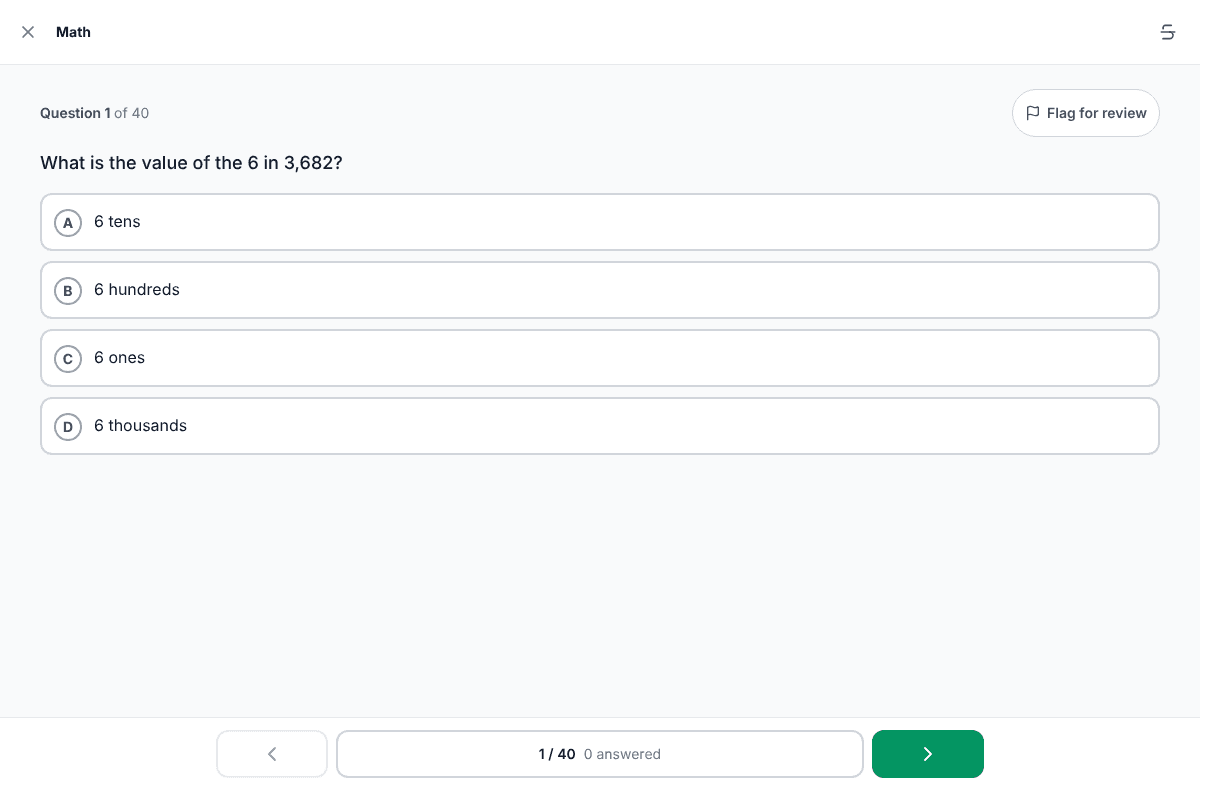
Test on desktop
The MAP Growth exam at a glance
MAP Growth is NWEA's computer adaptive test that many US schools give in the fall, winter and spring (and sometimes summer) to measure what a student knows and how much they grow. Students in grades 2 to 5 take Math 2-5, Reading 2-5 and Language Usage 2+. Each test is untimed, usually takes about 45 to 60 minutes, and has at most 43 questions, a few of them unscored field-test items. Questions get harder or easier as the student answers, and the result is a RIT score, compared with national norms updated in 2025. Math covers Operations and Algebraic Thinking, Number and Operations, Measurement and Data, and Geometry; Reading covers Literary Text, Informational Text and Vocabulary; Language Usage covers writing, grammar and usage, and mechanics.
Tigertest has two full practice tests in Math, Reading and Language Usage at NWEA's own blueprint, untimed like the real test, with a percent score per subject, and ten drills, one per instructional area, most of which teach the basics first. All of it is free with no account required. It is a fixed practice test, not adaptive, so it gives no RIT score.
- Who takes it
- Students in grades K to 12; the 2-5 tests are for grades 2 to 5
- Subjects
- Math, Reading, Language Usage (and Science in some schools)
- Questions
- Up to 43 per subject, including up to 3 or 4 unscored field-test items
- Time
- Untimed, usually about 45 to 60 minutes per subject
- Format
- Computer adaptive; multiple choice, multiselect, hot text and other item types
- Score
- RIT score per subject, with national percentiles from the 2025 norms
- How often
- Up to four times a year: fall, winter, spring and optional summer
- Pass mark
- None: MAP Growth measures achievement and growth
Updated by the Tigertest team. Practice questions follow NWEA's MAP Growth Technical Report for 2024-2025 (April 2026) and MAP Growth Instructional Areas (CCSS, April 2025). Exam rules change, so confirm current details with NWEA: MAP Growth Technical Report 2025.
How It Works
Drills on a Phone or Tablet
Ten short drills, one for each MAP Growth area, from fractions and geometry to main idea and commas. Most open with the basics, a short lesson and two quick questions, before the grade-level questions. One tap to check, a kid-friendly explanation straight away, and every miss comes back until it is mastered.
Full Test on a Computer
Math, Reading and Language Usage in one sitting or one at a time, with no clock, just like the real test. Flag questions to come back to, reading passages stay beside their questions, and you finish with a percent score per subject and a list of what to drill next.
Built on the Real Exam Format
Each practice test follows NWEA's published blueprint for the Common Core version of MAP Growth: the same instructional areas, with the same number of scored questions in each. Questions run from grade 3 to grade 5 standards, easy to hard. The real test adapts to each child and reports a RIT score; this one is a fixed set, so it reports percent correct and shows which areas to work on.

Teach Grades 2 to 5?
Teachers can set it for a class for free: post one link, students join with just their first name, and you see who practiced, their scores in each subject and the questions your class misses most.
Make a class at tigertest.io/teachHow to Help Your Child Prepare for MAP Growth
1. Make the test feel familiar
A short practice session or two lets your child see choose-two questions, typed answers and passages beside the questions before test day, so the real thing feels normal instead of new.
2. Expect hard questions
MAP Growth gets harder when your child is doing well, so everyone meets questions they cannot answer. Tell them that is how the test works, not a sign they are failing, and that a careful best guess is fine.
3. Slow down, there is no clock
The test is untimed, and rushing is the most common way to lose points. Encourage your child to read every answer choice, use scrap paper for math, and look back at the passage before choosing.
4. Drill the weakest area a little at a time
Take Practice Test 1, look at the scores by area, and spend ten minutes a day on the weakest drill. Then take Practice Test 2. Its questions never appear in the drills, so it shows real progress.
MAP Growth Test Frequently Asked Questions
What is the MAP Growth test?
MAP Growth is a computer test from NWEA that many US schools give in the fall, winter and spring to see what each student knows and how much they grow during the year. Students in grades 2 to 5 usually take Math, Reading and Language Usage. It is adaptive: when your child answers correctly the next question gets harder, and when they miss one it gets easier, so every child sees a different test.
How long is the MAP Growth test, and how many questions are there?
Each subject has at most 43 questions, including a few unscored trial questions, and it is untimed. NWEA says most students take about 45 to 60 minutes per subject. The Tigertest practice tests have 40 math, 39 reading and 39 language questions each, matching the number of scored questions per area in NWEA's blueprint, with no clock.
What is a RIT score?
RIT is the scale MAP Growth reports on. Because it measures skill rather than grade level, a RIT score can be compared across grades and across the year to show growth, and NWEA compares it with national norms (updated in 2025) to give a percentile. Tigertest cannot give a RIT score: a fixed practice test is not adaptive, so it reports percent correct per subject and shows which areas need work.
What does MAP Growth cover in grades 2 to 5?
Math covers Operations and Algebraic Thinking, Number and Operations (place value, base ten and fractions), Measurement and Data, and Geometry. Reading covers Literary Text, Informational Text and Vocabulary. Language Usage covers writing for a purpose and audience, grammar and usage, and capitalization, punctuation and spelling. Tigertest uses exactly these areas, with the same number of questions in each as NWEA's blueprint.
Can you study for the MAP test?
MAP Growth is not a pass or fail test, so there is nothing to cram. Practice still helps: it makes the question types familiar, so your child spends the real test thinking about the content, not the screen. The best preparation is steady work on the skills in each area, which is what the Tigertest drills are for: each one teaches the basics, then gives grade-level questions until every one is mastered.
Which grade is this practice test for?
Grades 2 to 5, the band the real Math 2-5, Reading 2-5 and Language Usage tests cover. Questions run from grade 3 to grade 5 standards, easy to hard within each subject, so a second grader will find the end hard and a fifth grader will find the start easy. That is normal, and it is how the real adaptive test feels too.
Is the Tigertest MAP Growth practice free?
Yes, all of it: both full practice tests, all ten drills, the basics lessons and every explanation, with no account required. An account saves progress across devices.
I teach a grade 2 to 5 class. Can my students use Tigertest?
Yes, for free. Make a class at tigertest.io/teach, post one link, and students join with just their name. You see who practiced, their test scores and the topics your class misses most.
MAP Growth sample questions and answers
6 of the 318 practice questions, one from each topic, with the answer explained.
- 1.
A rectangle is cut into 6 equal parts. What fraction of the whole rectangle is one part?
- A.
1/6
- B.
1/5
- C.
6/6
- D.
6/1
Answer: A.One part out of 6 equal parts is 1/6 of the whole. 6/6 would be all of the parts.
- A.
- 2.
What is the value of 3 × (8 + 2) - 4?
- A.
18
- B.
22
- C.
26
- D.
30
Answer: C.Do the parentheses first: 8 + 2 = 10. Then 3 × 10 = 30, and 30 - 4 = 26. Skipping the parentheses gives 3 × 8 + 2 - 4 = 22.
- A.
- 3.
A box is 4 cm long, 3 cm wide and 5 cm tall. What is the volume of the box?
- A.
12 cubic centimeters
- B.
20 cubic centimeters
- C.
60 cubic centimeters
- D.
94 cubic centimeters
Answer: C.Volume is length x width x height: 4 x 3 x 5 = 60 cubic centimeters. 12 uses only the length and width.
- A.
- 4.
What is 1/2 + 1/3?
- A.
1/6
- B.
2/6
- C.
2/5
- D.
5/6
Answer: D.Use sixths: 1/2 = 3/6 and 1/3 = 2/6, so the sum is 5/6. Adding the tops and the bottoms to get 2/5 does not work.
- A.
- 5.
The words "transport," "export," and "portable" all share the Latin root "port." What does "port" most likely mean?
- A.
to see
- B.
to hear
- C.
to carry
- D.
to write
Answer: C.A portable radio is one you can carry, and to transport is to carry from place to place. Vis is the root that means to see.
- A.
- 6.
Which sentence uses the past progressive tense?
- A.
Ben is reading a book.
- B.
Ben was reading a book.
- C.
Ben will be reading a book.
- D.
Ben had read a book.
Answer: B.The past progressive uses was or were with an -ing verb, like was reading. Is reading happens now, in the present.
- A.
Related practice tests
Every test on Tigertest is free to start, with no account needed.
Ready for Test Day?
Free. No account required. Two full practice tests, ten drills and the basics, from fractions to commas.
Start practicing