
Free NAPLEX Practice Test 2026
236 original pharmacist licensure questions on NABP's 2025 content outline, with typed calculations. Free to start, no account needed.
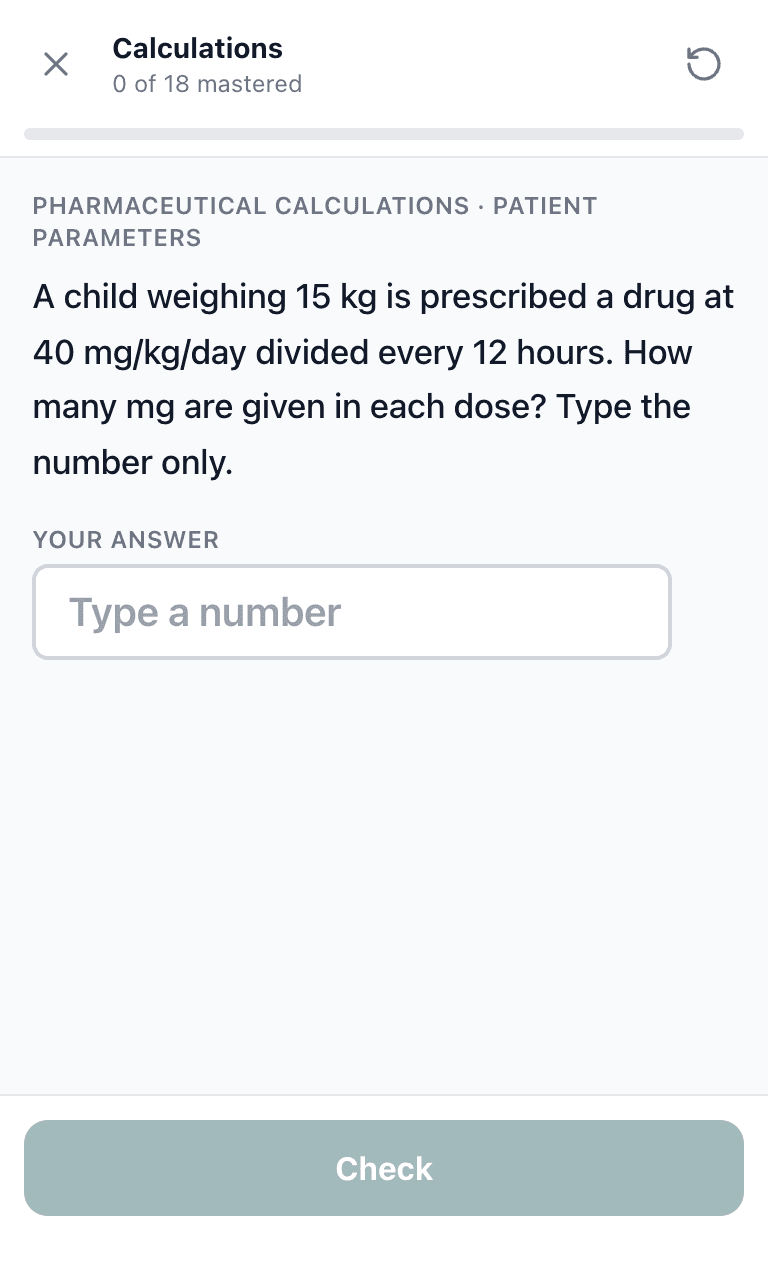
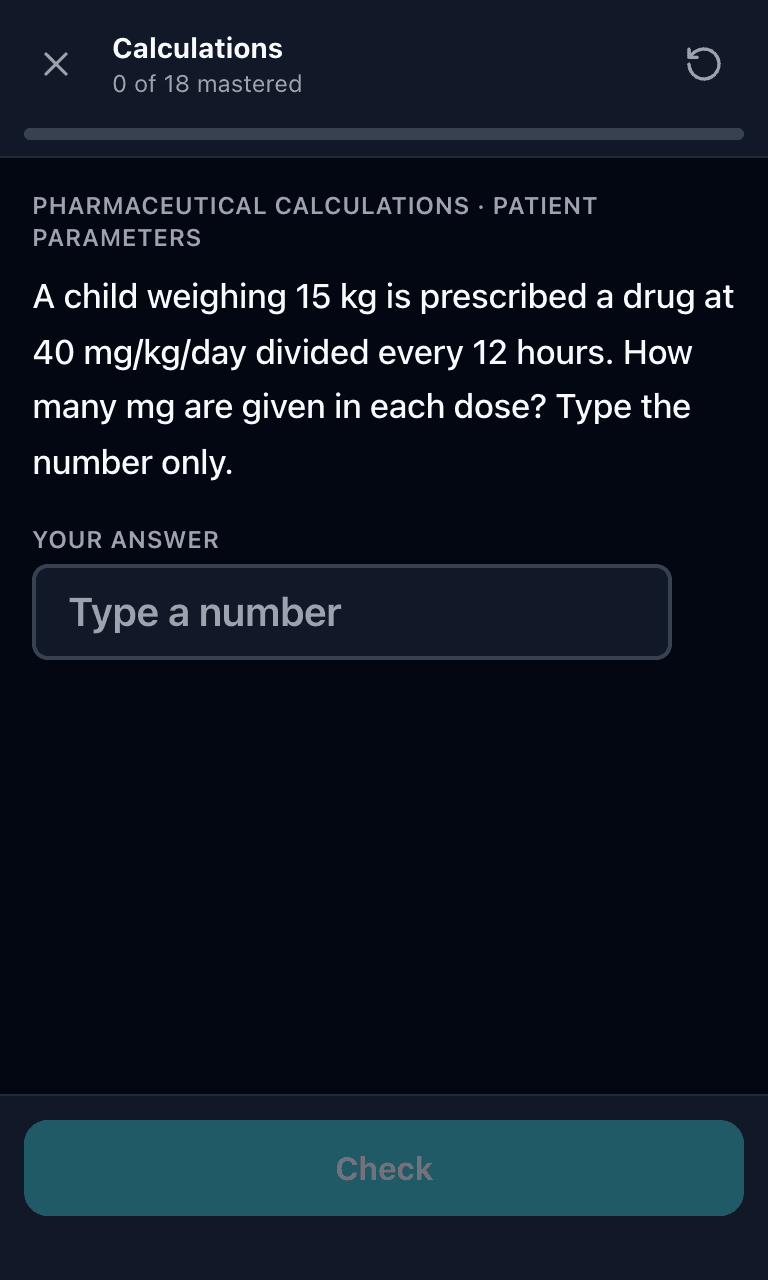
Train on mobile
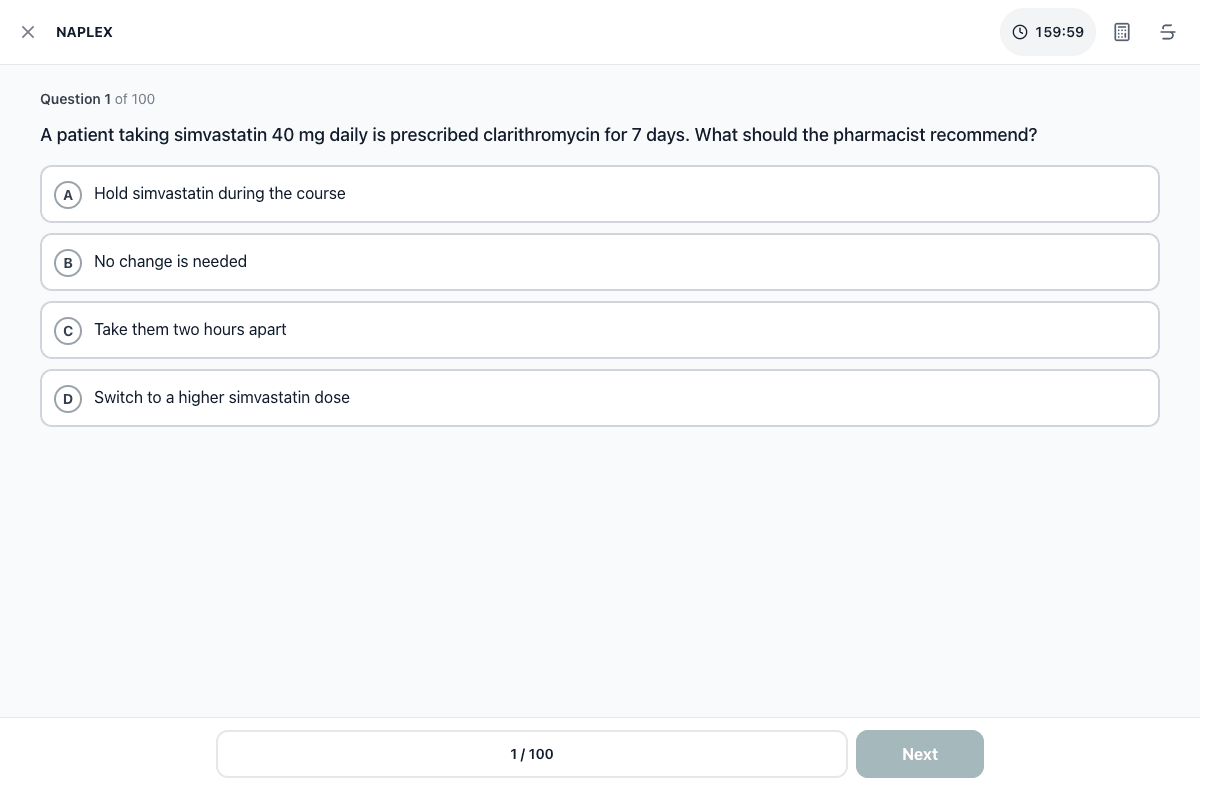
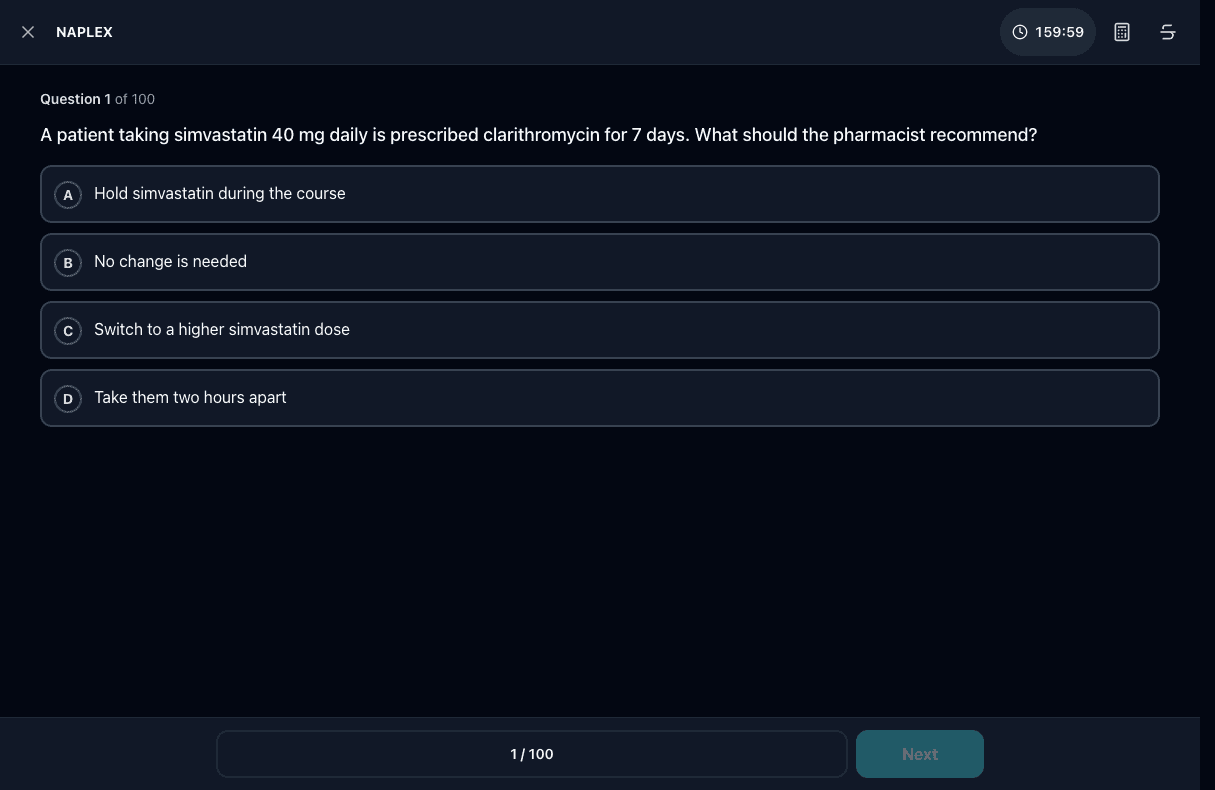
Test on desktop
The NAPLEX exam at a glance
The NAPLEX is NABP's North American Pharmacist Licensure Examination, which every US board of pharmacy uses to assess a new pharmacist's competence. It is a 6-hour computerized fixed-form exam of 225 questions, 200 scored and 25 unscored pretest questions, mostly scenario-based with a patient profile. Questions are answered in order: none can be skipped and an answer cannot be changed after moving on. Formats are multiple choice, multiple response, constructed response (a typed number), ordered response and hot spot, with an on-screen scientific calculator. The content outline in force since May 1, 2025 weights five domains: Foundational Knowledge 25%, Medication Use Process 25%, Person-Centered Assessment and Treatment Planning 40%, Professional Practice 5% and Pharmacy Management and Leadership 5%. Results are pass or fail; on NABP's 0 to 150 scale a scaled score of 75 passes.
Tigertest has two 100-question NAPLEX practice tests at the real pace, in order with no going back, weighted like the 2025 content outline, with typed calculations, select all that apply and ordered questions, plus eight drills by content area. It is free to start, with no account required.
- Questions
- 225: 200 scored, 25 unscored pretest
- Time
- 6 hours, two optional 10-minute breaks
- Navigation
- In order, no skipping, no going back
- Formats
- Multiple choice, multiple response, numeric, ordered response, hot spot
- Domains
- 25% / 25% / 40% / 5% / 5%
- Result
- Pass or fail; scaled 75 of 150 passes
- Retakes
- 45-day wait, 3 attempts in 12 months, 5 in all
- Given by
- NABP
Updated by the Tigertest team. Practice questions follow NABP's NAPLEX Content Outline effective May 1, 2025 and the NAPLEX/MPJE Candidate Application Bulletin (March 2026). Exam rules change, so confirm current details with NABP.
How It Works
Drills by Content Area
Eight drills: pharmaceutical science, calculations, prescriptions and orders, immunization and handling, appropriate therapy, assessment and monitoring, counseling with OTC products and devices, and practice and management. Each question you miss comes back until you have mastered it.
Practice Tests
Two practice tests of 100 questions in 2 hours 40 minutes, the real NAPLEX pace, answered in order with no going back and the calculator on. You see your percent correct and how you did in each content area. Practice Test 2 is held out of the drills, so it measures readiness.
Built on the NAPLEX Content Outline
Questions follow NABP's five content domains in force since May 1, 2025, at the outline's weights. Drugs are named by generic name, practice is US practice, and state pharmacy law is left to the MPJE.
Help Make Tigertest Better
Have an idea, a topic you'd like covered, or a question that could be clearer? We read every message and use it to improve every test.
Share FeedbackHow to Prepare for the NAPLEX
1. Spend most of your time on patient care
Person-centered assessment and treatment planning is 40% of the scored questions. Practice spotting the drug therapy problem in a patient case: an interaction, a dose that does not fit the kidney function, a missing therapy, a drug that causes the symptom.
2. Make calculations automatic
Constructed response questions need an exact typed answer with the rounding the question asks for. Drill creatinine clearance, infusion rates, concentrations, alligations and pharmacokinetic parameters until you can set each one up without thinking.
3. Answer once and move on
You cannot go back on the NAPLEX, so commit to each answer. Practice under the same rule, and keep to about 1.6 minutes a question so the long patient cases do not eat your time.
4. Test yourself, then drill your weakest area
Take a timed practice test, use the breakdown by content area to find what costs you the most, and drill it until you have mastered it. Save Practice Test 2 for when you think you are ready.
NAPLEX Frequently Asked Questions
What is on the NAPLEX?
The NAPLEX content outline in force since May 1, 2025 has five domains, weighted as a share of the 200 scored questions: Foundational Knowledge for Pharmacy Practice 25% (pharmacology, pharmacokinetics, pharmaceutics, compounding, calculations, drug development, biostatistics and drug information), Medication Use Process 25% (interpreting prescriptions and orders, therapeutic substitution, immunization, and handling, storage and disposal), Person-Centered Assessment and Treatment Planning 40% (histories, reconciliation, drug therapy problems, monitoring, patient education, OTC products and devices), Professional Practice 5% and Pharmacy Management and Leadership 5%.
How long is the NAPLEX and how many questions does it have?
The NAPLEX is a 6-hour computerized exam of 225 questions in a fixed form. 200 are scored and 25 are unscored pretest questions spread through the exam. There are two optional 10-minute breaks. Questions must be answered in order: you cannot skip a question or change an answer after moving on.
What question types are on the NAPLEX?
NABP uses multiple choice, multiple response (select all that apply), constructed response (you type a number, rounded as the question says), ordered response (put every option in the right order) and hot spot (click a region of an image). Most questions are scenario-based with a patient profile or medical record. An on-screen scientific calculator is provided. Tigertest models every type except hot spot.
What score do you need to pass the NAPLEX?
NABP's scale runs from 0 to 150, and a scaled score of 75 or higher passes. Results are now reported only as pass or fail; a failing report shows relative performance in the five content areas. A scaled 75 is not the same as 75% correct, so Tigertest shows your practice percent correct and does not convert it to a NAPLEX score. Unanswered questions count as incorrect.
How is this practice test different from the real NAPLEX?
Each practice test is 100 questions in 2 hours 40 minutes, the real pace of about 1.6 minutes a question, weighted across the five domains like the outline: 25 foundational knowledge, 25 medication use process, 40 assessment and treatment planning, 5 professional practice and 5 management. Like the real exam it runs in order with no going back. Questions stand alone rather than sharing long patient records, and there are no hot spot items. Every question is original; none comes from NABP sample items, the Pre-NAPLEX or a review book.
Is the Tigertest NAPLEX practice test free?
It is free to start, with no account required. Practice Test 1 and most drills are free; the last two drills and Practice Test 2 are part of Tigertest Premium, one payment with no subscription. Create a free account if you want your progress saved across your phone and computer.
I teach a NAPLEX review course. Can my students use Tigertest?
Yes, for free. Make a class at tigertest.io/teach, post one link, and students join with just their name. You see who practiced, their test scores and the topics your class misses most.
NAPLEX sample questions and answers
6 of the 236 practice questions, one from each topic, with the answer explained.
- 1.
Which FDA resource lists therapeutic equivalence ratings used for generic substitution?
- A.
The Green Book
- B.
The Red Book
- C.
The Purple Book
- D.
The Orange Book
Answer: D.Approved Drug Products with Therapeutic Equivalence Evaluations, the Orange Book, gives the codes such as AB that show a generic can be substituted. The Purple Book lists biologics and the Green Book animal drugs.
- A.
- 2.
Which drug is a P2Y12 inhibitor?
- A.
Dipyridamole
- B.
Cilostazol
- C.
Ticagrelor
- D.
Vorapaxar
Answer: C.Ticagrelor blocks the platelet P2Y12 ADP receptor. Cilostazol inhibits phosphodiesterase 3, dipyridamole affects adenosine uptake and phosphodiesterase, and vorapaxar blocks the PAR-1 thrombin receptor.
- A.
- 3.
A patient wants to get rid of leftover tablets that are not on the FDA flush list, and a take-back site is nearby. What is the best advice?
- A.
Mix them with coffee grounds
- B.
Pour them down the kitchen sink drain
- C.
Flush them down the toilet
- D.
Take them to the take-back site
Answer: D.FDA guidance puts take-back first. Household trash mixed with an unappealing substance is for when no take-back is available, and only drugs on the flush list are flushed.
- A.
- 4.
Which test guides dose changes for a continuous IV unfractionated heparin infusion?
- A.
Serum creatinine
- B.
aPTT or anti-Xa level
- C.
Fibrinogen and D-dimer
- D.
INR
Answer: B.Heparin infusions are titrated to an aPTT or anti-factor Xa target. INR guides warfarin, and platelets are watched separately for heparin-induced thrombocytopenia.
- A.
- 5.
Where should most medicines be stored at home?
- A.
The bathroom cabinet
- B.
A cool, dry place out of reach
- C.
A sunny windowsill by the kitchen sink
- D.
The car glove box
Answer: B.Heat and moisture break drugs down, so the bathroom, a car and a windowsill are poor choices. Storage should also be out of children's sight and reach.
- A.
- 6.
An adult patient's daughter calls and asks what her mother's new prescription is for. The patient has not given permission. What should the pharmacist do?
- A.
Share it if she knows the birthdate
- B.
Share it but write a note in the profile
- C.
Share it because she is family
- D.
Not share it without the patient's OK
Answer: D.Patient health information is confidential, and HIPAA lets the pharmacist share it with family only when the patient agrees, does not object or, in limited cases, when it is in the patient's best interest.
- A.
Related practice tests
Every test on Tigertest is free to start, with no account needed.
Ready to Take On the NAPLEX?
Start for free. No account required. 236 questions across all five content domains.
Start practicing