
Free Nova Scotia Learner's Practice Test 2026
200 original questions on Nova Scotia road signs, traffic lights, right-of-way, graduated licensing, demerit points and safe driving, from the Nova Scotia Driver's Handbook. Five tests split 20 signs and 20 rules, like the real one. Tuned for mobile. No account needed.
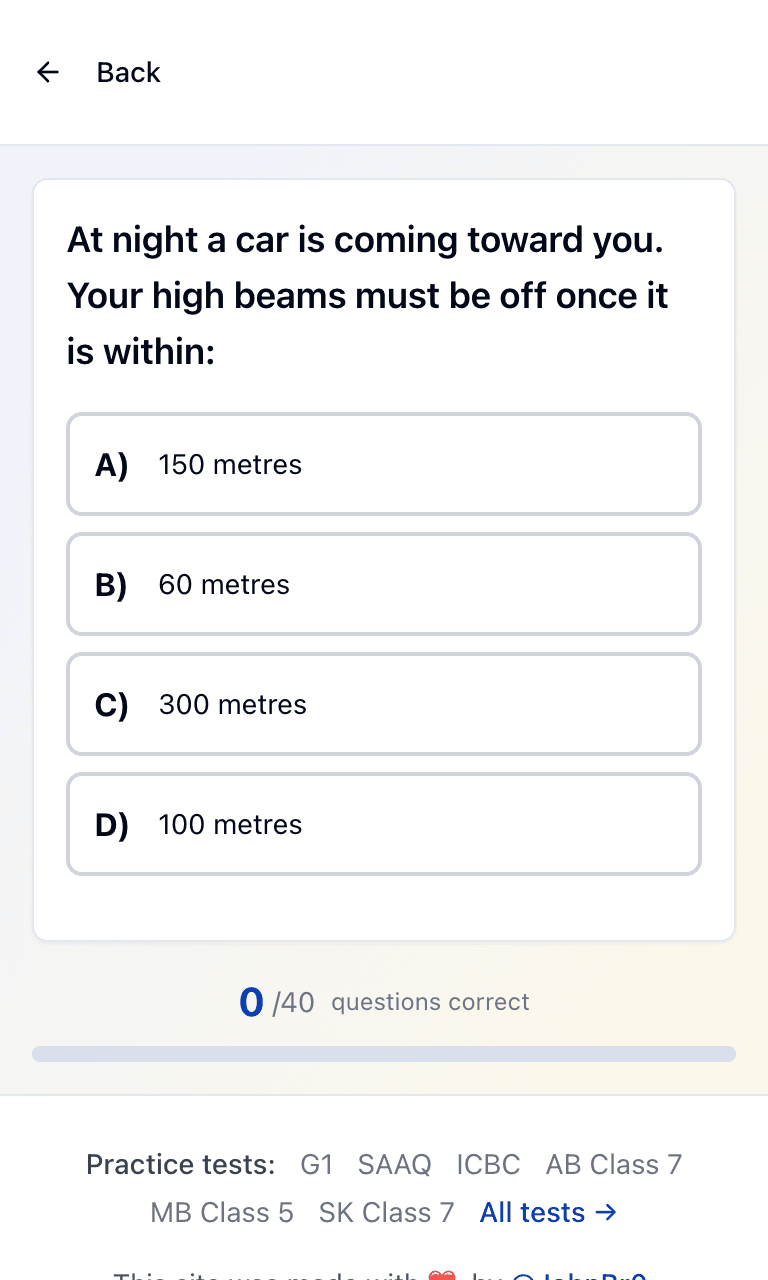
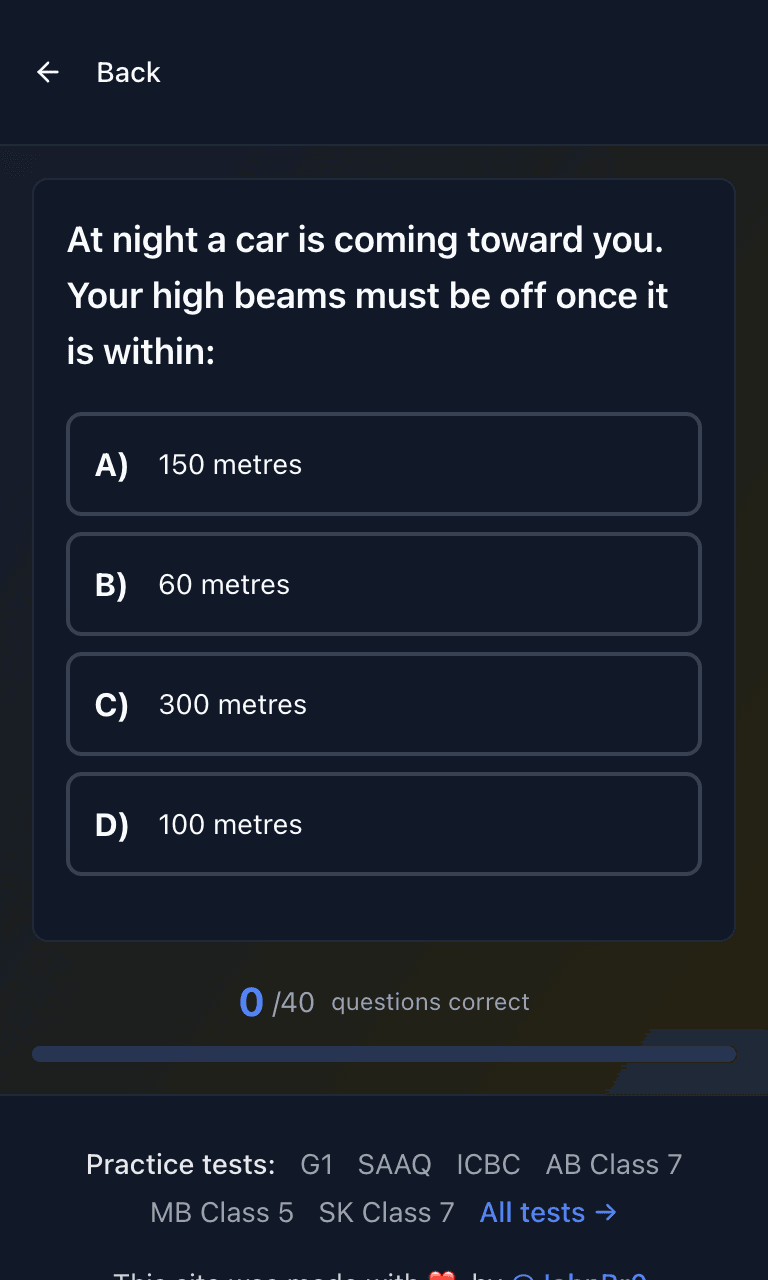
Train on mobile
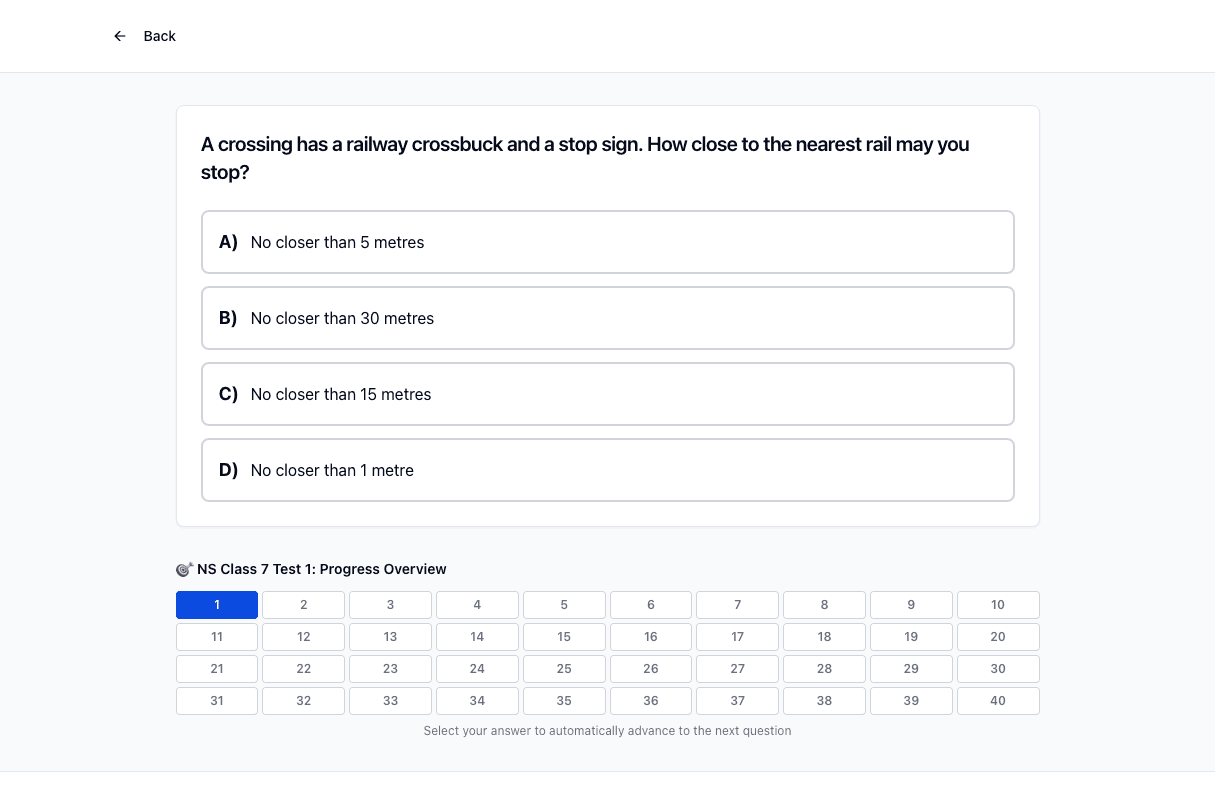
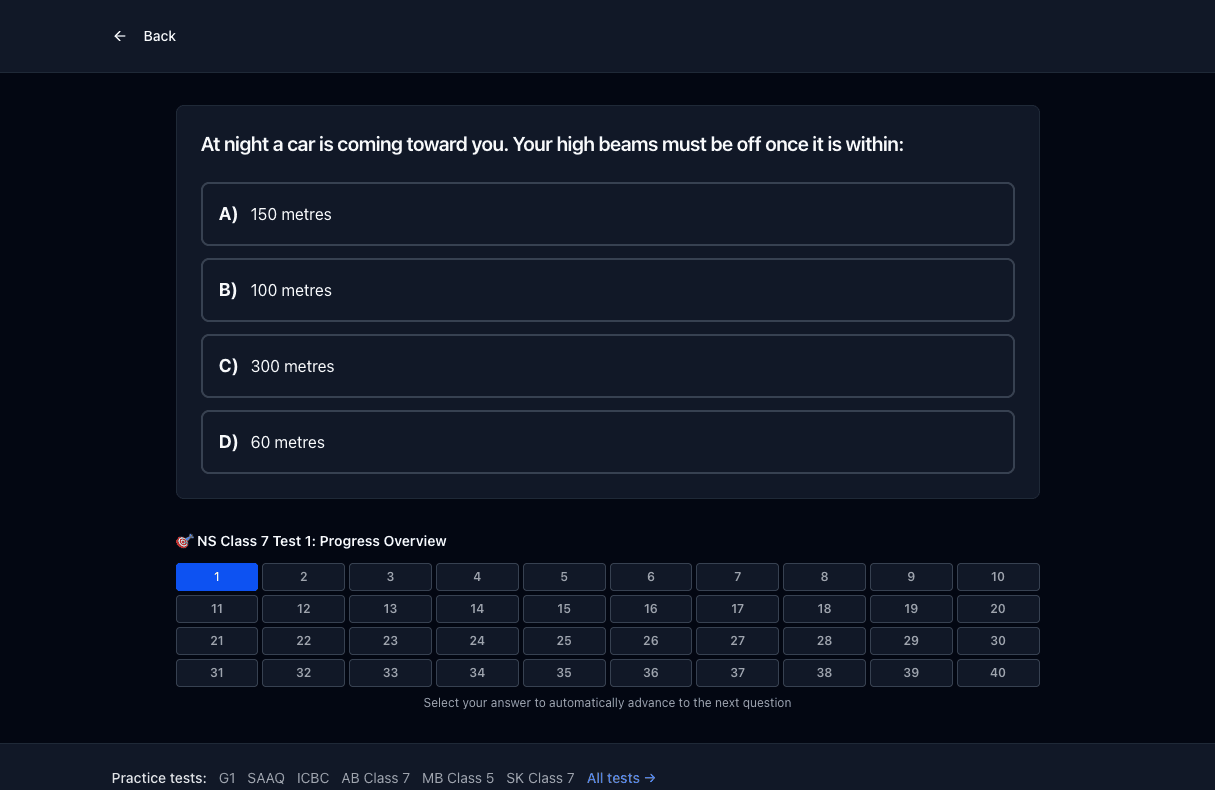
Test on desktop
The NS Class 7 exam at a glance
The Nova Scotia Class 7 knowledge test is the written test for a learner's licence. It has two parts, a rules of the road test and a road sign test, each with 20 multiple-choice questions, and you need at least 16 correct on each part (80 percent), with 30 minutes per part. You can take it online in English or French with a webcam, or in person at a Registry of Motor Vehicles office or Access Nova Scotia centre. You must be at least 16, with a parent's written consent at 16 or 17, and you also pass a vision test before the licence is issued.
Tigertest has 200 NS Class 7 practice questions with explanations, all free with no account required.
- Format
- Two parts: rules of the road and road signs
- Questions
- 20 multiple choice per part
- Passing score
- 16 of 20 on each part (80%)
- Time
- 30 minutes per part
- Where
- Online (English or French, webcam) or at the RMV / Access Nova Scotia
- Minimum age
- 16 (written parental consent at 16 or 17)
- Also required
- Vision test, ID, photo
- Retake
- Only the failed part; next day in person, no wait online
- Next step
- Road test after 12 months (9 with approved driver education)
Updated by the Tigertest team. Practice questions follow novascotia.ca learner's licence test and RMV pages and the Nova Scotia Driver's Handbook, checked October 2026. Exam rules change, so confirm current details with Nova Scotia: Take a driver knowledge test, Learner's Licence (class 7).
How It Works
Train, Then Test
Five training sets, one per practice test: Set 1 holds exactly the 40 questions of Test 1, and so on. Master Set 1, take Test 1, then move on. Questions you miss come back until you have mastered them.
Practice Tests
Five 40-question tests, each 20 sign questions and 20 rules of the road questions like the real two-part test, with an 80 percent pass line and an explanation of the right answer and the common wrong pick on every question.
Built on the Nova Scotia Driver's Handbook
The real test is two parts of 20: a road sign test and a rules of the road test. Every practice test here is the same 20 and 20. The signs half covers regulatory, warning and work zone signs plus lights and pavement markings; the rules half follows the handbook's chapters on licensing, right-of-way, driving, sharing the road and adverse conditions. The rules are Nova Scotia's own: the three-stage graduated licence, the 80 km/h default limit, school zone speeds, slow down and move over, and the one-metre gap for cyclists.

Help Make Tigertest Better
Have an idea, a topic you'd like covered, or a question that could be clearer? We read every message and use it to improve every test.
Share FeedbackHow to Pass the Nova Scotia Learner's Test
1. Treat the signs test as its own exam
Half the test is road signs, and you need 16 of 20 on that half alone. Learn the families by shape and colour first: the octagon stop sign, the downward yield triangle, the five-sided fluorescent yellow-green school zone sign, white rectangular regulatory signs, yellow diamond warning signs, orange work zone signs and green guide signs. Then work through the pictures in chapter 3 of the handbook, including the flashing arrow boards in work zones.
2. Make a table of the numbers
The rules half loves numbers: 80 km/h unless posted, 50 km/h in urban areas, the posted school area limit whenever children are present, 60 km/h past a stopped emergency vehicle, 150 metres behind a fire truck, low beams within 150 metres of oncoming traffic and 60 metres when following, one metre when passing a cyclist, and the two-second rule. Write them in one table and quiz yourself until they are automatic.
3. Know the graduated licence rules cold
Expect questions on your own licence: a supervising driver in the front seat and no other passengers, zero alcohol, 4 demerit points for a learner suspension, 12 months (or 9 with driver education) before the road test, then the newly licensed stage with its midnight to 5 a.m. curfew and one front-seat passenger, and 2 more years as a novice driver with zero alcohol after that.
4. Fix your misses, then retest
Tigertest tracks your accuracy by topic. Master each training set, then take its practice test and check both halves: you need 16 of 20 on the signs and 16 of 20 on the rules, not just 80 percent overall. Drill the questions you missed, retrain that set, and take all five tests before you sit the real one.
Nova Scotia Learner's Test Frequently Asked Questions
What score do I need to pass the Nova Scotia learner's test?
The Class 7 knowledge test has two parts, a rules of the road test and a road sign test, each with 20 multiple-choice questions. You need at least 16 correct on each part, which is 80 percent. The practice tests here use the same 80 percent pass line, so aim for 16 of 20 on the signs half and on the rules half.
How long is the test and can I take it online?
Each part must be finished within 30 minutes. You can take the test online in English or French on a desktop or laptop with a webcam (phones and tablets are not allowed), or in person at a Registry of Motor Vehicles office or Access Nova Scotia centre. You must work alone with no notes. Online you can retry with no wait after paying again; in person you wait until the next day.
What else do I need to get my learner's licence?
You must be at least 16, and if you are 16 or 17 a parent or guardian must give written consent. You also need to pass a vision test, show identification with your legal name and date of birth, pay the licence fee and have your photo taken. If you test online, you finish these steps at a Registry of Motor Vehicles office or Access Nova Scotia centre after you pass.
What are the rules for a Class 7 learner in Nova Scotia?
You may drive only with a supervising driver in the front seat who holds a regular licence and is not in the graduated licensing program, and you may carry no other passengers. Your blood-alcohol level must be zero, and 4 demerit points bring a six-month suspension. The licence is valid for 2 years, and you can take the road test after 12 months, or 9 months with an approved driver education course.
Are these the real Nova Scotia knowledge test questions?
No. The Registry of Motor Vehicles does not publish its question bank. Every question here is original, written from the Nova Scotia Driver's Handbook and the province's current learner rules, including the Traffic Safety Act changes in force since October 19, 2026. Signs are described in words, so study the sign pictures in the handbook too. It is a study tool, not a licence.
Related practice tests
Every test on Tigertest is free and needs no account to start.
- Ontario G1 Practice TestOntario MTO, DriveTest
- SAAQ Practice TestSAAQ (Quebec)
- ICBC Practice TestICBC, British Columbia
- Alberta Class 7 Practice TestAlberta registry agents · Class 7 learner's licence
- Manitoba Class 5 Practice TestManitoba Public Insurance (MPI)
- Saskatchewan Class 7 Practice TestSGI (Saskatchewan Government Insurance)
Ready to Get Your Learner's?
Free to start. No account required. 200 questions on Nova Scotia signs and rules of the road.
Start practicing