
Free NZ Day Skipper Practice Test 2026
200 original questions on New Zealand boating: give-way rules, lights and sound signals, IALA A buoys, the 5 knot rule, tides, marine weather, anchoring, knots and Mayday calls. Four 50-question tests. Tuned for mobile. Free to start, no account needed.
Try one now
Pick an answer
Facing forward on your boat, the green sidelight is on which side?
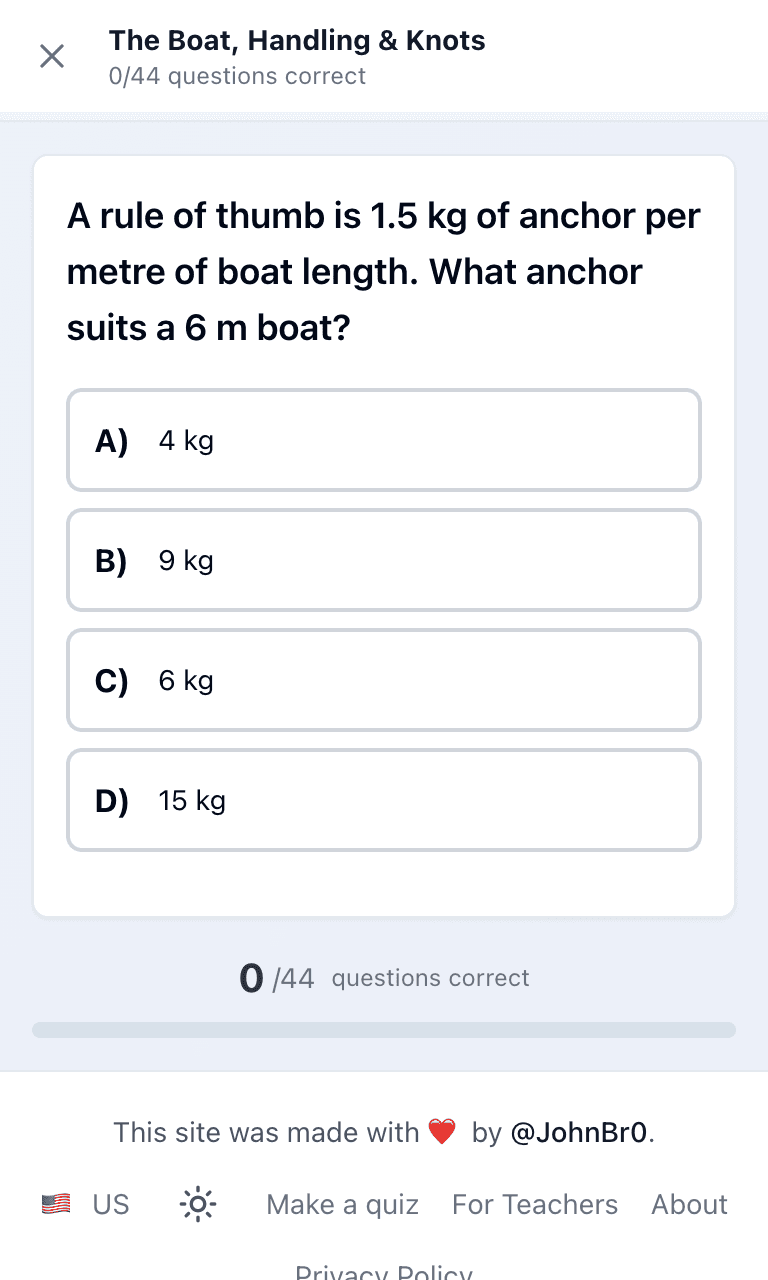
Train on mobile
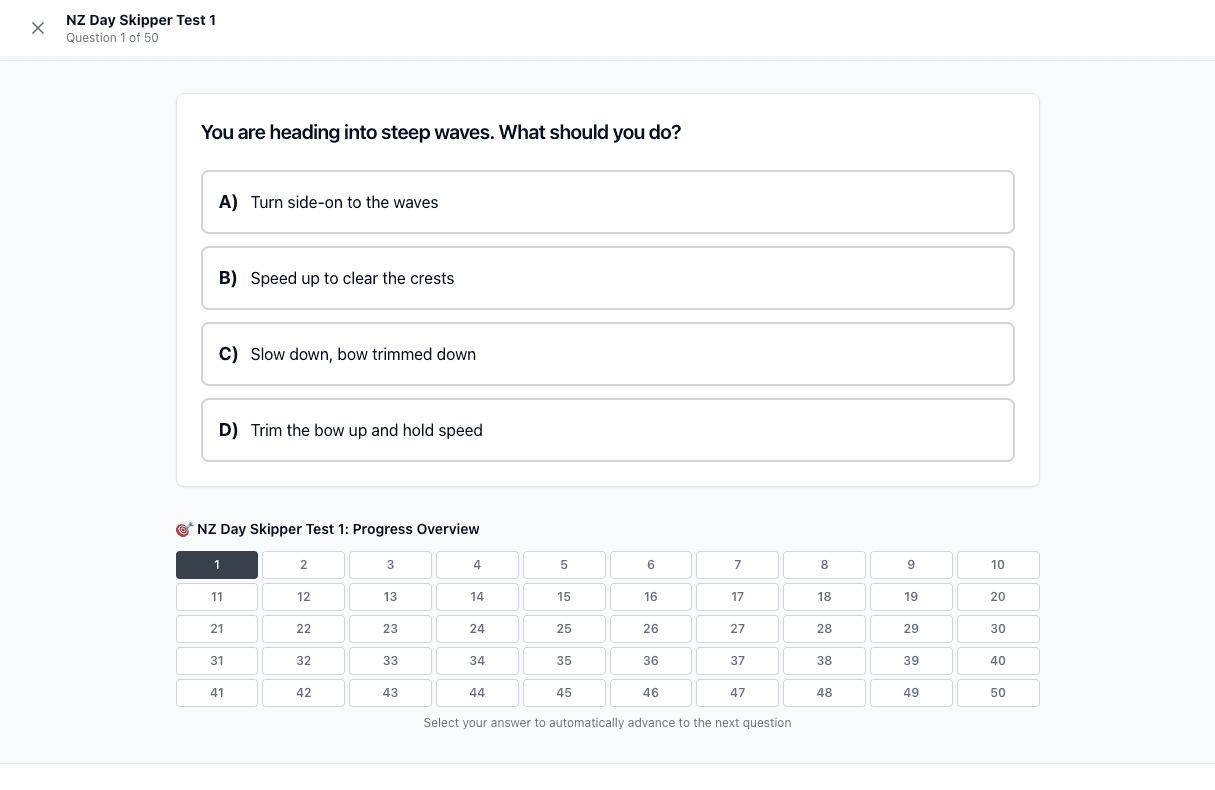
Test on desktop
The NZ Day Skipper exam at a glance
Day Skipper is Coastguard Boating Education's introductory course for recreational boaties and crew in New Zealand, especially people new to being skipper of their own boat. Its learning outcomes are the parts of a boat and its equipment, basic boat handling, navigational charts, basic tide and weather terms, navigational marks, Maritime Rules and Regulations, emergencies and common marine knots. It runs in a classroom (four weeks including two days in class), a virtual classroom or online self-study within four weeks, and every version ends with an online assessment. Coastguard Boating Education does not publish the number of questions or a pass mark; a learner who falls short gets feedback and a second attempt at the questions they got wrong. The certificate is an internal Coastguard Education certificate, not an NZQA qualification. New Zealand requires no licence to skipper a recreational boat, but skippers must follow the Maritime Rules and regional bylaws.
Tigertest has 200 NZ Day Skipper practice questions with explanations, free to start with no account required.
- Run by
- Coastguard Boating Education
- Assessment
- Online assessment at the end of the course; no question count or pass mark published
- Resits
- Feedback, then a second attempt at the questions answered wrongly
- Course
- Classroom (2 days), virtual classroom or online self-study, within 4 weeks
- Covers
- Boat and equipment, handling, charts, tides and weather, marks, Maritime Rules, emergencies, knots
- Eligibility
- Domestic learners aged 16 and over
- Certificate
- Coastguard Education internal certificate (not NZQA)
- Licence needed to skipper?
- No, but the Maritime Rules and regional bylaws apply
Updated by the Tigertest team. Practice questions follow Coastguard Boating Education's Day Skipper course page, its Domestic Learner Handbook (18 March 2026) and FAQ, checked November 2026. Exam rules change, so confirm current details with Coastguard Boating Education: Day Skipper.
How It Works
Train One Topic at a Time
Five training sets: the boat, handling and knots; charts, tides and weather; navigational marks and lights; the rules of the road and local rules; and emergencies and communications. Questions you miss come back until you have mastered them.
Four Practice Tests
Four tests of 50 questions, each drawn across every topic of the course with an 80% target. No question appears in more than one test, and every answer explains the rule behind it.
Built on the Day Skipper Learning Outcomes
Coastguard Boating Education lists what the course teaches but publishes no topic weights, so each test here gives every learning outcome its share, with extra weight on the rules of the road:
Help Make Tigertest Better
Have an idea, a topic you'd like covered, or a question that could be clearer? We read every message and use it to improve every test.
Share FeedbackHow to Get Ready for Day Skipper
1. Learn the 5 knot rule first
No more than 5 knots within 200 m of the shore or any structure, within 200 m of a boat flying the diver's flag, within 50 m of another boat or a person in the water, and while anyone has part of their body over the bow or side. Your region may add its own speed zones.
2. Know who gives way
Power gives way to sail unless it is being overtaken, the overtaking boat always keeps clear, power boats meeting head-on both turn to starboard, and in a crossing you give way to a boat on your starboard side by passing astern of it.
3. Picture the marks and lights
Entering harbour, keep red port marks to port and green starboard marks to starboard. Cardinal marks follow a clock face (three flashes east, six south, nine west, continuous north), and at night red over white means fishing while two reds mean not under command.
4. Rehearse an emergency
Remember LIFES (Lifejackets, Investigate, Fix, Emit a signal, Stay with the boat), the Mayday call on channel 16, *500 for non-urgent help and 111 in an emergency. Then check your own regional council's bylaws before you head out.
Day Skipper Frequently Asked Questions
What is the Day Skipper course?
Day Skipper is Coastguard Boating Education's introductory course for recreational boaties and crew, especially people new to being skipper of their own boat. It covers the general knowledge needed to run a pleasure craft in familiar waters in daylight: the parts of a boat and its equipment, basic boat handling, charts, basic tide and weather terms, navigational marks, Maritime Rules and Regulations, emergencies and common knots. You can do it in a classroom over about two days, in a virtual classroom, or online at your own pace within four weeks.
Do you need a licence to drive a boat in New Zealand?
No. New Zealand has no licence for skippering a recreational boat, but every skipper must follow the Maritime Rules and the regional council's navigation bylaws, such as the 5 knot rule, carrying a lifejacket for everyone on board and, since 9 October 2026, wearing one on boats 6 m or under whenever they are underway. Coastguard Boating Education calls Day Skipper the minimum training it recommends. Operating a marine VHF radio, except in an emergency, does need an operator's qualification.
How is the Day Skipper assessed?
Every version of the course ends with an online assessment. Coastguard Boating Education does not publish its number of questions or a pass mark. Its learner handbook says that if you do not reach the required level you get feedback and a second try at the questions you got wrong. The certificate is Coastguard Education's own internal certificate, not an NZQA qualification. Tigertest's four tests of 50 questions and 80% line are its own target, not the real format.
What do these practice tests cover?
The 200 questions follow the course's learning outcomes and the rules behind them: Maritime Rules Part 22 (collision prevention, lights and sound signals), Part 91 (navigation safety, including the 5 knot rule and lifejackets), the IALA A buoyage system used in New Zealand, LINZ tide guidance, marine forecasts, and emergencies such as Mayday and Pan-pan calls. A few questions are labelled as Hawke's Bay rules, because each region's bylaws differ, so check your own regional council's rules too.
Are these the real Day Skipper questions?
No. Every question is original, written by Tigertest from the Maritime Rules, regional council harbourmaster guidance and LINZ tide information. Tigertest is not affiliated with Coastguard Boating Education, Coastguard New Zealand or Maritime New Zealand, and this practice does not replace the course or its certificate.
NZ Day Skipper sample questions and answers
6 of the 200 practice questions, one from each topic, with the answer explained.
1. For a 5-year-old going out in your boat, which lifejacket should they wear?
- A.An adult jacket left loose
- B.One sized to fit them
- C.An adult jacket, tightened
- D.A buoyancy aid of any size
Answer: B. Maritime Rule 91.4 requires a personal flotation device of an appropriate size for each person on board. An adult jacket can slip off a child in the water.
2. Why should you not anchor close to navigation leads?
- A.Leads warn of shallow rock
- B.Leads mark a reserved area
- C.The current is strongest there
- D.You would block the line
Answer: D. Leads show the safe course in and out. Hawke's Bay Regional Council's guide says anchoring near them is strictly prohibited, because an anchored boat sits on the line other vessels steer along.
3. Paddling a kayak near a larger vessel, how should you cross its path?
- A.Pass behind it
- B.Pass close ahead of it
- C.Wait alongside it
- D.Stop directly ahead of it
Answer: A. Paddle craft are slow and hard to see, so stay clear of larger vessels and always pass behind them, not in front.
4. What should every skipper do with the crew before leaving the wharf?
- A.Let them start the engine
- B.Ask who can swim the farthest
- C.Show where the safety gear is
- D.Hand over the boat's papers
Answer: C. A few minutes showing your crew where safety equipment is stowed and how to use it can save lives if the skipper is the one in trouble.
5. A paddle-wheel speed log fouled with weed is likely to show:
- A.Your speed over the ground
- B.Your exact speed, unchanged
- C.A speed lower than real
- D.More speed than you are doing
Answer: C. Sand or seaweed can block an engine-based or paddle-wheel log, so it shows a lower speed than the real one. Check it, especially near 5 knot zones.
6. Under Rule 91.14, what must you never do to a navigation aid?
- A.Interfere with it
- B.Pass it at night
- C.Use it to take a bearing
- D.Steer close past it
Answer: A. Rule 91.14(2): no person may damage, remove, deface or otherwise interfere with an aid to navigation.
Related practice tests
Every test on Tigertest is free to start, with no account needed.
- NZ Firearms Licence Practice TestFirearms Safety and Education New Zealand · Firearms Safety Course theory test
- LCQ Practice TestNZQA unit standards 4646 and 16705 · approved LCQ providers
- NZ Drone Rules (Part 101) Practice TestCivil Aviation Authority of New Zealand · Part 101 and CATI 101-1 (pilot qualifications from approved organisations)
- NZ Amateur Radio Practice TestNZART for Radio Spectrum Management · General Amateur Operator's Certificate (HAREC syllabus)
Free practice tests for New ZealandSee all 409 practice tests
Ready to Skipper Your Own Boat?
Start for free. No account required. 200 questions across every Day Skipper topic.
Start practicing