
Free PSIRA Security Officer Practice Test 2026
200 original questions for the PSIRA Grade E, D and C courses: the PSIRA Act, arrest and use of force, access control, patrols and radio, occurrence books, first response, fire, first aid and OHS. Four 50-question mock tests. Tuned for mobile. No account needed.
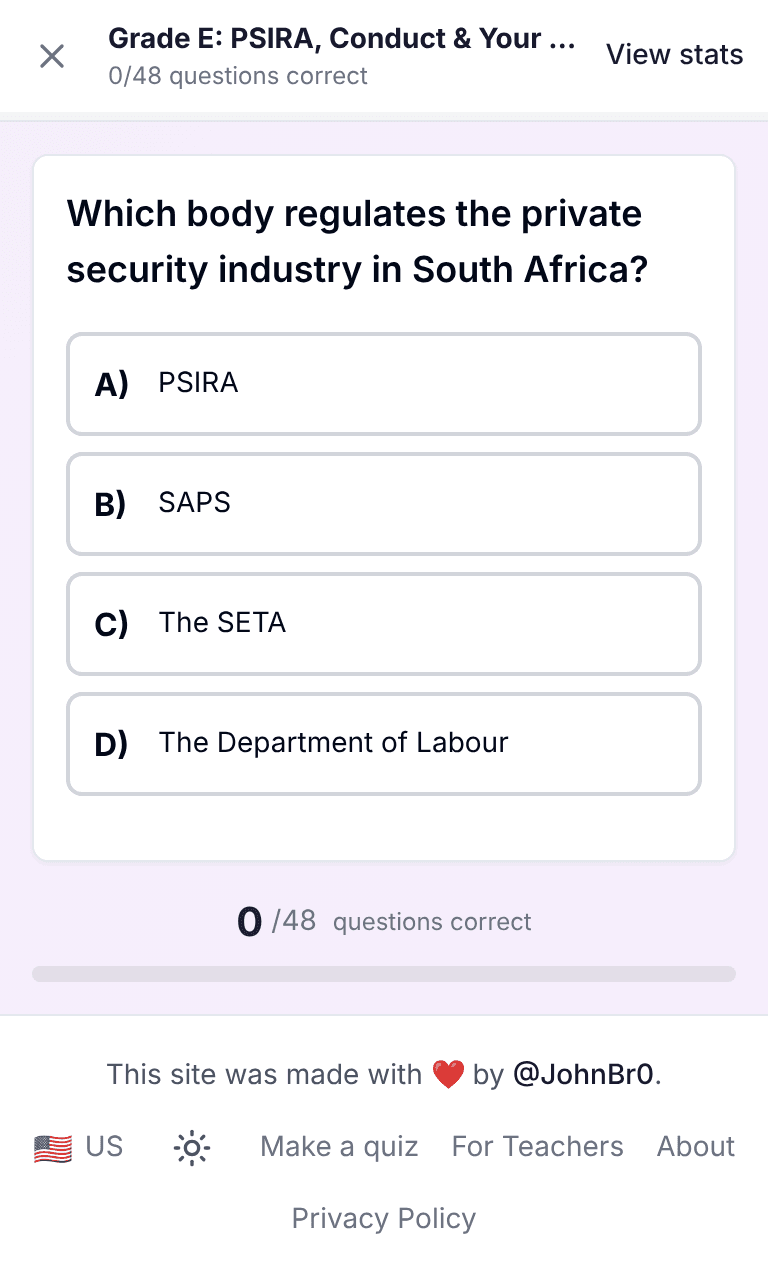
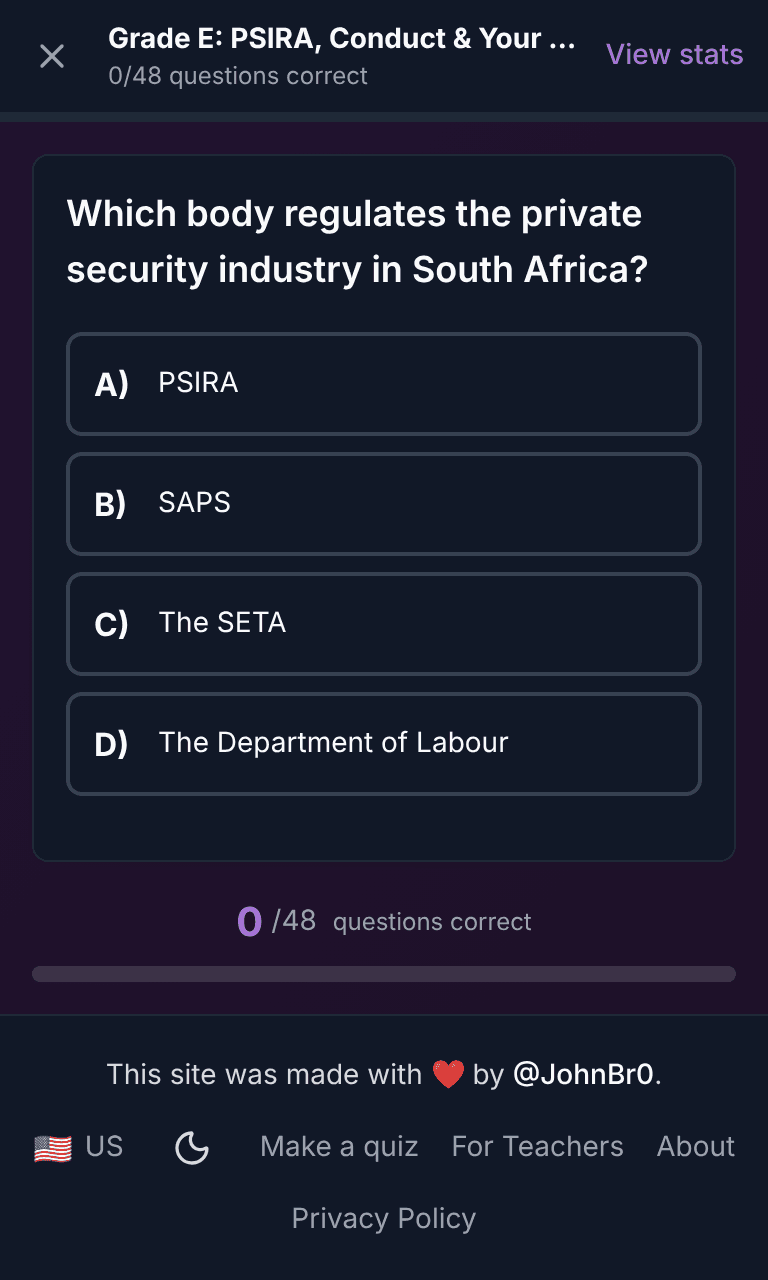
Train on mobile
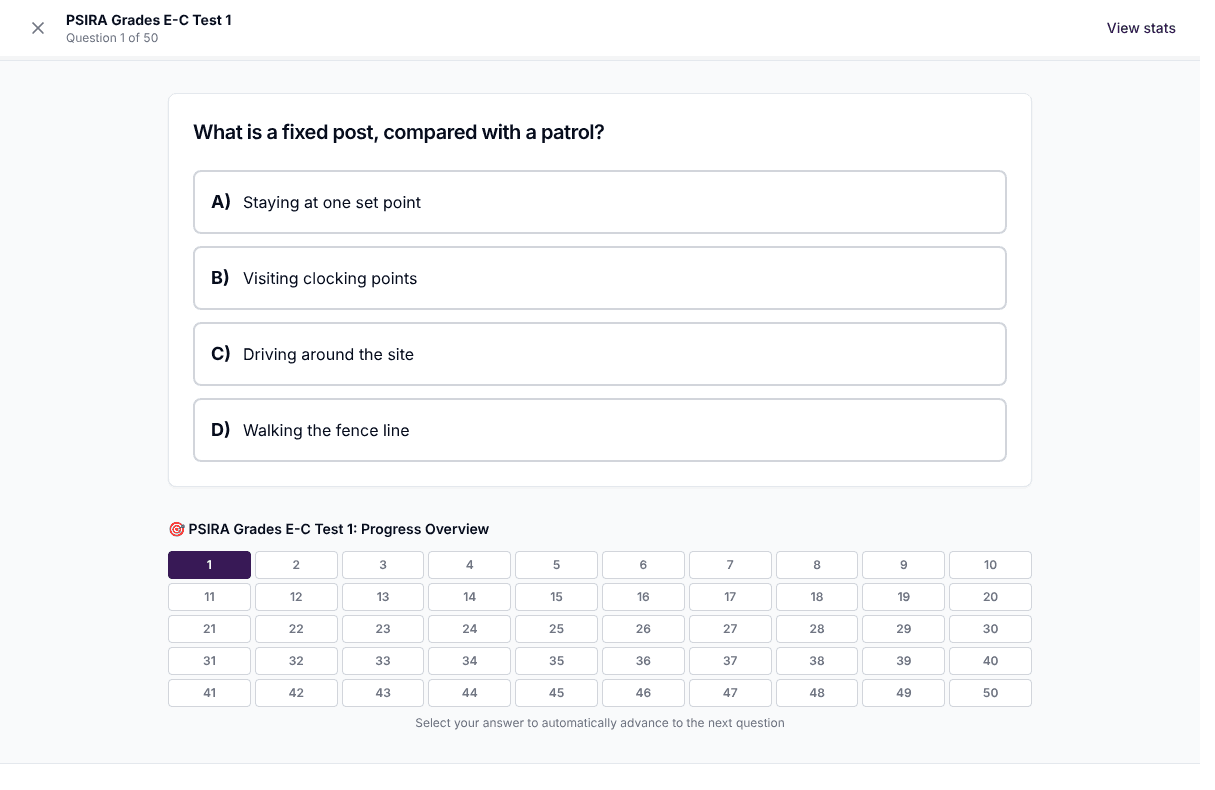
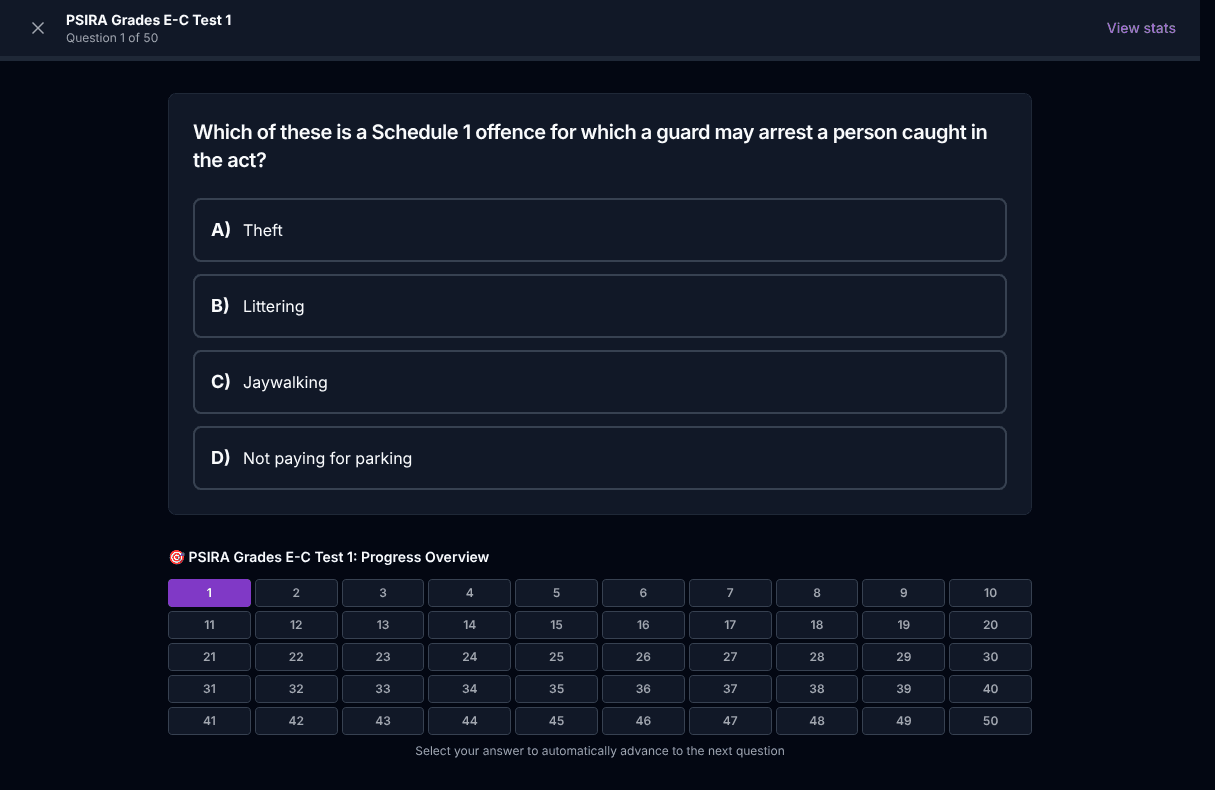
Test on desktop
The PSIRA Grades E-C exam at a glance
In South Africa, nobody may work as a security officer for pay without registering with the Private Security Industry Regulatory Authority (PSIRA), under section 20 of the Private Security Industry Regulation Act 56 of 2001. Section 23 requires an applicant to be a fit and proper person, a South African citizen or permanent resident, at least 18 and mentally sound, to have met the prescribed training requirements, and to have no conviction for an offence listed in the Act's Schedule (within 10 years before applying in the Act as published; the Amendment Act 18 of 2014 drops that limit once in operation). Security officer training is done in grades at PSIRA-accredited training centres, and each course ends in an assessment the centre sets. No official question count or pass mark was found; 70% is Tigertest's target.
Tigertest has 200 PSIRA Grades E-C practice questions with explanations, all free with no account required.
- Questions
- Set by the training centre; not published by PSIRA
- Pass mark
- Not published; 70% is Tigertest's target
- Grades covered
- E, D and C (Tigertest's grouping of the course topics)
- Before registering
- Prescribed training at a PSIRA-accredited centre
- Minimum age
- 18
- Citizenship
- South African citizen or permanent resident
- Run by
- PSIRA-accredited training centres; registration by PSIRA
Updated by the Tigertest team. Practice questions follow Private Security Industry Regulation Act 56 of 2001, ss. 20 and 23 (Government Gazette 23051), checked November 2026; assessment format not confirmed. Exam rules change, so confirm current details with South African Government: Private Security Industry Regulation Act.
How It Works
Train Grade by Grade
Four training sets: the PSIRA Act and your role, legal powers and access control (Grade E), patrols, radio and reports (Grade D), and first response and safety (Grade C). Questions you miss come back until you have mastered them.
Four Mock Tests
Four tests of 50 questions that mix every topic, with a 70% target. No question appears in more than one test, and every answer comes with a short explanation set at a South African mall, estate, warehouse or office park.
Built on the Grade E to C Course Topics
Training centres set the assessments and no official topic weights were found, so each 50-question test spreads the course topics as below. The law questions follow the Private Security Industry Regulation Act 56 of 2001, the Criminal Procedure Act 51 of 1977 and the Occupational Health and Safety Act 85 of 1993.

Help Make Tigertest Better
Have an idea, a topic you'd like covered, or a question that could be clearer? We read every message and use it to improve every test.
Share FeedbackHow to Pass Your PSIRA Grade Assessment
1. Know a private person's powers
PSIRA registration does not make you a peace officer. You arrest as a private person under section 42 of the Criminal Procedure Act, use only force that is reasonably necessary and proportional, search by consent, and hand a suspect to SAPS as soon as possible.
2. Learn the key numbers once
10111 for SAPS, 10177 for an ambulance, 112 from a cellphone. To register you must be at least 18, and a conviction for an offence listed in the Act's Schedule or improper conduct in the last 5 years can stop registration. An arrested person goes before a court within 48 hours, and an injury at work is reported before the end of the shift.
3. Write the occurrence book as facts
Exact times, what you saw and heard, descriptions from head to toe, registration numbers and direction of travel. No opinions, no back-dating, no torn-out pages, and protect the scene for SAPS.
4. Practise each grade, then test
Finish the four training sets first, then take the mock tests. Aim for 80% or better on every mock test before your assessment, and ask your training centre how its assessment is set.
PSIRA Security Officer Frequently Asked Questions
What do I need to register with PSIRA as a security officer?
Under section 20 of the Private Security Industry Regulation Act 56 of 2001, nobody may work as a security officer for pay unless registered with the Private Security Industry Regulatory Authority (PSIRA). Section 23 says a person applying must be a fit and proper person, a South African citizen or permanent resident, at least 18, mentally sound, and must have met the prescribed training requirements, with no conviction for an offence listed in the Act's Schedule in the 10 years before applying (the Amendment Act 18 of 2014 drops that time limit once it comes into operation). The training is done at a PSIRA-accredited training centre.
How many questions are in the PSIRA Grade E, D or C assessment and what is the pass mark?
Each grade's assessment is set by the accredited training centre that runs the course, and Tigertest could not confirm an official question count, time or pass mark from PSIRA. Each mock test here has 50 questions and uses 70% as Tigertest's target, not an official figure. Ask your training centre how its assessment works.
What topics do the Grade E, D and C courses cover?
The courses cover the PSIRA Act and code of conduct, the security officer's role, a private person's arrest powers and the limits on force, access control and searching, patrols, observation and radio work, occurrence books and incident reports, crime scene protection, first response to emergencies, fire safety, basic first aid and occupational health and safety. The four training sets here group those topics by grade, as Tigertest's own grouping.
Can a security officer arrest someone in South Africa?
A security officer has the arrest powers of any private person under section 42 of the Criminal Procedure Act: for example, someone committing a Schedule 1 offence such as theft in their presence, someone in an affray, and, when authorised by the owner, someone found committing an offence on the property. Force must be reasonably necessary and proportional under section 49, and the suspect is handed to SAPS as soon as possible.
Are these the real PSIRA assessment questions?
No. Every question is original, written by Tigertest from the Private Security Industry Regulation Act, the Criminal Procedure Act, the Occupational Health and Safety Act and standard guarding, fire and first aid practice. There is no firearm content: that is the separate firearm competency course. It is free practice, not affiliated with PSIRA, SAPS or any training centre, and it does not replace an accredited course.
Related practice tests
Every test on Tigertest is free and needs no account to start.
- SAPS Recruitment Practice TestSouth African Police Service · police trainee recruitment assessment
- SIRA Security Guard Practice TestSIRA (Security Industry Regulatory Agency, Dubai) · individual guard licence
- Security Guard Practice TestState guard card exams
Free practice tests for South AfricaSee all 285 practice tests
Ready for Your PSIRA Assessment?
Free to start. No account required. 200 questions across every topic of the Grade E to C courses.
Start practicing