
Free Swiss Driving Theory Test Practice 2026
200 original questions on Swiss road rules for your category B learner licence, in English: signs, priority to the right, speed limits, overtaking, parking and sharing the road. Four 50-question mock tests with 45 to pass. Tuned for mobile. Free to start, no account needed.
Try one now
Pick an answer
A solid white line runs along the middle of the road. What may you not do?
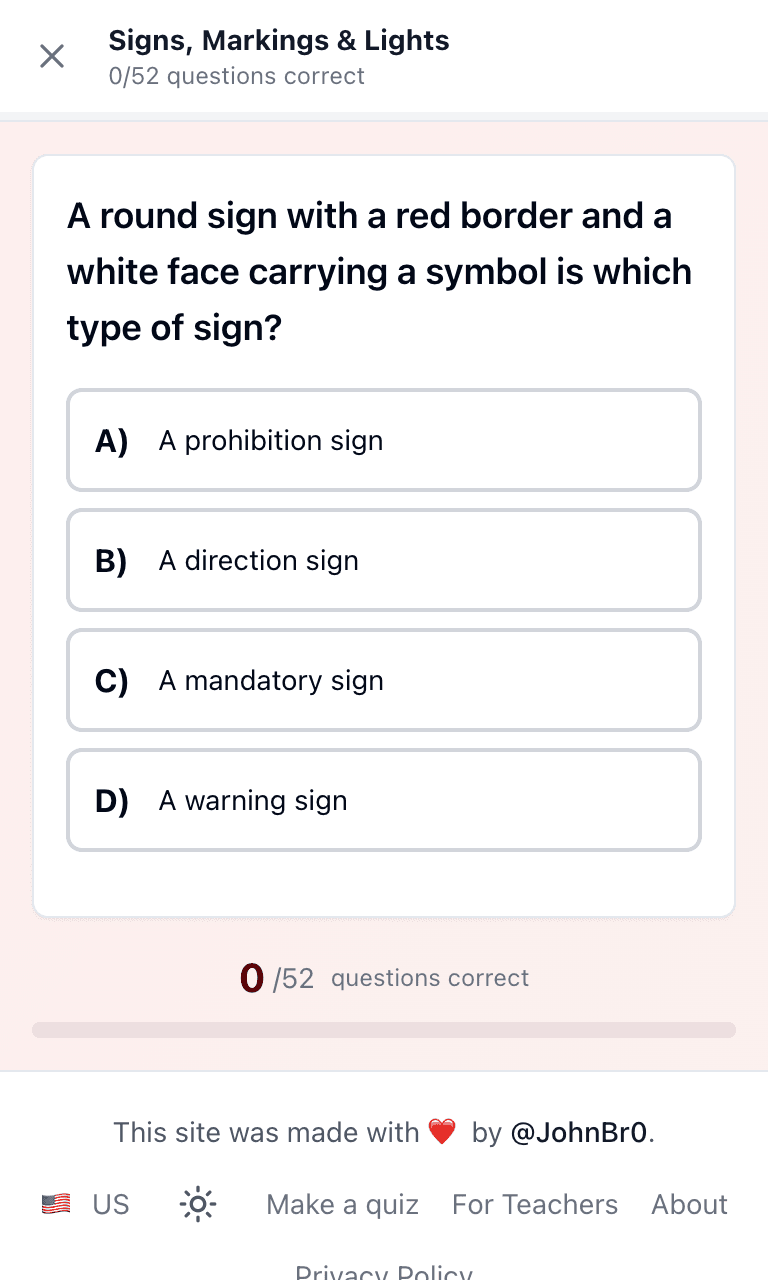
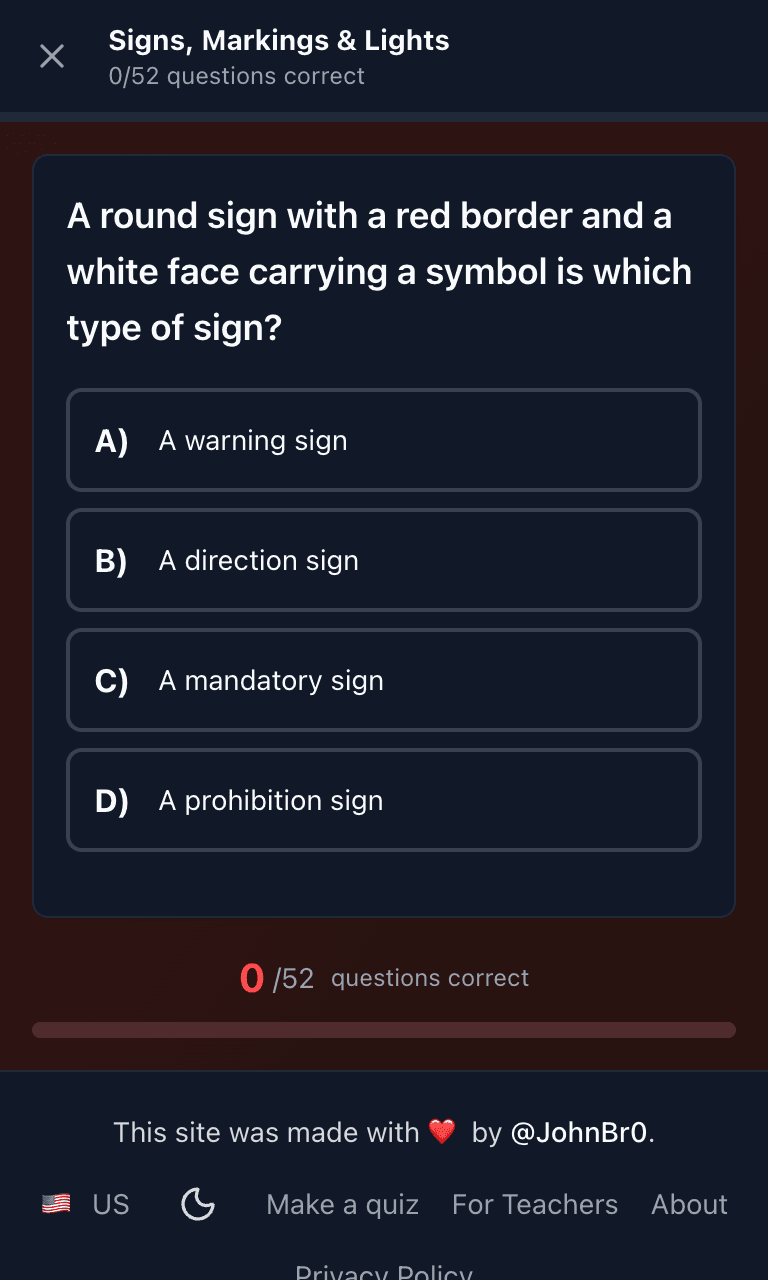
Train on mobile
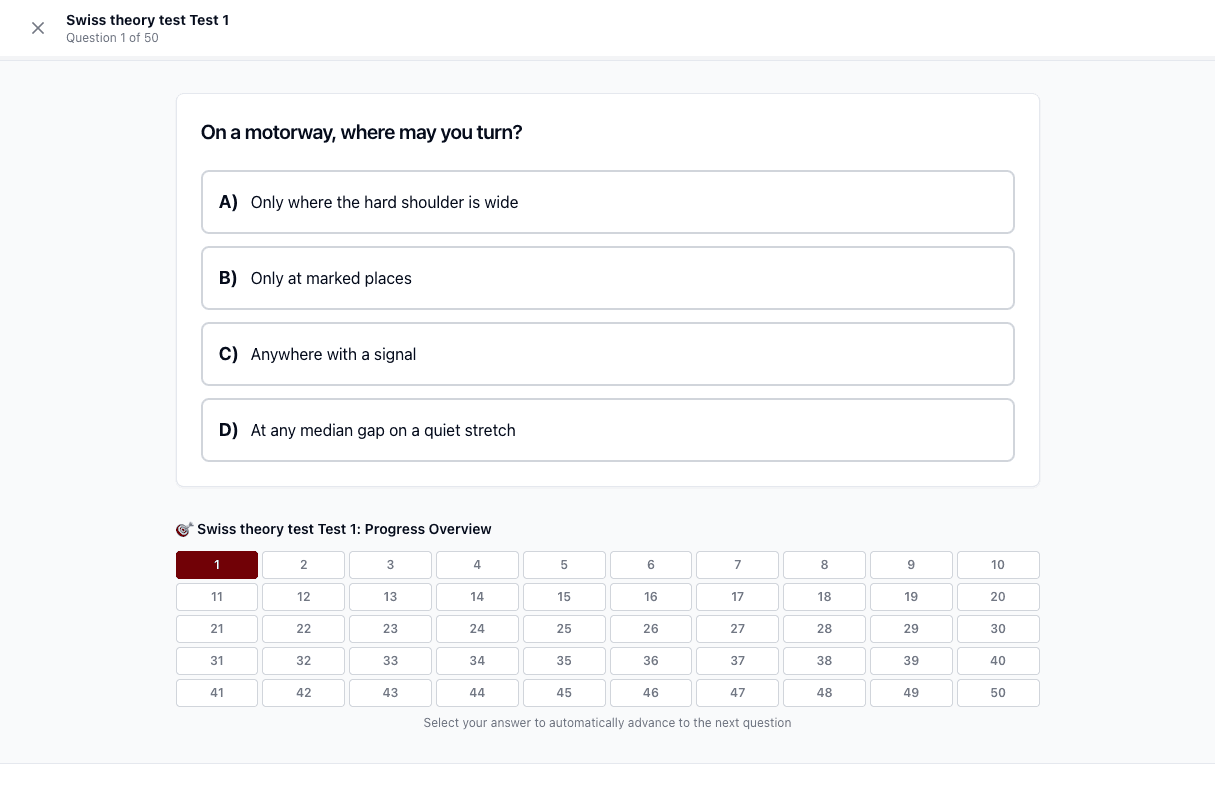
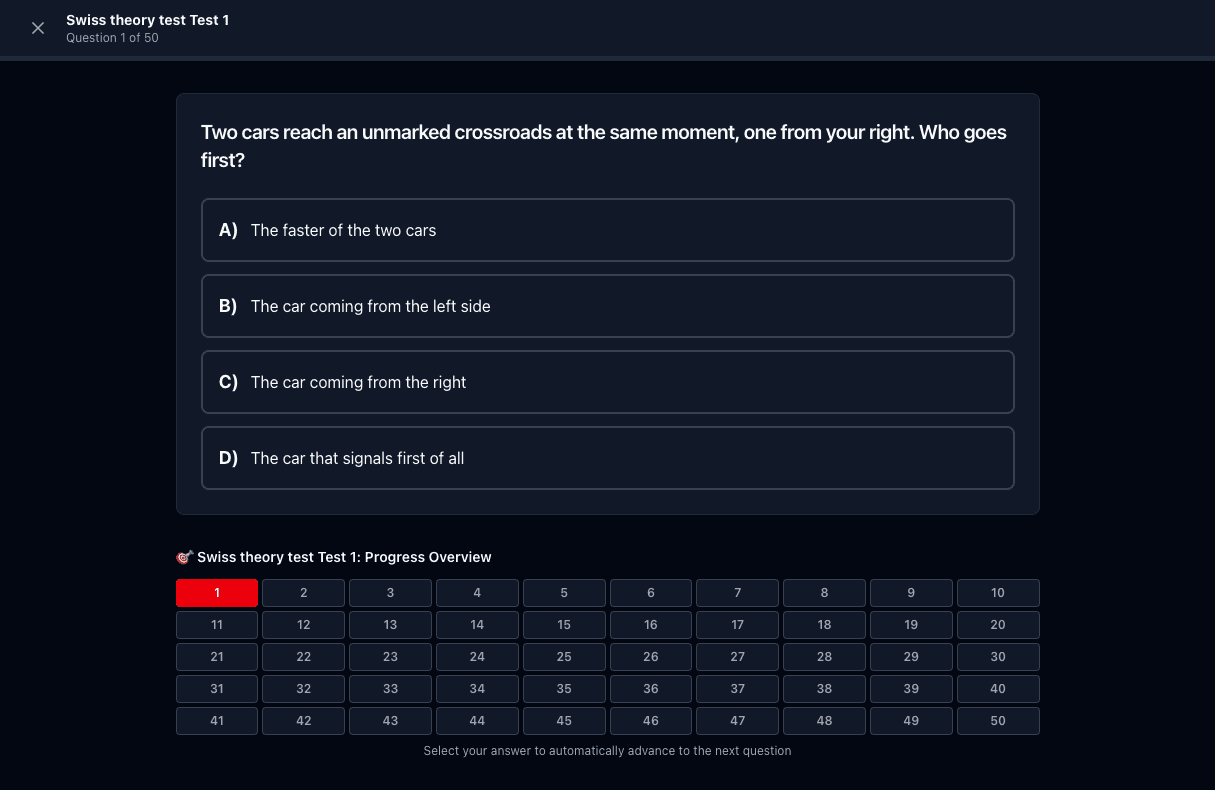
Test on desktop
The Swiss theory test exam at a glance
The Swiss basic theory test (Basis-Theorieprüfung) is the first test for a learner licence in category B (car) and categories A1 and A, taken at your canton's road traffic office. English is offered for this test only, alongside German, French and Italian. As the Aargau office describes it, there are 50 questions on a computer in 45 minutes out of 150 points, and you may collect at most 15 error points; Zurich's page lists 55 questions and 17 errors, the same 10%. Each question scores 1 to 3 error points and some have more than one right answer. If you fail, you can retake it after at least one day.
Tigertest has 200 Swiss theory practice questions with explanations, free to start with no account required.
- Run by
- Cantonal road traffic offices (Strassenverkehrsämter)
- Questions
- About 50, three options, one or two right
- Time
- 45 minutes
- Pass rule
- At most 15 error points of 150 (Zurich lists 17)
- Languages
- German, French, Italian and English
- Who sits it
- First-time learner licence applicants (A1, A, B)
- Tigertest mock tests
- 4 x 50 questions, 45 to pass
- Study material
- SVG, VRV and SSV (federal traffic law)
Updated by the Tigertest team. Practice questions follow the cantonal road traffic office pages of Zurich and Aargau and the Swiss federal road traffic law (SVG, VRV, SSV), checked November 2026. Exam rules change, so confirm current details with Canton of Zurich: Theorieprüfung.
How It Works
Train by Topic
Four training sets cover road signs, markings and junctions, speed, parking and sharing the road, and licences, safety and emergencies. Questions you miss come back until you have mastered them.
Real-Length Mock Tests
Four 50-question tests with 45 to pass, the same length as the real test and the same 10% error limit. No question repeats across tests, and every answer explains the rule and the common wrong pick.
Built on the Swiss Traffic Rules
Every question follows Swiss federal rules: driving on the right, priority to the right at junctions, a yellow diamond for priority roads, speed limits in km/h, and the zero-alcohol rule for learners and probationary drivers. The road traffic offices do not publish how many questions come from each topic, so these per-test counts are Tigertest's, with signs and priority weighted most. Signs are described in words.

Help Make Tigertest Better
Have an idea, a topic you'd like covered, or a question that could be clearer? We read every message and use it to improve every test.
Share FeedbackHow to Pass the Swiss Theory Test
1. Learn signs by shape and colour
Red-bordered triangles warn, red circles forbid, blue circles give orders, the red octagon means stop and the upside-down triangle means give way. Learn the families first and most signs explain themselves.
2. Think priority to the right
Where nothing says otherwise, the vehicle from your right goes first, even if you are on a wider road. A yellow diamond with a white border means you have priority, a roundabout gives priority to vehicles already in the circle, and you give way to oncoming traffic when you turn left. Pedestrians on a crossing and trams come first.
3. Read every option
Your mistakes are limited, so careless reading costs passes. Read the whole question, especially words like "not" and "first", and check each option before you tap. You have 45 minutes for the whole test, so there is no need to rush.
4. Aim above 45
Aim for 47 or more in every mock test. Tigertest tracks your accuracy by topic, so drill the questions you missed, retrain the weakest set, then take all four tests before your test day.
Swiss Driving Theory Test Frequently Asked Questions
What is the Swiss basic theory test like?
It is the first test for a learner licence, taken at your canton's road traffic office. As the Aargau and Zurich road traffic offices describe it, you answer about 50 questions on a computer in 45 minutes out of 150 points, and you may collect at most 15 error points (Zurich's page lists 55 questions and 17 errors, which is the same 10% of the points). Each question can score between 1 and 3 error points, and some have more than one right answer. Tigertest uses four 50-question mock tests with one answer each and 45 to pass.
Can I take the Swiss theory test in English?
Yes, for the basic theory test. The canton of Zurich lists German, French, Italian and English, and says English is offered only for the basic theory test (categories A1, A and B). Other cantons set their own languages and booking, so check with your cantonal road traffic office (Strassenverkehrsamt) before you book.
Who needs to sit the basic theory test?
Anyone applying for a first learner licence in category B (car) or the motorcycle categories. People who already hold a category A1, A, B1 or B licence do not have to take it again, the Aargau office says. After you pass you receive the learner licence, which you need for practical driving lessons.
Which rules does the test use?
Swiss federal traffic law: the Road Traffic Act (SVG), the Traffic Rules Ordinance (VRV) and the Signalling Ordinance (SSV). Traffic drives on the right, vehicles from the right have priority unless a sign says otherwise, and the general limits are 50 km/h in built-up areas, 80 km/h outside them, 100 km/h on expressways and 120 km/h on motorways. A driver counts as unfit through alcohol at 0.5 per mille, and learners and probationary drivers may not drive with alcohol in the blood.
Are these the real test questions?
No. Every question is original, written by Tigertest from the federal traffic rules, so it tests the same knowledge without copying the official question bank that the road traffic offices license. Signs are described in words, so study pictures of the signs too. Tigertest is free practice and is not affiliated with the road traffic offices, and it does not book or replace your test.
Swiss theory test sample questions and answers
6 of the 200 practice questions, one from each topic, with the answer explained.
1. When may hazard warning lights be used while driving?
- A.To show you are driving slowly
- B.To warn of danger, such as a queue
- C.To say thanks to a driver who let you in
- D.To park briefly where stopping is banned
Answer: B. Hazard lights may be used only to warn of dangers, such as an unexpected accident site or tail-back (VRV art. 23 para. 3).
2. A traffic officer's hand signal conflicts with the green light. Which do you follow?
- A.The green light
- B.The traffic light on the cross road
- C.The priority sign
- D.The officer's signal
Answer: D. The Road Traffic Act (SVG art. 27) puts the police's instructions ahead of the general rules, signals and markings, so traffic lights included.
3. At a junction, how are riders and people leading horses treated for priority?
- A.Like vehicle drivers
- B.They must always give way
- C.They always have priority
- D.Like pedestrians on a crossing
Answer: A. Riders and people leading horses or other large animals are treated like vehicle drivers for priority (VRV art. 14 para. 4).
4. When may you stop in a tunnel?
- A.At the lay-bys whenever you like
- B.When traffic is light
- C.Only in an emergency
- D.To check a map
Answer: C. In tunnels you may stop only in emergencies and must stop the engine at once (VRV art. 39 para. 3).
5. There is neither pavement nor footpath along a road, but a cycle path. May pedestrians use it?
- A.Only after it has got dark
- B.Only if they walk in a group
- C.Yes, because no footway exists
- D.No, never at any time of the day
Answer: C. Pedestrians may use cycle paths where a pavement and footpath are missing (VRV art. 40 para. 2).
6. What does a blue square with a white pedestrian and triangle (crossing symbol) tell you?
- A.The location of a pedestrian crossing
- B.Pedestrians are not allowed to cross
- C.A school bus stop in the area
- D.A footbridge across the road
Answer: A. The information sign (4.11) marks where a pedestrian crossing is. Pedestrians who stand on or wait at a crossing must be allowed across (VRV art. 6).
Related practice tests
Every test on Tigertest is free to start, with no account needed.
- German Driving Theory Test (Class B)TÜV / DEKRA test centres · Klasse B theory test, in German
- French Driving Theory Test (Code de la route)French Interior Ministry, approved centres · code de la route (ETG), in French
- Italian Driving Theory Test (Patente B)Motorizzazione civile (Italy) · patente B theory quiz, in Italian
Free practice tests for SwitzerlandSee all 444 practice tests
Ready for Your Theory Test?
Start for free. No account required. 200 questions on Swiss road rules and signs.
Start practicing