
Free Victoria Firearms Safety Practice Test 2026
200 original questions for the Victorian firearm safety course test: the Firearms Act 1996 (Vic), licence categories, permits to acquire, storage, carriage and the ten rules of the Firearm Safety Code. Four 50-question practice tests. Tuned for mobile. Free to start, no account needed.
Try one now
Pick an answer
Under the Firearms Act 1996 (Vic), a bolt action .22 rimfire rifle is a:
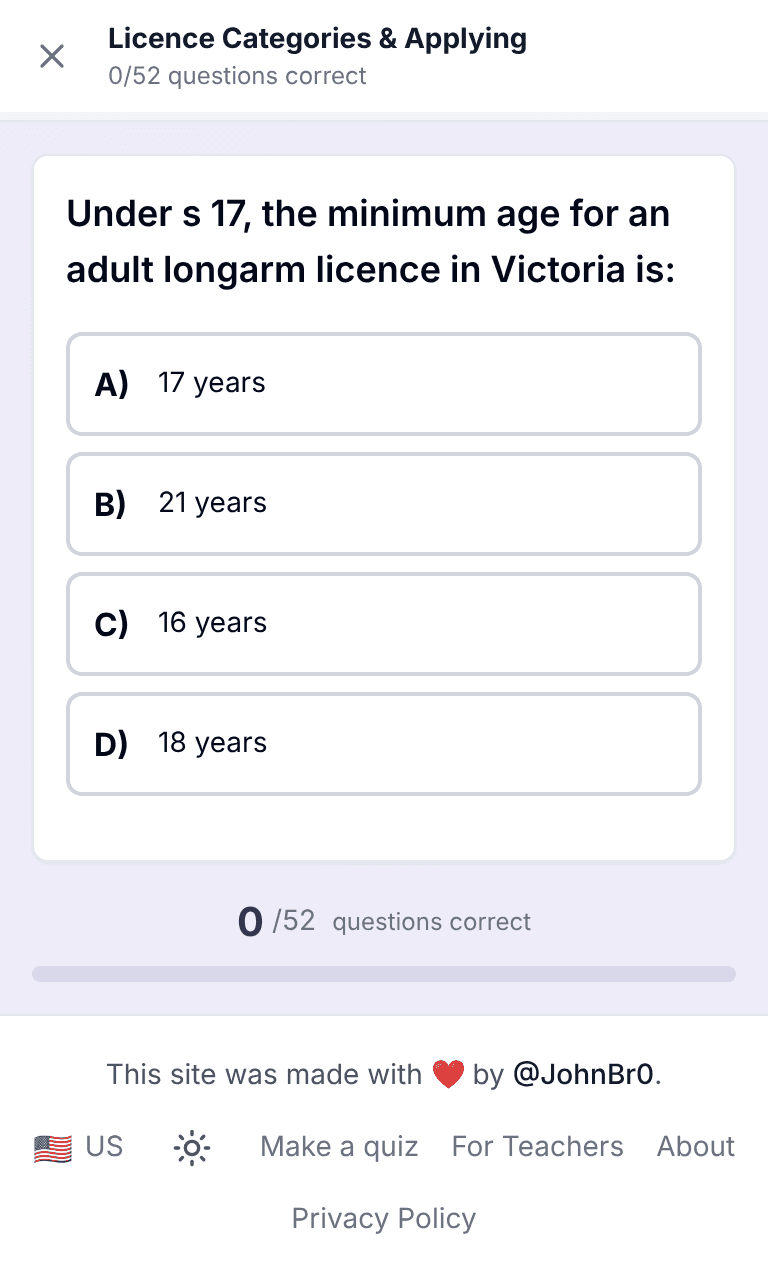
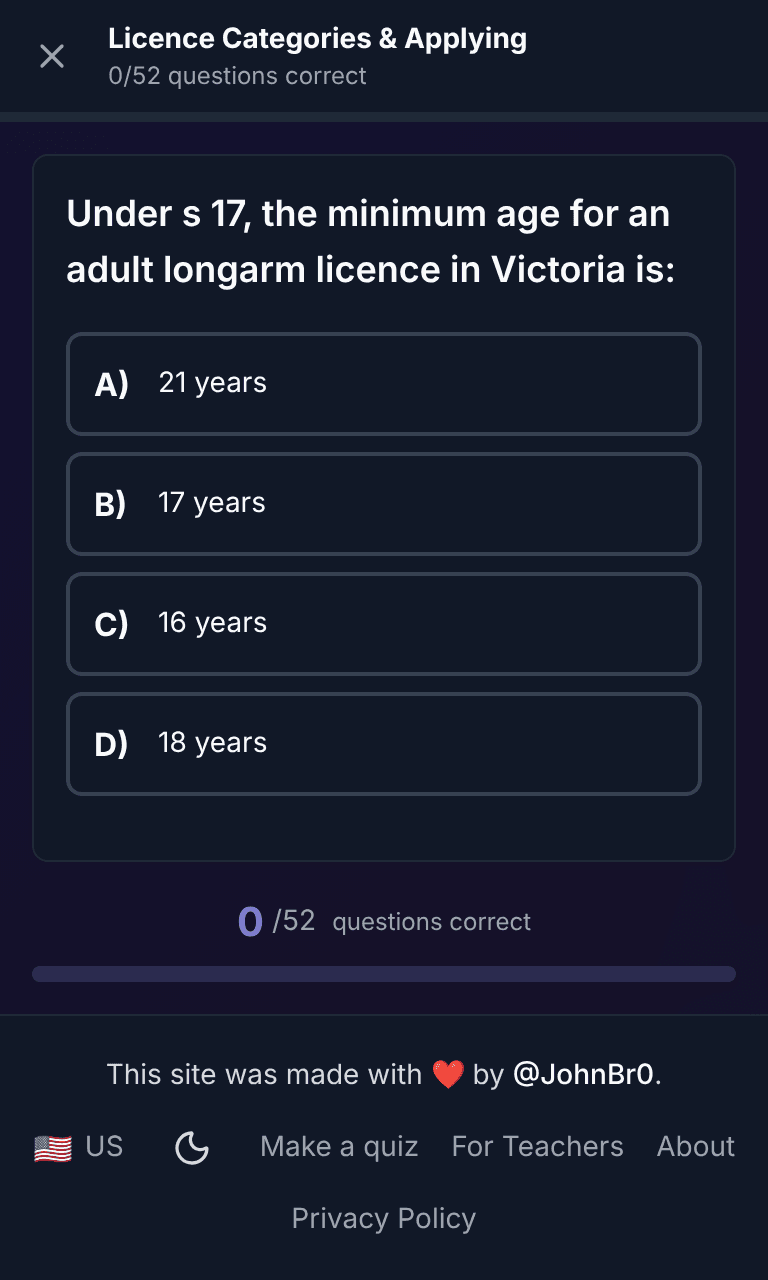
Train on mobile
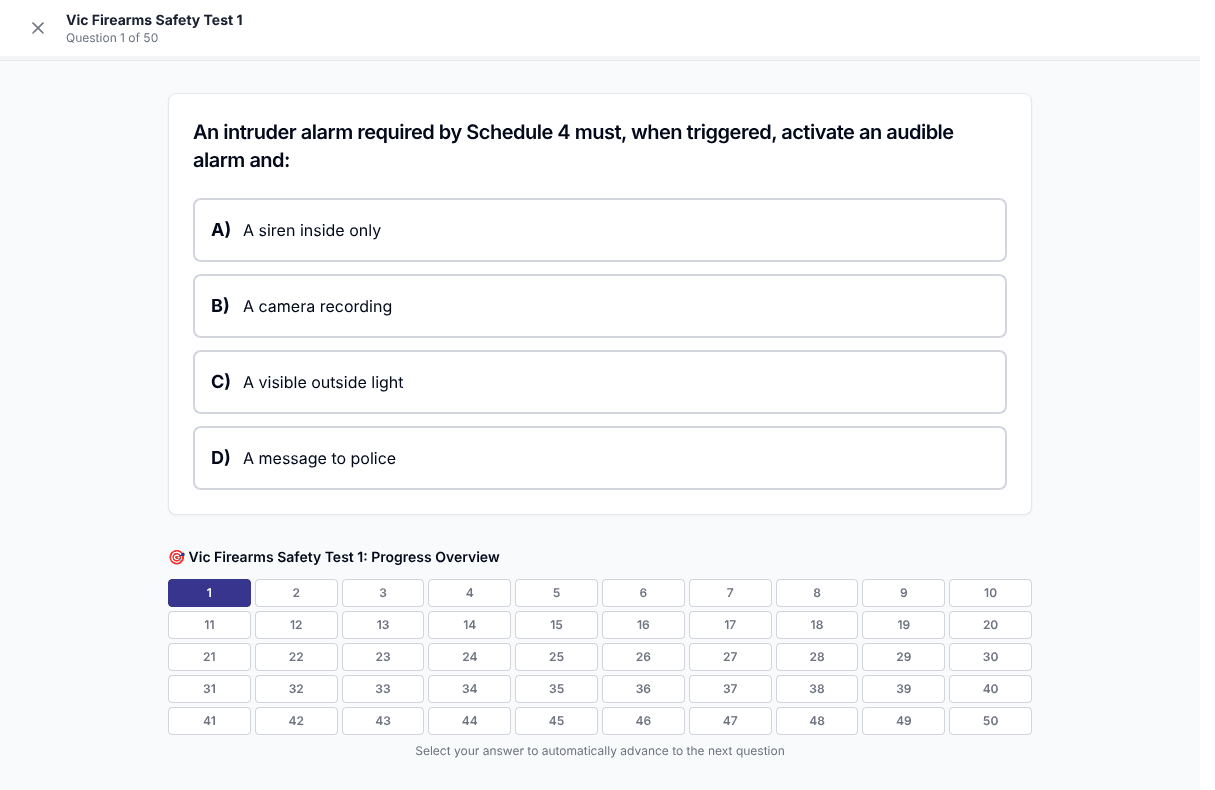
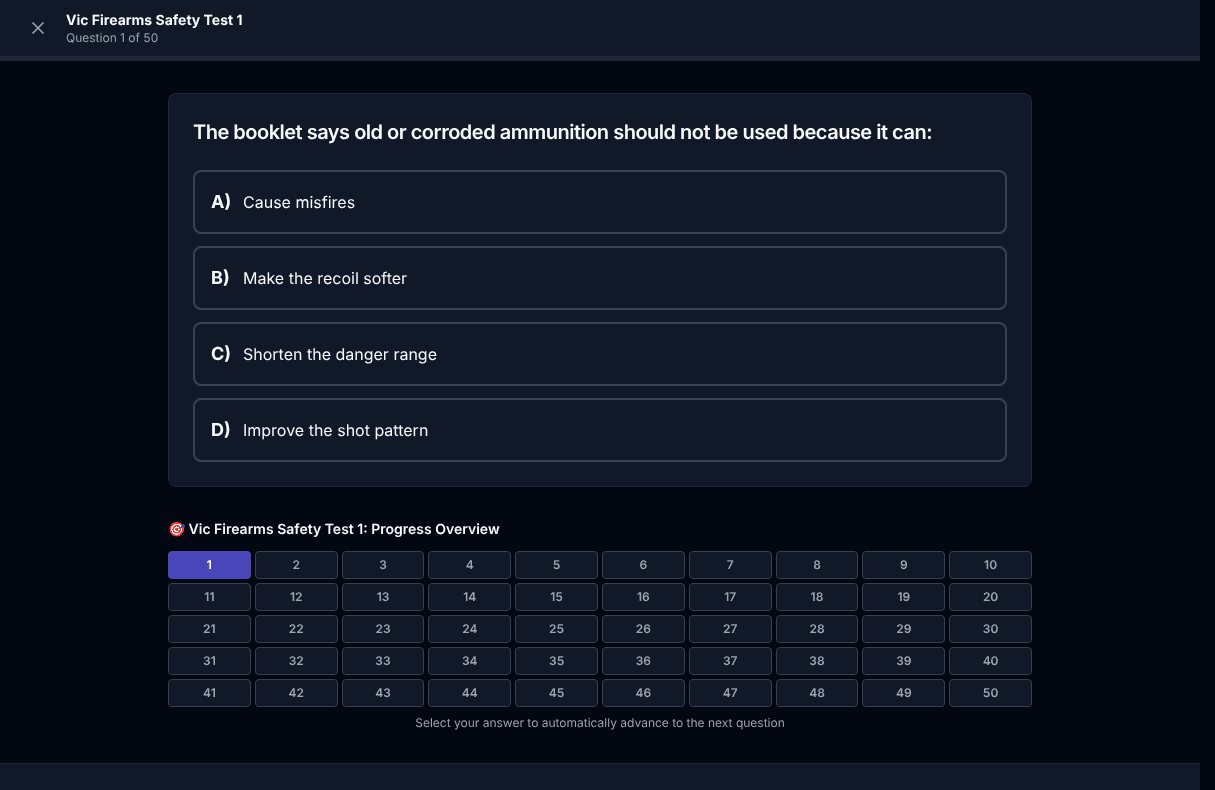
Test on desktop
The Vic Firearms Safety exam at a glance
In Victoria, a firearm licence is not issued unless the applicant has satisfactorily completed an approved course of firearms safety and has a good knowledge of firearms law (Firearms Act 1996, s 17). Victoria Police sets the minimum course requirements and approves independent instructors; the longarm course ends with a short multiple-choice safety and law knowledge test sat in person, and a pass earns a certificate for the licence application. Licences are issued by Victoria Police's Licensing and Regulation Division. An adult applicant must be 18 or over, live or work in Victoria, be a fit and proper person with a genuine reason, and be able to meet the storage rules. A first licence cannot be issued until 28 days after applying.
Tigertest has 200 Vic Firearms Safety practice questions with explanations, free to start with no account required.
- Course
- Approved firearm safety course for the licence type (longarm course for categories A and B and junior licences)
- Assessment
- Short multiple-choice safety and law knowledge test, sat in person
- Licence age
- 18 for an adult licence; 12 to 17 for a junior licence with written parental consent
- Waiting period
- 28 days after applying for a licence
- Licence term
- Up to 5 years for categories A and B; up to 3 years for C, D and E
- Permit to acquire
- Needed for every firearm, valid 28 days
- Licensing body
- Victoria Police Licensing and Regulation Division
Updated by the Tigertest team. Practice questions follow The Firearms Act 1996 (authorised version in force from 19 August 2026) on legislation.vic.gov.au, the Victoria Police eligibility page and the Firearm Safety Code booklet, checked November 2026. Exam rules change, so confirm current details with Victoria Police: eligibility requirements for firearm applications.
How It Works
Train by Topic
Four training sets: licence categories and applying; permits, carriage and the law; storage and the ten safety rules; and the field and firearm basics. Questions you miss come back until you have mastered them.
Mixed Practice Tests
Four practice tests of 50 questions, each mixing Victorian law with safe handling. Aim for 80% or better. No question appears in more than one test, and every one comes with an explanation.
Written from Victorian Law and the Firearm Safety Code
Every legal rule comes from the Firearms Act 1996 as it stands in Victoria from 19 August 2026, including the steel safe standard in Schedule 4. Safe handling, the field and firearm basics follow the Victoria Police Firearm Safety Code booklet and the longarm course material. Other states have their own laws, so check theirs before you travel.

Help Make Tigertest Better
Have an idea, a topic you'd like covered, or a question that could be clearer? We read every message and use it to improve every test.
Share FeedbackHow to Prepare for the Course
1. Learn the safety code by heart
The Victorian Firearm Safety Code has ten basic rules, from treating every firearm as loaded to never climbing fences with a loaded firearm. Learn them in order and what each one means in the field: most of the handling questions come back to them.
2. Know the categories and your licence
Learn which firearms are category A, B, C, D and E, the genuine reasons the Act accepts, how permits to acquire work, and the notices you must give: loss or theft within 24 hours and a change of address within 14 days.
3. Get storage and transport exactly right
Know what a compliant steel safe looks like, why ammunition goes in a separate locked container, and why a loaded firearm in a vehicle on a public road is an offence.
4. Fix your misses, then retest
Tigertest tracks your accuracy by topic. Aim for 80% or better on every practice test before your course. After each test, drill the questions you missed and retrain the weakest topic.
Victoria Firearms Safety Frequently Asked Questions
Do I need a safety course for a Victorian firearm licence?
Yes. Under section 17 of the Firearms Act 1996, the Chief Commissioner must be satisfied that an applicant has satisfactorily completed an approved course of firearms safety and has a good knowledge of firearms law, and section 20 sets the same rule for junior licences. Victoria Police sets the minimum course requirements and approves independent instructors, and the course must suit the licence you apply for.
What is on the Victorian firearm safety test?
Victoria Police says the longarm course ends with a short multiple-choice safety and law knowledge test, sat in person even when the course is online, with photo identification. The course covers the ten rules of the Firearm Safety Code, firearm types and actions, safe handling, and the parts of the Firearms Act you need: licence categories, permits to acquire, storage, carriage and your duties. If you pass, the instructor gives you a certificate to attach to your licence application. Victoria Police does not publish a question count or pass mark in the documents read for this practice test, so the 80 percent line here is a readiness target, not the official standard.
What licence categories are there in Victoria?
Category A covers airguns, rimfire rifles that are not semi-automatic and shotguns that are not lever, pump or semi-automatic. Category B covers muzzle loaders, centre fire rifles that are not semi-automatic, and lever action shotguns of up to 5 rounds. Category C covers semi-automatic rimfire rifles of up to 10 rounds and semi-automatic or pump shotguns of up to 5 rounds, and is limited to reasons such as primary production and clay target shooting. Categories D and E are restricted further. A junior licence lets 12 to 17 year olds shoot under immediate supervision.
How must firearms be stored in Victoria?
Schedule 4 of the Firearms Act says category A and B longarms must be kept in a purpose-built steel receptacle of at least 1.6 mm steel to AS/NZS 1594, bolted to the building if it weighs less than 150 kg empty and locked with a sturdy lock. Ammunition goes in a separate locked container. More than 15 firearms on the premises need an intruder alarm, and for category C and D firearms the safe key must be carried by you or kept securely in another room.
Are these the real test questions?
No. Every question is original, written by Tigertest from the Firearms Act 1996 (Vic), the Victoria Police Firearm Safety Code booklet and the longarm course material. Tigertest is not affiliated with Victoria Police, its Licensing and Regulation Division or any firearm safety course provider.
Vic Firearms Safety sample questions and answers
6 of the 200 practice questions, one from each topic, with the answer explained.
1. Under s 126(4), anyone carrying cartridge ammunition must make sure it is carried:
- A.Well apart from any firearm
- B.Securely and not dangerously
- C.In its original packet
- D.In a locked metal tin
Answer: B. Section 126(4) requires ammunition being carried or used to be handled in a secure, not dangerous way, with reasonable precautions so that it is not lost or stolen.
2. You change your rifle's calibre in a way the maker never provided for. You must notify the Chief Commissioner within:
- A.24 hours
- B.14 days
- C.28 days
- D.7 days
Answer: D. Section 134B requires notice of a calibre alteration not provided for in the original manufacture within 7 days of making it.
3. Before even a short local hunting trip, the instructors manual says you should:
- A.Tell someone your plans
- B.Clean and oil the barrel
- C.Re-zero your rifle at a range
- D.Charge your spotlight
Answer: A. The manual says to tell somebody where you are going and when you expect to return, even if it is only a short trip locally.
4. According to Victoria Police, a person prohibited because of criminal offending may stay prohibited for up to:
- A.10 years after the offence
- B.2 years after the court case
- C.15 years after prison
- D.5 years after prison
Answer: C. Victoria Police says prohibition for criminal offending can last from 12 months after a finding of guilt up to 15 years after serving a term of imprisonment, as set out in s 3.
5. The booklet's glossary says a pistol grip stock is not permitted on:
- A.A break-open shotgun
- B.A lever action rifle
- C.A sporting semi-auto
- D.A bolt action rifle
Answer: C. The glossary says a pistol grip is a stock type often fitted to military-type firearms and is not permitted on a sporting semi-automatic firearm.
6. A South Australian with an interstate permit to acquire buys a rifle in Victoria. The permit must have been issued no more than:
- A.28 days before
- B.7 days before
- C.90 days before
- D.6 months before
Answer: A. Section 102(5) exempts an interstate permit holder from needing a Victorian permit if the interstate permit was issued not more than 28 days before and the buyer attends the dealer's premises in person.
Related practice tests
Every test on Tigertest is free to start, with no account needed.
- QLD Firearms Safety Practice TestQueensland Police Service Weapons Licensing · approved firearms safety course (11029NAT)
- NSW Firearms Safety Practice TestNSW Police Force Firearms Registry · firearms safety course for a first licence (Firearms Act 1996)
- WA Firearm Safety Training Practice TestWestern Australia Police Force · Firearm Safety Training Course for a first firearm authority (Firearms Act 2024)
Ready for Your Firearms Safety Course?
Start for free. No account required. 200 questions on Victorian firearms law and safe firearm handling.
Start practicing