
Free AFOQT Practice Test 2026
250 original questions across eight Air Force Officer Qualifying Test subtests, at the real pace. Free to start, no account needed.
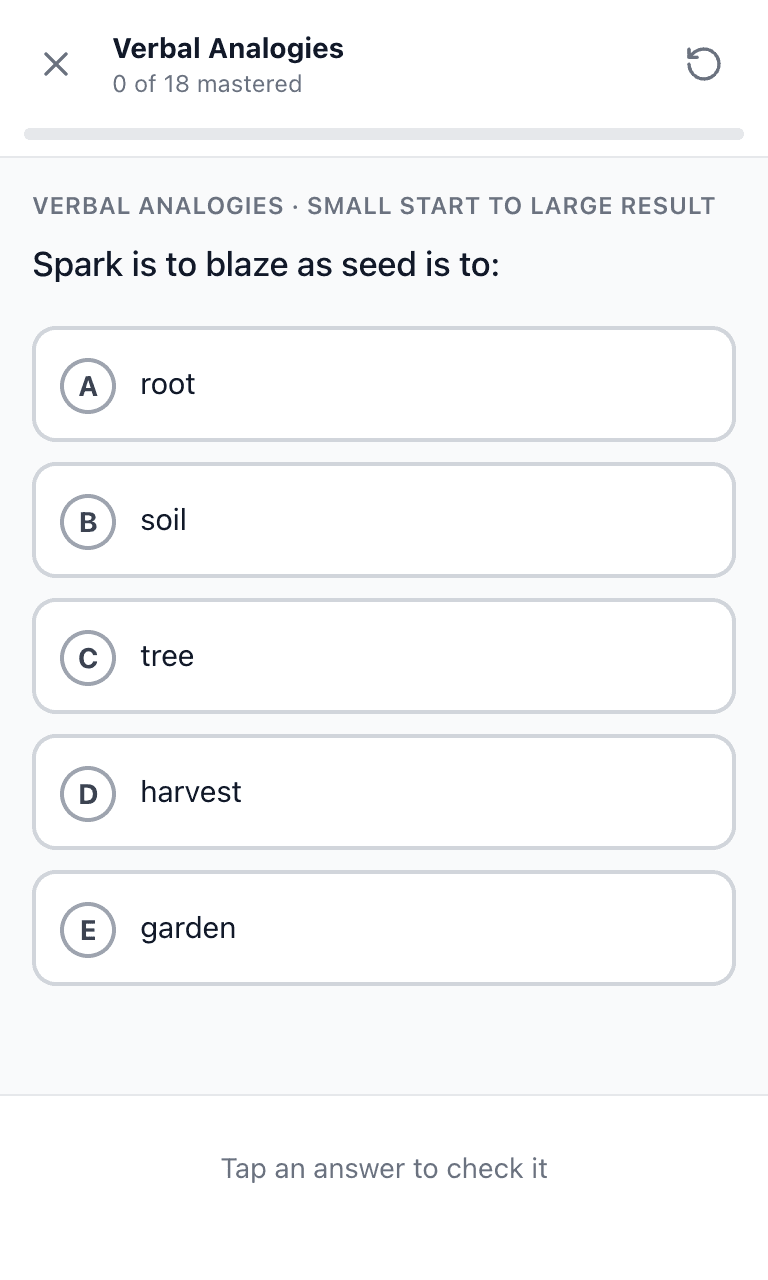
Train on mobile
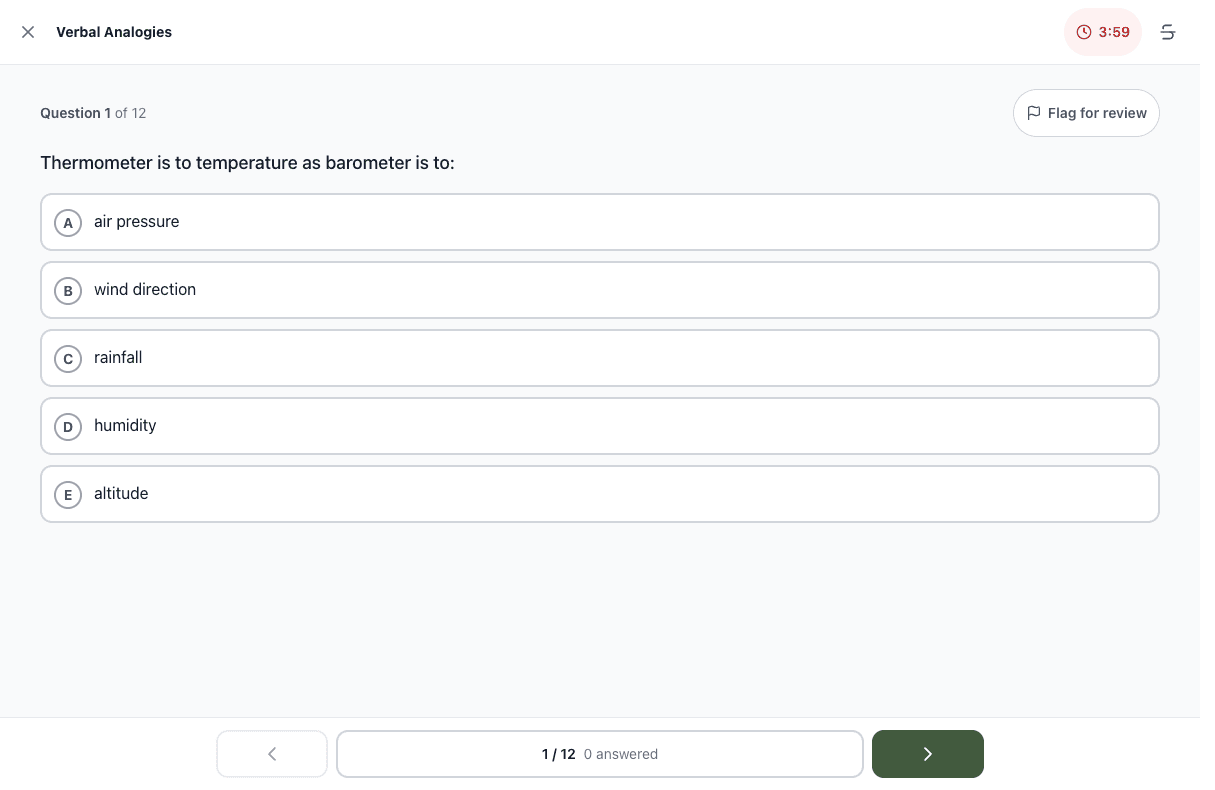
Test on desktop
The AFOQT exam at a glance
The AFOQT (Air Force Officer Qualifying Test) is the Air Force's aptitude test for officer commissioning programs such as Officer Training School and Air Force ROTC, and for selection into training such as pilot and navigator training. Form T has 12 timed multiple-choice subtests, 516 questions in about five hours with breaks: Verbal Analogies, Arithmetic Reasoning, Word Knowledge, Math Knowledge, Reading Comprehension, Situational Judgment, the ungraded Self-Description Inventory, Physical Science, Table Reading, Instrument Comprehension, Block Counting and Aviation Information. Subtests combine into composites reported as 1 to 99 percentiles, not percent correct. Air Force ROTC, citing DAFMAN 36-2664, gives the minimums as the 15th percentile on Verbal and the 10th on Quantitative; rated programs set higher bars. It is free, taken with a voucher from a recruiter or test control officer, and limited to two attempts (three with a waiver).
Tigertest has two AFOQT practice tests with eight subtests at about half length and the real pace, and a drill for each subtest. Start for free, no account required; the last two drills and Practice Test 2 are part of Premium. Situational Judgment, Instrument Comprehension, Block Counting and the Self-Description Inventory are not included, and scores are percent correct, not AFOQT percentiles.
- Questions
- 516 multiple choice across 12 subtests (Form T)
- Time
- About 5 hours including breaks
- Scores
- 1 to 99 percentiles on composites
- Minimums
- Verbal 15 and Quantitative 10 (AFROTC, citing DAFMAN 36-2664)
- Attempts
- Two, or three with an approved waiver
- Cost
- Free, voucher from a recruiter or test control officer
- Given by
- U.S. Air Force, delivered by Pearson VUE
Updated by the Tigertest team. Practice questions follow The Air Force's AFOQT page at Pearson VUE and AFROTC Detachment 485's AFOQT page (checked November 2026). Exam rules change, so confirm current details with Pearson VUE (U.S. Air Force).
How It Works
A Drill for Every Subtest
Eight drills, one per subtest. Arithmetic Reasoning and Math Knowledge open with short lessons on the basics, such as setting up word problems and solving for x. Questions you miss come back until you have mastered them.
Practice Tests
Two practice tests of eight subtests in the Form T order, each on its own clock at the real time per question, with the 15-minute break after Reading Comprehension. You see percent correct on every subtest. Practice Test 2 is held out of the drills, so it measures readiness.
Built on AFOQT Form T
Each practice test has the eight Form T subtests that can be written as text, at about half the real length and the same time per question. The AFOQT's pace varies a lot: Word Knowledge and Table Reading give you seconds a question, while Arithmetic Reasoning gives you more than a minute. Situational Judgment, Instrument Comprehension and Block Counting are not included.

We Just Launched
Have an idea, a topic you'd like covered, or a question that could be clearer? We read every message and use it to improve every test.
Share FeedbackHow to Prepare for the AFOQT
1. Know the composites you need
Every officer applicant needs the Verbal and Quantitative minimums, but pilot, combat systems officer and air battle manager applicants are also judged on their own rated composites, with higher bars. Ask your recruiter or detachment which composites matter for the job you want, and spend your time there.
2. Rebuild your math without a calculator
Arithmetic Reasoning and Math Knowledge are done by hand. Refresh fractions, percents, ratios, rate and time, solving equations, exponents and basic geometry until you can set up a word problem in a few seconds.
3. Train speed on the fast subtests
Word Knowledge and Table Reading leave you only seconds a question. Read widely to grow your vocabulary, name the relationship before you look at an analogy's choices, and drill Table Reading until finding a row and column is automatic.
4. Learn how airplanes fly
Aviation Information and Physical Science reward plain physics: the four forces, the three axes and the controls that move the aircraft about them, lift and drag, Newton's laws, work, energy and simple machines. Then take a full practice test and drill the subtest that costs you the most.
AFOQT Frequently Asked Questions
What is on the AFOQT?
The AFOQT (Form T) has 12 timed multiple-choice subtests, 516 questions in about five hours with breaks: Verbal Analogies, Arithmetic Reasoning, Word Knowledge, Math Knowledge, Reading Comprehension, Situational Judgment, the Self-Description Inventory (a personality survey that is not graded), Physical Science, Table Reading, Instrument Comprehension, Block Counting and Aviation Information. Every question must be answered to receive results.
How is the AFOQT scored?
Subtest scores are combined into composites, and each composite is reported as a percentile from 1 to 99 against other test takers, not as percent correct. The Air Force's result areas are Verbal, Quantitative, Academic Aptitude, Pilot, Combat Systems Officer and Air Battle Manager. Air Force ROTC, citing DAFMAN 36-2664, gives the minimums as the 15th percentile on Verbal and the 10th on Quantitative; pilot, CSO and ABM applicants need more. Tigertest shows percent correct for each subtest and never estimates an AFOQT percentile.
How many times can I take the AFOQT?
The Air Force limits the AFOQT to two attempts, or three with an approved waiver. Air Force ROTC cadets get up to three attempts, at least 90 days apart, and the best composite across attempts becomes the score of record. The test is free; you get a voucher from a recruiter or test control officer and schedule it with Pearson VUE.
Which AFOQT subtests are in this practice test?
Eight: Verbal Analogies, Arithmetic Reasoning, Word Knowledge, Math Knowledge, Reading Comprehension, Physical Science, Table Reading and Aviation Information, in the Form T order, at about half the real length and the real time per question, with five answer choices. Situational Judgment, Instrument Comprehension and Block Counting are not included (they rely on keyed judgment scenarios or on pictures of instruments and block stacks), and neither is the ungraded Self-Description Inventory. Every question is original, not taken from an Air Force pamphlet or a past test.
Is the Tigertest AFOQT practice test free?
It is free to start, with no account required. Practice Test 1 and six of the eight drills are free; the Table Reading and Aviation Information drills and Practice Test 2 are part of Tigertest Premium, one payment with no subscription. Create a free account if you want your progress saved across your phone and computer.
I teach AFOQT prep. Can my students use Tigertest?
Yes, for free. Make a class at tigertest.io/teach, post one link, and students join with just their name. You see who practiced, their test scores and the topics your class misses most.
AFOQT sample questions and answers
6 of the 250 practice questions, one from each topic, with the answer explained.
- 1.
Minute is to hour as ounce is to:
- A.
gram
- B.
pound
- C.
yard
- D.
inch
- E.
weight
Answer: B.Minutes make up an hour, and ounces make up a pound in the same system. A gram is a metric unit, and an inch and a yard measure length.
- A.
- 2.
One pump can fill a tank in 6 hours and a second pump can fill it in 3 hours. How long do the two pumps take working together?
- A.
1.5 hours
- B.
2 hours
- C.
3 hours
- D.
4.5 hours
- E.
9 hours
Answer: B.Together they fill 1/6 + 1/3 = 1/2 of the tank an hour, so the whole tank takes 2 hours. Averaging the two times gives 4.5 hours, which is slower than the faster pump alone.
- A.
- 3.
VERBOSE most nearly means:
- A.
active
- B.
wordy
- C.
silent
- D.
honest
- E.
angry
Answer: B.Verbose writing or speech uses more words than it needs; the root verb means word. Silent is the opposite.
- A.
- 4.
What is the supplement of a 68 degree angle?
- A.
22 degrees
- B.
68 degrees
- C.
112 degrees
- D.
122 degrees
- E.
292 degrees
Answer: C.Supplementary angles add to 180 degrees, so 180 - 68 = 112. 22 degrees is the complement, which adds to 90.
- A.
- 5.
A block has a mass of 200 grams and a volume of 50 cubic centimeters. What is its density?
- A.
0.25 g/cm³
- B.
4 g/cm³
- C.
150 g/cm³
- D.
250 g/cm³
- E.
10,000 g/cm³
Answer: B.Density is mass over volume: 200 / 50 = 4 grams per cubic centimeter. 0.25 divides the other way.
- A.
- 6.
A glider with a lift-to-drag ratio of 10 starts 6,000 feet above flat ground in still air. About how far can it glide?
- A.
600 feet
- B.
6,000 feet
- C.
10,000 feet
- D.
60,000 feet
- E.
600,000 feet
Answer: D.Glide distance is height times the lift-to-drag ratio: 6,000 x 10 = 60,000 feet. Dividing gives 600.
- A.
Related practice tests
Every test on Tigertest is free to start, with no account needed.
- GED Practice TestHigh school equivalency · RLA, Math, Science, Social Studies
- HiSET Practice TestPSI · high school equivalency, five subtests
- TABE Practice TestData Recognition Corporation (DRC) · TABE 13&14, Level D
- Praxis Core Practice TestETS · Reading 5713, Writing 5723, Math 5733
- SAT Practice TestDigital SAT · Reading and Writing, Math
- PSAT Practice TestDigital PSAT/NMSQT and PSAT 10 · Reading and Writing, Math
Ready to Take On the AFOQT?
Start for free. No account required. 250 questions across eight subtests.
Start practicing