
Free MLT(ASCP) Practice Test 2026
200 original medical laboratory technician questions on the ASCP BOC content guideline: blood banking, urinalysis, chemistry, hematology, immunology, microbiology and lab operations. Four 50-question practice tests. Tuned for mobile. Free to start, no account needed.
Try one now
Pick an answer
A female allogeneic whole blood donor has a fingerstick hemoglobin of 12.1 g/dL. Under FDA rules she is:
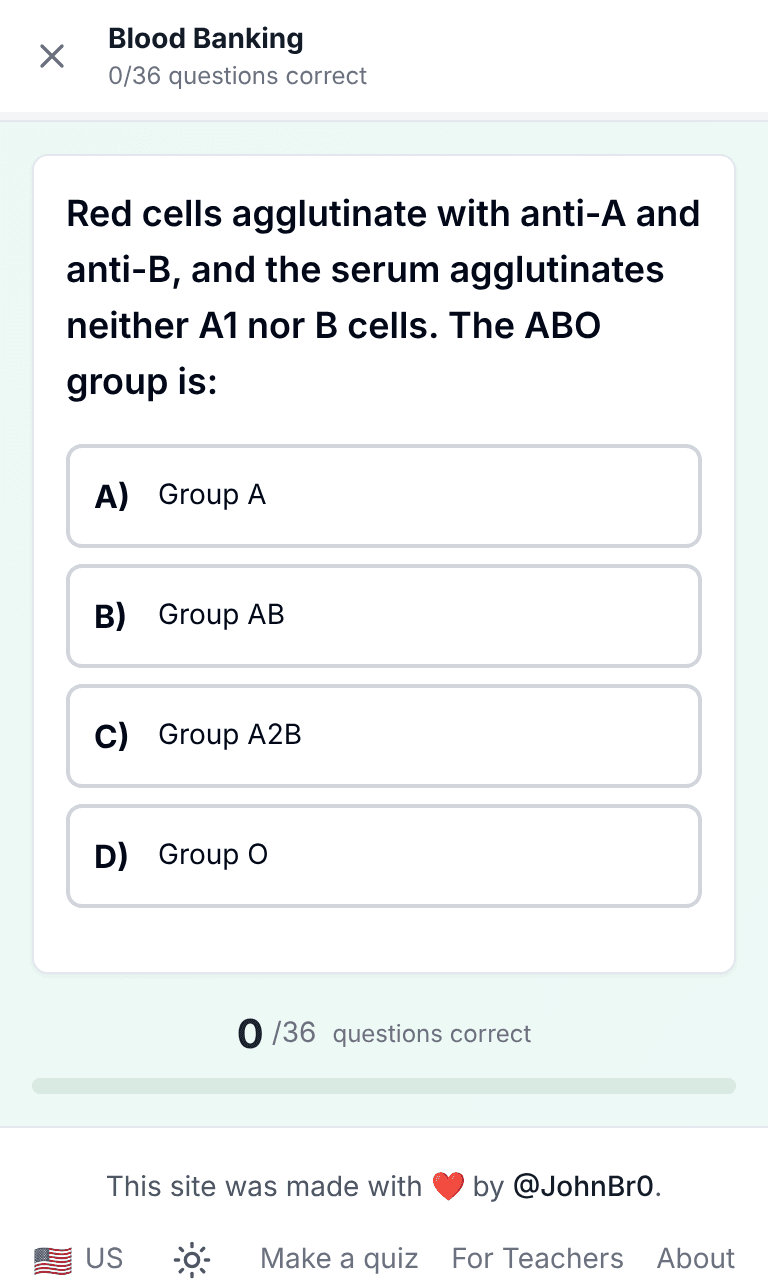
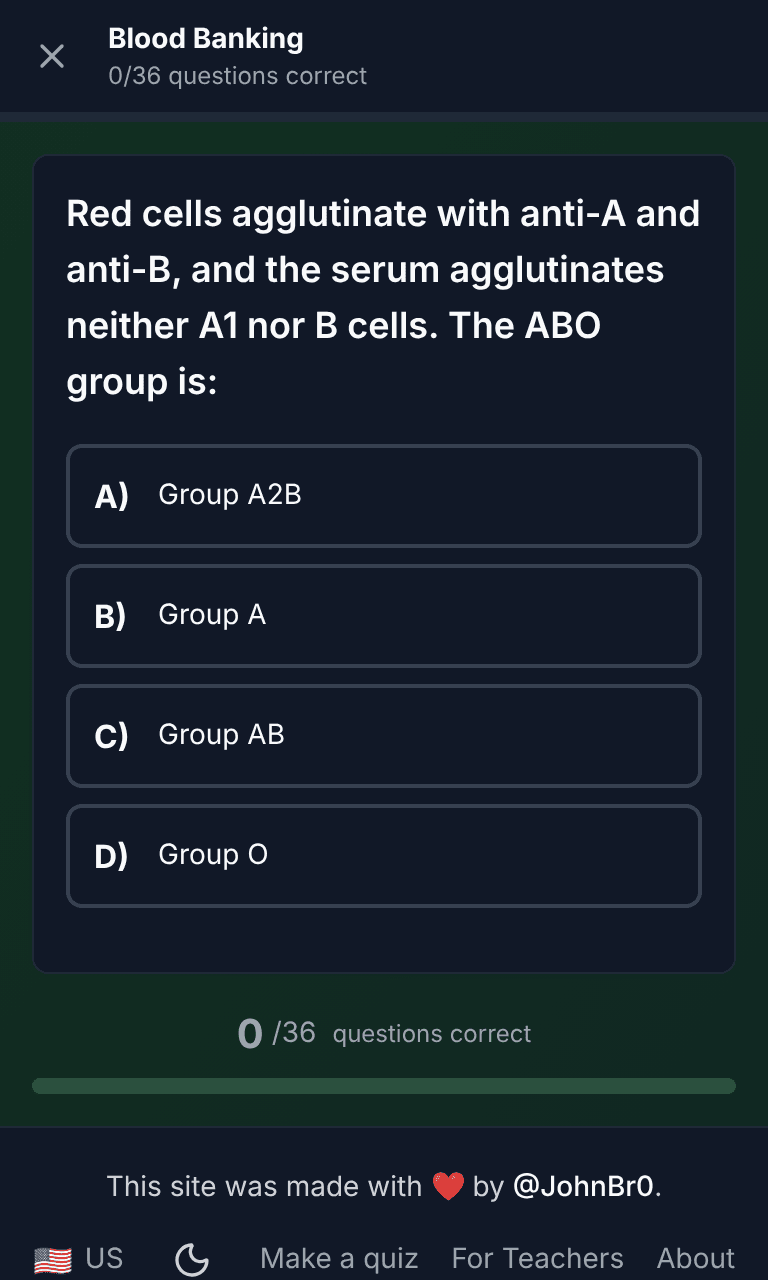
Train on mobile
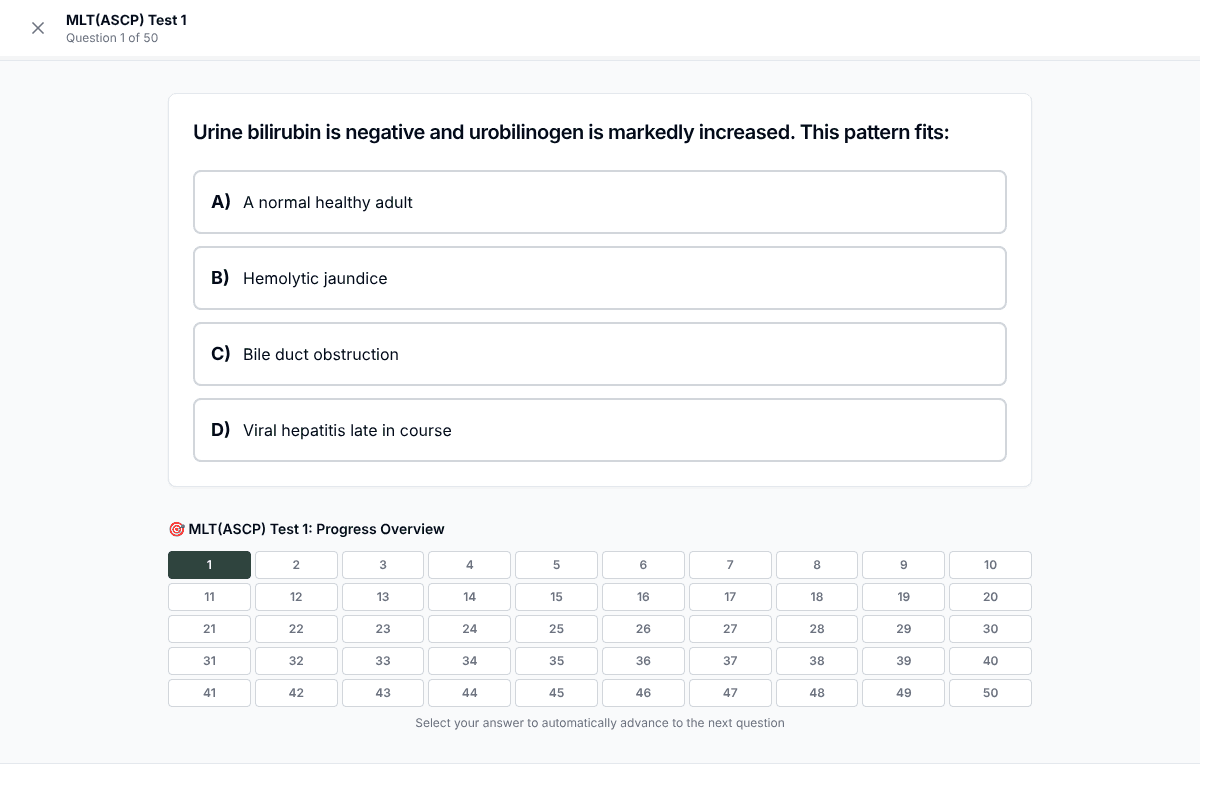
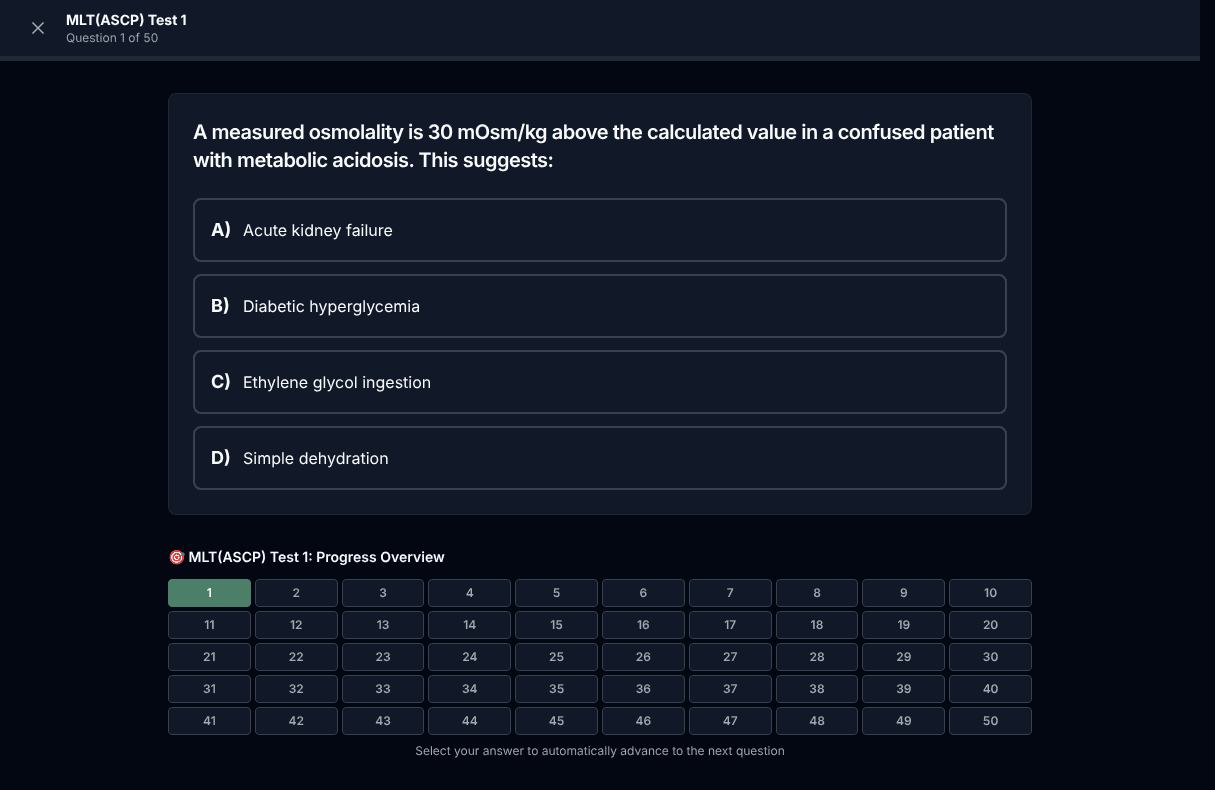
Test on desktop
The MLT(ASCP) exam at a glance
The MLT(ASCP) exam is the medical laboratory technician certification exam of the American Society for Clinical Pathology Board of Certification (ASCP BOC), which earns the MLT(ASCP) credential (MLT(ASCPi) internationally). The BOC content guideline (revised September 25, 2025) gives 100 multiple-choice questions with one best answer in 2 hours 30 minutes, delivered as computer adaptive testing. Content areas are Chemistry 20 to 25%, Hematology 20 to 25%, Blood Banking 15 to 20%, Microbiology 15 to 20%, and Urinalysis and Other Body Fluids, Immunology and Laboratory Operations 5 to 10% each. Regulatory questions are based on U.S. sources. The BOC reports a scaled score from 100 to 999, with 400 to pass.
Tigertest has 200 MLT(ASCP) practice questions with explanations, free to start with no account required.
- Questions
- 100 multiple choice, one best answer
- Time
- 2 hours 30 minutes
- Format
- Computer adaptive testing (CAT)
- Largest areas
- Chemistry and Hematology, 20 to 25% each
- Pass mark
- Scaled score of 400 on a 100 to 999 scale
- Run by
- ASCP Board of Certification (BOC)
Updated by the Tigertest team. Practice questions follow The ASCP BOC Medical Laboratory Technician MLT(ASCP) and MLT(ASCPi) Examination Content Guideline (revised September 25, 2025), checked November 2026. Exam rules change, so confirm current details with ASCP BOC: MLT(ASCP) Examination Content Guideline.
How It Works
Train by Content Area
Four training sets follow the ASCP BOC content guideline: blood banking; urinalysis and chemistry; hematology and hemostasis; and immunology, microbiology and laboratory operations. Questions you miss come back until you have mastered them.
Weighted Practice Tests
Four fixed practice tests of 50 questions, each weighted like the content areas of the real exam. The real exam is computer adaptive; these are not. Aim for 70% or better. No question appears in more than one test, and every one comes with an explanation.
Built on the ASCP BOC Content Guideline
The BOC publishes a percentage range for each content area of its 100-question exam, and every practice test here stays inside those ranges, scaled to 50 questions: 11 each on chemistry and hematology, 9 on blood banking, 8 on microbiology, 4 each on urinalysis and immunology, and 3 on laboratory operations. MLT program instructors can set Tigertest as board review at tigertest.io/teach and see which topics the class misses most.

Help Make Tigertest Better
Have an idea, a topic you'd like covered, or a question that could be clearer? We read every message and use it to improve every test.
Share FeedbackHow to Pass the MLT(ASCP) Exam
1. Put chemistry and hematology first
Together they are up to half the exam. Know the methods and interferences behind glucose, lipids, enzymes, electrolytes and blood gases, and in hematology the anemias, leukemias, red cell indices and smear findings, plus PT, APTT and mixing studies.
2. Learn blood bank workups
Blood banking is 15 to 20% of the exam. Review ABO and Rh typing discrepancies, antibody identification, enzyme and DTT effects, component storage and donor rules, and the steps of a transfusion reaction investigation.
3. Practice the calculations
The BOC lists the calculations to know: transferrin saturation, indirect bilirubin, Friedewald LDL and non-HDL, A/G ratio, timed urine, creatinine clearance, Beer's law, corrected WBC counts, hemocytometer counts, red cell indices and absolute counts. Work each one until it is quick.
4. Fix your misses, then retest
Tigertest tracks your accuracy by category. Aim for 70% or better on every practice test before your exam date. After each test, drill the questions you missed and retrain the weakest category.
MLT(ASCP) Exam Frequently Asked Questions
What is the MLT(ASCP) exam?
It is the medical laboratory technician certification exam of the American Society for Clinical Pathology Board of Certification (ASCP BOC). Passing it earns the MLT(ASCP) credential, or MLT(ASCPi) for the international version. Many candidates take it after an associate degree MLT program.
How many questions are on the MLT(ASCP) exam?
The BOC content guideline says the exam has 100 multiple-choice questions with one best answer, given in 2 hours 30 minutes. It is computer adaptive, so the questions each candidate sees depend on earlier answers. Tigertest models it as four fixed 50-question practice tests.
What score do you need to pass the MLT(ASCP) exam?
The ASCP BOC reports a scaled score rather than a percent correct, on a scale from 100 to 999 with 400 to pass. The 70 percent line on these practice tests is a readiness target, not the official standard.
What is on the MLT(ASCP) exam?
Chemistry and hematology are the largest content areas at 20 to 25 percent each, and blood banking and microbiology are 15 to 20 percent each. Urinalysis and other body fluids, immunology and laboratory operations are 5 to 10 percent each. The guideline also lists the calculations to know, such as creatinine clearance, red cell indices and the Friedewald LDL. Each practice test here keeps that balance.
Are these the real MLT(ASCP) exam questions?
No. Every question is original, written by Tigertest from the ASCP BOC content guideline and from public rules such as the FDA blood donor and blood product regulations and the CLIA laboratory rules. It covers the same knowledge without copying the exam. Tigertest is not affiliated with the American Society for Clinical Pathology.
I teach an MLT program. Can my students use Tigertest?
Yes, for free. Make a class at tigertest.io/teach, post one link, and students join with just their name. You see who practiced, their test scores and the topics your class misses most.
MLT(ASCP) sample questions and answers
6 of the 200 practice questions, one from each topic, with the answer explained.
1. What is the minimum hemoglobin for an autologous donor under FDA rules?
- A.10.0 g/dL
- B.11.0 g/dL
- C.12.5 g/dL
- D.13.0 g/dL
Answer: B. 21 CFR 630.10 sets 11.0 g/dL (or a hematocrit of 33%) for autologous donors. Allogeneic donors need 12.5 g/dL (female) or 13.0 g/dL (male).
2. In a solid-phase red cell adherence antibody screen, a positive reaction appears as:
- A.A tight button of cells
- B.Cells held at the top of a gel
- C.Clear fluid with no cells
- D.Cells spread across the well
Answer: D. In solid phase, antibody binds indicator cells to the well, so they coat the bottom. A negative test leaves a button at the center.
3. Pregnancy immunoassays target which part of hCG so that LH does not cross-react?
- A.The beta subunit
- B.The alpha subunit
- C.The carbohydrate chain
- D.The LH receptor site
Answer: A. hCG, LH, FSH and TSH share the same alpha subunit, so assays use antibodies to the hCG beta subunit, which is specific to hCG.
4. Which form of vitamin D is measured to assess a patient's vitamin D status?
- A.Vitamin D binding protein
- B.7-dehydrocholesterol
- C.25-hydroxyvitamin D
- D.1,25-dihydroxyvitamin D
Answer: C. 25-hydroxyvitamin D is the main circulating form and reflects stores. The active 1,25-dihydroxy form is tightly regulated and can stay normal in deficiency.
5. Why is a sickle solubility screen unreliable in a 2-month-old infant?
- A.Too few reticulocytes
- B.Maternal antibodies
- C.High hemoglobin F
- D.Low hemoglobin A2
Answer: C. Newborns have mostly hemoglobin F and little S, so solubility screens can read falsely negative or unclear. Electrophoresis or HPLC is used instead.
6. Severe ADAMTS13 deficiency with schistocytes and thrombocytopenia indicates:
- A.TTP
- B.ITP
- C.Hemophilia A
- D.Bernard-Soulier syndrome
Answer: A. In thrombotic thrombocytopenic purpura (TTP), without ADAMTS13 very large vWF multimers build up and form platelet clots in small vessels, shredding red cells into schistocytes.
Related practice tests
Every test on Tigertest is free to start, with no account needed.
- NCLEX-RN Practice TestNCSBN 2026 RN test plan
- NCLEX-PN Practice TestNCSBN 2026 PN test plan
- NAPLEX Practice TestNABP · North American Pharmacist Licensure Examination
- CNA Practice TestNurse aide written exam
- PTCB Practice TestPharmacy technician certification
- Phlebotomy Practice TestPhlebotomy certification practice
Ready to Pass the MLT(ASCP) Exam?
Start for free. No account required. 200 questions across every content area of the ASCP BOC guideline.
Start practicing