
Free BC Security Guard Practice Test 2026
200 original questions for the BC Basic Security Training (BST) exam: the Security Services Act, arrest and use of force, BC's Trespass Act, the Code of Conduct and privacy, reports and personal safety. Four 50-question practice tests. Tuned for mobile. Free to start, no account needed.
Try one now
Pick an answer
The Security Services Act that licenses security workers in BC was passed by:
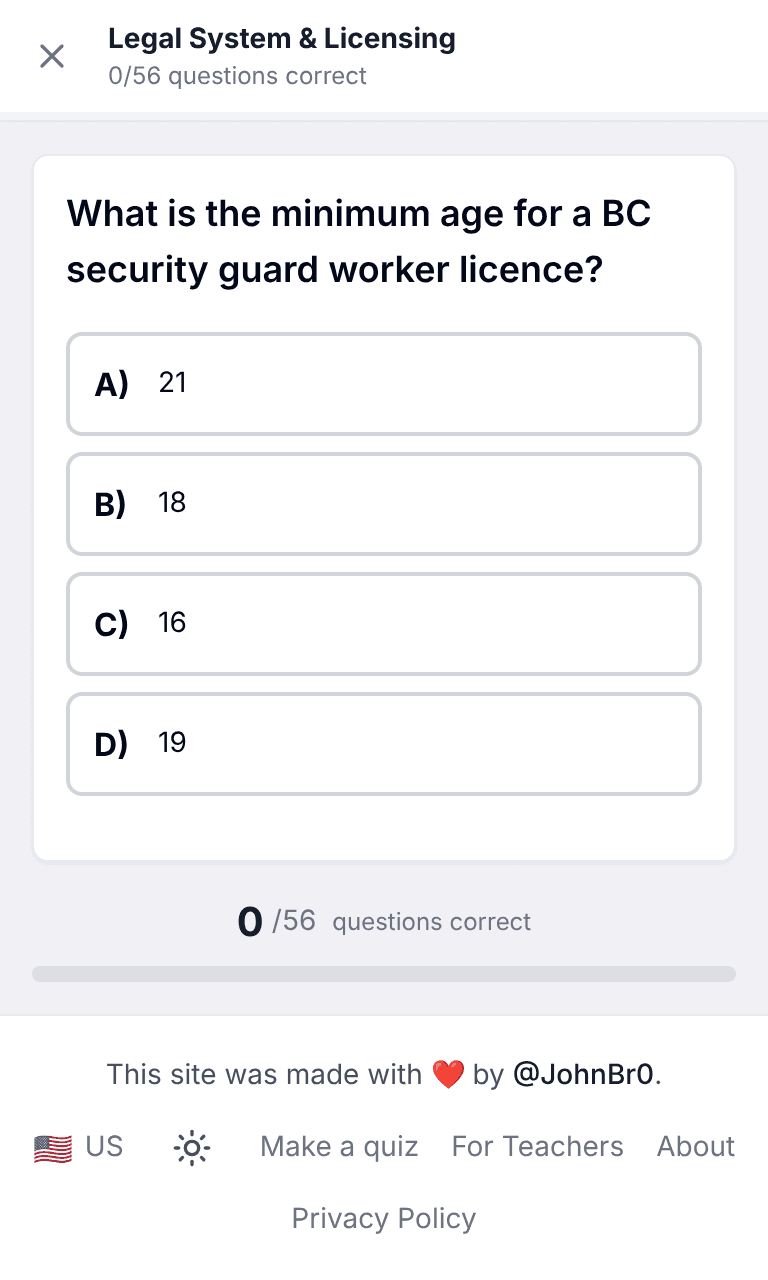
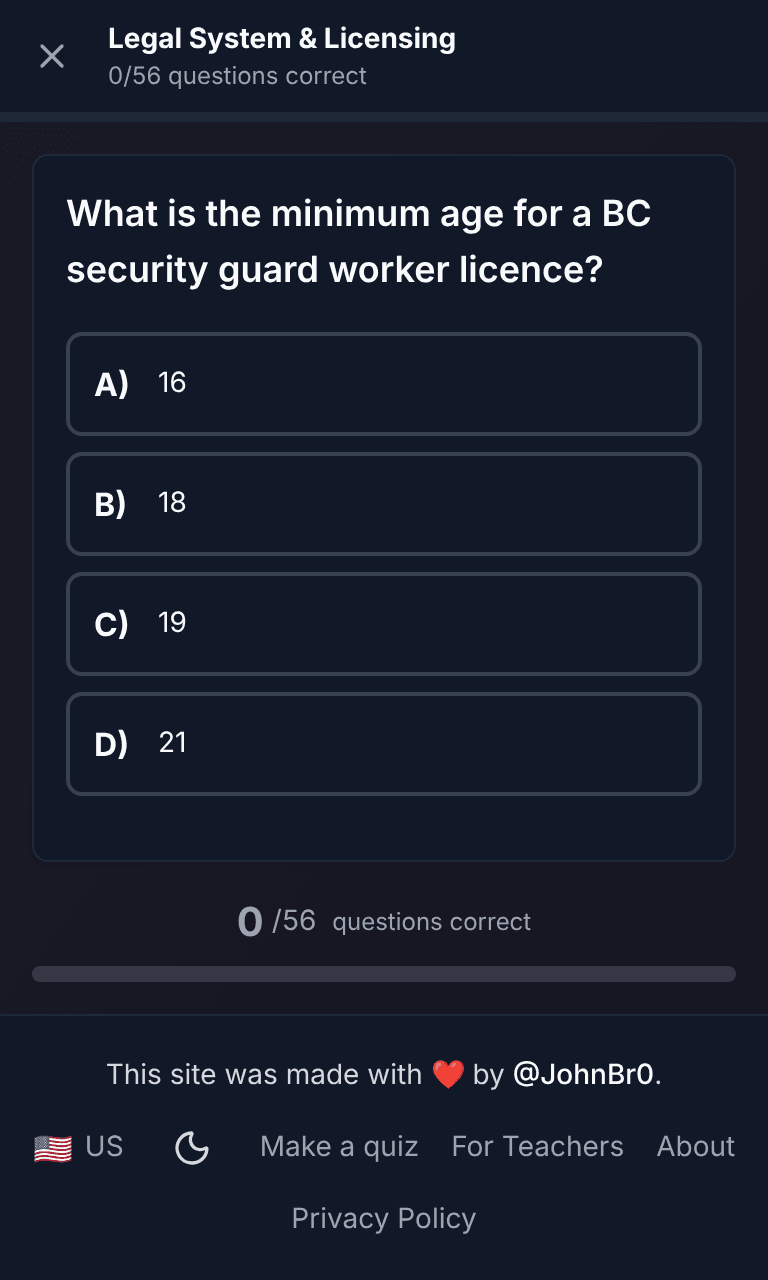
Train on mobile
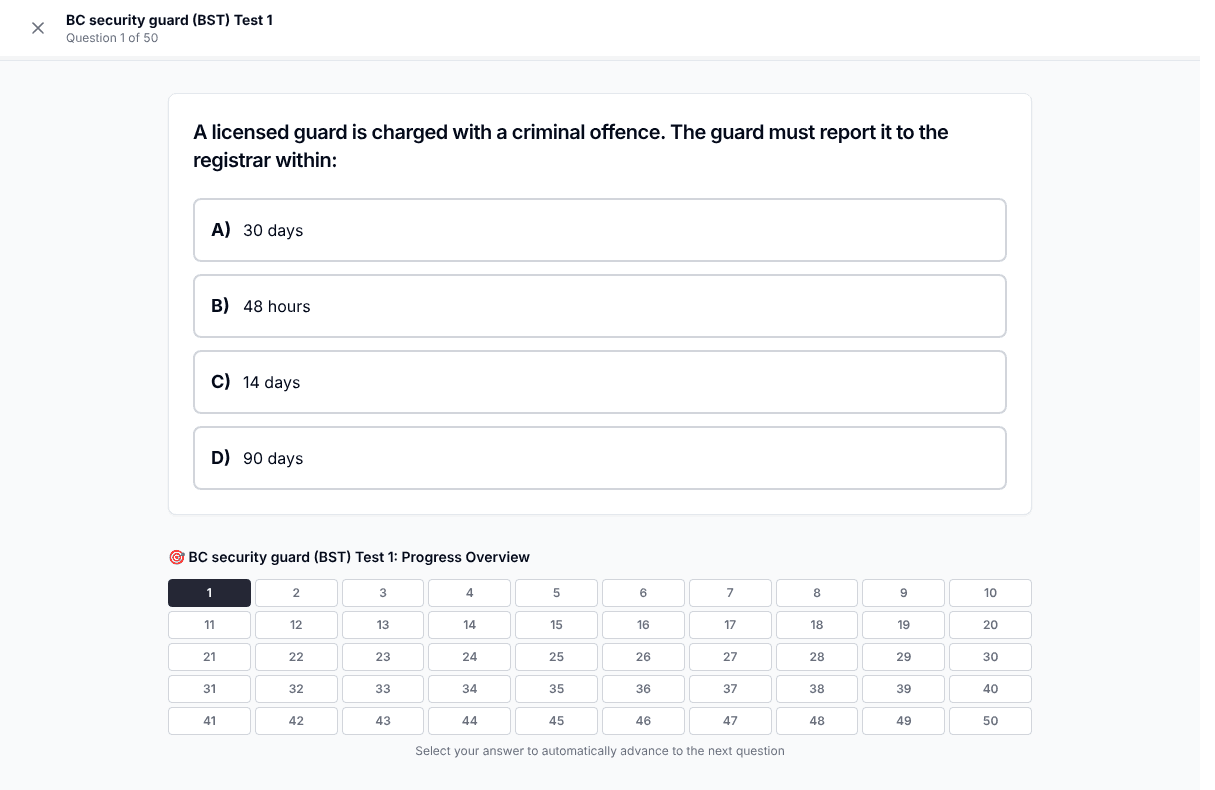
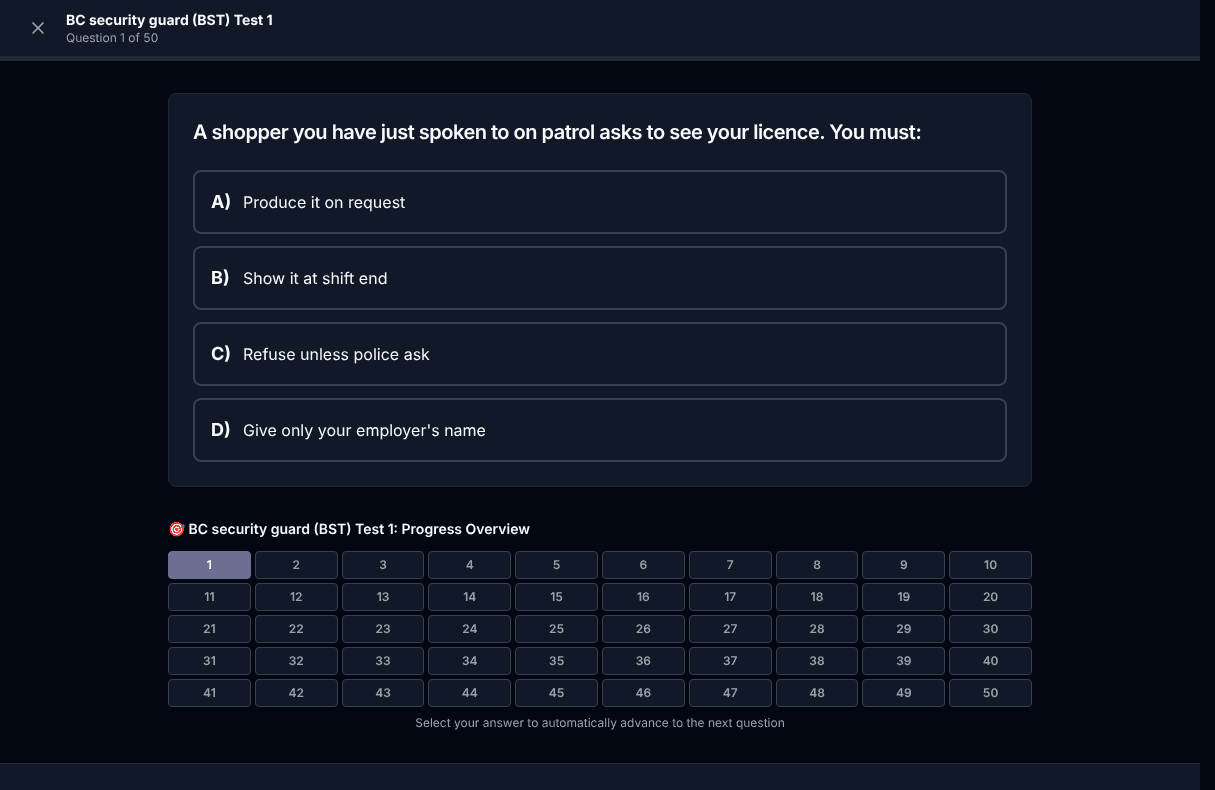
Test on desktop
The BC Security Guard (BST) exam at a glance
Basic Security Training (BST) is the training standard the BC Registrar of Security Services accepts for a security guard worker licence under the Security Services Act. It is a 40-hour theory course followed by the BST Assessment, a final exam that the Justice Institute of British Columbia (JIBC) runs and invigilates on the registrar's behalf. JIBC's program page lists the exam as 75 questions in 90 minutes with a 70% pass mark (its assessment course page gives a two-hour time limit instead), written at JIBC in New Westminster or by online proctoring for some students outside the Lower Mainland, within six months of the course, with two attempts before the course must be retaken. It tests a guard's legal authority to act and the rule that public and personal safety come first. To be licensed you must be at least 19 and ordinarily resident in Canada, and you apply to the Security Programs Division.
Tigertest has 200 BC Security Guard (BST) practice questions with explanations, free to start with no account required.
- Exam
- BST Assessment, 75 questions; 90 minutes on JIBC's program page, two hours on its course page
- Pass mark
- 70%
- Course
- BST Theory, 40 hours, in person or online
- Attempts
- Two, then the theory course again
- Run by
- Justice Institute of BC, for the Registrar of Security Services
- Licence
- Security guard worker licence, age 19, from the Security Programs Division
- Tigertest practice tests
- 4 x 50 questions, 70% to pass
Updated by the Tigertest team. Practice questions follow JIBC's Basic Security Training program and assessment pages and the BC Security Programs Division's licensing pages, checked November 2026. Exam rules change, so confirm current details with JIBC: Basic Security Training.
How It Works
Train Topic by Topic
Four training sets: the legal system and licensing, arrest and use of force, trespass, conduct and privacy, and reports and personal safety. Questions you miss come back until you have mastered them.
Four Practice Tests
Four tests of 50 questions that mix all eight topics, with the BST exam's 70% pass mark. No question appears in more than one test, and every answer comes with a short explanation from BC law and the registrar's rules.
Built on BC Security Law
JIBC publishes no topic weights, so each 50-question test leans on a guard's legal authority, as the BST exam does, and covers every topic as below. The questions follow the Security Services Act, the registrar's policies, BC's Trespass Act and the Criminal Code.

Help Make Tigertest Better
Have an idea, a topic you'd like covered, or a question that could be clearer? We read every message and use it to improve every test.
Share FeedbackHow to Pass the BST Exam
1. Know where your powers come from
The Security Services Act licenses you but gives you no arrest power. Arrest comes from section 494 of the Criminal Code, and force from sections 25 to 35. BC's Trespass Act lets you tell a trespasser to leave and ask for a name and address, but only a peace officer may arrest for trespass.
2. Learn the licence rules
Carry your physical licence and show it on request, report charges and address changes within 14 days, and know the uniform and vehicle markings. Badges, batons, pepper spray and the Sam Browne belt are out, and handcuffs need the registrar's authorization.
3. Put safety first
Public and personal safety come before property. Know the Code of Conduct, record every use of force, and know WorkSafeBC's rules for working alone, violence and refusing unsafe work.
4. Practise each topic, then test
Finish the four training sets first, then take the practice tests. Aim for at least 35 out of 50 on every test, and keep your BST course notes close, because the course is what the exam is written from.
BC Security Guard Frequently Asked Questions
What is the BST exam?
Basic Security Training (BST) is the training standard the BC Registrar of Security Services accepts for a security guard worker licence. It has two parts: a 40-hour theory course, in person or online, and a final exam, the BST Assessment. The Justice Institute of British Columbia (JIBC) delivers the training and invigilates the exam on the registrar's behalf, and approved security training schools also teach the course.
How many questions are on the BST exam and what is the pass mark?
JIBC's program page lists the exam as 75 questions in 90 minutes, with 70% needed to pass; its assessment course page gives a two-hour time limit and books sessions in two-hour blocks, so confirm the time with JIBC. It is written in person at JIBC in New Westminster on your own laptop, or by online proctoring for some students outside the Lower Mainland, within six months of finishing the theory course. You have two attempts before you must retake the theory course. Check JIBC for current dates and details before you book.
What do I need for a BC security guard licence?
Under the Security Services Act you must be at least 19 and ordinarily resident in Canada, pass the background checks (fingerprinting is part of the process), meet the English fluency standard and have the training: BST, or training the registrar accepts as equal. You apply to the Security Programs Division. A licence from another province does not replace a BC licence.
What does the BST exam cover?
JIBC names professionalism and ethics, legal studies, report writing and personal safety, and says the exam focuses on a guard's legal authority to act and on public and personal safety coming first. The practice tests here cover the legal system and the regulator, the Security Services Act and licence rules, arrest, use of force and equipment, trespass and common offences, the Code of Conduct and privacy, notes and reports, and personal safety. JIBC publishes no topic weights, so the split here is Tigertest's.
Are these the real BST exam questions?
No. Every question is original, written by Tigertest from the Security Services Act and Regulation, the registrar's published licence policies, BC's Trespass Act, the Criminal Code, BC's Personal Information Protection Act and WorkSafeBC's rules. No JIBC course material or exam question was used. This is free revision, not affiliated with JIBC or the BC government, and it does not replace the BST course.
I teach a Basic Security Training (BST) course. Can my students use Tigertest?
Yes, for free. Make a class at tigertest.io/teach, post one link, and students join with just their name. You see who practiced, their test scores and the topics your class misses most.
BC Security Guard (BST) sample questions and answers
6 of the 200 practice questions, one from each topic, with the answer explained.
1. A business that rents its store, rather than owning the building, is under section 494(2):
- A.Covered only with the landlord's consent
- B.A person in lawful possession
- C.Unable to authorize a guard
- D.Only a licensed occupant
Answer: B. Section 494(2) covers the owner or a person in lawful possession of property, and anyone either of them authorizes. A tenant running a store is in lawful possession.
2. Consent obtained by giving someone false or misleading information about the purpose is:
- A.Valid if signed
- B.Valid for 30 days
- C.Valid for investigations
- D.Not valid
Answer: D. Section 7(3) says consent is not valid if obtained by false or misleading information or deceptive practices.
3. Self-defence under section 34 protects an act done for the purpose of:
- A.Defending against force
- B.Punishing the attacker
- C.Recovering a stolen item
- D.Ending a loud argument
Answer: A. Section 34(1)(b) requires the act to be done to defend or protect yourself or another person from the use or threat of force.
4. When the registrar refuses to issue a licence, the applicant is entitled to:
- A.An automatic temporary licence
- B.A police review panel
- C.Written reasons
- D.A refund
Answer: C. Section 4 lets the registrar refuse for the listed grounds and requires the decision to come with written reasons.
5. An unpaid volunteer doing door security at a licensed bar:
- A.Needs only a server permit
- B.Needs only basic training
- C.Needs a guard licence
- D.Needs no licence at all
Answer: C. The regulation exempts most unpaid security work, but not door security at a liquor-licensed establishment.
6. A report that leaves out force you used during an incident is:
- A.Incomplete and misleading
- B.Complete if force is on another form
- C.Acceptable if the force was minor
- D.Misleading only if someone was hurt
Answer: A. Licensees must record any use of force, and the Code bars negligent false statements. Leaving force out paints a false picture.
Related practice tests
Every test on Tigertest is free to start, with no account needed.
- Canadian Firearms Safety Course Practice TestRCMP Canadian Firearms Program · non-restricted PAL
- Red Seal Electrician Practice TestRed Seal interprovincial exam · provincial apprenticeship authorities
- WHMIS Practice TestHealth Canada HPR · WHMIS 2015 workplace training
- Ontario Security Guard Practice TestOntario Ministry of the Solicitor General (PSISB)
- Red Seal Automotive Service Technician Practice TestRed Seal interprovincial exam · 2023 RSOS, 310S
- Red Seal Plumber Practice TestRed Seal interprovincial exam · 2023 RSOS, 306A
Ready for the BST Exam?
Start for free. No account required. 200 questions across every BST topic.
Start practicing