
Free Canadian Amateur Radio Basic Practice Test 2026
200 original questions on ISED's Basic syllabus: regulations, bands and power limits, call signs, Ohm's law, receivers, transmitters, antennas and propagation. Four 50-question practice tests. Tuned for mobile. Free to start, no account needed.
Try one now
Pick an answer
With the Basic Qualification only (no Honours), where may you transmit?
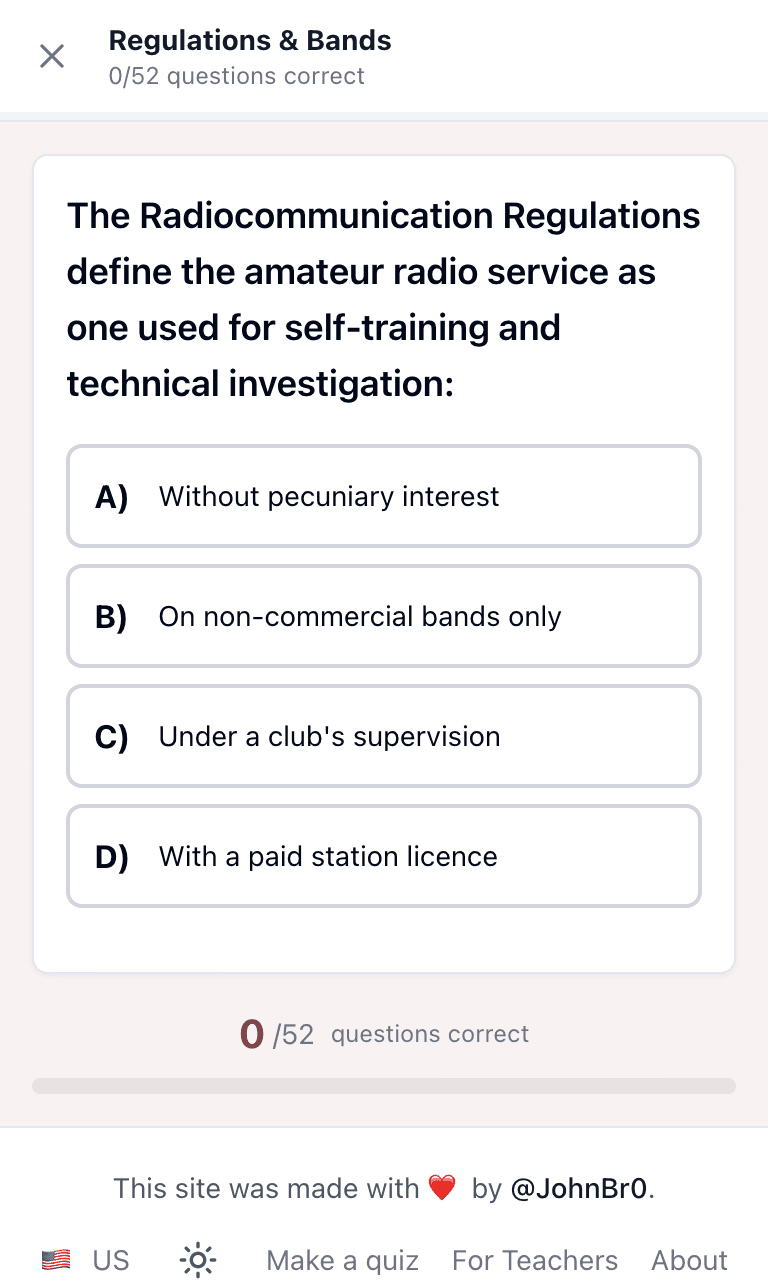
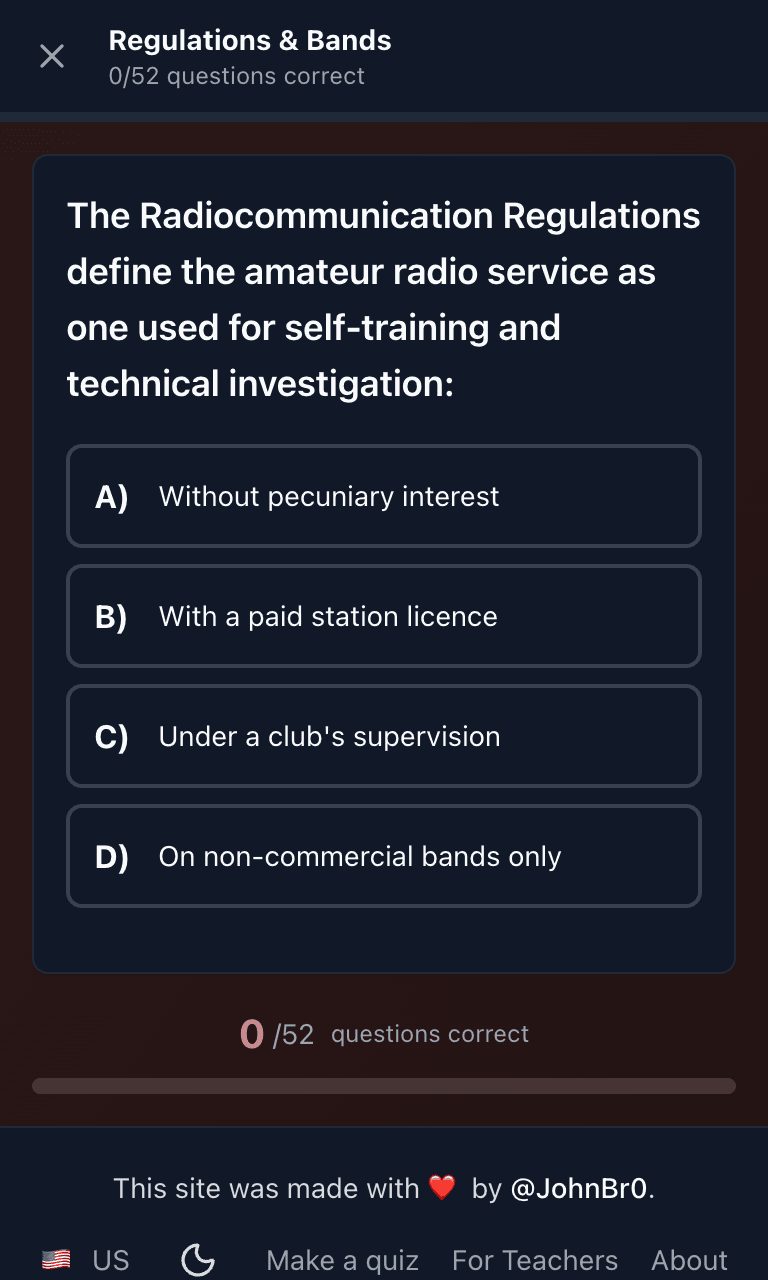
Train on mobile
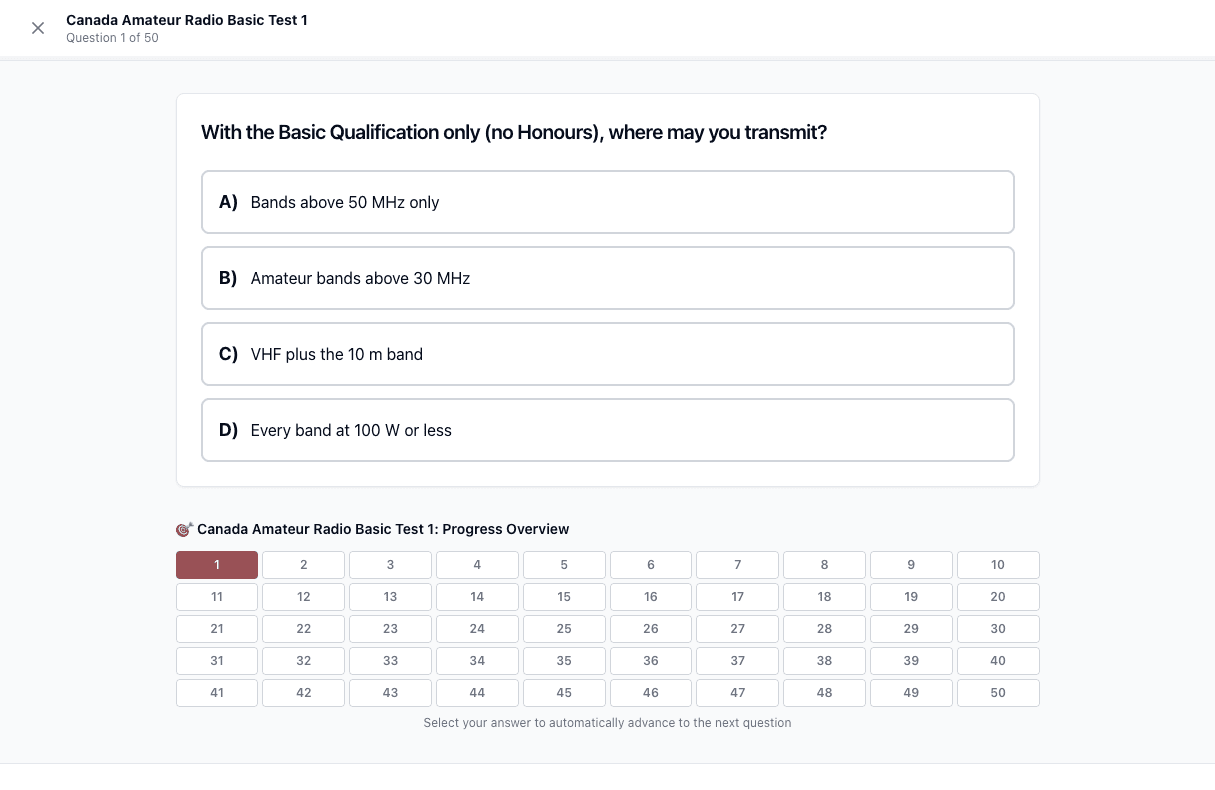
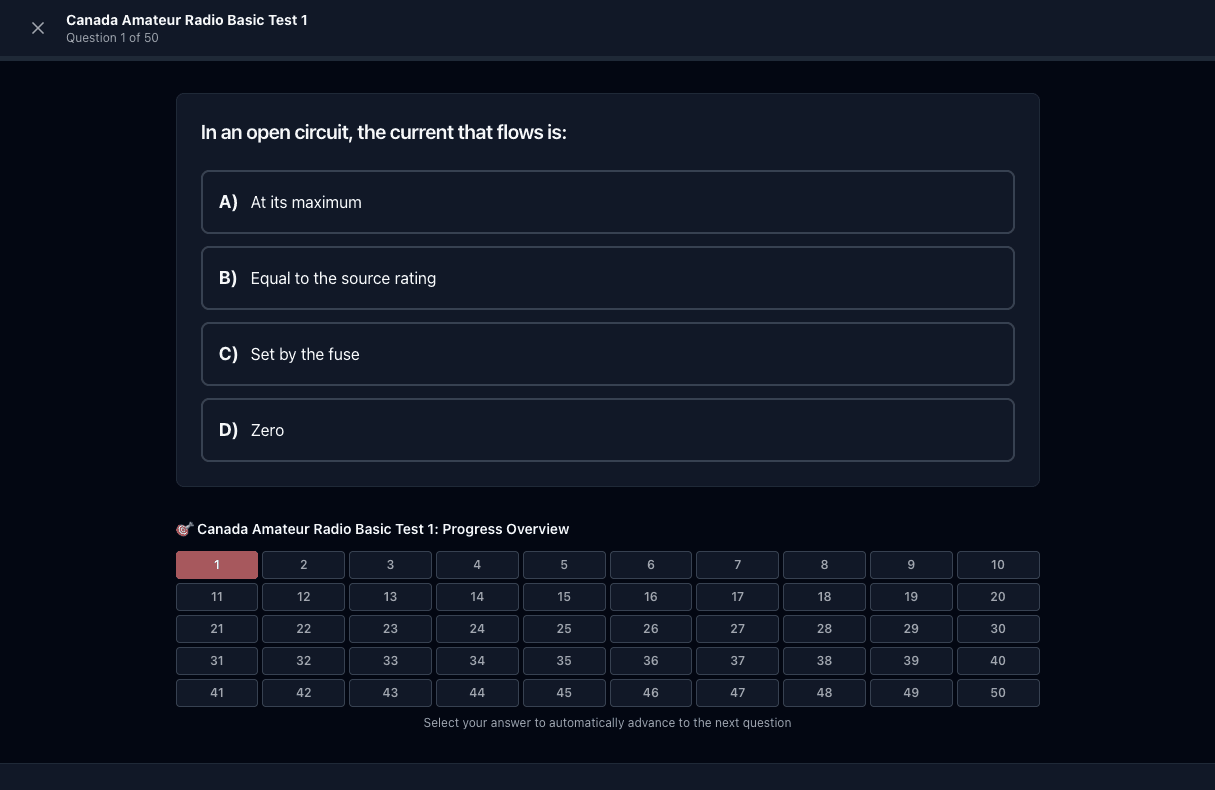
Test on desktop
The Canada Amateur Radio Basic exam at a glance
In Canada, Innovation, Science and Economic Development Canada (ISED) issues the Amateur Radio Operator Certificate with Basic Qualification and a call sign, which together let you operate an amateur station without a separate station licence. The Basic exam has 100 multiple-choice questions, one drawn from each of the 100 topics in ISED's Basic syllabus (RIC-3), and the pass mark is 70%. A score of 80% or more earns Basic with Honours, which adds the amateur bands below 30 MHz; Basic alone covers every band above 30 MHz. ISED-accredited examiners give the exam in person or by videoconference. It is closed book except for ISED's approved formula and block diagram sheet, a calculator that cannot store formulas or text is allowed, and there is no set time limit. Since July 15, 2025 every Basic exam uses ISED's updated question bank.
Tigertest has 200 Canada Amateur Radio Basic practice questions with explanations, free to start with no account required.
- Questions
- 100 multiple choice, one from each of 100 syllabus topics
- Pass mark
- 70%; 80% or more gives Basic with Honours
- Time
- No set limit; most finish within an hour
- Aids
- ISED formula and block diagram sheet; calculator without memory
- Run by
- ISED-accredited examiners, in person or by videoconference
- Basic privileges
- All amateur bands above 30 MHz, up to 250 W DC input
- Honours adds
- All amateur bands below 30 MHz (HF)
Updated by the Tigertest team. Practice questions follow ISED RIC-3 Issue 5 (March 2022), RIC-1 Issue 8 (May 2025), RBR-4 Issue 3 (July 2022) and the amateur radio exam generator page (updated July 15, 2025), checked November 2026. Exam rules change, so confirm current details with ISED: RIC-3, Information on the Amateur Radio Service.
How It Works
Train by Syllabus Topic
Four training sets follow ISED's Basic syllabus: regulations and bands; operating and station layout; electronics, components and safety; and antennas, propagation and interference. Questions you miss come back until you have mastered them.
Weighted Practice Tests
Four practice tests of 50 questions, each weighted like the 100-question real exam. Aim for 70% to pass, and 80% for Honours and the HF bands. No question appears in more than one test, and every one comes with an explanation.
Built on the ISED Basic Syllabus
ISED draws one question from each of the 100 topics in its Basic syllabus, so every real exam has the same mix, and each practice test here keeps it, scaled to 50 questions. Regulations and station assembly carry almost half the questions. Club instructors running a Basic course can set Tigertest as revision at tigertest.io/teach and see which topics the class misses most.

Help Make Tigertest Better
Have an idea, a topic you'd like covered, or a question that could be clearer? We read every message and use it to improve every test.
Share FeedbackHow to Pass the Amateur Radio Exam
1. Learn the licence conditions first
Regulations and policies give 25 of the 100 questions. Read RBR-4 and the amateur sections of the Radiocommunication Regulations: band edges and bandwidths, Basic power limits, identification every 30 minutes, call sign prefixes and what a Basic holder may build and modify.
2. Practise the sums with the formula sheet
Ohm's law, series and parallel resistors and capacitors, power, decibels, wavelength and antenna lengths come up on every exam. ISED's formula and block diagram sheet and a basic calculator are allowed, so practise with the same formulas (300/F, 142/F, 71/F, 306/F) until they are automatic.
3. Know how a station works
Learn the blocks on ISED's diagrams, from the superhet receiver to the SSB and FM transmitters and the HF station, what each stage does, how harmonics and interference arise and are filtered, and how feed lines, antennas and the ionosphere get your signal to the other station.
4. Fix your misses, then retest
Tigertest tracks your accuracy by topic. Aim for 80% or better on every practice test before your exam, so Honours is within reach, then drill the questions you missed and retrain the weakest topic. A local amateur radio club can put you in touch with an accredited examiner.
Canadian Amateur Radio Basic Frequently Asked Questions
What is the Basic Qualification?
The Amateur Radio Operator Certificate with Basic Qualification is the certificate Innovation, Science and Economic Development Canada (ISED) issues to new amateur radio operators, with a call sign. It lets you operate on every amateur band above 30 MHz, such as 2 m and 70 cm, at up to 250 W DC input, and build any station equipment except transmitters, which must be assembled from commercial kits of professional design. The exam is given by ISED-accredited examiners, in person or by videoconference, and there is no age or nationality limit.
How many questions are on the Basic exam, and what is the pass mark?
The exam has 100 multiple-choice questions, one drawn from each of the 100 topics in ISED's Basic syllabus. You need 70% to pass. There is no set time limit; ISED says most candidates finish within an hour. The exam is closed book, but you may use ISED's approved formula and block diagram sheet and a calculator that cannot store formulas or text.
What does Basic with Honours give you?
A score of 80% or more earns Basic with Honours, which adds every amateur band below 30 MHz, the HF bands used for long-distance contacts. Without Honours, a Basic holder can reach HF by adding the Morse Code (5 wpm) or Advanced qualification. The practice tests here use the 70% pass line; aim for 80% if you want HF.
What is on the Basic exam?
ISED's syllabus has eight sections: regulations and policies (25 questions), station assembly, practice and safety (21), basic electronics and theory (13), feed lines and antenna systems (13), operating and procedures (9), radio wave propagation (8), circuit components (6) and interference and suppression (5). Each practice test here keeps that balance, scaled to 50 questions.
Are these the real ISED exam questions?
No. Every question is original, written by Tigertest from ISED's Basic syllabus in RIC-3, RBR-4, the Radiocommunication Regulations and the Radiocommunication Act, so it covers the same knowledge without copying ISED's public question bank. ISED updated that bank on July 15, 2025 and publishes it with an exam generator, and studying it as well is a good idea. Tigertest is not affiliated with ISED.
I teach an amateur radio club Basic course. Can my students use Tigertest?
Yes, for free. Make a class at tigertest.io/teach, post one link, and students join with just their name. You see who practiced, their test scores and the topics your class misses most.
Canada Amateur Radio Basic sample questions and answers
6 of the 200 practice questions, one from each topic, with the answer explained.
1. Antenna gain measured against a half-wave dipole is written in:
- A.dBc
- B.dBd
- C.dBi
- D.dBm
Answer: B. dBd compares gain with a half-wave dipole, and dBi with an isotropic radiator; a dipole has about 2.15 dBi. dBm is power relative to 1 mW and dBc is relative to the carrier.
2. ISED finds your station causes interference that is not harmful interference. Under section 52, the Minister may:
- A.Cancel your certificate at once
- B.Move you to another band
- C.Require you to rewrite the exam
- D.Order it stopped or changed
Answer: D. Section 52 of the Radiocommunication Regulations lets the Minister order the person controlling radio apparatus to cease or modify its operation until it works without causing that interference.
3. An amplifier turns a 3 W input into a 30 W output. Its power gain is:
- A.10 dB
- B.20 dB
- C.3 dB
- D.27 dB
Answer: A. Power gain in decibels is 10 log of the ratio: 30 / 3 = 10 times, and 10 log 10 = 10 dB. Using 20 log, the voltage formula, gives 20 dB.
4. A good voltmeter should have an input resistance that is:
- A.Exactly 50 ohms
- B.Equal to the load
- C.Very high
- D.Very low
Answer: C. A voltmeter is connected across the part being measured. A very high input resistance draws little current, so it barely changes the voltage it measures.
5. To stop one strong 2 m signal from overloading a scanner while passing others, use a:
- A.High-pass filter
- B.Ferrite bead on the power cord
- C.Band-reject (notch) filter
- D.Low-pass filter
Answer: C. A band-reject or notch filter removes a narrow range of frequencies and passes everything else, so the scanner hears other bands normally.
6. Why do amateurs exchange QSL cards?
- A.To confirm a contact
- B.To report interference
- C.To renew a call sign
- D.To request a schedule
Answer: A. QSL means acknowledging receipt, so a QSL card or electronic QSL confirms that a contact took place. Schedules are arranged on the air or by message.
Related practice tests
Every test on Tigertest is free to start, with no account needed.
- Canadian Firearms Safety Course Practice TestRCMP Canadian Firearms Program · non-restricted PAL
- Red Seal Electrician Practice TestRed Seal interprovincial exam · provincial apprenticeship authorities
- WHMIS Practice TestHealth Canada HPR · WHMIS 2015 workplace training
- Ontario Security Guard Practice TestOntario Ministry of the Solicitor General (PSISB)
- Red Seal Automotive Service Technician Practice TestRed Seal interprovincial exam · 2023 RSOS, 310S
- Red Seal Plumber Practice TestRed Seal interprovincial exam · 2023 RSOS, 306A
Ready to Pass the Amateur Radio Exam?
Start for free. No account required. 200 questions across every section of ISED's Basic syllabus.
Start practicing