
Free Canada Drone Basic Exam Practice Test 2026
200 original questions on Canada's drone rules for the Transport Canada Small Basic Exam: registration, the 30 m and 122 m limits, airspace and airports, weather, human factors and emergencies. Five 35-question practice tests like the real exam. Tuned for mobile. Free to start, no account needed.
Try one now
Pick an answer
In which airspace may a basic certificate holder fly?
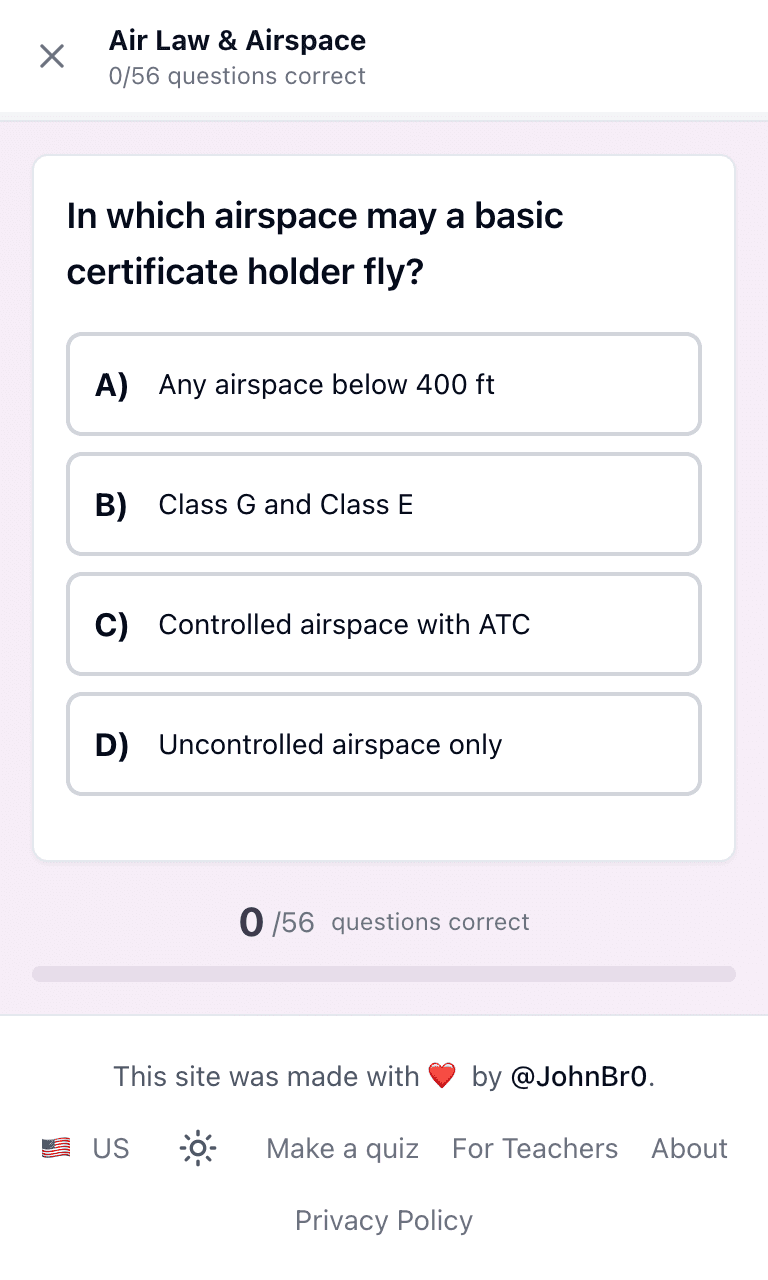
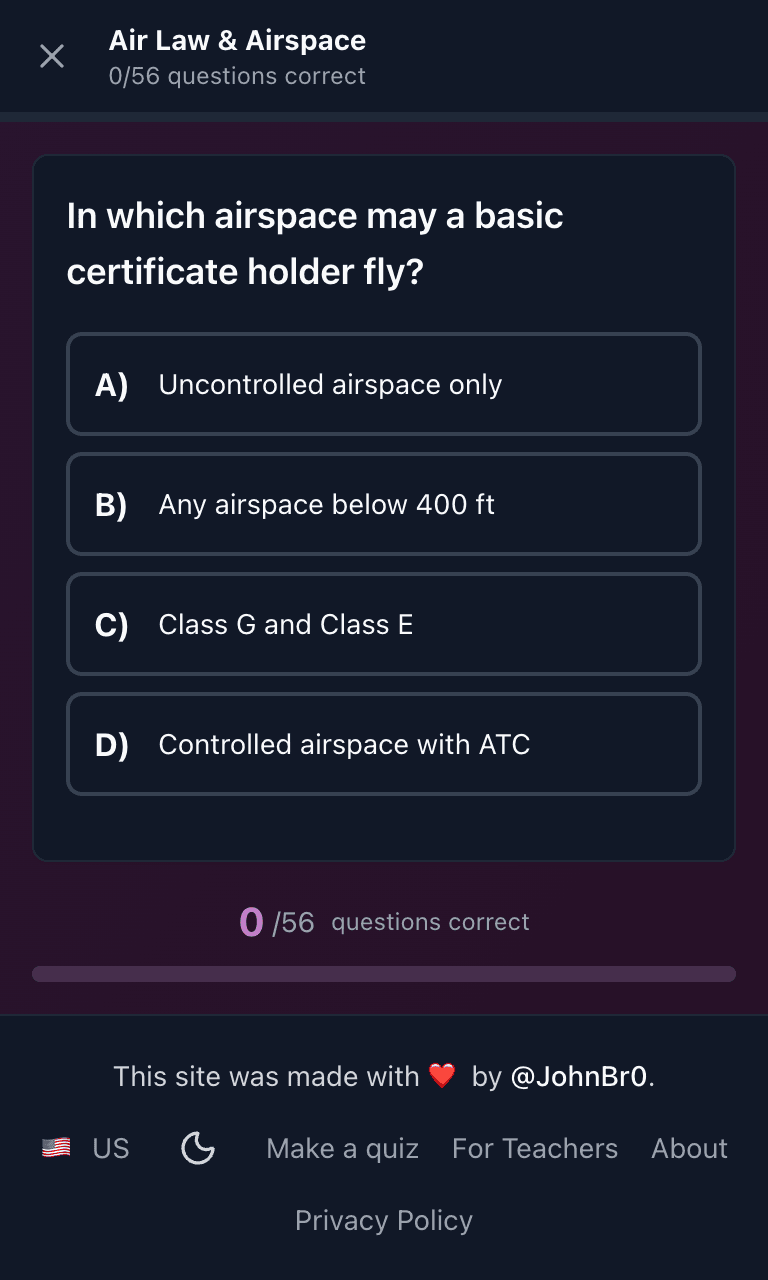
Train on mobile
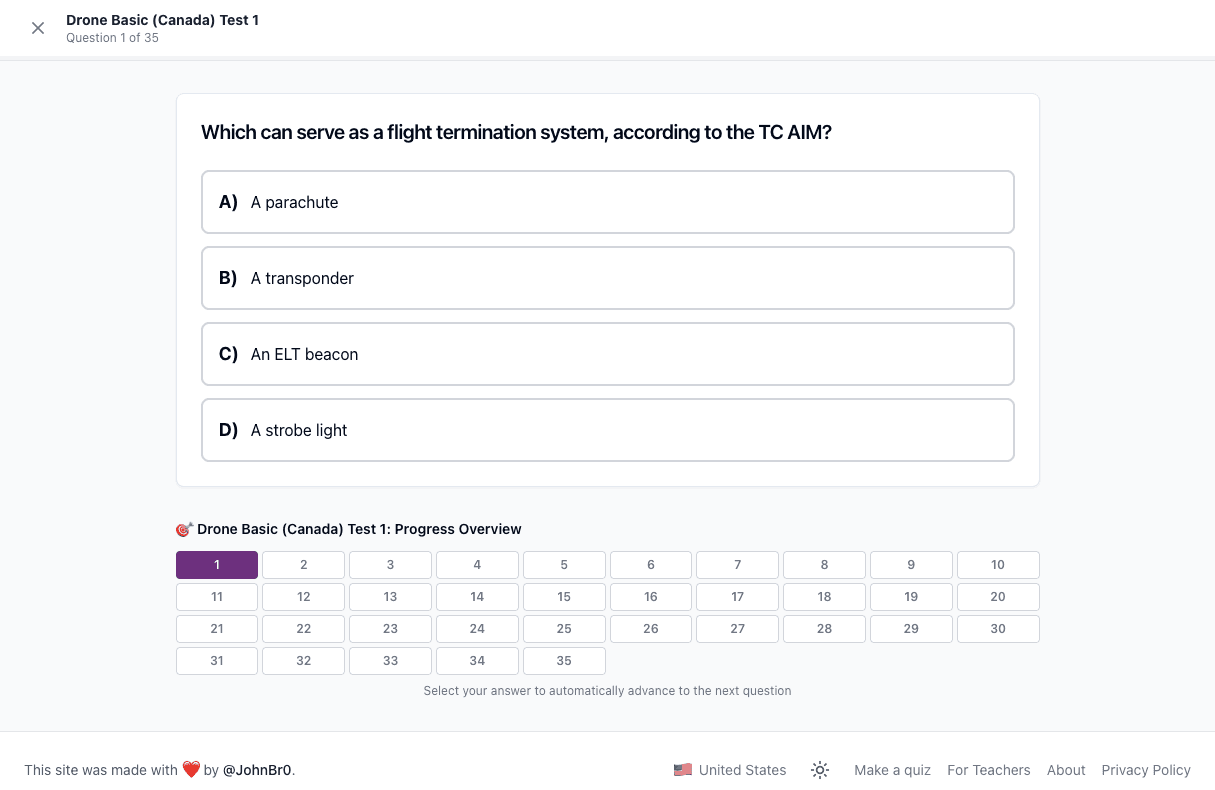
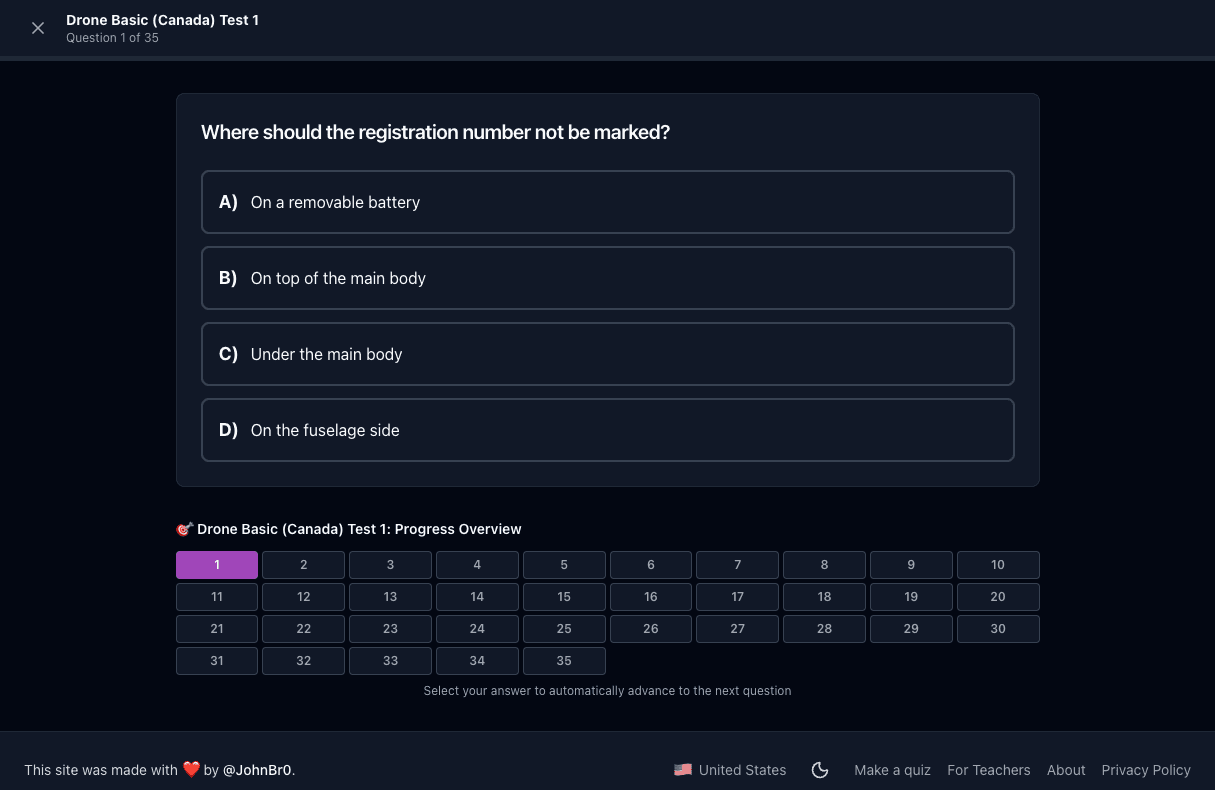
Test on desktop
The Drone Basic (Canada) exam at a glance
In Canada, anyone flying a drone that weighs 250 g to 25 kg needs a pilot certificate from Transport Canada, unless directly supervised by a certified pilot, and the drone must be registered and marked. The Pilot Certificate - Basic Operations comes from passing the Small Basic Exam online in Transport Canada's Drone Management Portal: 35 multiple-choice questions in 90 minutes, with 65% or higher to pass, open to people 14 and older. Questions are based on Transport Canada's knowledge requirements document TP 15263. A basic certificate covers flights in uncontrolled airspace, at least 30 m horizontally from people not involved, below 122 m (400 ft) above ground and outside 3 nautical miles of an airport and 1 nautical mile of a heliport. Flying in controlled airspace or near people needs the advanced certificate. The certificate does not expire, but pilots must show recent activity within 24 months.
Tigertest has 200 Drone Basic (Canada) practice questions with explanations, free to start with no account required.
- Questions
- 35 multiple choice
- Time
- 90 minutes
- Pass mark
- 65%
- Minimum age
- 14
- Based on
- TP 15263 (Fourth Edition, March 2025) and CARs Part IX
- Where
- Online, Transport Canada Drone Management Portal, English or French
- Retakes
- After a 24-hour wait, as often as needed
- Certificate
- Does not expire; 24-month recency rule
- Run by
- Transport Canada
Updated by the Tigertest team. Practice questions follow Transport Canada's Small Basic Exam page and TP 15263, and CARs Part IX as amended by SOR/2025-70, checked November 2026. Exam rules change, so confirm current details with Transport Canada: Small Basic Exam.
How It Works
Train by Topic
Four training sets follow TP 15263: air law and airspace; operating rules and navigation; drone systems and weather; and human factors and flight operations. Questions you miss come back until you have mastered them.
Real-Length Practice Tests
Five practice tests of 35 questions, the length of the real exam, each mixing every topic. The real exam passes at 65%; aim for 80% or better here. No question appears in more than one test, and every one comes with an explanation.
Built on CARs Part IX and TP 15263
Transport Canada writes the Small Basic Exam from its knowledge requirements document, TP 15263, which points to Part IX of the Canadian Aviation Regulations and topics from weather to human factors. Every practice test here mixes those topics, using the rules in force since the 2025 amendments.

Help Make Tigertest Better
Have an idea, a topic you'd like covered, or a question that could be clearer? We read every message and use it to improve every test.
Share FeedbackHow to Prepare for the Small Basic Exam
1. Know the numbers
250 g, 25 kg, 30 m, 122 m, 3 NM, 1 NM, 12 hours, 7 days and 24 months. Learn what each one belongs to: registration, the weight classes, distance from people, maximum altitude, airports and heliports, alcohol, registration notices and recency.
2. Know where basic pilots may fly
Basic pilots stay in uncontrolled airspace. Learn the airspace classes, Class F restricted and advisory areas, forest fire restrictions and emergency security perimeters, and check the NRC drone site selection tool and NOTAMs before you fly.
3. Do not skip the non-law topics
TP 15263 also covers batteries and links, GPS and compass errors, fog and wind, visual scanning, fatigue and alcohol, charts and UTC time, emergencies and basic theory of flight. They are a large share of every test here.
4. Fix your misses, then retest
Tigertest tracks your accuracy by category. Aim for 80% or better on every practice test, well above the real 65%. After each test, drill the questions you missed and retrain the weakest category.
Canada Drone Basic Exam Frequently Asked Questions
What is the Transport Canada Small Basic Exam?
It is the online exam for the Pilot Certificate - Basic Operations, which you need to fly a drone that weighs 250 g to 25 kg in Canada. Transport Canada gives you 35 multiple-choice questions and 90 minutes, and a score of 65% or higher is a pass. You take it online through Transport Canada's Drone Management Portal, in English or French, and you must be at least 14 years old.
What can I do with a basic drone pilot certificate?
Basic operations are flights of a small drone in uncontrolled airspace, at least 30 m (100 ft) horizontally from people who are not involved, at any altitude, and no closer than 3 nautical miles to the centre of an airport or 1 nautical mile to the centre of a heliport. Flying in controlled airspace, closer to people or with a medium drone needs an advanced certificate. The drone must also be registered and marked with its registration number.
Did the drone rules change in 2025?
Yes. Amendments to Part IX of the Canadian Aviation Regulations came into force in two stages, on April 1, 2025 and November 4, 2025. They added the Level 1 Complex certificate for some lower-risk flights beyond visual line-of-sight, rules for medium drones up to 150 kg, and sheltered and extended visual line-of-sight operations for advanced pilots. Basic operations are now defined as flights in uncontrolled airspace at least 30 m from uninvolved people. These practice tests follow the rules in force in November 2026.
What do these practice tests cover?
Each 35-question test mixes the topics Transport Canada marks for basic operations in TP 15263: registration, pilot certificates and recency, the general operating and flight rules of Part IX, airspace classes, aerodromes, forest fires and restricted airspace, drone systems, links and batteries, human factors, low-level weather, navigation, charts and time, and flight operations, emergencies and theory of flight.
Are these the real exam questions?
No. Every question is original, written by Tigertest from the Canadian Aviation Regulations, TP 15263, the TC AIM and Transport Canada's guidance, as in force in November 2026. Tigertest is not affiliated with Transport Canada, NAV CANADA or any flight school.
Drone Basic (Canada) sample questions and answers
6 of the 200 practice questions, one from each topic, with the answer explained.
1. What do you need to fly a drone in Class A airspace?
- A.An advanced certificate and ATC
- B.TC and NAV CANADA authorization
- C.ATC and airport authorization
- D.TC and DND authorization
Answer: B. The TC AIM says Class A, which starts around FL 180 in southern airspace, needs specific authorization from both Transport Canada and NAV CANADA, through an SFOC.
2. Getting a drone too close to whales can lead to charges under which act?
- A.Navigation Protection Act
- B.Customs Act
- C.Canada Shipping Act
- D.Fisheries Act
Answer: D. The TC AIM says the Marine Mammal Regulations and Species at Risk Act apply, and getting too close to marine mammals could result in charges under the Fisheries Act.
3. After a dive with no decompression stops, how long should you avoid sites up to 8,000 ft ASL?
- A.12 hours
- B.24 hours
- C.6 hours
- D.48 hours
Answer: A. RPAS 101 advises avoiding altitudes up to 8,000 ft ASL for 12 hours after a dive without decompression stops, and 24 hours after one that needed them.
4. Which federal privacy law does the TC AIM name for drone recordings?
- A.CEPA
- B.CTA
- C.PIPEDA
- D.CASL
Answer: C. The TC AIM says the Privacy Act, the Personal Information Protection and Electronic Documents Act (PIPEDA) or provincial privacy laws may apply, and advises getting consent before recording private information.
5. What causes the difference between true north and magnetic north on a chart?
- A.Wind drift angle
- B.Compass deviation
- C.Magnetic variation
- D.Magnetic inclination
Answer: C. Variation is the angle between true and magnetic north for a location. Deviation is local error from nearby metal or electrical equipment, as RPAS 101 notes.
6. May a drone carry a person on board?
- A.Only under an SFOC
- B.Only with an advanced certificate
- C.Only if it is a medium drone
- D.Only with ATC approval
Answer: A. CAR 901.22 forbids carrying persons on board except under a special flight operations certificate issued under section 903.03.
Related practice tests
Every test on Tigertest is free to start, with no account needed.
- Canadian Firearms Safety Course Practice TestRCMP Canadian Firearms Program · non-restricted PAL
- Red Seal Electrician Practice TestRed Seal interprovincial exam · provincial apprenticeship authorities
- WHMIS Practice TestHealth Canada HPR · WHMIS 2015 workplace training
- Ontario Security Guard Practice TestOntario Ministry of the Solicitor General (PSISB)
- Red Seal Automotive Service Technician Practice TestRed Seal interprovincial exam · 2023 RSOS, 310S
- Red Seal Plumber Practice TestRed Seal interprovincial exam · 2023 RSOS, 306A
Ready to Fly by the Rules?
Start for free. No account required. 200 questions across CARs Part IX and TP 15263.
Start practicing