
Free CBSPD CSPDT Practice Test 2026
200 original questions on the 2026 CBSPD technician exam outline: safety and regulations, decontamination, instrument preparation and packaging, sterilization, sterile storage and ethics. Four 50-question practice tests. Tuned for mobile. Free to start, no account needed.
Try one now
Pick an answer
On CDC's ranking of resistance to germicides, which group comes right after bacterial spores?
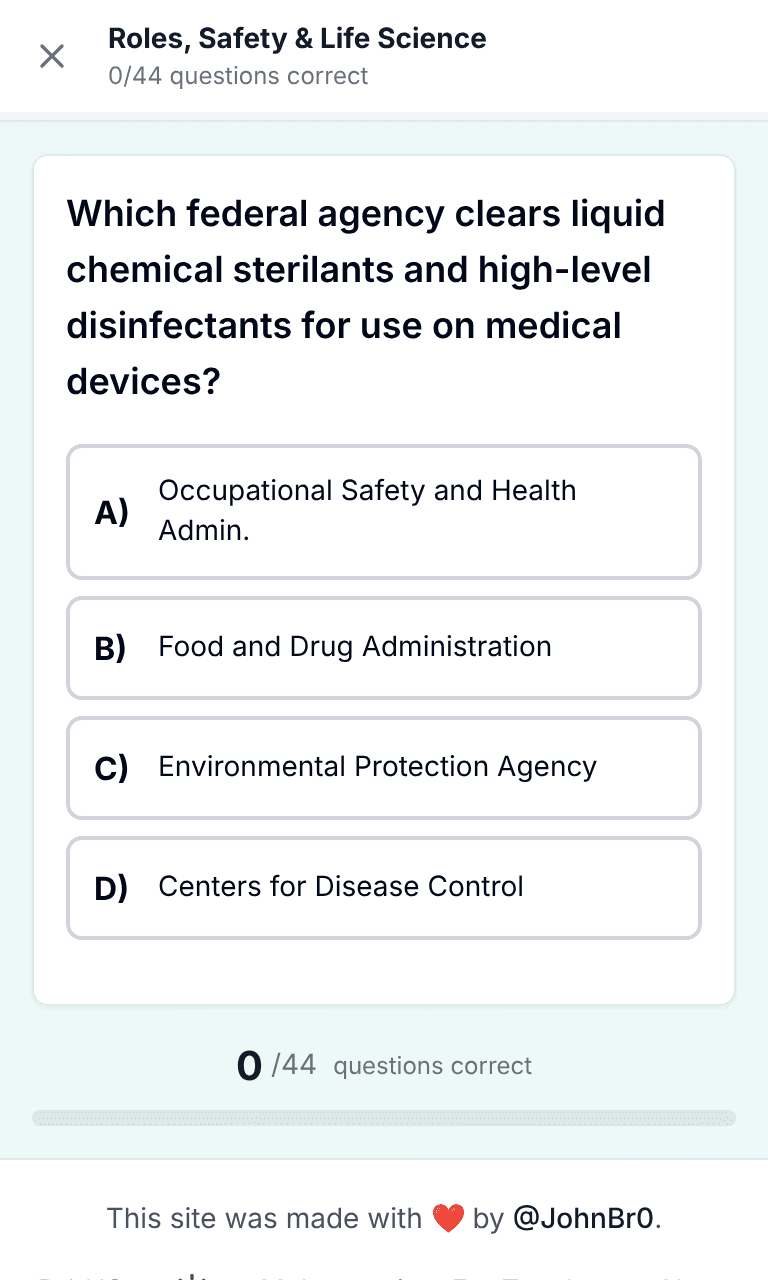
Train on mobile
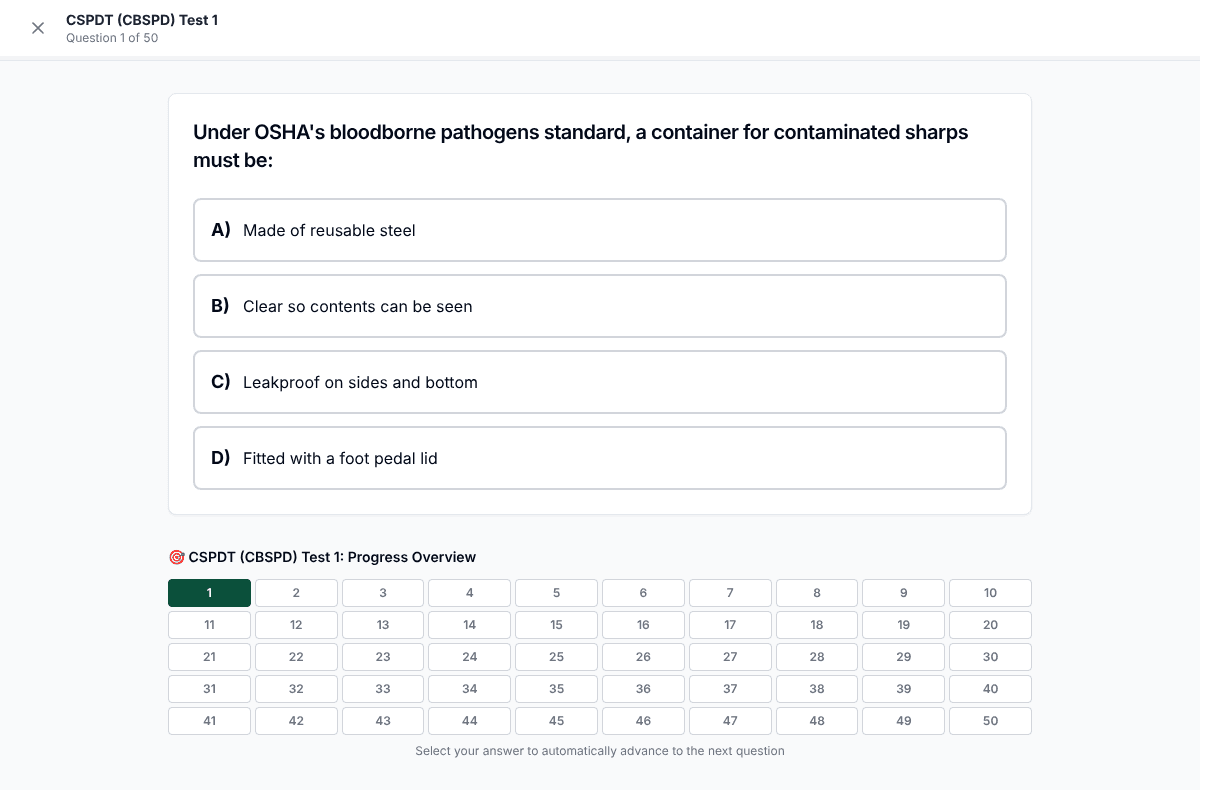
Test on desktop
The CSPDT (CBSPD) exam at a glance
The Certified Sterile Processing and Distribution Technician (CSPDT) exam is the Certification Board for Sterile Processing and Distribution's (CBSPD) certification exam for sterile processing and central service technicians. CBSPD's 2026 candidate bulletin gives it 150 multiple-choice questions, 125 scored and 25 unscored pretest items, taken on a computer at a PSI test center in 3 hours, four times a year in a one-week window. The passing scaled score is 70, which is not the same as 70 percent correct; candidates testing in the U.S. get an official pass or fail at the end, and only failing candidates receive a numeric score. Certification is valid for five years and is renewed with 100 points of continuing education and related activity over that time.
Tigertest has 200 CSPDT (CBSPD) practice questions with explanations, free to start with no account required.
- Questions
- 150 multiple choice (125 scored, 25 pretest)
- Time
- 3 hours
- Pass mark
- Scaled score of 70 (not a percent correct)
- Largest areas
- Decontamination and disinfection 19%, sterilization 18%
- Where
- Computer based at PSI test centers, four windows a year
- Renewal
- Every 5 years, with 100 recertification points
- Run by
- Certification Board for Sterile Processing and Distribution (CBSPD)
Updated by the Tigertest team. Practice questions follow CBSPD's Technician Candidate Bulletin (2026 version) and 2020 technician test specifications, checked November 2026. Exam rules change, so confirm current details with CBSPD: Technician certification.
How It Works
Train by Outline Section
Five training sets follow the CBSPD technician outline: roles and life science; decontamination and disinfection; preparation and handling; sterilization; and sterile storage, patient care equipment and ethics. Questions you miss come back until you have mastered them.
Weighted Practice Tests
Four practice tests of 50 questions, each weighted like the eight content areas of the real exam. Aim for 70% or better. No question appears in more than one test, and every one comes with an explanation.
Built on the CBSPD Technician Exam Outline
CBSPD's 2026 candidate bulletin gives the weight of each of the eight content areas, and every practice test here keeps that balance, scaled to 50 questions: 9 each on decontamination and sterilization, 8 on preparation and handling, 7 on roles and responsibilities, 6 on storage and distribution, 4 each on life science and ethics, and 3 on patient care equipment. Sterile processing program instructors can set Tigertest as CSPDT review at tigertest.io/teach and see which topics the class misses most.

Help Make Tigertest Better
Have an idea, a topic you'd like covered, or a question that could be clearer? We read every message and use it to improve every test.
Share FeedbackHow to Pass the CSPDT Exam
1. Own decontamination and sterilization
Decontamination and disinfection (19%) and sterilization (18%) are over a third of the exam. Know detergent types, washer and ultrasonic checks, high-level disinfectant testing and PPE, then the parameters of each sterilization method and how mechanical, chemical and biological monitors are read and recorded.
2. Know your instruments and packaging
Preparation and handling is 16%. Learn instrument parts and names, how to inspect and test them, how trays are configured, and which packaging and indicators suit each sterilization method.
3. Do not skip the rules and the people side
Roles and responsibilities, life science and ethics add up to 30% of this outline. Know OSHA's bloodborne pathogens and ethylene oxide rules, Safety Data Sheets, IFU symbols, CJD handling, basic microbiology and medical terms, and what professional conduct looks like when a record or a step is skipped.
4. Fix your misses, then retest
Tigertest tracks your accuracy by category. Aim for 70% or better on every practice test before your exam date. After each test, drill the questions you missed and retrain the weakest category.
CSPDT Exam Frequently Asked Questions
What is the CBSPD CSPDT exam?
It is the certification exam for the Certified Sterile Processing and Distribution Technician credential from the Certification Board for Sterile Processing and Distribution (CBSPD). It is written for technicians with about one year of experience and covers safety and regulations, microbiology, decontamination, instrument preparation and packaging, sterilization, sterile storage and distribution, patient care equipment and ethics.
How many questions are on the CSPDT exam?
CBSPD's 2026 candidate bulletin gives the technician exam 150 multiple-choice questions: 125 scored and 25 unscored pretest questions. Candidates have 3 hours, and the exam is taken on a computer at PSI test centers, offered four times a year in a one-week window.
What score do you need to pass the CSPDT?
The passing scaled score is 70. That is a scaled score, not 70 percent correct, because each form of the exam has its own raw-to-scale conversion. Candidates testing in the U.S. get an official pass or fail at the end of the exam; passing candidates get no numeric score, and failing candidates get their score with a report by content area. The 70 percent line on these practice tests is a readiness target.
How is the CSPDT different from the HSPA CRCST?
They are separate certifications from separate boards. The CSPDT comes from CBSPD and follows CBSPD's own eight-area outline, led by decontamination and disinfection at 19 percent and sterilization at 18 percent, and it is valid for five years with 100 recertification points. The CRCST comes from the Healthcare Sterile Processing Association (HSPA), with its own outline and yearly continuing education. Tigertest has a separate practice test for each.
Are these the real CSPDT exam questions?
No. Every question is original, written by Tigertest from CBSPD's published exam outline and from public guidance such as CDC's Guideline for Disinfection and Sterilization in Healthcare Facilities and OSHA's standards. Always follow the manufacturer's instructions for use for each device and product. Tigertest is not affiliated with the Certification Board for Sterile Processing and Distribution.
I teach a sterile processing program. Can my students use Tigertest?
Yes, for free. Make a class at tigertest.io/teach, post one link, and students join with just their name. You see who practiced, their test scores and the topics your class misses most.
CSPDT (CBSPD) sample questions and answers
6 of the 200 practice questions, one from each topic, with the answer explained.
1. Studies cited by CDC found that manual and mechanical cleaning of endoscopes cuts contaminating organisms by about how much?
- A.12 log10, a full kill
- B.4 log10, or 99.99%
- C.1 log10, or 90%
- D.6 log10, or 99.9999%
Answer: B. CDC reports cleaning alone achieves about a 4-log10 reduction on endoscopes, which is why cleaning is essential but is not disinfection.
2. A manager asks a technician to release an implant load before its biological indicator result, with no emergency documented. What applies?
- A.Release it as asked
- B.Release it if the CI changed
- C.Release it and log the reason
- D.Question the request
Answer: D. CDC calls for quarantining implants until the BI is negative whenever possible. An early release needs documented justification under policy, so the request is questioned.
3. A set labeled for a thoracotomy is used to open which part of the body?
- A.The chest
- B.The abdomen
- C.The skull
- D.The spine
Answer: A. Thorac- means chest and -otomy means incision, so a thoracotomy opens the chest. A laparotomy opens the abdomen and a craniotomy the skull.
4. Before using a new disinfectant on a monitor's screen, what else must be checked?
- A.That contact time is short
- B.That unit staff like it
- C.The maker's IFU allows it
- D.The EPA label claim alone
Answer: C. An EPA label proves germ kill, but the device manufacturer's instructions say which chemicals the device tolerates without damage.
5. Why is instrument air, not room air, used to dry lumens before packaging?
- A.It sterilizes the lumen
- B.It adds moisture to the lumen
- C.It is filtered and oil-free
- D.It is colder and faster
Answer: C. Instrument air is clean, dry, filtered compressed air without oil or particles. Room air or shop air can leave contaminants.
6. Under FDA policy, a hospital that reprocesses single-use devices is regulated as:
- A.A manufacturer
- B.A device user only
- C.A testing laboratory site
- D.An exempt facility
Answer: A. FDA's guidance states that hospitals and third-party reprocessors of single-use devices are considered manufacturers and must meet the same requirements as the original maker.
Related practice tests
Every test on Tigertest is free to start, with no account needed.
- NCLEX-RN Practice TestNCSBN 2026 RN test plan
- NCLEX-PN Practice TestNCSBN 2026 PN test plan
- NAPLEX Practice TestNABP · North American Pharmacist Licensure Examination
- CNA Practice TestNurse aide written exam
- PTCB Practice TestPharmacy technician certification
- Phlebotomy Practice TestPhlebotomy certification practice
Ready to Pass the CSPDT Exam?
Start for free. No account required. 200 questions across every area of the CBSPD technician exam outline.
Start practicing