
Free CCRN Practice Test 2026
200 original questions on the AACN Adult CCRN test plan: cardiovascular, respiratory, multisystem, neuro and renal critical care, plus professional caring and ethics. Four 50-question mock exams. Free to start, no account needed.
Try one now
Pick an answer
A patient with an inferior STEMI has ST elevation in II, III and aVF, a BP of 84/50, clear lungs and distended neck veins. Which order should the nurse expect first?
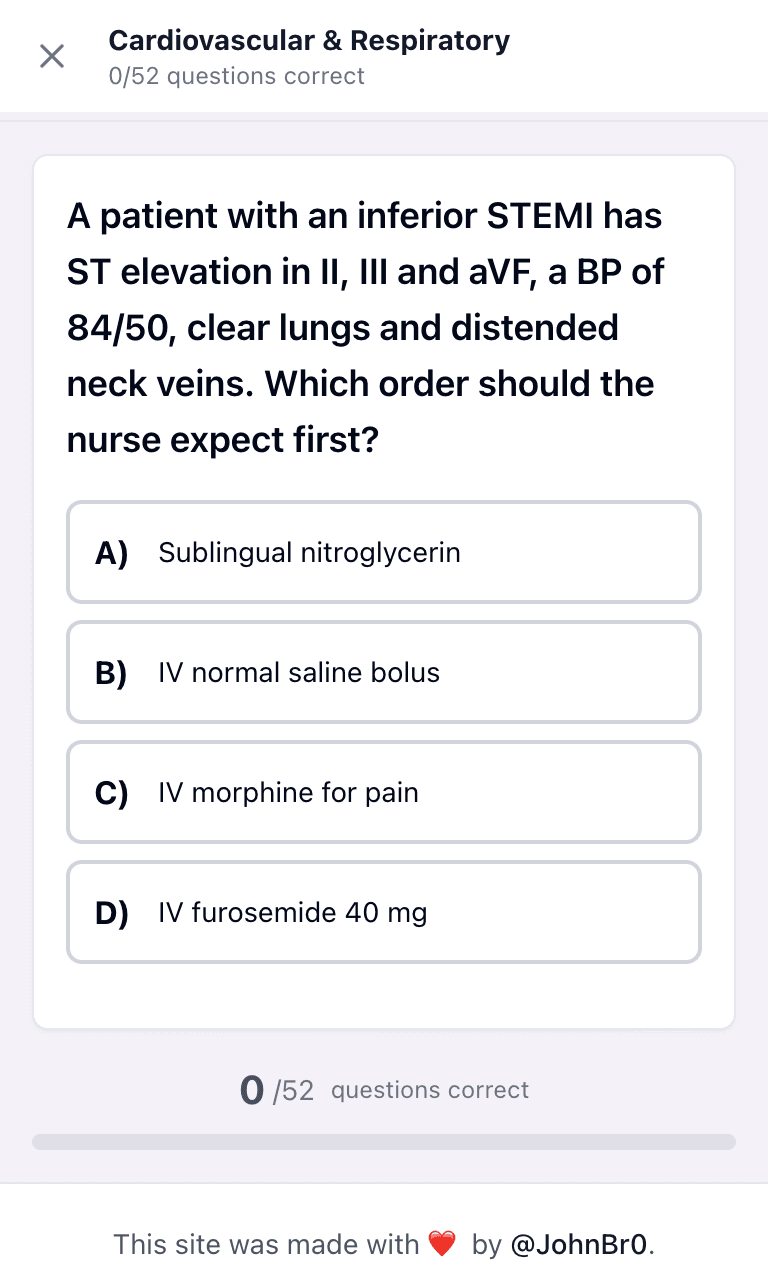
Train on mobile
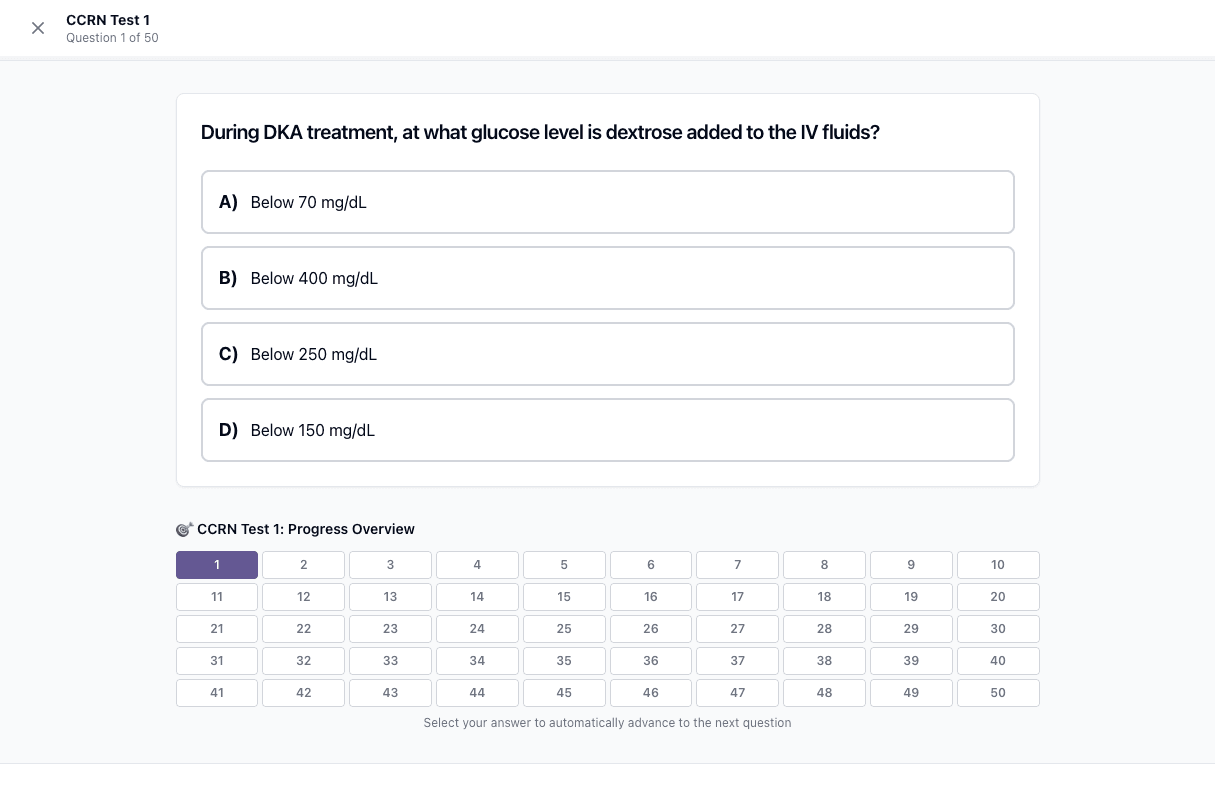
Test on desktop
The CCRN exam at a glance
CCRN (Adult) is the acute and critical care nursing certification of AACN Certification Corporation, for RNs and APRNs who care for acutely or critically ill adults. The exam has 150 multiple-choice questions in 3 hours; 125 are scored and 25 are unscored pretest items. It is taken by computer at a PSI testing center or by live remote proctoring. The passing point is a raw number of correct answers set by a modified Angoff study, not a percentage. Under the Adult test plan for exams taken on and after November 12, 2025, 80% is Clinical Judgment (Cardiovascular 13%, Respiratory 12%, Endocrine, Hematology/Immunology, GI, Renal/GU and Integumentary 21%, Musculoskeletal, Neurological and Behavioral/Psychosocial 18%, Multisystem 16%) and 20% is Professional Caring and Ethical Practice. Certification lasts 3 years.
Tigertest has 200 CCRN practice questions with explanations, free to start with no account required.
- Questions
- 150 multiple choice (125 scored, 25 unscored)
- Time
- 3 hours
- Pass mark
- A raw cut score set by modified Angoff, not a percentage
- Content
- Clinical Judgment 80% (CV 13, respiratory 12, endocrine/heme/GI/renal/skin 21, neuro/MSK/behavioral 18, multisystem 16), Professional Caring and Ethical Practice 20%
- Eligibility
- U.S. RN or APRN license; 1,750 direct care hours in 2 years or 2,000 in 5 years
- Where
- PSI testing centers or live remote proctoring
- Retakes
- Up to 4 attempts in a rolling 12 months
- Run by
- AACN Certification Corporation
Updated by the Tigertest team. Practice questions follow The AACN CCRN Exam Handbook (Direct Care pathway, July 2026) with the Adult test plan for exams on and after November 12, 2025, and the AACN Certification Exam Policy Handbook (September 2026), checked November 2026. Exam rules change, so confirm current details with AACN: CCRN (Adult) certification.
How It Works
Train by Content Area
Five training sets follow the Adult CCRN test plan: cardiovascular and respiratory; endocrine, hematology, GI and renal; neuro, musculoskeletal and behavioral; multisystem; and professional caring and ethical practice. Questions you miss come back until you have mastered them.
Weighted Mock Exams
Four mock exams of 50 questions, each weighted like the Adult CCRN test plan. Aim for 70% or better. No question appears in more than one test, and every one comes with an explanation.
Built on the Adult CCRN Test Plan
AACN publishes the share of the exam that comes from each area, and every mock exam here keeps that balance, scaled to 50 questions: 7 cardiovascular, 6 respiratory, 10 endocrine, hematology, GI, renal and skin, 9 neuro, musculoskeletal and behavioral, 8 multisystem, and 10 professional caring and ethical practice. The real exam has 150 questions in 3 hours; these forms keep the same mix at a shorter length. Educators running a CCRN review course can set Tigertest as class practice at tigertest.io/teach and see which topics the class misses most.

Help Make Tigertest Better
Have an idea, a topic you'd like covered, or a question that could be clearer? We read every message and use it to improve every test.
Share FeedbackHow to Pass the CCRN Exam
1. Study by body system, weighted like the test plan
Clinical judgment is 80% of the exam, and the combined endocrine, hematology, GI, renal and skin area (21%) is the single largest block. Cardiovascular and respiratory together are another quarter. Spend your time in roughly those proportions.
2. Know the hemodynamic patterns cold
Shock states, preload and afterload, PAOP, cardiac index and SVR, IABP timing, pacemaker problems and CPP all come back to a few patterns. Practice reading a set of numbers and naming the problem before you look at the answers.
3. Learn the current guidelines
Sepsis care, DKA and HHS, ventilation in ARDS, and pain, sedation and delirium have clear published recommendations. Know the thresholds, such as a MAP of 65, a tidal volume of 6 mL/kg of predicted body weight and when potassium delays insulin.
4. Do not skip professional caring and ethics
One question in five comes from the Synergy Model: advocacy, caring practices, clinical inquiry, collaboration, teaching, diversity and systems thinking. Learn each competency's meaning and how it looks in a real situation at the bedside.
CCRN Frequently Asked Questions
What is the CCRN (Adult) exam?
CCRN is the specialty certification in acute and critical care nursing granted by AACN Certification Corporation, the credentialing arm of the American Association of Critical-Care Nurses. The Adult exam is for registered nurses and APRNs who care for, or influence the care of, acutely and critically ill adults. Candidates need a current, unencumbered U.S. RN or APRN license and either 1,750 hours of direct care of acutely or critically ill patients in the previous two years (875 in the most recent year) or 2,000 hours in five years (144 in the most recent year). Separate pathways exist for tele-critical care and knowledge professional roles.
How many questions are on the CCRN exam?
The CCRN exam is a 3-hour test of 150 multiple-choice questions. Of those, 125 are scored and 25 are unscored questions used to gather data on items for future exams. It is taken by computer at a PSI testing center or by live remote proctoring, and results show on screen when you finish.
What score do you need to pass the CCRN?
AACN sets the passing point with a modified Angoff study, in which experts rate every question. The cut score is a raw number of correct answers, not a percentage, and it can change when exam forms are updated, so AACN does not publish it as a percent. The 70 percent line on these practice tests is a readiness target. Your score report shows how many questions you answered correctly in each content area.
What is on the CCRN Adult test plan?
For exams taken on and after November 12, 2025, 80 percent of the exam is Clinical Judgment: Cardiovascular 13 percent, Respiratory 12 percent, Endocrine, Hematology/Immunology, GI, Renal/GU and Integumentary 21 percent, Musculoskeletal, Neurological and Behavioral/Psychosocial 18 percent, and Multisystem 16 percent. The other 20 percent is Professional Caring and Ethical Practice, built on the AACN Synergy Model: advocacy and moral agency, caring practices, clinical inquiry, collaboration, facilitation of learning, response to diversity and systems thinking.
Are these the real CCRN questions?
No. Every question is original, written by Tigertest from the AACN CCRN Exam Handbook and test plan and from current guidelines such as the Surviving Sepsis Campaign 2021, the 2024 hyperglycemic crises consensus report and the SCCM PADIS guideline. The AACN sample questions are not used. Each mock exam is a fixed 50-question form weighted like the test plan, shorter than the real 150. Tigertest is not affiliated with AACN or AACN Certification Corporation.
I teach a CCRN review course or critical care nurse residency. Can my students use Tigertest?
Yes, for free. Make a class at tigertest.io/teach, post one link, and students join with just their name. You see who practiced, their test scores and the topics your class misses most.
CCRN sample questions and answers
6 of the 200 practice questions, one from each topic, with the answer explained.
1. A patient with a continuous-flow left ventricular assist device has no palpable pulse. How is blood pressure best measured?
- A.Automated cuff systolic reading
- B.Doppler with a manual cuff
- C.Capillary refill time
- D.Counting the radial pulse
Answer: B. Continuous-flow devices produce little pulsatility, so automated cuffs often fail and pulses may be absent. The pressure at which the Doppler signal returns approximates the mean arterial pressure, which is the value followed.
2. What is the usual first-line treatment for immune thrombocytopenia in an adult without life-threatening bleeding?
- A.Platelet transfusion
- B.A heparin infusion
- C.Plasma exchange
- D.Corticosteroids
Answer: D. Steroids, with IV immunoglobulin when a quick rise is needed, reduce antibody-driven platelet destruction in ITP. Transfused platelets are destroyed quickly and are kept for serious bleeding; plasma exchange treats TTP.
3. A peripheral IV running norepinephrine has infiltrated, and the skin is pale and cool. Which antidote is usually injected into the area?
- A.Phentolamine
- B.IV naloxone
- C.Hyaluronidase
- D.Heparin flush
Answer: A. Phentolamine, an alpha blocker, reverses the local vasoconstriction from vasopressor extravasation. Hyaluronidase is used for other vesicants and hypertonic fluids. The infusion is stopped and moved first.
4. Which approach does the PADIS guideline suggest to improve sleep in the ICU?
- A.Aromatherapy and music
- B.Routine sleep EEGs
- C.Less noise and light
- D.Propofol for sleep
Answer: C. PADIS suggests noise and light reduction and a multicomponent sleep protocol. It suggests against propofol to improve sleep and does not suggest aromatherapy, acupressure or music for it.
5. A malnourished patient with alcohol use disorder is confused with an unsteady gait and abnormal eye movements. Which order of treatment is correct?
- A.Naloxone before thiamine
- B.Glucose before thiamine
- C.Thiamine before glucose
- D.Folic acid alone
Answer: C. These signs suggest Wernicke encephalopathy. Thiamine is given before or with glucose, because a glucose load uses up the remaining thiamine and can worsen the injury.
6. Nurses on a unit are ignoring frequent false monitor alarms. Which change best reduces alarm fatigue?
- A.Customize alarm limits
- B.Turn off SpO2 alarms
- C.Turn the volumes down
- D.Keep default limits
Answer: A. Setting alarm limits and delays to the individual patient, changing electrodes daily and removing monitoring that is not needed cut false alarms so that real ones are heard. Silencing or ignoring alarms puts patients at risk.
CCRN practice questions by topic
Ten questions on each area of the exam, with the answers explained.
Related practice tests
Every test on Tigertest is free to start, with no account needed.
- NCLEX-RN Practice TestNCSBN 2026 RN test plan
- NCLEX-PN Practice TestNCSBN 2026 PN test plan
- NAPLEX Practice TestNABP · North American Pharmacist Licensure Examination
- CNA Practice TestNurse aide written exam
- PTCB Practice TestPharmacy technician certification
- Phlebotomy Practice TestPhlebotomy certification practice
Ready to Pass the CCRN?
Start for free. No account required. 200 questions across every area of the Adult CCRN test plan.
Start practicing