
Free CEH Practice Test 2026
200 original questions weighted to EC-Council's CEH v13 blueprint, from footprinting and scanning to web, wireless, cloud and crypto attacks. Tuned for mobile. Free to start, no account needed.
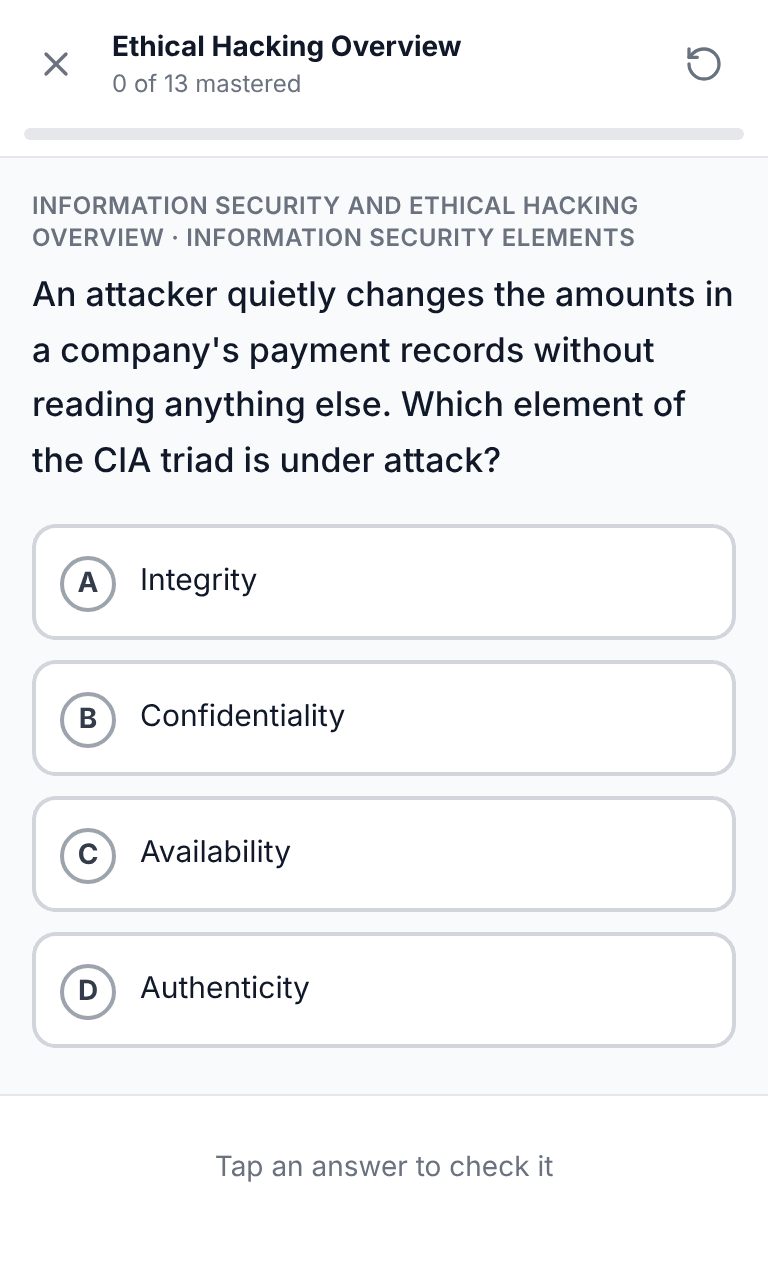
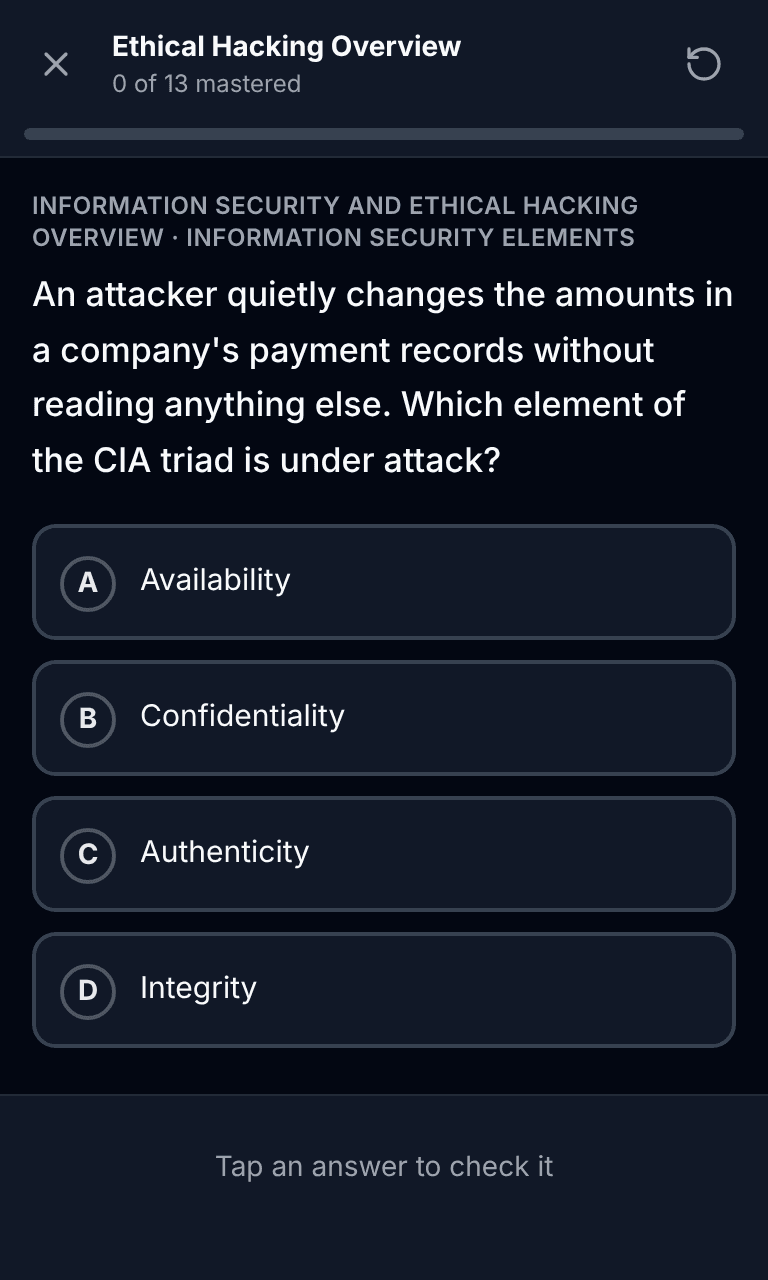
Train on mobile
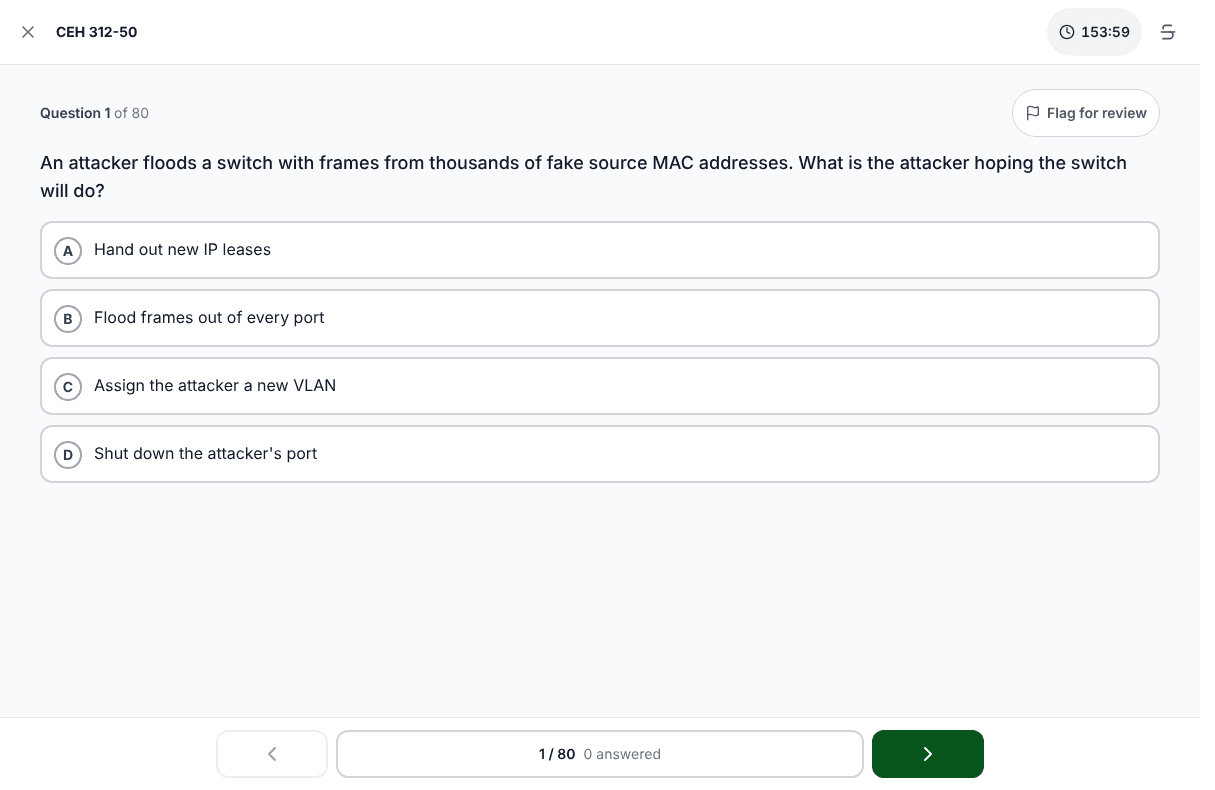
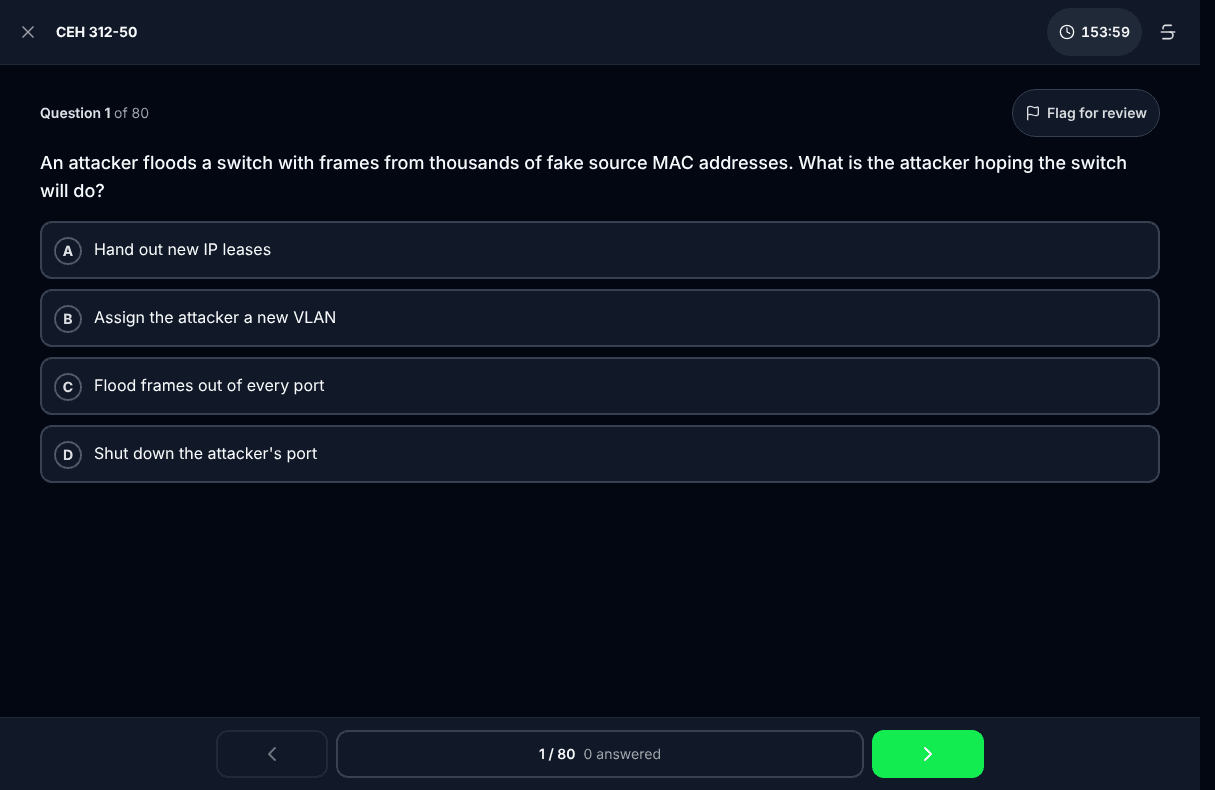
Test on desktop
The CEH exam at a glance
The EC-Council Certified Ethical Hacker exam (CEH v13, exam 312-50) has 125 multiple-choice questions in 4 hours and is not open book. EC-Council sets a cut score for each exam form between 60% and 85%, depending on how hard that form's questions are. The CEH Exam Blueprint v5.0 weights nine domains: Information Security and Ethical Hacking Overview 6%, Reconnaissance Techniques 17%, System Hacking Phases and Attack Techniques 15%, Network and Perimeter Hacking 24%, Web Application Hacking 14%, Wireless Network Hacking 5%, Mobile Platform, IoT and OT Hacking 10%, Cloud Computing 5% and Cryptography 5%. The credential is valid for three years and is renewed with 120 continuing education credits.
Tigertest has 200 CEH practice questions with explanations, free to start with no account required.
- Questions
- 125 multiple choice
- Time
- 4 hours
- Passing score
- 60% to 85%, set for each exam form
- Exam code
- 312-50 (CEH v13)
- Valid for
- 3 years, renewed with 120 credits
- Given by
- EC-Council, at ECC Exam Centres, Pearson VUE or remote proctoring
Updated by the Tigertest team. Practice questions follow EC-Council's CEH Exam Blueprint v5.0, the CEH certification page and the CEH Candidate Handbook, checked November 2026. Exam rules change, so confirm current details with EC-Council: Certified Ethical Hacker.
How It Works
Seven Drills
One drill per part of the blueprint: ethical hacking overview, reconnaissance, system hacking and malware, network and perimeter hacking, web application hacking, wireless, mobile, IoT and OT, and cloud and cryptography. Questions you miss come back until you have mastered them.
Practice Tests
Two 80-question tests in 154 minutes with flagging and review, the same pace as the real 125 questions in 4 hours. Practice Test 2 is held out of the drills, so it measures readiness, not memory.
Built on the CEH Exam Blueprint
EC-Council publishes how many questions come from each domain. Every practice test follows those weights, from footprinting and scanning through system, network and web attacks to the cloud and cryptography.

Help Make Tigertest Better
Have an idea, a topic you'd like covered, or a question that could be clearer? We read every message and use it to improve every test.
Share FeedbackHow to Pass CEH
1. Put your time where the weight is
Network and perimeter hacking alone is about a quarter of the exam, and reconnaissance and system hacking add almost a third more. Learn sniffing, social engineering, DoS, session hijacking and IDS evasion well before you spend long on the small domains.
2. Know what each scan and response means
Many questions describe a probe and a reply and ask what it shows. Know how a closed port answers a SYN, what silence means to a FIN, NULL or Xmas scan, what an ACK scan maps, how an idle scan works and which ports common services use.
3. Learn each attack with its defence
For every attack, know the countermeasure the exam expects: port security for MAC flooding, DHCP snooping for rogue servers, dynamic ARP inspection for ARP poisoning, SYN cookies for SYN floods, HttpOnly and new session IDs for hijacking, salts for rainbow tables.
4. Drill your weak area, then sit a full test
Tigertest tracks your accuracy by domain. Retake the drill you miss most until you clear 80 percent, then take Practice Test 2 cold, at the real exam's pace of a little under two minutes a question.
CEH Frequently Asked Questions
How many questions are on the CEH exam?
The CEH knowledge exam (312-50) has 125 multiple-choice questions in 4 hours. It is not open book, and you take it at an ECC Exam Centre, a Pearson VUE center or by remote proctoring.
What is the passing score for CEH?
EC-Council sets a cut score for each exam form, anywhere from 60 percent to 85 percent, depending on how hard that form's questions are. You are not told which form you will get, so aim for 80 percent or better on these practice tests before you book.
What is on the CEH v13 exam?
Nine domains from the CEH Exam Blueprint v5.0: Information Security and Ethical Hacking Overview 6 percent, Reconnaissance Techniques 17 percent, System Hacking Phases and Attack Techniques 15 percent, Network and Perimeter Hacking 24 percent, Web Application Hacking 14 percent, Wireless Network Hacking 5 percent, Mobile Platform, IoT and OT Hacking 10 percent, Cloud Computing 5 percent and Cryptography 5 percent.
Is CEH v13 the current version?
Yes. EC-Council says CEH is currently on version 13 and that it releases new versions every 12 to 18 months. No successor has been announced, so v13 is the version to study for.
Is this practice test the same format as the real exam?
Each practice test is 80 multiple-choice questions in 154 minutes, the same pace as the real 125 questions in 4 hours, with free navigation and flagging. The questions follow the blueprint's weights. The hands-on CEH Practical exam is not modelled, and no working exploit payloads are shown.
Is the Tigertest CEH practice test free?
It is free to start, with no account required. Practice Test 1 and every drill but the last are free; the last drill (Cloud and Cryptography) and the final practice test are part of Tigertest Premium, one payment with no subscription. Create a free account if you want your progress saved across devices.
I teach a CEH or ethical hacking course. Can my students use Tigertest?
Yes, for free. Make a class at tigertest.io/teach, post one link, and students join with just their name. You see who practiced, their test scores and the topics your class misses most.
CEH sample questions and answers
6 of the 200 practice questions, one from each topic, with the answer explained.
- 1.
Which U.S. law requires public companies to keep reliable financial records and internal controls over them, which reach the IT systems that hold those records?
- A.
HIPAA
- B.
FISMA
- C.
Digital Millennium Copyright Act
- D.
Sarbanes-Oxley Act
Answer: D.SOX was passed after major accounting scandals and makes executives answer for financial reporting controls. HIPAA covers health information, and the DMCA covers copyright.
- A.
- 2.
Which port and protocol does an SNMP agent listen on for queries?
- A.
TCP 389
- B.
TCP 161
- C.
UDP 162
- D.
UDP 161
Answer: D.SNMP agents take requests on UDP 161, and traps are sent to the manager on UDP 162. TCP 389 is LDAP.
- A.
- 3.
An analyst studies a suspicious file by reading its strings, headers and imported functions without running it. What kind of analysis is this?
- A.
Behavioural sandboxing
- B.
Memory forensics
- C.
Static analysis
- D.
Dynamic analysis
Answer: C.Static analysis examines the code and file structure without executing it. Dynamic analysis runs the sample, usually in an isolated sandbox, and watches what it does.
- A.
- 4.
Which firewall type works at the session layer, checking that a TCP handshake is legitimate before relaying the session, without looking at the data inside the packets?
- A.
Application proxy firewall
- B.
Router access list
- C.
Static packet filter
- D.
Circuit-level gateway
Answer: D.A circuit-level gateway (SOCKS is the classic example) validates the session setup and then relays traffic without inspecting its content. An application proxy reads the content, and a static packet filter judges each packet alone.
- A.
- 5.
Besides fixing the code, which setting limits the damage of a SQL injection in a web application?
- A.
A shared admin login for all apps
- B.
A least-privilege database account
- C.
Turning off query logging
- D.
Verbose database error pages for users
Answer: B.If the app's database account can only read the tables it needs, an injection cannot drop tables or reach other databases. Verbose errors help attackers, not defenders.
- A.
- 6.
An attacker uses a Bluetooth flaw to copy contacts and messages from a phone without the owner's knowledge. What is this attack called?
- A.
Bluesnarfing
- B.
Bluejacking
- C.
Bluesmacking
- D.
Blueprinting
Answer: A.Bluesnarfing steals data over Bluetooth. Bluejacking only sends unsolicited messages, bluesmacking is a denial of service, and blueprinting fingerprints a device.
- A.
Related practice tests
Every test on Tigertest is free to start, with no account needed.
- CompTIA Security+ Practice TestCompTIA SY0-701
- CompTIA CySA+ Practice TestCompTIA CS0-004
- CompTIA PenTest+ Practice TestCompTIA · PenTest+ PT0-003 exam objectives
- Fortinet NSE 1 (FCF) Practice TestFortinet Training Institute · NSE 1 Cybersecurity and Cloud Fundamentals (formerly FCF)
- CISSP Practice TestISC2 · CISSP exam outline, April 2024
- CompTIA Network+ Practice TestCompTIA N10-009
Ready to Pass CEH?
Start for free. No account required. 200 questions across all nine domains.
Start practicing