
Free CEN Practice Test 2026
200 original questions on the BCEN content outline effective July 2026: cardiac, respiratory, neuro, trauma, toxicology, triage and more. Four 50-question mock exams. Tuned for mobile. Free to start, no account needed.
Try one now
Pick an answer
A patient with chest pain arrives in the emergency department. Within how many minutes of arrival should a 12-lead ECG be done?
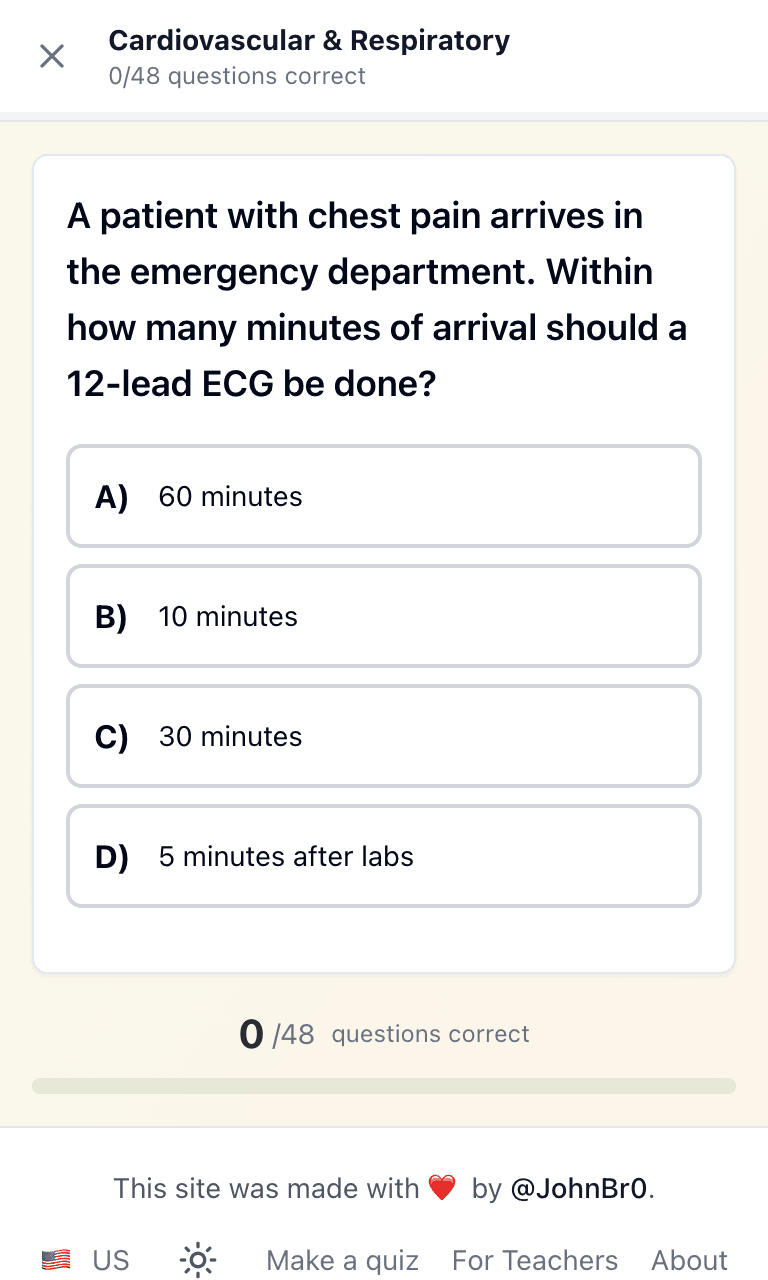
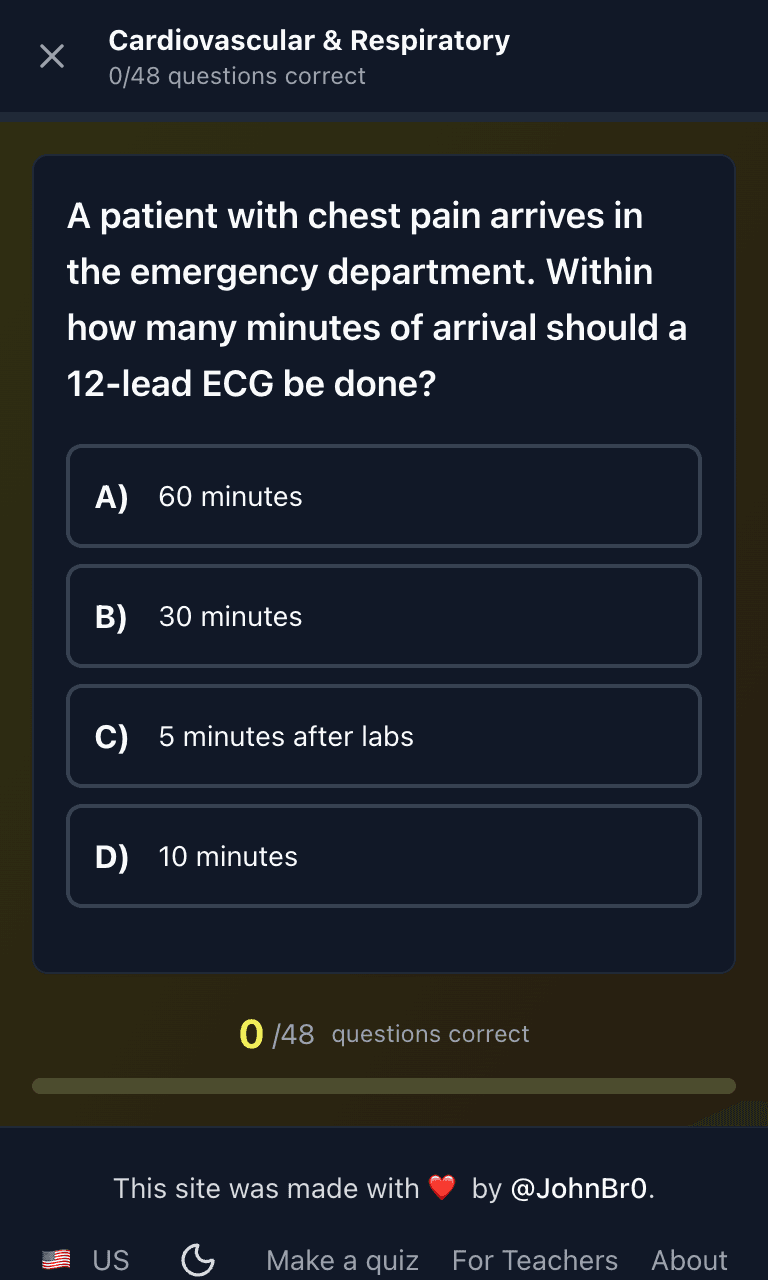
Train on mobile
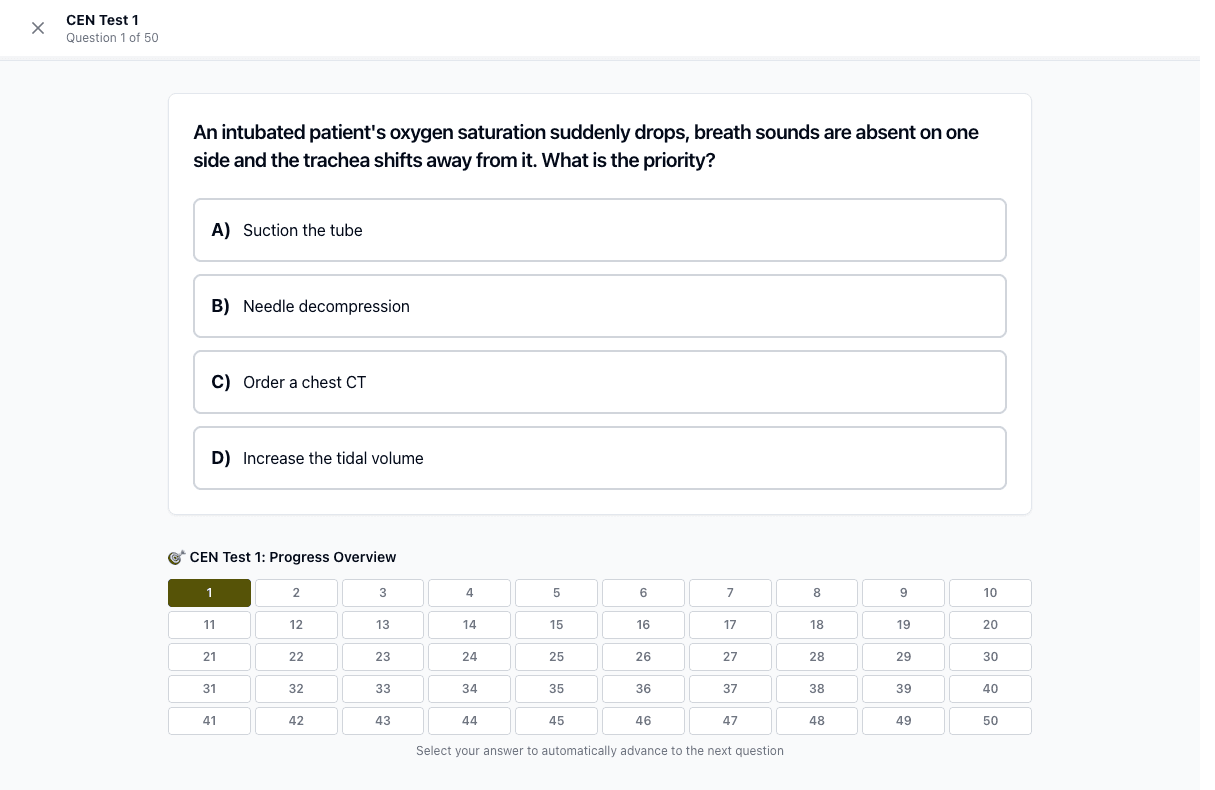
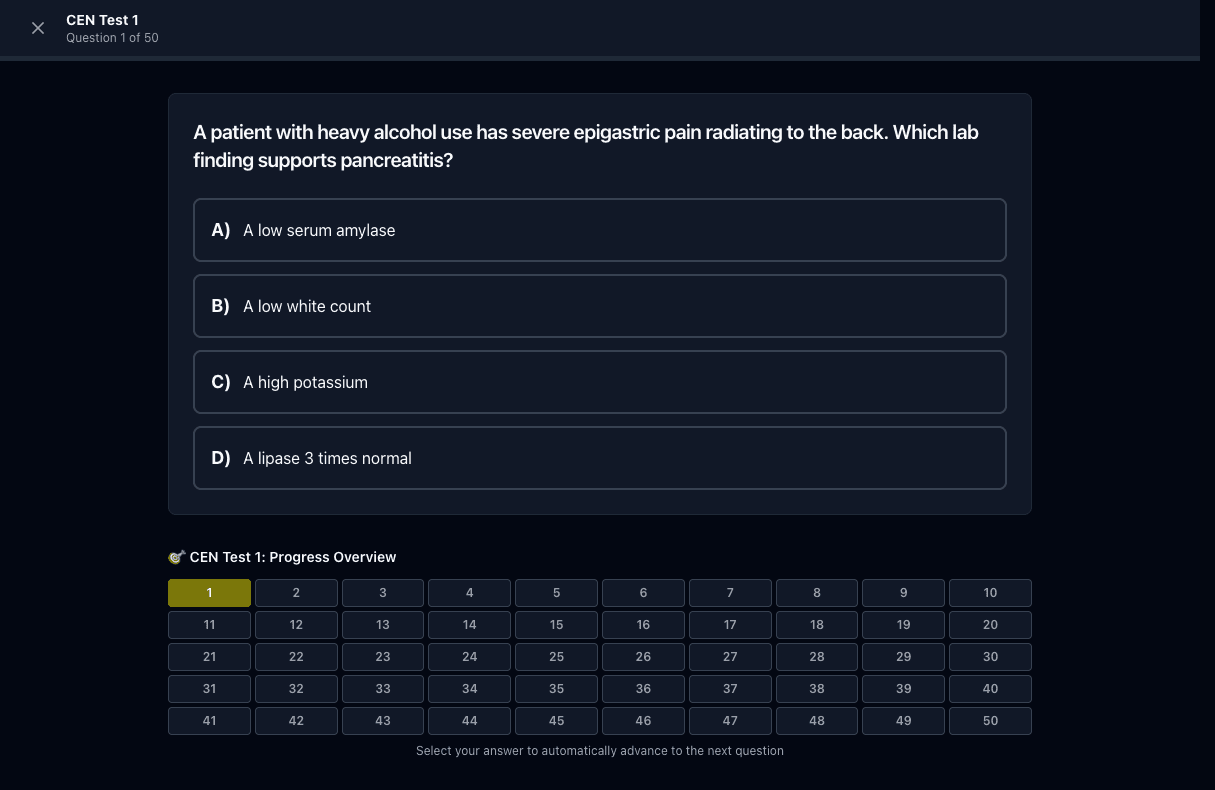
Test on desktop
The CEN exam at a glance
The Certified Emergency Nurse (CEN) exam is the Board of Certification for Emergency Nursing's (BCEN) exam for registered nurses in emergency care. It has 175 multiple-choice items, 150 scored and 25 unscored pretest items, with 180 minutes of seat time, taken by computer at a PSI test center or at home by live remote proctoring. Under the content outline in effect from July 2026 the 150 scored items cover eleven areas, led by cardiovascular (18), respiratory (17) and neurological (17) emergencies. A pass needs 99 of the 150 scored items right, a raw count with no curve. After a failed attempt you wait 90 days to retest, and the CEN is renewed every four years.
Tigertest has 200 CEN practice questions with explanations, free to start with no account required.
- Questions
- 175 multiple choice (150 scored, 25 pretest)
- Time
- 180 minutes of seat time
- Pass mark
- 99 of 150 scored items (66%)
- Content
- 11 areas: cardiovascular 18, respiratory 17, neurological 17, medical 15, GI 14, mental health 13, environment and toxicology 13, professional issues 12, musculoskeletal and wound 11, GU/OB 10, HEENT 10
- Where
- PSI test center or live remote proctoring
- Retake
- Wait 90 days after a failed attempt
- Renewal
- Every four years
- Run by
- Board of Certification for Emergency Nursing (BCEN)
- Exam fee
- $285 for ENA members, $380 for non-members official source
Fee and retake rules checked on 2026-11-10.
Updated by the Tigertest team. Practice questions follow The BCEN CEN Examination Content Outline effective July 2026 and the BCEN CEN exam FAQ, checked November 2026. Exam rules change, so confirm current details with BCEN: Certified Emergency Nurse (CEN).
How It Works
Train by Content Area
Five training sets follow the BCEN content outline: cardiovascular and respiratory; neurological and gastrointestinal; GU, obstetric, mental health and medical; wounds, HEENT and toxicology; and professional issues. Questions you miss come back until you have mastered them.
Weighted Mock Exams
Four mock exams of 50 questions, each weighted like the 150 scored items on the real exam. Aim for 66% or better, the real pass line. No question appears in more than one test, and every one comes with an explanation.
Built on the BCEN Content Outline
BCEN publishes how many of the 150 scored items come from each of the eleven content areas, and every mock exam here keeps that balance, scaled to 50 questions. Educators running a CEN review course can set Tigertest as class practice at tigertest.io/teach and see which topics the group misses most.

Help Make Tigertest Better
Have an idea, a topic you'd like covered, or a question that could be clearer? We read every message and use it to improve every test.
Share FeedbackHow to Pass the CEN Exam
1. Start with the big three
Cardiovascular, respiratory and neurological emergencies are 52 of the 150 scored items. Know ACS and its ECG territories, the arrest rhythms and what to do for each, tension pneumothorax, asthma and COPD, stroke timing and raised intracranial pressure.
2. Learn the antidotes and the numbers
Toxicology and medical emergencies reward recall: naloxone, N-acetylcysteine, hydroxocobalamin, calcium for hyperkalemia, the Parkland formula, the rule of nines and the Glasgow Coma Scale. Work each calculation until the setup is automatic.
3. Do not skip professional issues
Twelve items cover triage, mass casualty, EMTALA, consent, forensic evidence, abuse reporting, drug diversion and workplace violence. These are easy points once you know the rules.
4. Fix your misses, then retest
Tigertest tracks your accuracy by content area. Aim for 66% or better on every mock exam before your exam date, then push higher. After each test, drill the questions you missed and retrain the weakest area.
CEN Exam Frequently Asked Questions
What is the CEN exam?
The Certified Emergency Nurse (CEN) exam is the certification exam of the Board of Certification for Emergency Nursing (BCEN). Passing it earns the CEN credential, which shows a registered nurse's knowledge of emergency nursing across every age group. The CEN is renewed every four years.
How many questions are on the CEN exam?
The exam has 175 multiple-choice items: 150 are scored and 25 are unscored pretest items you cannot tell apart. You have 180 minutes of seat time. It is taken by computer at a PSI test center or at home by live remote proctoring.
What score do you need to pass the CEN exam?
BCEN says candidates must answer 99 of the 150 scored items correctly, which is 66 percent. It is a raw count, not a curve. The practice tests here use the same 66 percent line. After a failed attempt you wait 90 days before retesting.
What is on the CEN exam?
Under the content outline in effect from July 2026, the 150 scored items cover eleven areas: cardiovascular 18, respiratory 17, neurological 17, gastrointestinal 14, genitourinary, gynecology and obstetrical 10, mental health 13, medical 15, musculoskeletal and wound 11, head, eye, ear, nose and throat 10, environment and toxicology emergencies and communicable diseases 13, and professional issues 12. Each 50-question practice test here keeps that balance.
Are these the real CEN exam questions?
No. Every question is original, written by Tigertest from BCEN's published content outline and current clinical guidance, so it covers the same knowledge without copying the exam. Rhythm strips and wounds are described in words. Tigertest is not affiliated with BCEN.
I teach a CEN review course. Can my students use Tigertest?
Yes, for free. Make a class at tigertest.io/teach, post one link, and students join with just their name. You see who practiced, their test scores and the topics your class misses most.
CEN sample questions and answers
6 of the 200 practice questions, one from each topic, with the answer explained.
1. A patient with a history of IV drug use has fever, a new murmur and painless red spots on the palms. What does this suggest?
- A.Acute viral pericarditis
- B.Infective endocarditis
- C.Rheumatic arthritis
- D.Kawasaki disease
Answer: B. Fever with a new murmur and Janeway lesions (painless palm and sole spots) suggests endocarditis. Blood cultures are drawn before antibiotics.
2. A live insect is in a patient's ear canal. What is done first?
- A.Flush with warm water first
- B.Grab it with forceps
- C.Leave it to crawl out
- D.Kill it with mineral oil
Answer: D. Mineral oil or lidocaine kills the insect so it stops moving and hurting, then it can be removed safely.
3. What is the recommended treatment for uncomplicated gonorrhea in an adult under 150 kg?
- A.Ceftriaxone 500 mg IM
- B.Azithromycin 1 g orally
- C.Penicillin G IM weekly
- D.Metronidazole for 7 days
Answer: A. CDC 2021 guidelines recommend a single 500 mg IM dose of ceftriaxone, with doxycycline added if chlamydia is not excluded.
4. A patient with gastroenteritis is weak with a potassium of 2.9 mEq/L. Which ECG change is expected?
- A.Shortened QT
- B.Tall P waves only
- C.Prominent U waves
- D.Peaked T waves
Answer: C. Hypokalemia flattens T waves and produces U waves. Peaked T waves are a sign of high potassium.
5. A newborn's heart rate is 50 beats per minute despite effective ventilation. What is the next step?
- A.Give oral glucose
- B.Stop the ventilation
- C.Start chest compressions
- D.Keep watching closely
Answer: C. Compressions begin when the newborn heart rate stays below 60 after 30 seconds of effective ventilation, at a 3:1 ratio with breaths.
6. A patient revived with naloxone after a long-acting opioid overdose wants to leave. Why is monitoring continued?
- A.Naloxone can wear off first
- B.Naloxone causes seizures
- C.The opioid is now gone
- D.Naloxone raises sugar
Answer: A. Naloxone often lasts a shorter time than the opioid, so breathing can slow again. Repeat doses or an infusion may be needed.
CEN practice questions by topic
Ten questions on each area of the exam, with the answers explained.
Related practice tests
Every test on Tigertest is free to start, with no account needed.
- NCLEX-RN Practice TestNCSBN 2026 RN test plan
- NCLEX-PN Practice TestNCSBN 2026 PN test plan
- NAPLEX Practice TestNABP · North American Pharmacist Licensure Examination
- CNA Practice TestNurse aide written exam
- PTCB Practice TestPharmacy technician certification
- Phlebotomy Practice TestPhlebotomy certification practice
Ready to Pass the CEN Exam?
Start for free. No account required. 200 questions across every area of the BCEN content outline.
Start practicing