
Free CIS Instrument Specialist Practice Test 2026
200 original questions on the HSPA CIS exam content outline: instrument identification, materials, inspection and testing, implants, packaging, loaners, tracking and water quality. Four 50-question practice tests. Tuned for mobile. Free to start, no account needed.
Try one now
Pick an answer
Before the day's cases start, the decontamination lead checks detergent stock, brush sizes and which trays come back first. What part of the cleaning process is this?
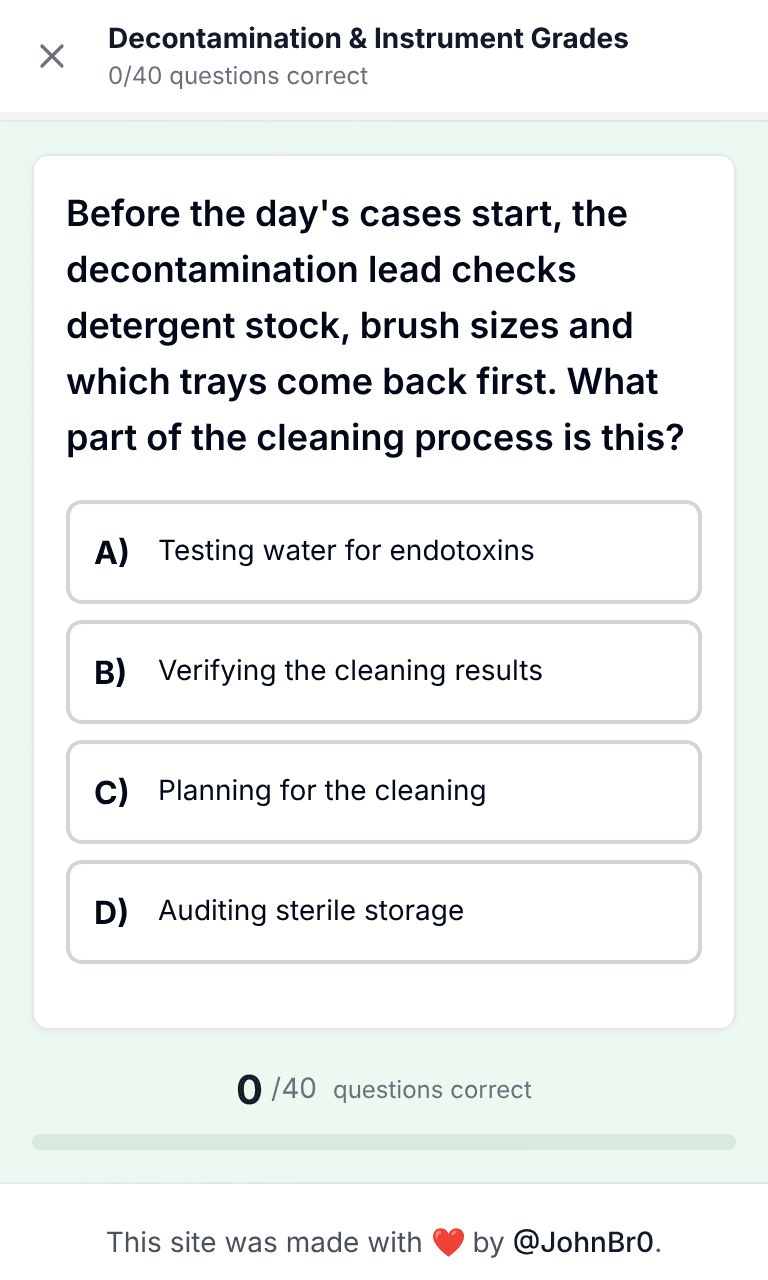
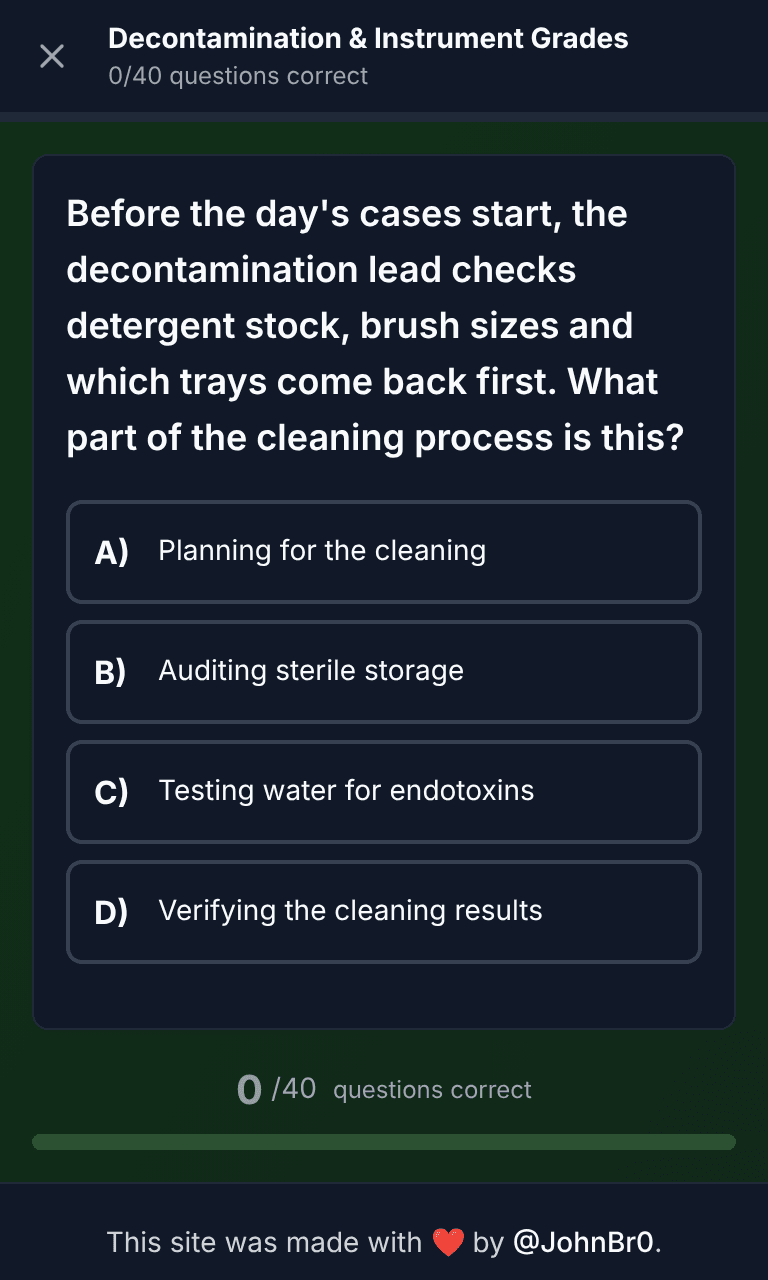
Train on mobile
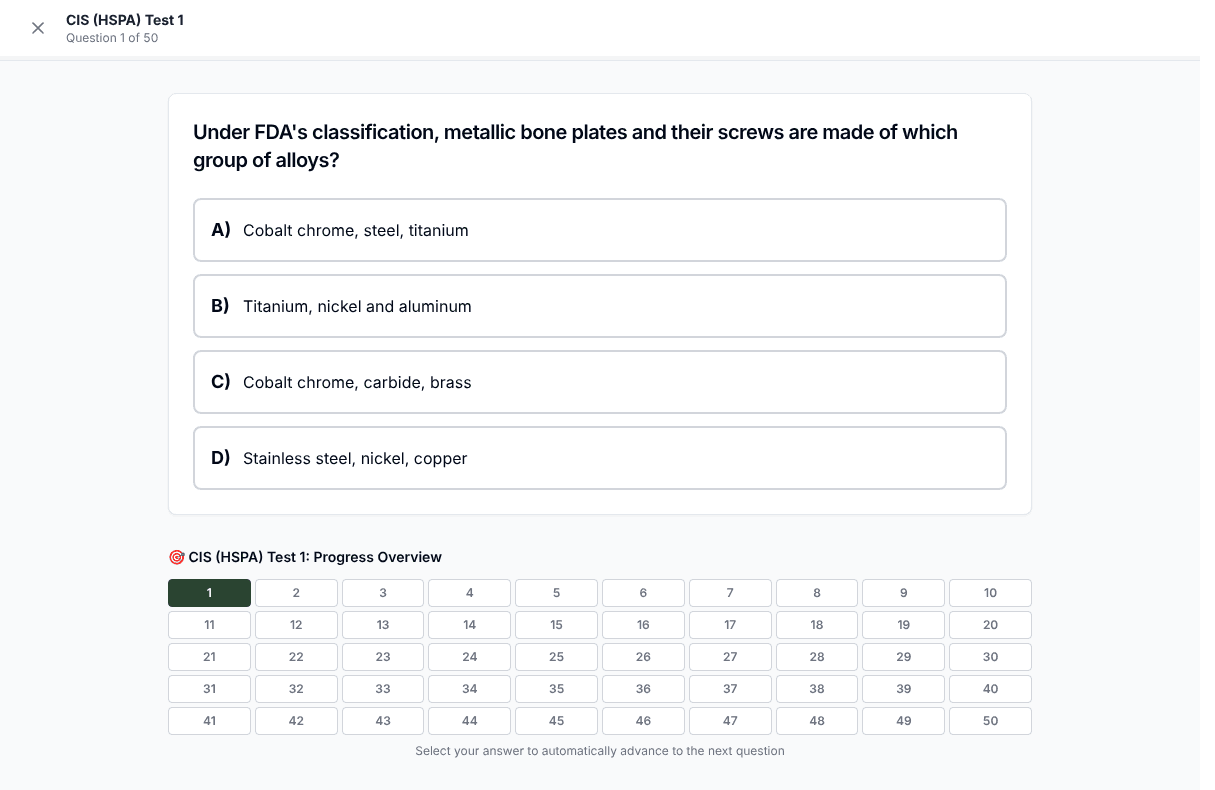
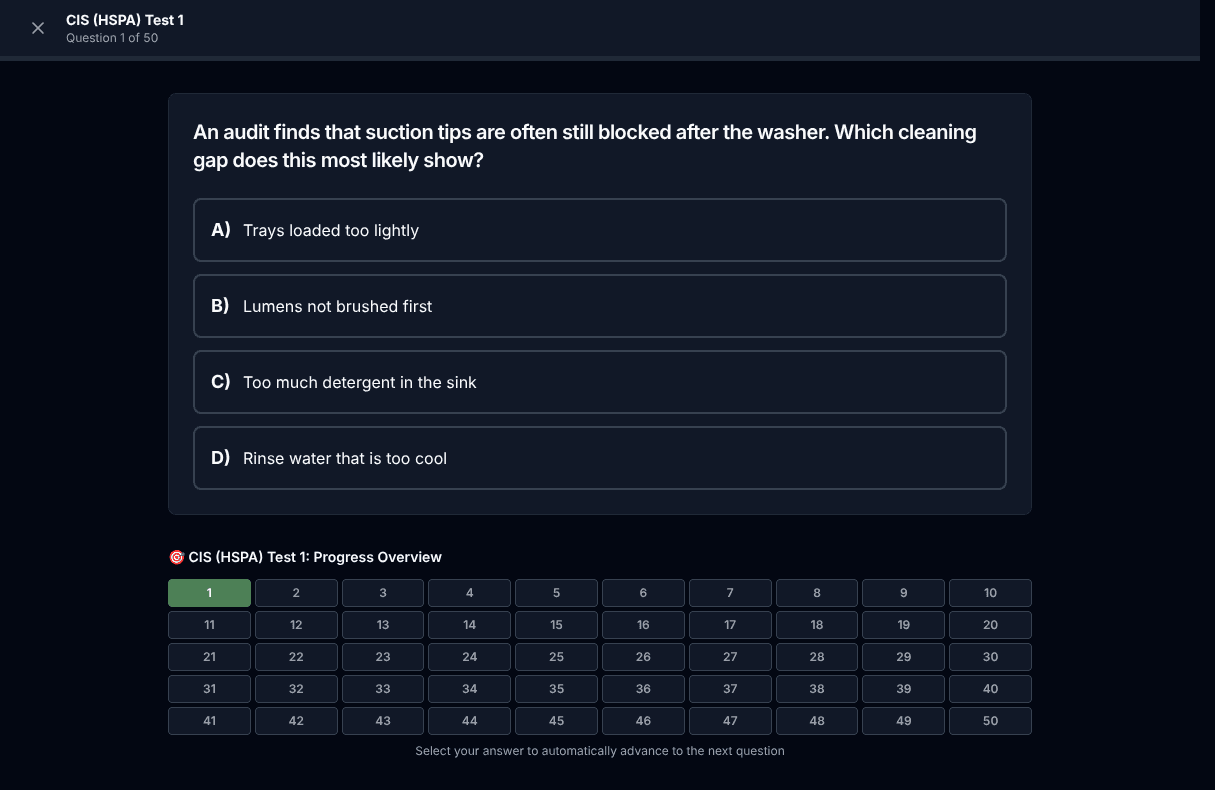
Test on desktop
The CIS (HSPA) exam at a glance
The Certified Instrument Specialist (CIS) exam is the Healthcare Sterile Processing Association's (HSPA) advanced certification for sterile processing technicians who identify, inspect, test, assemble and track surgical instruments. HSPA's handbook gives it 150 multiple-choice questions, 125 scored and 25 unscored pretest items, taken on a computer at a Prometric test center in 3 hours. Pass or fail depends on the number of scored questions answered correctly against a passing point HSPA sets by the Angoff method and does not publish as a percentage. To apply, candidates must hold a current CRCST and document 200 hours of hands-on sterile processing experience, separate from their CRCST hours, and the certification is renewed every year with continuing education.
Tigertest has 200 CIS (HSPA) practice questions with explanations, free to start with no account required.
- Questions
- 150 multiple choice (125 scored, 25 pretest)
- Time
- 3 hours
- Pass mark
- Set number of scored questions correct (Angoff method); no percentage published
- Largest section
- Instrumentation identification, 32%
- Eligibility
- Current CRCST plus 200 hours of hands-on sterile processing experience
- Where
- Computer based at Prometric test centers
- Renewal
- Every year, with continuing education
- Run by
- Healthcare Sterile Processing Association (HSPA)
Updated by the Tigertest team. Practice questions follow HSPA's CIS Exam Content Outline (revised October 2024) and Certification Handbook (revised January 2026), checked November 2026. Exam rules change, so confirm current details with HSPA: Certified Instrument Specialist (CIS).
How It Works
Train by Outline Section
Five training sets follow the HSPA CIS outline: decontamination and instrument grades; specialty instruments and implants; inspection, testing and repair; quality and information systems; and packaging and sterilization. Questions you miss come back until you have mastered them.
Weighted Practice Tests
Four practice tests of 50 questions, each weighted like the six sections of the real exam. Aim for 70% or better. No question appears in more than one test, and every one comes with an explanation.
Built on the HSPA CIS Content Outline
HSPA publishes the weight of each of the six sections, and every practice test here keeps that balance, scaled to 50 questions: 16 on instrumentation identification, 10 each on inspection and testing and on quality and information systems, 6 on decontamination, 5 on packaging and 3 on disinfection and sterilization. Sterile processing program instructors can set Tigertest as CIS review at tigertest.io/teach and see which topics the class misses most.

Help Make Tigertest Better
Have an idea, a topic you'd like covered, or a question that could be clearer? We read every message and use it to improve every test.
Share FeedbackHow to Pass the CIS Exam
1. Know the instruments by name and use
Instrumentation identification is 32% of the exam. Learn the instruments of each specialty, from rongeurs, osteotomes and reamers to lid specula, bulldog clamps and cervical dilators, the surgical terms that name procedures, and how grade, metal and finish change how an instrument is used and cared for.
2. Inspect and test like a specialist
Inspection, testing and assembly are 20%. Know what magnification, a borescope, an insulation tester and test media show, how to tell staining from rust, when an instrument goes for repair, and how preventive maintenance keeps sets in service.
3. Do not skip quality and systems
Quality and information systems are another 20%. Know UDI and tracking systems, count sheet upkeep, the loaner process from receipt to pickup, water categories and what poor water does to steel, and the audits and teamwork that cut immediate-use sterilization.
4. Fix your misses, then retest
Tigertest tracks your accuracy by category. Aim for 70% or better on every practice test before your exam date. After each test, drill the questions you missed and retrain the weakest category.
CIS Exam Frequently Asked Questions
What is the HSPA CIS exam?
It is the certification exam for the Certified Instrument Specialist credential from the Healthcare Sterile Processing Association (HSPA). It covers the identification, cleaning, inspection, testing, assembly, packaging and tracking of surgical instruments, along with implants, loaned instrumentation and water quality. CIS is a secondary certification: candidates must hold a current CRCST and document 200 hours of hands-on sterile processing experience, separate from the hours used for the CRCST.
How many questions are on the CIS exam?
HSPA's certification handbook gives the CIS exam 150 multiple-choice questions: 125 scored and 25 unscored pretest questions mixed in so they cannot be told apart. It is taken on a computer at a Prometric test center, there is no paper version, and candidates have 3 hours. Questions can be marked for review and changed later in the exam.
What score do you need to pass the CIS exam?
HSPA does not publish a percentage. Pass or fail is decided by the number of scored questions answered correctly, against a passing point set by the Angoff procedure with the Beuk compromise and approved by the Certification Council. The 70 percent line on these practice tests is a readiness target, not HSPA's standard.
What is on the CIS exam?
HSPA's content outline, revised October 2024, has six sections. Instrumentation identification is the largest at 32 percent, covering surgical and floor grade instruments, specialty instruments and terminology, materials and finishes, implants and marking methods. Inspection, testing, integrity and assembly and quality and information systems are 20 percent each, decontamination processes is 12 percent, preparation and packaging is 10 percent, and disinfection and sterilization processes is 6 percent. Each practice test here keeps that balance.
Are these the real CIS exam questions?
No. Every question is original, written by Tigertest from HSPA's published content outline and from public sources such as FDA's device classification rules and reprocessing guidance and CDC's sterilization recommendations. Instruments are described in words, not pictures. Always follow the manufacturer's instructions for use for each instrument and product. Tigertest is not affiliated with the Healthcare Sterile Processing Association.
I teach a sterile processing program. Can my students use Tigertest?
Yes, for free. Make a class at tigertest.io/teach, post one link, and students join with just their name. You see who practiced, their test scores and the topics your class misses most.
CIS (HSPA) sample questions and answers
6 of the 200 practice questions, one from each topic, with the answer explained.
1. Ophthalmic cannulas come back with viscoelastic inside. What is the concern if it dries?
- A.It only matters for implants
- B.It leaves a sticky residue
- C.It dissolves in the washer
- D.It etches the cannula lining
Answer: B. Dried viscoelastic leaves a residue that is hard to flush out of fine cannulas. The outline names it as a risk factor for ophthalmic instrumentation.
2. A risk assessment for instrument marking looks at which question?
- A.Whether it costs less than tape
- B.Whether it lasts a full year
- C.Whether it matches set colors
- D.Whether it harms the device
Answer: D. Marking must not harm the instrument's function or cleaning. The UDI rule also excuses direct marking that would interfere with a device's safety or effectiveness.
3. Why does FDA guidance urge caution with oil-based and silicone lubricants on reusable devices?
- A.They can shield microbes
- B.They turn the steel blue
- C.They dull cutting edges
- D.They stain the box locks
Answer: A. FDA warns that these lubricants may coat and protect surface microorganisms and reduce the effectiveness of steam and EO sterilization. The IFU names a compatible lubricant.
4. Why is a bright nickel-plated finish a concern on some lower-grade instruments?
- A.The plating melts in steam
- B.The plating blocks laser marks
- C.Flaking exposes base metal
- D.The plating makes steel harder
Answer: C. Nickel plating over a base metal looks bright when new, but once it chips the base metal corrodes and the flakes can shed into a wound.
5. A peel pouch with a heavy instrument has a pinhole in the plastic after sterilization. What is its status?
- A.Usable for minor cases
- B.Sterile if used today
- C.Not sterile, so repackaged
- D.Sterile if the indicator changed
Answer: C. Any breach of the barrier means the contents are no longer sterile. Heavy or pointed items in pouches should be protected to prevent holes.
6. Why is a multidisciplinary team used to solve an instrument problem that spans SPD, the OR and the vendor?
- A.Each group sees part of it
- B.It moves the cost to the OR
- C.It is faster than one owner
- D.It satisfies the surveyors
Answer: A. Problems that cross departments need people from each one, because no single group sees every step where things go wrong.
Related practice tests
Every test on Tigertest is free to start, with no account needed.
- NCLEX-RN Practice TestNCSBN 2026 RN test plan
- NCLEX-PN Practice TestNCSBN 2026 PN test plan
- NAPLEX Practice TestNABP · North American Pharmacist Licensure Examination
- CNA Practice TestNurse aide written exam
- PTCB Practice TestPharmacy technician certification
- Phlebotomy Practice TestPhlebotomy certification practice
Ready to Pass the CIS Exam?
Start for free. No account required. 200 questions across every section of the HSPA CIS content outline.
Start practicing