
Free CompTIA SecurityX Practice Test
240 original enterprise-security MCQs, four drills and two practice tests. Interactive performance tasks are not included. Free to start, no account needed.
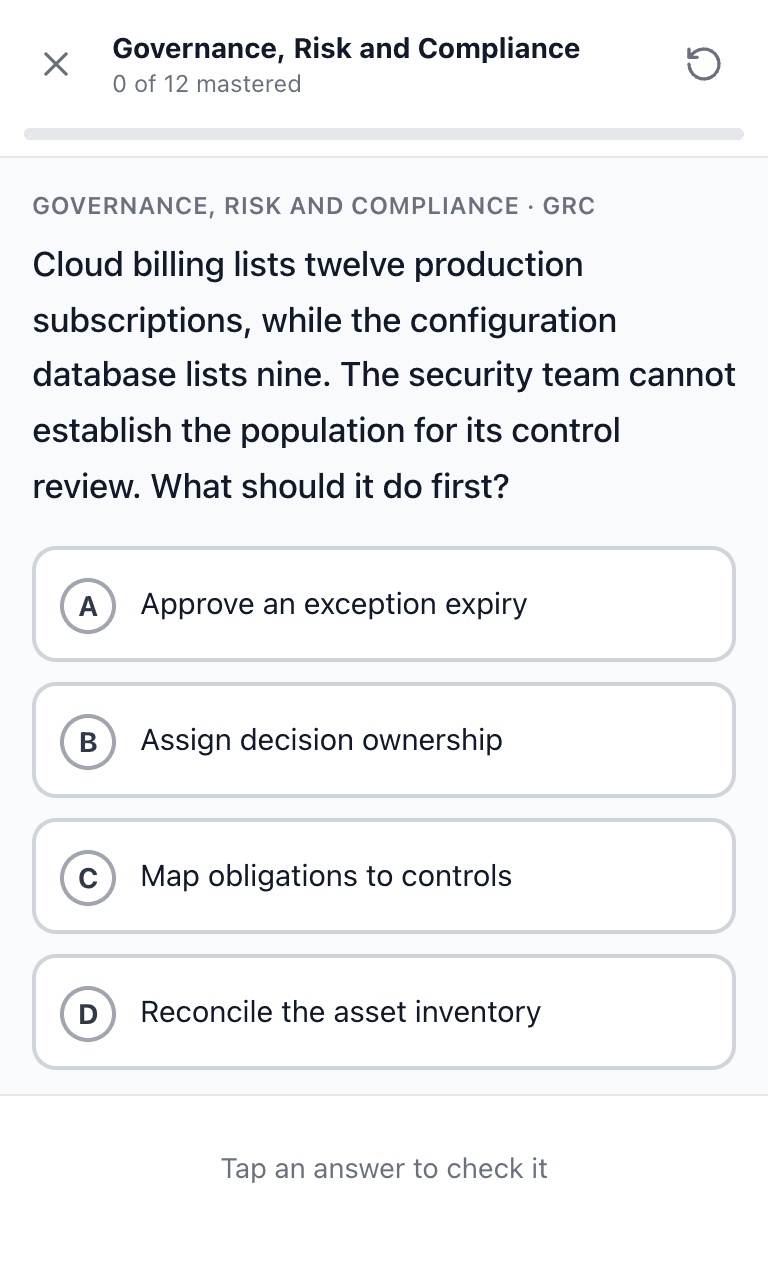
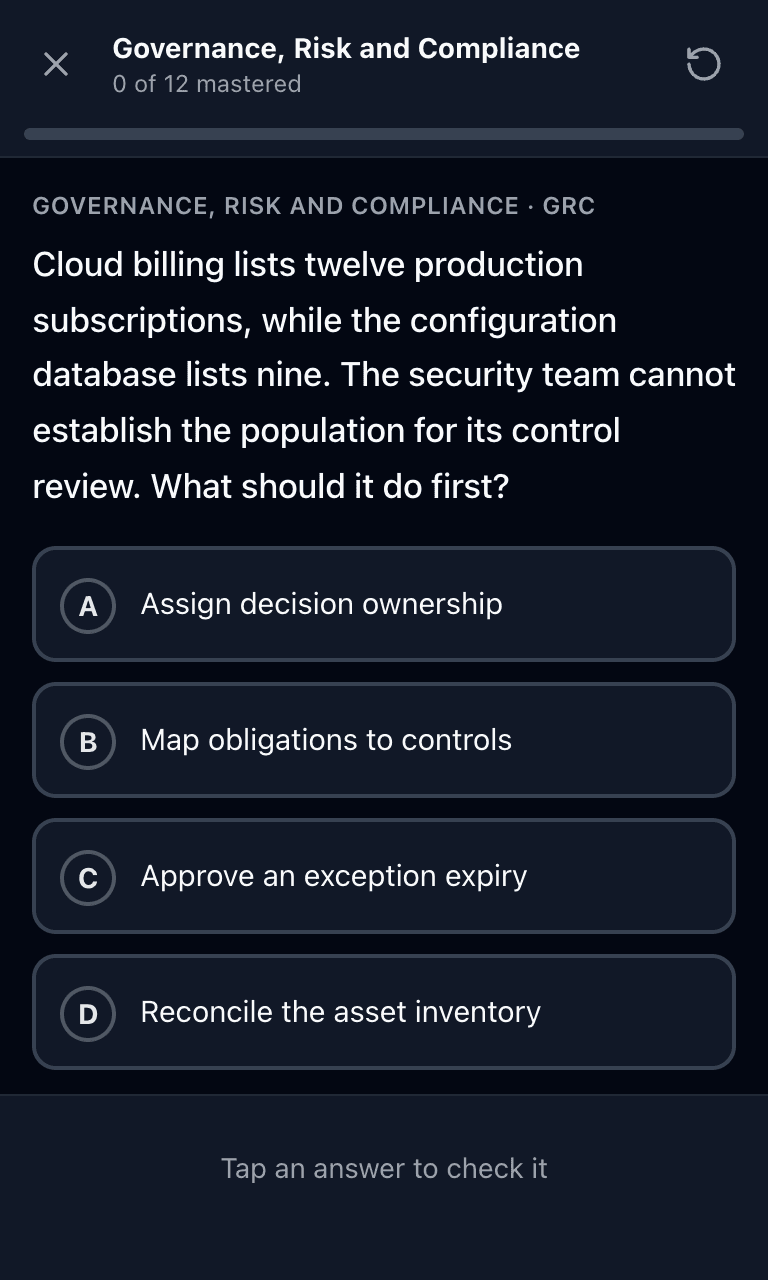
Train on mobile
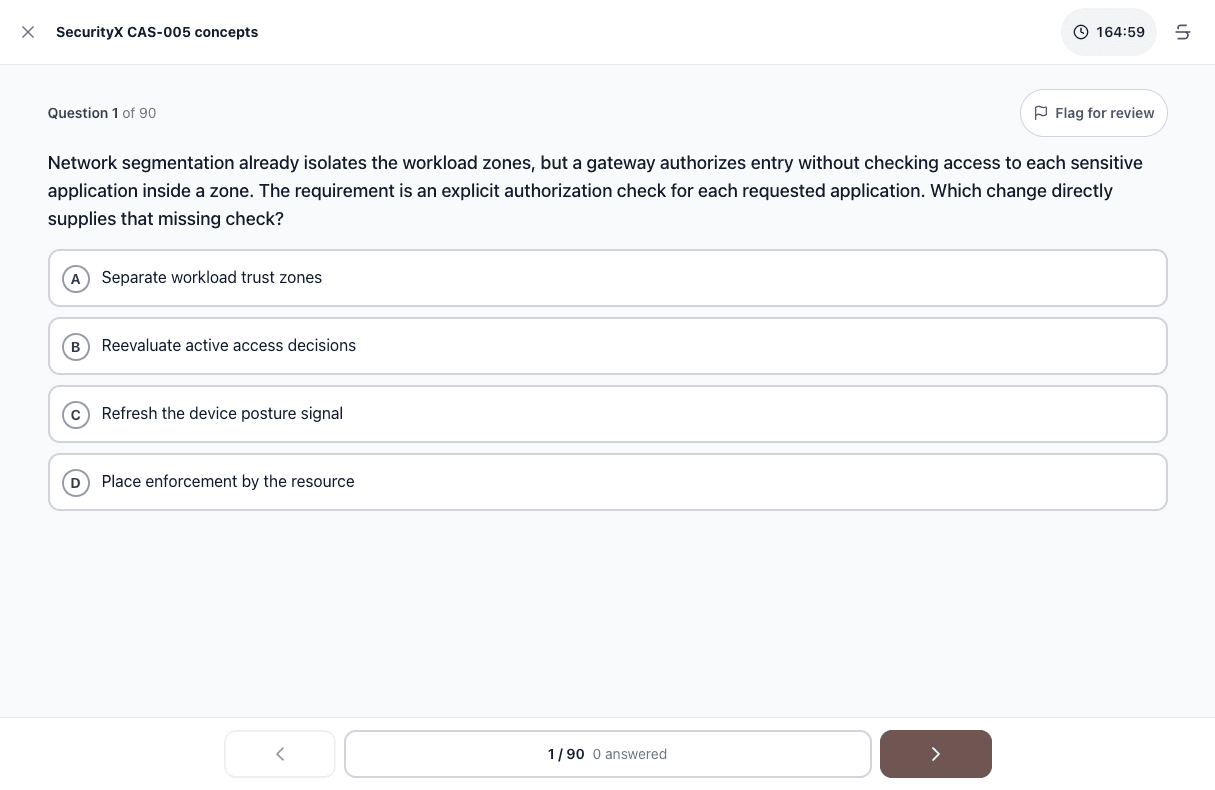
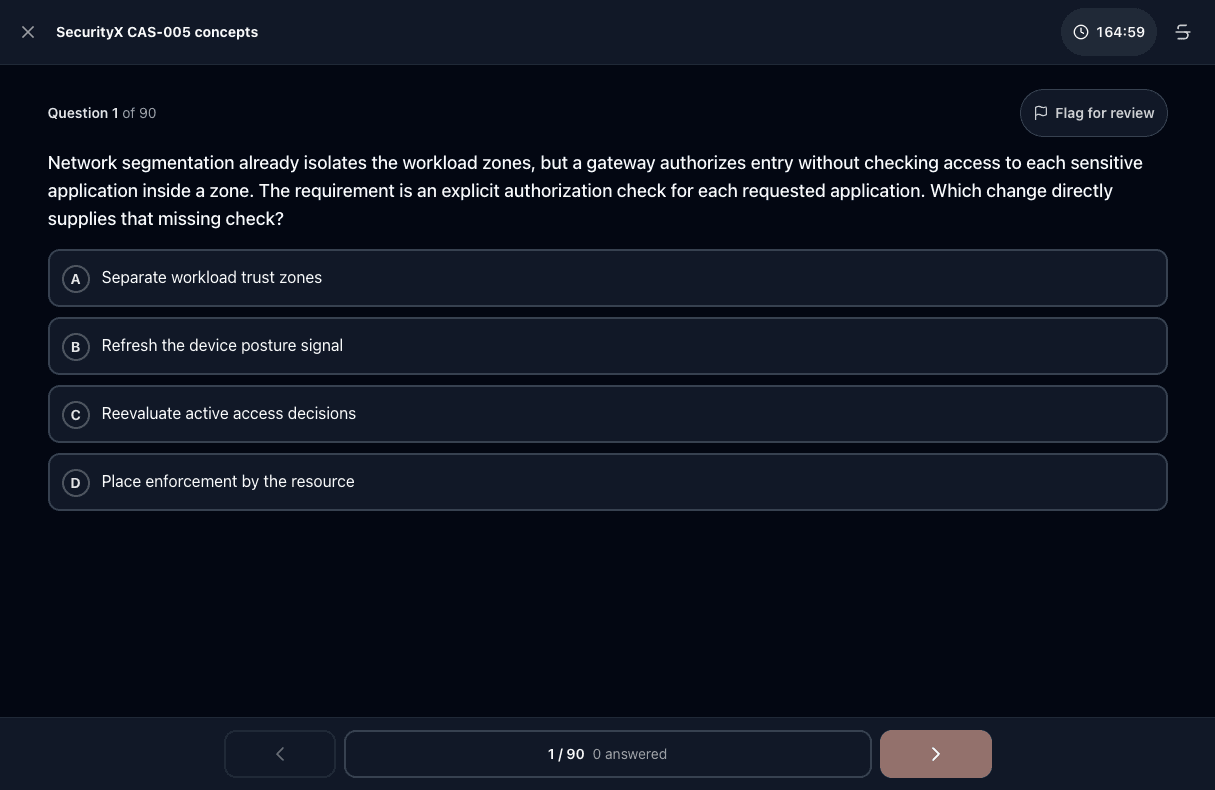
Test on desktop
The SecurityX exam at a glance
CompTIA SecurityX (CAS-005, formerly CASP+) assesses advanced enterprise security across governance, architecture, engineering and operations. The exam has a maximum of 90 multiple-choice and performance-based questions in 165 minutes. Tigertest provides 240 original conceptual MCQs, four drills and two 90-question tests. Interactive performance tasks are not included.
Tigertest has 240 SecurityX practice questions with explanations, all free with no account required.
- Current outline
- CAS-005 V5; objectives document version 7.0
- Official format
- Maximum 90 questions; multiple-choice and performance-based
- Official time
- 165 minutes
- Official result
- Pass/fail only; no scaled score
- Practice coverage
- 240 original MCQs; four drills and two 90-question tests
- Not included
- Interactive performance tasks and exhaustive technology coverage
- Practice scoring
- Percentage correct; 80% study goal is not an official threshold
- Access
- Free to start; final drill and Practice Test 2 require Premium
Updated by the Tigertest team. Practice questions follow CompTIA CAS-005 V5 objectives document version 7.0, checked 17 November 2026. Official domain weights 20/27/31/22% are rounded to 18/24/28/20 questions per practice test. Exam rules change, so confirm current details with CompTIA SecurityX CAS-005 objectives.
How It Works
Four Domain Drills
Read each scenario, choose an answer and use the explanation to check the distinction. Missed questions return for more practice. The 60 drill questions are separate from both test banks.
Two Practice Tests
Each test has 90 single-answer questions and a 165-minute timer. Flag questions and review them before finishing. The tests use separate questions; the second is held out for a fresh check of these concepts.
The Four CAS-005 Domains
Official domain weights guide the allocation. Practice questions focus on selected conceptual decisions and defensive analysis, with interactive tasks and exhaustive technology coverage left out.
Risk ownership, supplier obligations, threat modeling and AI governance.
Zero trust, access boundaries, resilient systems and software assurance.
Identity and network diagnostics, endpoints, OT, automation and cryptography.
Monitoring, defensive remediation, threat hunting and incident evidence.

Help Make Tigertest Better
Spot an unclear scenario or explanation? Use the question feedback, or send us an idea. We read every message and use it to improve every test.
Share FeedbackStudy the Decision Behind the Answer
1. Identify the constraint
Find the actual requirement: a trust boundary, a recovery limit, an operational safety need or an authorization rule. Several controls may be useful, but only one directly addresses the stated gap.
2. Follow the evidence
Separate authentication from authorization, configuration from observed behavior, and a completed change from a verified outcome. Use the logs and measurements provided in the question.
3. Explain the alternatives
For each missed question, identify the circumstance in which another option would be appropriate. This builds understanding of scope and timing.
4. Add hands-on preparation
Use authorized lab work and the current official outline alongside these conceptual drills. A high percentage here does not assess interactive performance or guarantee the certification result.
SecurityX Frequently Asked Questions
Is SecurityX the same certification as CASP+?
SecurityX is the renamed CompTIA advanced security certification formerly called CASP+. This practice follows CAS-005 V5 objectives document version 7.0, checked on 17 November 2026. It does not claim to reproduce older CAS-004 questions.
What is the SecurityX exam format?
CompTIA specifies a maximum of 90 multiple-choice and performance-based questions in 165 minutes. These two practice tests each contain 90 original single-answer MCQs with a 165-minute timer. Interactive performance tasks are omitted, so these are not complete format simulations.
What does the practice bank cover?
Governance, Risk and Compliance, Security Architecture, Security Engineering and Security Operations. Each test uses 18, 24, 28 and 20 questions respectively, rounding the official 20%, 27%, 31% and 22% weights. There are 60 additional drill-only questions. Selected concepts span all numbered objectives, but not every technology example in the outline.
What score do I need to pass SecurityX?
CompTIA reports pass/fail only, with no scaled score or published percentage cutoff. Tigertest reports percentage correct. Its default 80% study goal is editorial, not an official threshold or a prediction that you will pass.
How should I prepare for performance-based questions?
Combine conceptual study with authorized hands-on practice and the current CompTIA objectives. These questions exercise interpretation and design decisions, but do not assess your ability to operate an interactive lab or configure a live system.
Is this SecurityX practice free?
It is free to start with no account required. Practice Test 1 and the first three drills are free. The Security Operations drill and Practice Test 2 require Tigertest Premium, one payment with no subscription. CompTIA does not endorse or sponsor Tigertest.
I teach a SecurityX course. Can my students use Tigertest?
Yes, for free. Make a class at tigertest.io/teach, post one link, and students join with just their name. You see who practiced, their test scores and the topics your class misses most.
SecurityX sample questions and answers
4 of the 240 practice questions, one from each topic, with the answer explained.
- 1.
Business impact analysis concludes that an outage beyond six hours would cause unacceptable mission harm, even though the restoration target is shorter. Which metric captures this outer boundary?
- A.
Mean time to detect
- B.
Maximum tolerable downtime
- C.
Recovery time objective
- D.
Recovery point objective
Answer: B.Maximum tolerable downtime is the point beyond which harm becomes unacceptable; the RTO is set inside it. The RPO concerns data, and detection time is unrelated.
- A.
- 2.
Two services require each endpoint to authenticate the other during channel establishment. Which authentication property is required?
- A.
IPsec with a single pre-shared key for all hosts
- B.
Mutual TLS with client and server certificates
- C.
Server-only TLS with an API key in the body
- D.
Shared HMAC over each request body
Answer: B.Mutual TLS authenticates both ends during the handshake. Server-only TLS authenticates one side, and shared keys do not identify each endpoint individually.
- A.
- 3.
A recovery drill restores a reporting service before the identity service it requires, delaying all usable access. Which planning element should be revised?
- A.
Communications plan for affected users
- B.
Recovery sequence based on system dependencies
- C.
Recovery point objective for the reporting data
- D.
Backup schedule for the identity service
Answer: B.Restoring a service before its dependency produces nothing usable, so the sequence must follow dependencies. Recovery points, backup schedules and user messages do not fix the order.
- A.
- 4.
An analyst proposes a new detection based on one unusual sample. A controlled authorized test environment is available. Which step helps assess whether the observed behavior is reproducible?
- A.
Search the internet for similar samples
- B.
Ask the vendor to confirm the behavior
- C.
Detonate the sample in the isolated lab and compare
- D.
Deploy the detection to production immediately
Answer: C.Running the sample again in a controlled environment shows whether the behavior repeats before a rule is built on it. Deploying immediately risks noise based on one observation.
- A.
Related practice tests
Every test on Tigertest is free to start, with no account needed.
- CompTIA Security+ Practice TestCompTIA SY0-701
- CompTIA CySA+ Practice TestCompTIA CS0-004
- CompTIA PenTest+ Practice TestCompTIA · PenTest+ PT0-003 exam objectives
- Fortinet NSE 1 (FCF) Practice TestFortinet Training Institute · NSE 1 Cybersecurity and Cloud Fundamentals (formerly FCF)
- CISSP Practice TestISC2 · CISSP exam outline, April 2024
- CompTIA Network+ Practice TestCompTIA N10-009
Start SecurityX Practice
Start for free. No account required. Start with governance, then work through the four domains.
Start practicing