
Free CPA BAR Practice Test 2026
200 original multiple-choice questions on the AICPA's 2026 BAR blueprint: financial and cost analysis, budgets, capital and investment decisions, goodwill, revenue and stock compensation, business combinations, derivatives, leases, SEC reporting and state and local governments. Four 50-question mock tests. Tuned for mobile. Free to start, no account needed.
Try one now
Pick an answer
Maintenance cost was $62,000 at 4,000 machine hours and $97,000 at 9,000 machine hours. Using the high-low method, the fixed cost per month is:
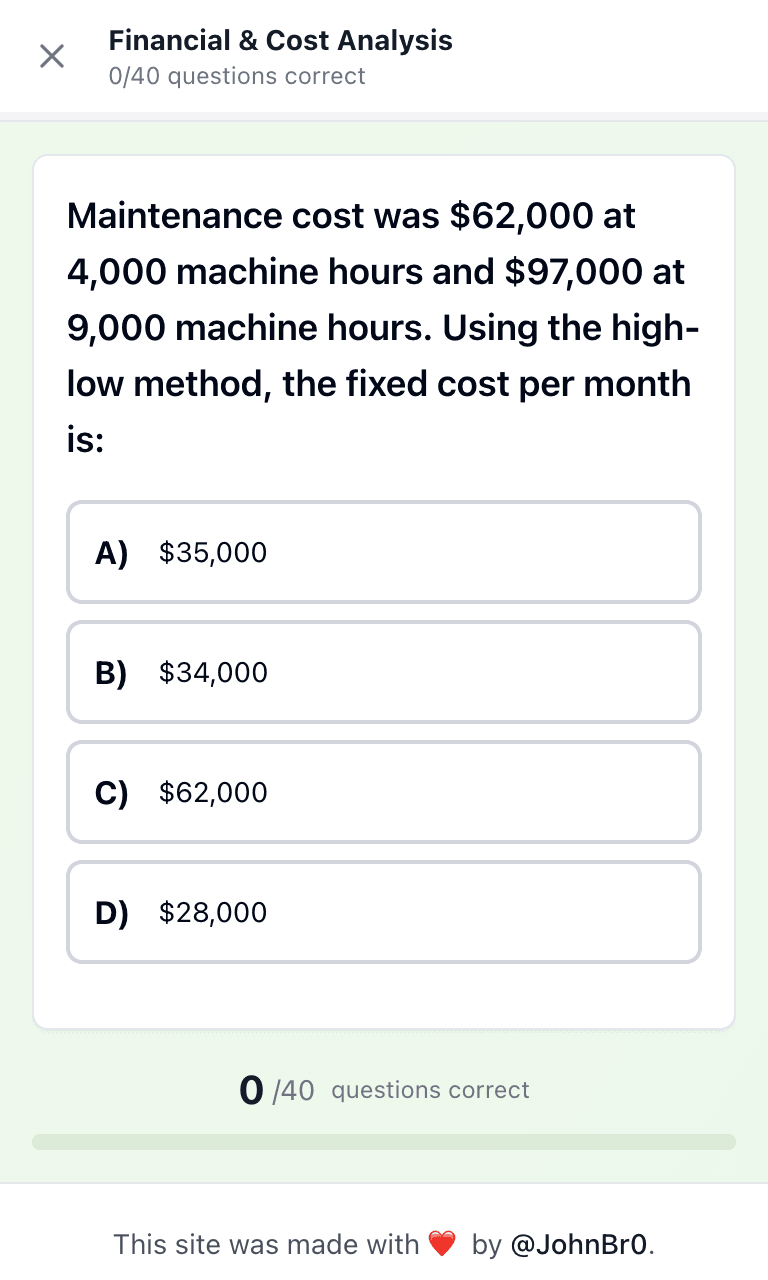
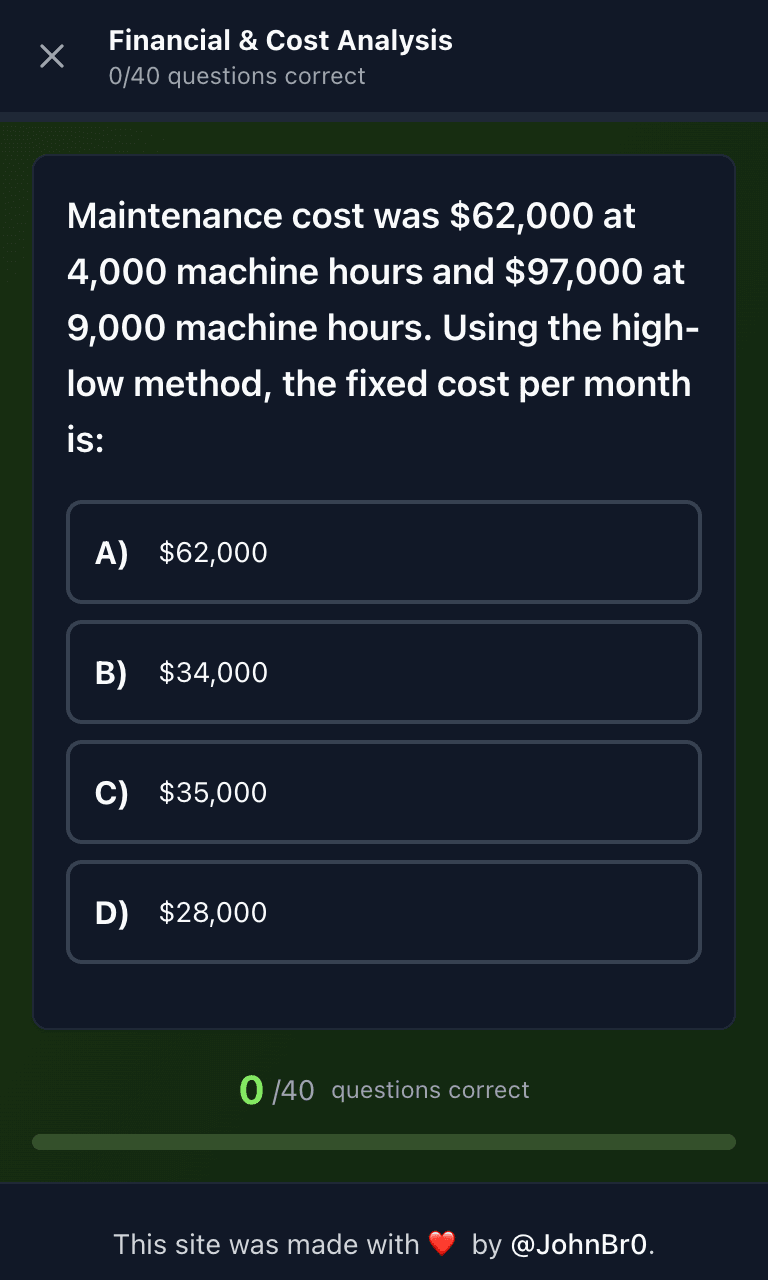
Train on mobile
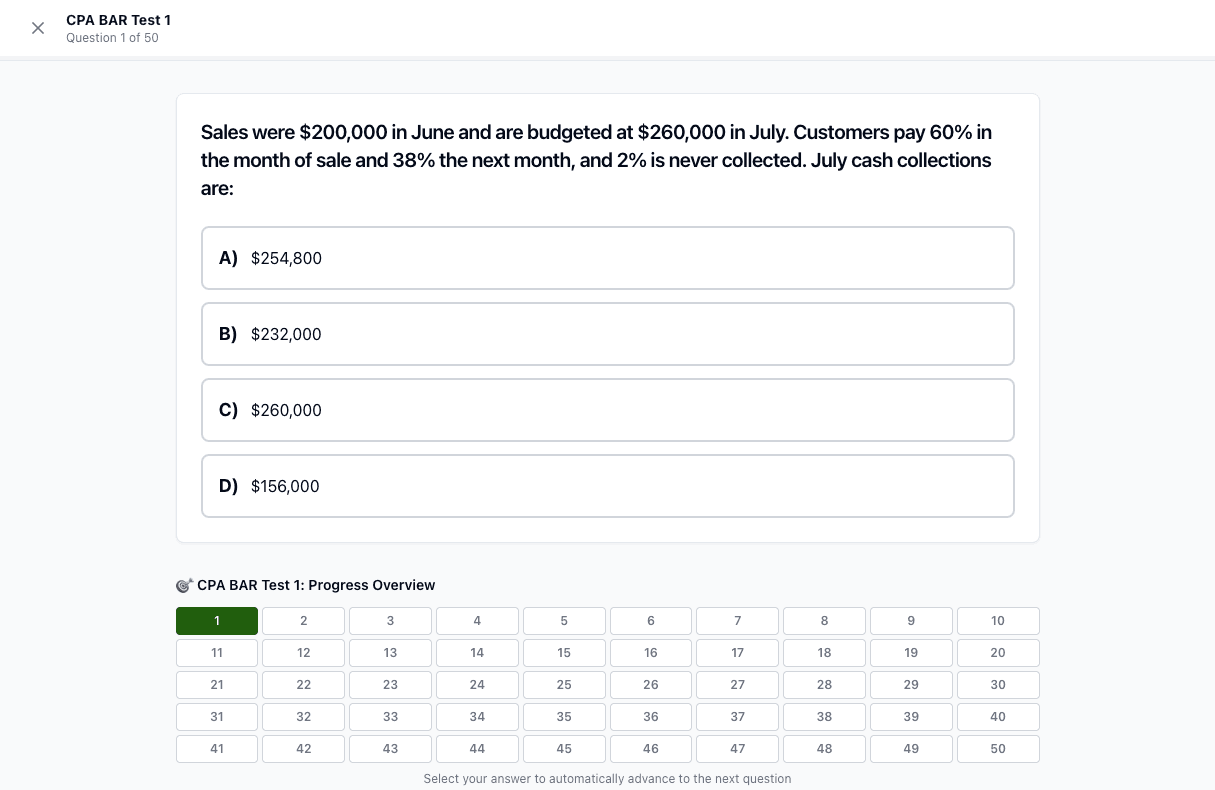
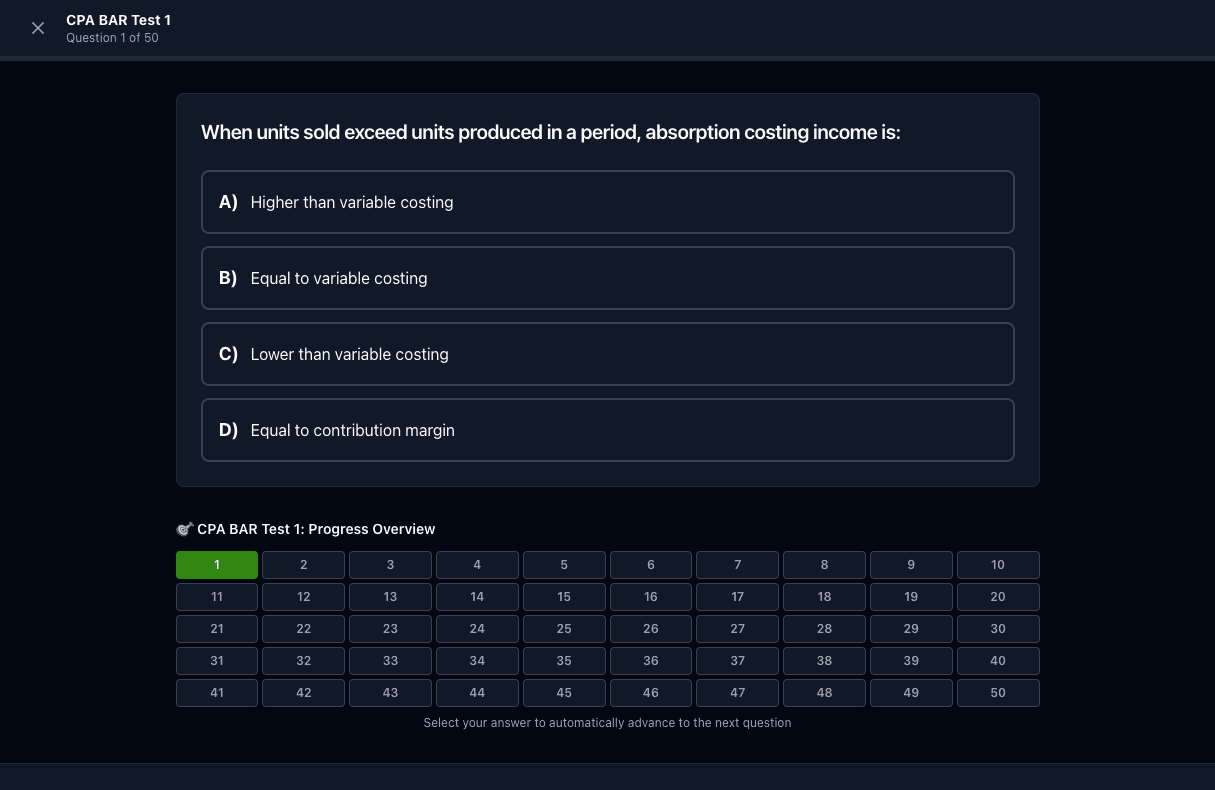
Test on desktop
The CPA BAR exam at a glance
BAR, Business Analysis and Reporting, is one of the three Discipline sections of the Uniform CPA Examination; candidates take the three Core sections and one Discipline section of their choice. BAR runs 4 hours with 50 multiple-choice questions and 7 task-based simulations, each worth half the score, and scores are reported from 0 to 99 with 75 to pass. Under the AICPA's blueprint effective January 2026, with only one task reworded for 2027, it covers business analysis (40 to 50%), technical accounting and reporting (35 to 45%) and state and local governments (10 to 20%).
Tigertest has 200 CPA BAR practice questions with explanations, free to start with no account required.
- Section time
- 4 hours
- Multiple-choice questions
- 50, in two testlets of 25
- Task-based simulations
- 7
- Score weighting
- 50% MCQ, 50% simulations
- Passing score
- 75 on a 0 to 99 scale
- Largest area
- Business analysis, 40 to 50%
- Run by
- AICPA, with NASBA and state boards of accountancy
Updated by the Tigertest team. Practice questions follow the AICPA's Uniform CPA Examination Blueprints effective January 2026, its summary of 2027 changes and NASBA's score information, checked November 2026. Exam rules change, so confirm current details with AICPA: Learn what is tested on the CPA Exam.
How It Works
Train by Topic
Six training sets: financial and cost analysis; budgets, capital and investments; intangibles, revenue and stock compensation; business combinations; derivatives, leases and SEC reporting; and state and local governments. Questions you miss come back until you have mastered them.
Weighted Mock Tests
Four mock tests of 50 multiple-choice questions in the blueprint's proportions, with a 75% target. No question appears in more than one test, and every calculation is worked through in the explanation.
Built on the AICPA's BAR Blueprint
The AICPA's 2026 blueprint gives each of BAR's three content areas a range, and the 2027 blueprint changes the wording of only one government task. Each mock test here gives business analysis 22 of 50 questions, technical accounting 20 and state and local governments 8, inside every range. Task-based simulations are not modelled.

Help Make Tigertest Better
Have an idea, a topic you'd like covered, or a question that could be clearer? We read every message and use it to improve every test.
Share FeedbackHow to Pass CPA BAR
1. Work the analysis, not just the formula
Business analysis is the largest area. For each ratio, variance or budget figure, know what makes it rise or fall and what that says about the business, because the questions ask you to explain results as often as to compute them.
2. Learn the measurement rule for each technical topic
Goodwill is tested against the reporting unit's fair value, liability awards and contingent consideration are remeasured, and cash flow hedge gains wait in other comprehensive income. Write the measurement basis and where the change goes before you look at the choices.
3. Keep government funds and government-wide apart
Governmental funds use the current financial resources focus and modified accrual; the government-wide statements use full accrual. Most government questions turn on which set of statements is asked about, so practice the reconciliation between them.
4. Practice the multiple choice, then the simulations
Multiple choice is half the score, and the task-based simulations build on the same rules. Aim for 80% or better on every mock test here, then work through simulations with the AICPA's sample tests before you sit the section.
CPA BAR Frequently Asked Questions
What is on the CPA BAR section?
Business Analysis and Reporting (BAR) is one of the three Discipline sections of the Uniform CPA Examination, and you take one Discipline section along with the three Core sections. The AICPA's 2026 blueprint splits BAR into three content areas: business analysis (40 to 50%), technical accounting and reporting (35 to 45%) and state and local governments (10 to 20%). The AICPA's summary of 2027 changes revises the wording of one state and local government task and does not change what is tested.
How many questions are on BAR and what score do I need?
BAR is a 4-hour section with 50 multiple-choice questions in two testlets of 25 and 7 task-based simulations, each half of the score. Scores are reported from 0 to 99 and 75 passes, but 75 is a scaled score, not 75 percent correct. The mock tests here use a 75 percent target as a readiness line.
How is BAR different from FAR?
FAR is the Core financial accounting section. BAR goes further: financial statement and cost analysis, budgeting, cost of capital and investment decisions, and the technical topics FAR leaves out, such as goodwill impairment, software and R&D costs, stock compensation, business combinations, variable interest entities, foreign currency translation, derivatives and hedges, lessor accounting, SEC reporting and employee benefit plans, plus a deeper look at state and local government reporting. The questions here are written to build on FAR without repeating it.
Does this practice test cover task-based simulations?
No. Every question here is multiple choice, which is half of your BAR score; task-based simulations, research tasks and preparing full statements from trial balances are not modelled. Every calculation, from variances and breakeven to goodwill, swap settlements and fund balance, is worked through in the explanation.
Are these real CPA Exam questions?
No. Every question is original, written by Tigertest from the AICPA's published BAR blueprint and the FASB, GASB, SEC and COSO sources it lists as references. It is practice, not affiliated with the AICPA, NASBA or any state board of accountancy, and it does not replace a full review course.
CPA BAR sample questions and answers
6 of the 200 practice questions, one from each topic, with the answer explained.
1. A budget that always covers the next 12 months by adding a month as each month ends is a:
- A.Capital budget
- B.Rolling budget
- C.Zero-based budget
- D.Flexible budget
Answer: B. A rolling, or continuous, budget extends one period as each period passes. A zero-based budget justifies every cost from zero instead of adjusting last year's figures.
2. Under ASU 2021-08, contract liabilities from an acquiree's customer contracts are measured on the acquisition date:
- A.At their acquisition-date fair value
- B.At the acquiree's tax basis
- C.At zero, with no liability
- D.As if the acquirer had originated them
Answer: D. ASU 2021-08 requires contract assets and liabilities to be recognized and measured under ASC 606, as if the acquirer had entered into the contracts, rather than at fair value.
3. Funding a new factory with 90-day commercial paper that must be rolled over for years exposes a company mainly to:
- A.Refinancing risk
- B.Foreign currency risk
- C.Inventory risk
- D.Customer credit risk
Answer: A. Matching long-lived assets with short-term debt means the company must keep renewing the debt, possibly at higher rates or not at all.
4. A company holds 30% of the voting equity of a variable interest entity and is its primary beneficiary. The company:
- A.Reports it at fair value
- B.Discloses it only
- C.Consolidates the VIE
- D.Uses the equity method
Answer: C. The VIE model looks to power and economics rather than voting control, so the primary beneficiary consolidates whatever its voting share.
5. A monthly utility bill made up of a flat service charge plus a rate per kilowatt-hour is:
- A.A variable cost
- B.A step cost
- C.A mixed cost
- D.A fixed cost
Answer: C. A cost with both a fixed part and a part that varies with activity is mixed. The high-low method or regression separates the two parts.
6. In a fair value hedge of fixed-rate debt, the swap's fair value falls by $90,000 and the debt's fair value for the hedged risk also falls by $90,000. The net effect on earnings is:
- A.No net effect
- B.A $90,000 loss
- C.A $90,000 gain
- D.A $180,000 loss
Answer: A. The $90,000 loss on the swap and the $90,000 gain from reducing the debt's carrying amount both go to earnings and offset.
CPA BAR practice questions by topic
Ten questions on each area of the exam, with the answers explained.
- Financial Statement & Performance Analysis
- Managerial & Cost Accounting
- Budgeting, Forecasting & Projection
- Capital Structure & Cost of Capital
- Investment Decision Models
- Risk Management & Economic Influences
- Goodwill, Software & R&D
- Revenue Recognition
- Stock Compensation
- Business Combinations
- Consolidation & Foreign Currency
- Derivatives & Hedge Accounting
- Lessor Accounting & Sale-Leaseback
- SEC Reporting, Segments & Benefit Plans
- Government Financial Reporting
- Government Transactions & Fund Balance
Related practice tests
Every test on Tigertest is free to start, with no account needed.
- CPA FAR Practice TestAICPA and NASBA · Uniform CPA Examination, FAR Core section
- CPA REG Practice TestAICPA and NASBA · Uniform CPA Examination, REG Core section
- CPA AUD Practice TestAICPA and NASBA · Uniform CPA Examination, AUD Core section
- ACCA FA Practice TestACCA · Applied Knowledge exam, Financial Accounting (FA/FFA)
- AAT Level 2 Practice TestAAT (Association of Accounting Technicians) · Level 2 Certificate in Accounting, Q2022
- CeMAP 1 Practice TestLIBF (Walbrook Institute London) · CeMAP Module 1, FSRE units FRE1 and FRE2
Ready to Pass CPA BAR?
Start for free. No account required. 200 questions across every area of the AICPA's BAR blueprint.
Start practicing