
Free Enrolled Agent Part 1 Practice Test 2026
200 original questions on the IRS Part 1 Individuals outline and 2025 tax law: filing status and dependents, income and retirement accounts, deductions and credits, AMT and payroll taxes, planning, estate and gift tax, FBAR. Four 50-question mock tests. Free to start, no account needed.
Try one now
Pick an answer
Before preparing a returning client's 2025 return, why should a preparer review the client's 2024 return?
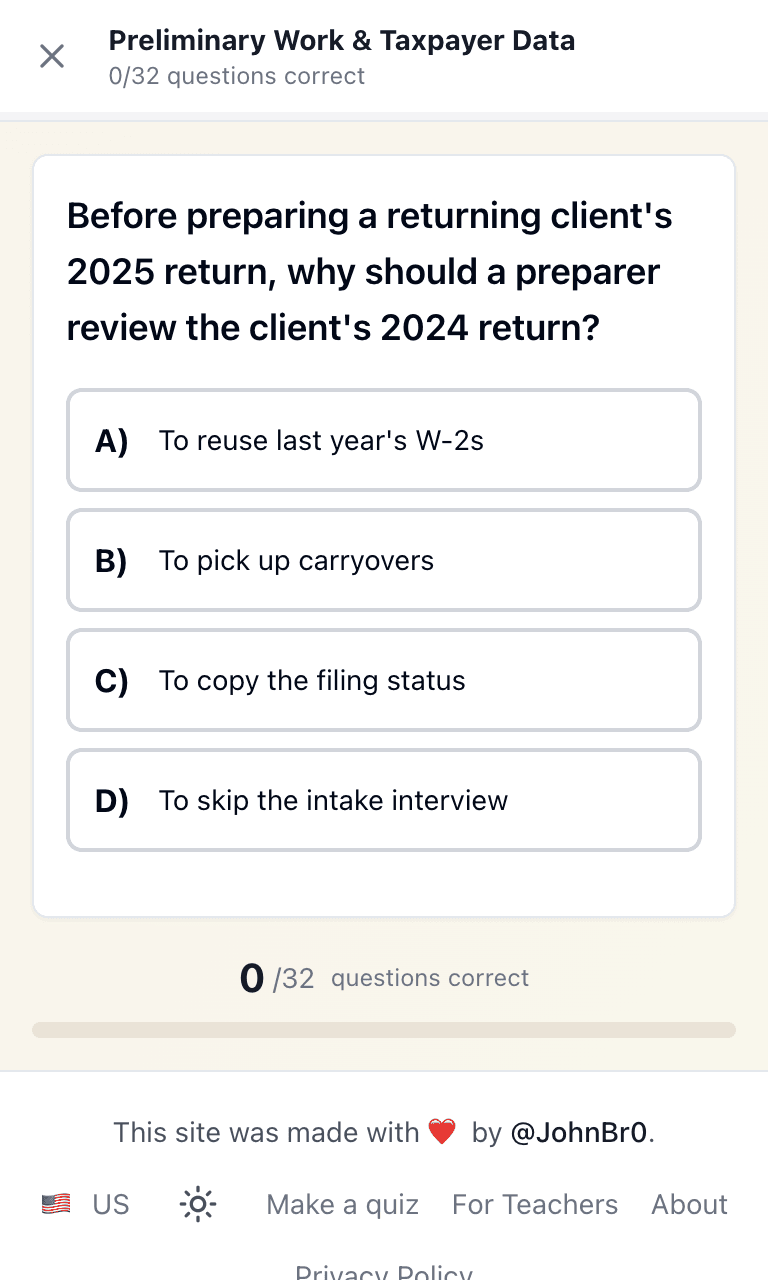
Train on mobile
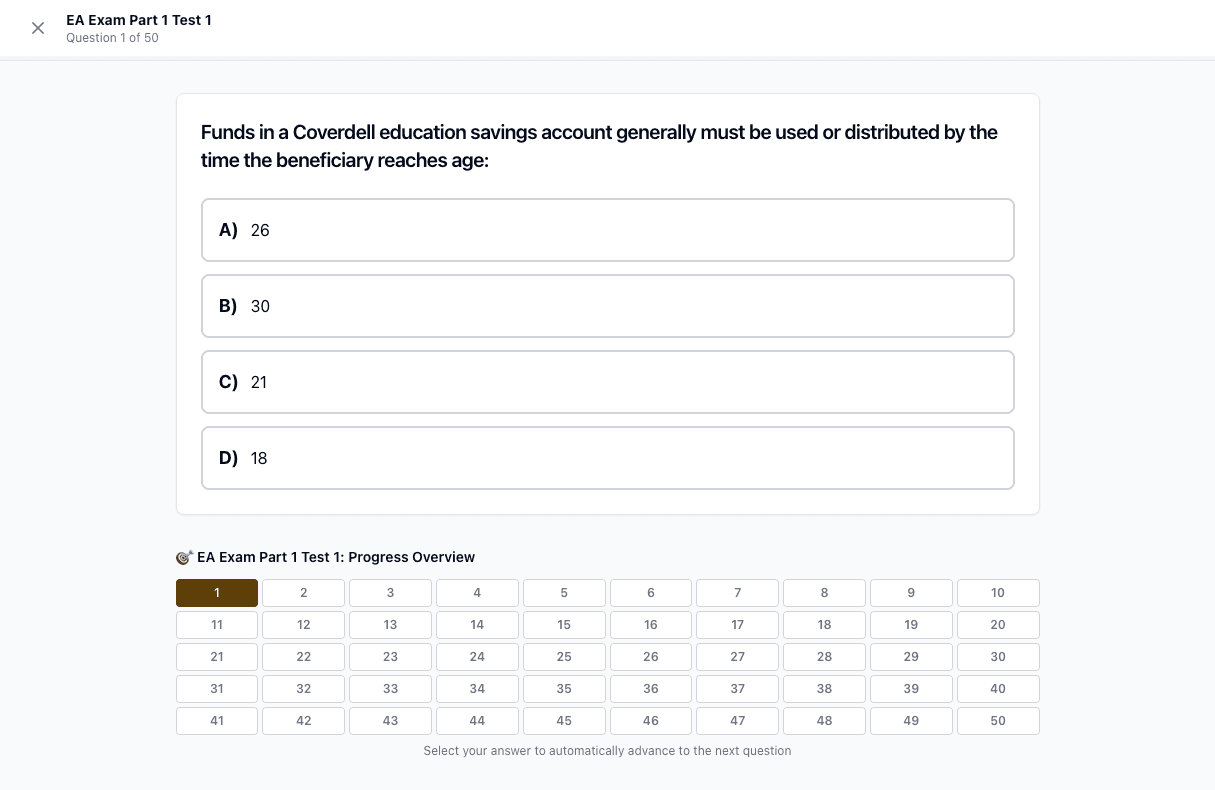
Test on desktop
The EA Exam Part 1 exam at a glance
The Special Enrollment Examination (SEE) is the IRS exam for becoming an enrolled agent, a tax practitioner who can represent taxpayers before the IRS. Part 1 covers individuals. Each of the three parts has 100 multiple-choice questions, 85 scored and 15 unscored, in 3.5 hours, and results are scaled from 200 to 800 with 500 to pass, which is not a fixed percentage. Part 1's six domains are preliminary work and taxpayer data (14 scored questions), income and assets (17), deductions and credits (17), taxation (15), advising the individual taxpayer (11) and specialized returns for individuals (11). For exams from July 1, 2026 to February 28, 2027, questions follow tax law as amended through December 31, 2025 and relate to calendar year 2025.
Tigertest has 200 EA Exam Part 1 practice questions with explanations, free to start with no account required.
- Questions
- 100 (85 scored, 15 unscored)
- Time
- 3.5 hours
- Passing score
- 500 on a 200 to 800 scale
- Tax year tested
- 2025, for July 1, 2026 to February 28, 2027
- Largest domains
- Income and assets 17, deductions and credits 17
- Where
- PSI test center or remote proctoring, both in the U.S.; international testing delayed
- Attempts
- Up to four per part each testing window
- Passed parts
- Carry over for three years
- Given by
- PSI for the IRS
Updated by the Tigertest team. Practice questions follow the PSI Candidate Information Bulletin for the IRS SEE (revised October 9, 2026) and the IRS enrolled agent FAQs, checked November 2026. Exam rules change, so confirm current details with IRS: Enrolled agents frequently asked questions.
How It Works
Train by Topic
Five training sets: preliminary work and taxpayer data, income and assets, deductions and credits, taxation, and advising and specialized returns. Questions you miss come back until you have mastered them.
Weighted Mock Tests
Four mock tests of 50 multiple-choice questions in the IRS outline's proportions, at the real exam's pace, with a 70% target. No question appears in more than one test, and every calculation is worked through in the explanation.
Built on the IRS Part 1 Outline
The IRS content outline gives each of Part 1's six domains a set number of the 85 scored questions. Each mock test here scales those counts to 50, so income and assets and deductions and credits make up 20 of every 50 questions. The 15 unscored experimental questions are not modelled.

Help Make Tigertest Better
Have an idea, a topic you'd like covered, or a question that could be clearer? We read every message and use it to improve every test.
Share FeedbackHow to Pass SEE Part 1
1. Study the 2025 rules, not this year's news
The current window tests calendar year 2025, with law as amended through December 31, 2025. Changes that start in 2026, such as the new gambling loss limit and the non-itemizer charitable deduction, are not on it.
2. Get filing status and dependents right first
Preliminary work is 14 scored questions, and later answers depend on it: the tie-breaker rules, head of household upkeep, the qualifying child and relative tests, and who can claim each credit.
3. Work every calculation on paper
Pro rata IRA basis, taxable Social Security, the net investment income tax and the dependent care credit come up as numbers. Write each step, then check the result against the choices; the explanations here show every step.
4. Do not leave estate and gift tax for last
Specialized returns is 11 scored questions: Form 706 and 709 deadlines, portability, gift splitting, joint property and FBAR and Form 8938 reporting. They are quick points once learned.
Enrolled Agent Part 1 Frequently Asked Questions
What is on Part 1 of the Enrolled Agent exam?
Part 1 of the Special Enrollment Examination (SEE) covers individual taxation. The IRS content outline in the Candidate Information Bulletin lists six domains with their scored questions: preliminary work and taxpayer data (14), income and assets (17), deductions and credits (17), taxation (15), advising the individual taxpayer (11) and specialized returns for individuals (11), which covers estate and gift tax and international information reporting.
How many questions are on Part 1 and what score do I need?
Each part has 100 multiple-choice questions, 85 scored and 15 unscored, in 3.5 hours. Results are scaled from 200 to 800 and the IRS passing score is 500, which is not a fixed percentage. The mock tests here are 50 questions at the same pace, with a 70 percent target as a readiness line.
Which tax year does the exam test?
For exams taken from July 1, 2026 to February 28, 2027, the bulletin says questions follow the Internal Revenue Code, regulations and IRS forms and publications as amended through December 31, 2025, and relate to calendar year 2025 unless stated. Every question here uses 2025 rules, and any dollar figure that changes each year names its year.
When can I take the SEE?
The exam is given by PSI for the IRS, in person at a PSI test center or by remote proctoring, both in the U.S. for now (international testing is delayed, and will be remote only when it resumes). The current window runs July 1, 2026 to February 28, 2027, with no testing in March and April while the exam is updated. Each part can be taken up to four times a window, in any order, and a passed part carries over for three years.
Are these real Enrolled Agent exam questions?
No. Every question is original, written by Tigertest from the IRS content outline, the Internal Revenue Code and IRS forms and publications. It is practice, not affiliated with the IRS or PSI, and it does not replace the IRS's own study materials.
EA Exam Part 1 sample questions and answers
6 of the 200 practice questions, one from each topic, with the answer explained.
1. Compared with a joint return, a married couple filing separately cannot deduct:
- A.Charitable gifts
- B.Student loan interest
- C.Mortgage interest
- D.State income taxes
Answer: B. The student loan interest deduction is not allowed for married filing separately. Mortgage interest, taxes and gifts can still be itemized, though if one spouse itemizes the other must too.
2. A married taxpayer living with her spouse wants the premium tax credit. Except in cases such as domestic abuse, she must:
- A.File separately
- B.File as head of household
- C.File as single
- D.File a joint return
Answer: D. Married taxpayers must file jointly to claim the premium tax credit. Victims of domestic abuse or spousal abandonment may claim it filing separately if they meet the rules.
3. Moving expenses are deductible for 2025 only by:
- A.Active-duty military movers
- B.Anyone moving 50 miles
- C.Self-employed people
- D.Workers paid by the hour
Answer: A. The moving expense deduction is suspended except for members of the armed forces on active duty who move under a permanent change of station order.
4. A client sold stock and got a Form 1099-B showing proceeds but no basis. The preparer should:
- A.Leave the sale off the return
- B.Use the proceeds as basis
- C.Get the basis from her records
- D.Report a basis of zero
Answer: C. Gain is proceeds minus basis. When the broker does not report basis, the preparer obtains it from purchase records or statements and reports it on Form 8949, keeping support in the file.
5. A taxpayer fails to file a required Form 8938 with her 2025 return. The statute of limitations on assessing tax for that return:
- A.Closes after 6 years
- B.Is shortened to 2 years
- C.Runs only from when it is filed
- D.Closes after 3 years anyway
Answer: C. Under section 6501(c)(8), when a required international information return is not filed, the assessment period for the return does not end until 3 years after the information is provided.
6. A taxpayer with a large ISO exercise wants to know if AMT applies. The form that compares tentative minimum tax with regular tax is:
- A.Form 6251
- B.Form 8801
- C.Form 3921
- D.Form 8960
Answer: A. Form 6251 computes alternative minimum taxable income and tentative minimum tax. Form 8801 is used later to claim the minimum tax credit.
Related practice tests
Every test on Tigertest is free to start, with no account needed.
- CPA FAR Practice TestAICPA and NASBA · Uniform CPA Examination, FAR Core section
- CPA REG Practice TestAICPA and NASBA · Uniform CPA Examination, REG Core section
- CPA AUD Practice TestAICPA and NASBA · Uniform CPA Examination, AUD Core section
- ACCA FA Practice TestACCA · Applied Knowledge exam, Financial Accounting (FA/FFA)
- AAT Level 2 Practice TestAAT (Association of Accounting Technicians) · Level 2 Certificate in Accounting, Q2022
- CeMAP 1 Practice TestLIBF (Walbrook Institute London) · CeMAP Module 1, FSRE units FRE1 and FRE2
Ready to Pass SEE Part 1?
Start for free. No account required. 200 questions across every domain of the IRS Part 1 outline.
Start practicing