
Free Enrolled Agent Part 2 Practice Test 2026
200 original questions on the IRS Part 2 Businesses outline and 2025 tax law: entities and partnerships, C and S corporations, business income and expenses, depreciation and accounting methods, payroll, trusts, exempt organizations, retirement plans, farmers and rentals. Four 50-question mock tests. Free to start, no account needed.
Try one now
Pick an answer
An LLC owned by one individual files no Form 8832. For federal income tax it is:
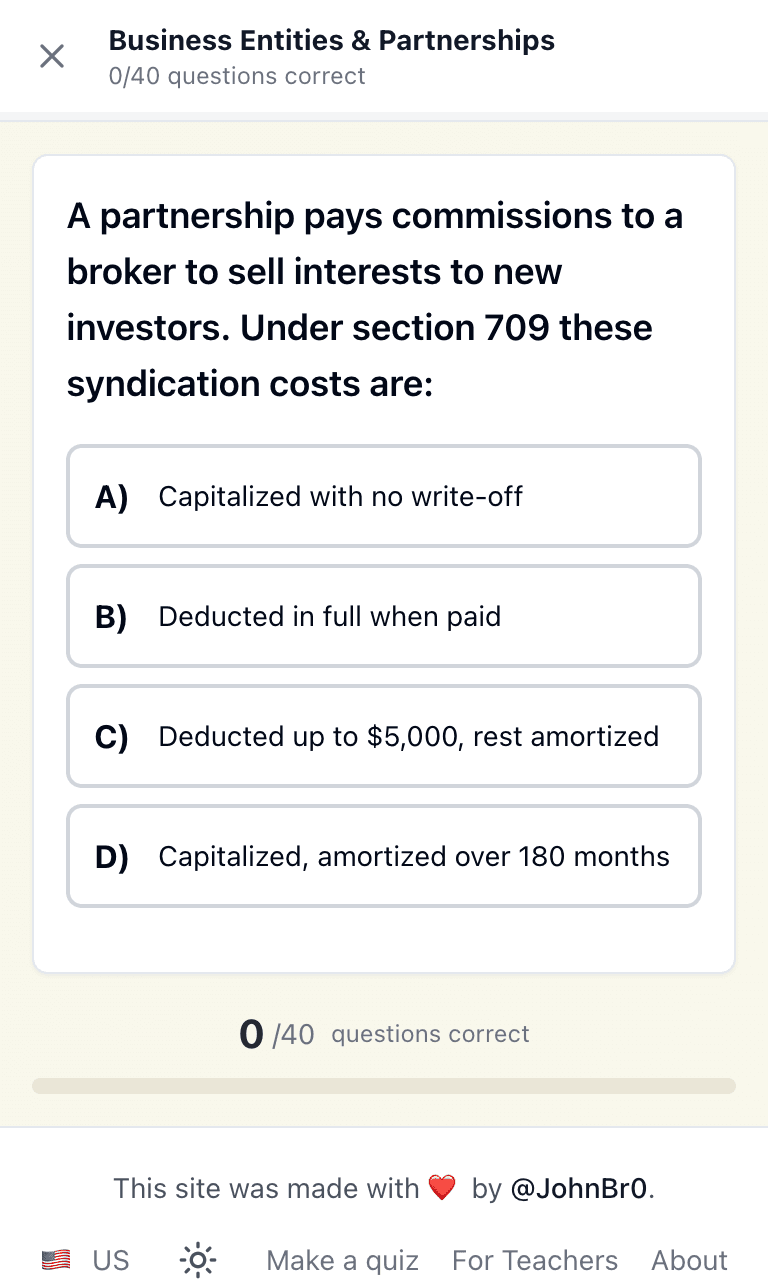
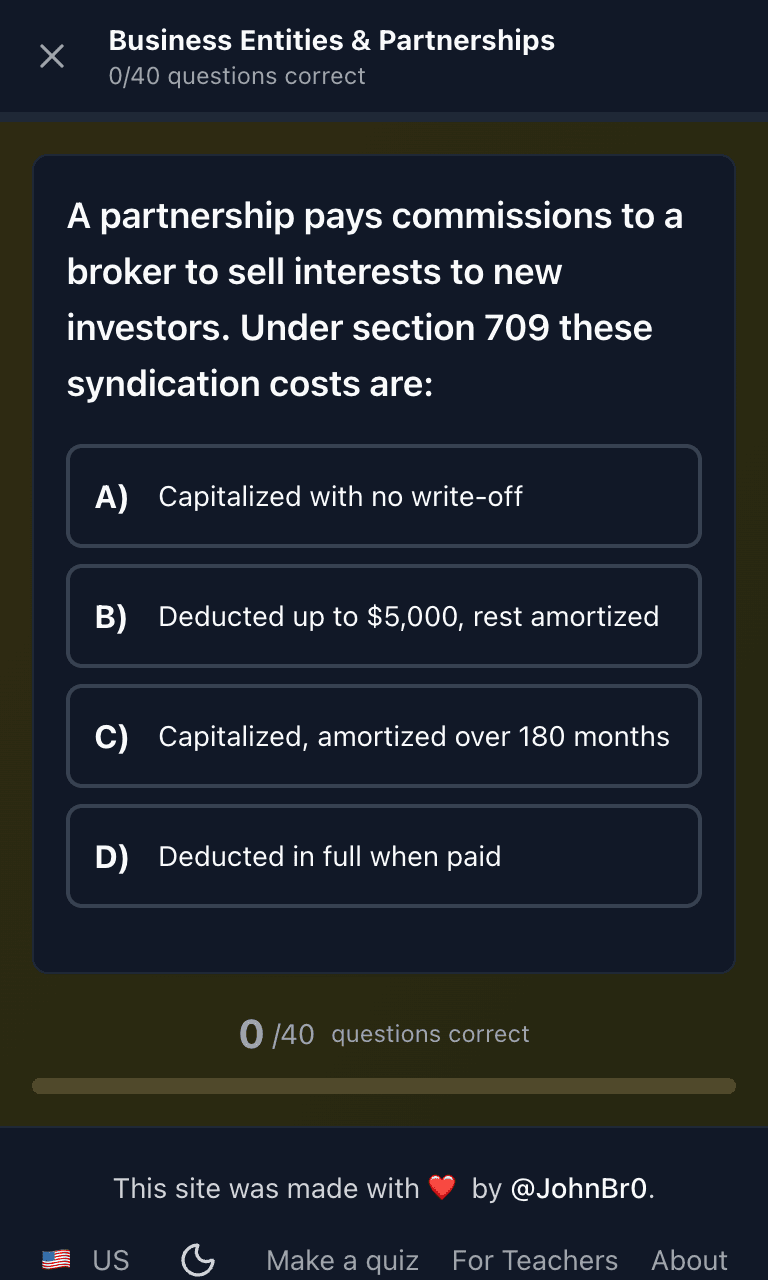
Train on mobile
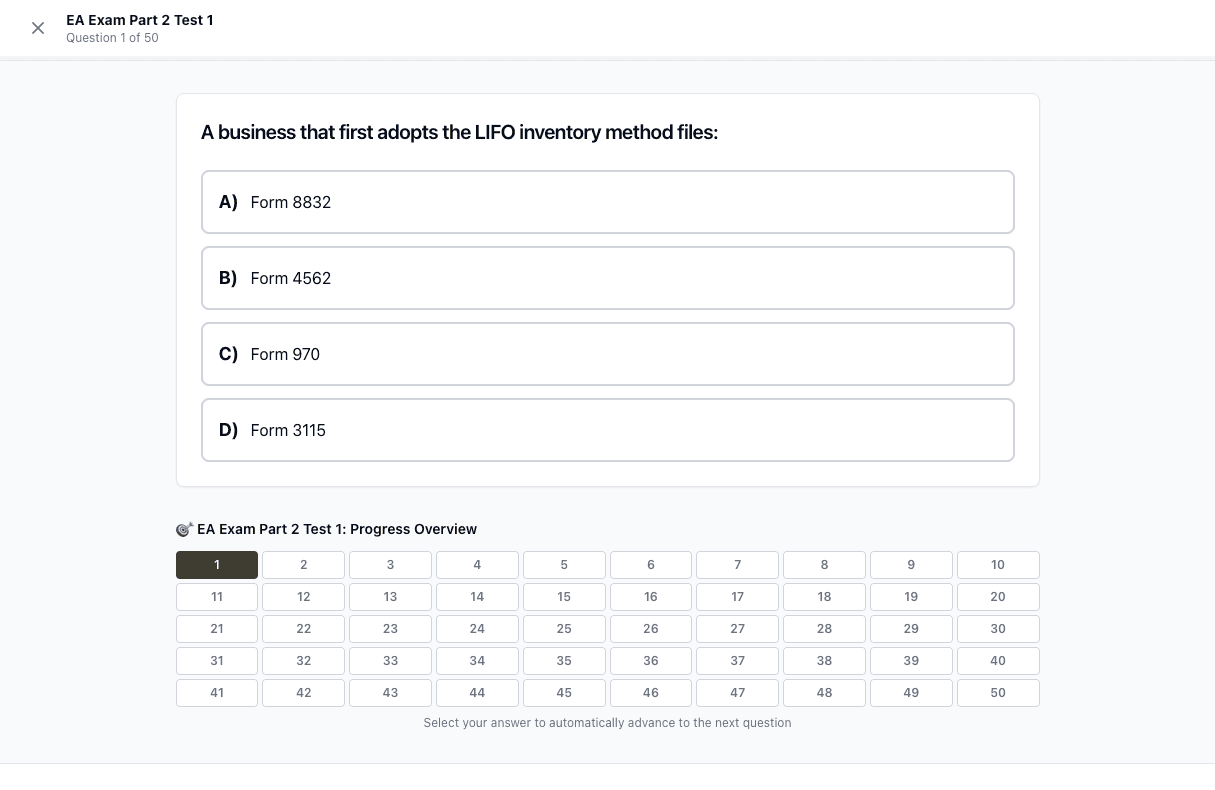
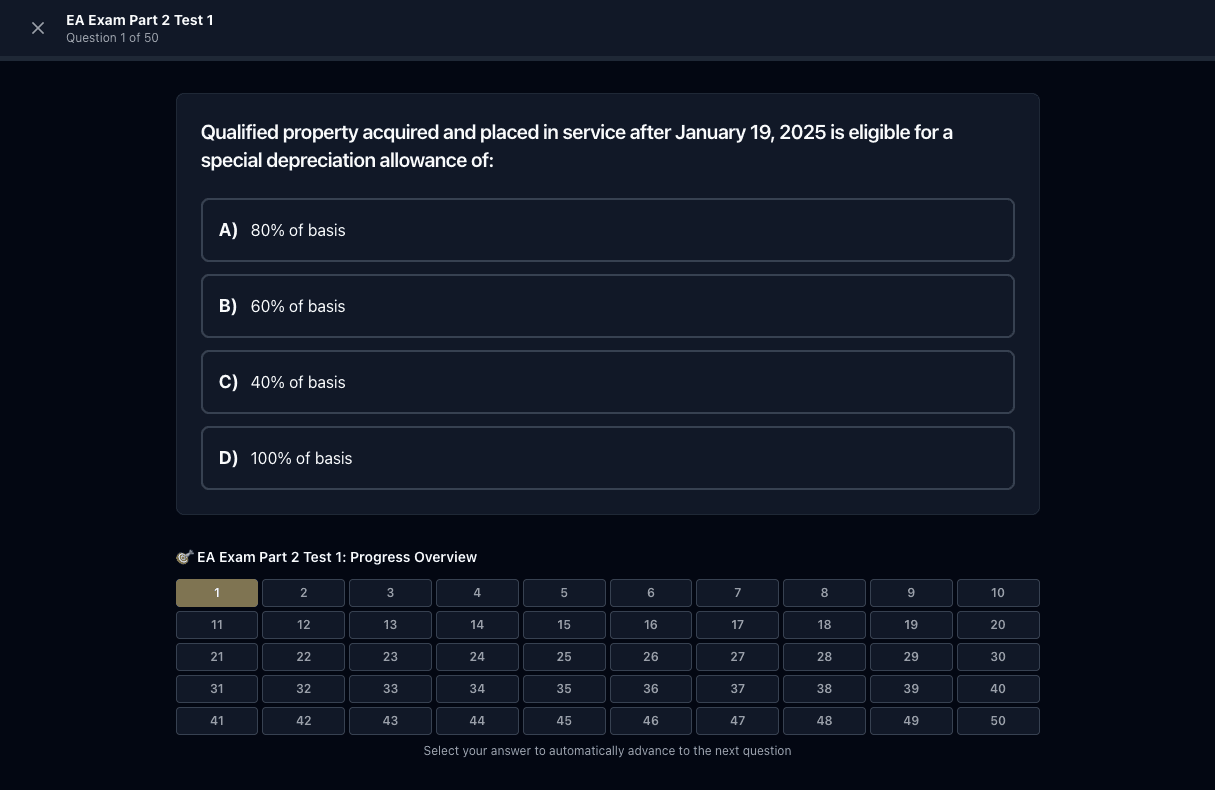
Test on desktop
The EA Exam Part 2 exam at a glance
The Special Enrollment Examination (SEE) is the IRS exam for becoming an enrolled agent, a tax practitioner who can represent taxpayers before the IRS. Part 2 covers businesses. Each of the three parts has 100 multiple-choice questions, 85 scored and 15 unscored, in 3.5 hours, and results are scaled from 200 to 800 with 500 to pass, which is not a fixed percentage. Part 2's three domains are business entities and considerations (30 scored questions), business tax preparation (37) and specialized returns and taxpayers (18). For exams from July 1, 2026 to February 28, 2027, questions follow tax law as amended through December 31, 2025 and relate to calendar year 2025.
Tigertest has 200 EA Exam Part 2 practice questions with explanations, free to start with no account required.
- Questions
- 100 (85 scored, 15 unscored)
- Time
- 3.5 hours
- Passing score
- 500 on a 200 to 800 scale
- Tax year tested
- 2025, for July 1, 2026 to February 28, 2027
- Largest domain
- Business tax preparation, 37 scored questions
- Where
- PSI test center or remote proctoring, both in the U.S.; international testing delayed
- Attempts
- Up to four per part each testing window
- Passed parts
- Carry over for three years
- Given by
- PSI for the IRS
Updated by the Tigertest team. Practice questions follow the PSI Candidate Information Bulletin for the IRS SEE (revised October 9, 2026) and the IRS enrolled agent FAQs, checked November 2026. Exam rules change, so confirm current details with IRS: Enrolled agents frequently asked questions.
How It Works
Train by Topic
Five training sets: entities and partnerships, C and S corporations, business income and expenses, assets and accounting, and specialized returns. Questions you miss come back until you have mastered them.
Weighted Mock Tests
Four mock tests of 50 multiple-choice questions in the IRS outline's proportions, at the real exam's pace, with a 70% target. No question appears in more than one test, and every calculation is worked through in the explanation.
Built on the IRS Part 2 Outline
The IRS content outline gives each of Part 2's three domains a set number of the 85 scored questions. Each mock test here scales those counts to 50, so business tax preparation makes up 22 of every 50 questions. The 15 unscored experimental questions are not modelled.

Help Make Tigertest Better
Have an idea, a topic you'd like covered, or a question that could be clearer? We read every message and use it to improve every test.
Share FeedbackHow to Pass SEE Part 2
1. Use the 2025 rules for depreciation
The current window tests calendar year 2025. That year has two bonus depreciation rates, 100% for property acquired after January 19, 2025 and 40% for earlier acquisitions, and new section 174A lets domestic research costs be deducted again.
2. Know basis cold for partners and shareholders
Business entities is 30 scored questions. Partner and S shareholder basis, the order of adjustments, distributions in excess of basis and liabilities come up again and again, often as numbers.
3. Learn the forms and deadlines by entity
Forms 1065 and 1120-S are due in March, Form 1120 and Form 1041 in April, Form 990 in May. Pair each return with its extension form and length, and with the election forms: 2553, 8832, 3115, 8869.
4. Do not skip the specialized returns
Specialized returns and taxpayers is 18 scored questions: trust DNI and exemptions, exempt organization filings and unrelated business income, SEP and SIMPLE rules, farm income and rental property limits. Each topic is small and learnable.
Enrolled Agent Part 2 Frequently Asked Questions
What is on Part 2 of the Enrolled Agent exam?
Part 2 of the Special Enrollment Examination (SEE) covers business taxation. The IRS content outline in the Candidate Information Bulletin lists three domains with their scored questions: business entities and considerations (30), business tax preparation (37) and specialized returns and taxpayers (18), which covers trusts and estates, exempt organizations, retirement plans, farmers and rental property.
How many questions are on Part 2 and what score do I need?
Each part has 100 multiple-choice questions, 85 scored and 15 unscored, in 3.5 hours. Results are scaled from 200 to 800 and the IRS passing score is 500, which is not a fixed percentage. The mock tests here are 50 questions at the same pace, with a 70 percent target as a readiness line.
Which tax year does the exam test?
For exams taken from July 1, 2026 to February 28, 2027, the bulletin says questions follow the Internal Revenue Code, regulations and IRS forms and publications as amended through December 31, 2025, and relate to calendar year 2025 unless stated. Every question here uses 2025 rules, including the 2025 changes to bonus depreciation and domestic research costs.
When can I take the SEE?
The exam is given by PSI for the IRS, in person at a PSI test center or by remote proctoring, both in the U.S. for now (international testing is delayed). The current window runs July 1, 2026 to February 28, 2027, with no testing in March and April while the exam is updated. Each part can be taken up to four times a window, in any order, and a passed part carries over for three years.
Are these real Enrolled Agent exam questions?
No. Every question is original, written by Tigertest from the IRS content outline, the Internal Revenue Code, Treasury regulations and IRS forms, instructions and publications. It is practice, not affiliated with the IRS or PSI, and it does not replace the IRS's own study materials.
EA Exam Part 2 sample questions and answers
6 of the 200 practice questions, one from each topic, with the answer explained.
1. An electing real property trade or business that opts out of the business interest limit must depreciate its buildings using:
- A.Section 179 expensing
- B.Alternative depreciation system
- C.Special depreciation allowance
- D.200% declining balance
Answer: B. Section 168(g)(1)(F) requires ADS for nonresidential real property, residential rental property and qualified improvement property held by an electing real property trade or business, which also bars bonus depreciation on them.
2. Which trust can hold stock in an S corporation?
- A.Foreign trust
- B.Charitable remainder trust
- C.Individual retirement account
- D.Qualified subchapter S trust
Answer: D. Section 1361 lets a qualified subchapter S trust, an electing small business trust, a grantor trust and certain others hold S stock. Foreign trusts, charitable remainder trusts and IRAs are not permitted shareholders.
3. A homeowners association that elects to be taxed under section 528 files:
- A.Form 1120-H
- B.Form 990-T
- C.Form 1120
- D.Form 990-EZ
Answer: A. A qualifying homeowners association may elect each year on Form 1120-H to exclude exempt function income such as member dues and pay tax only on other net income. Without the election it files Form 1120.
4. Business equipment with an adjusted basis of $9,000 and a value of $6,000 is totally destroyed by fire with no insurance. The deductible loss is:
- A.$3,000
- B.$8,900
- C.$9,000
- D.$6,000
Answer: C. For business property completely destroyed, the loss is the adjusted basis, less any insurance, under Reg. 1.165-7(b). The $100 reduction and 10% of AGI rules apply only to personal-use property.
5. Once a partnership makes a section 754 election, it applies:
- A.Only to the sale that prompted it
- B.For a fixed 5 tax years
- C.To later years until revoked
- D.Only to the year it is made
Answer: C. A section 754 election covers the year made and all later years, so basis adjustments under sections 734(b) and 743(b) apply to every later distribution and transfer until the IRS consents to revocation.
6. The trust fund recovery penalty for unpaid withheld employment taxes may be assessed against:
- A.Willful responsible persons
- B.Only the business entity
- C.Any employee who signs checks
- D.Only an outside payroll firm
Answer: A. Section 6672 makes any person responsible for collecting and paying over trust fund taxes who willfully fails to do so personally liable for 100% of the unpaid trust fund amount.
Related practice tests
Every test on Tigertest is free to start, with no account needed.
- CPA FAR Practice TestAICPA and NASBA · Uniform CPA Examination, FAR Core section
- CPA REG Practice TestAICPA and NASBA · Uniform CPA Examination, REG Core section
- CPA AUD Practice TestAICPA and NASBA · Uniform CPA Examination, AUD Core section
- ACCA FA Practice TestACCA · Applied Knowledge exam, Financial Accounting (FA/FFA)
- AAT Level 2 Practice TestAAT (Association of Accounting Technicians) · Level 2 Certificate in Accounting, Q2022
- CeMAP 1 Practice TestLIBF (Walbrook Institute London) · CeMAP Module 1, FSRE units FRE1 and FRE2
Ready to Pass SEE Part 2?
Start for free. No account required. 200 questions across every domain of the IRS Part 2 outline.
Start practicing