
Free Enrolled Agent Part 3 Practice Test 2026
200 original questions on the IRS Part 3 outline: Circular 230 duties and sanctions, preparer penalties, Forms 2848 and 8821, installment agreements, offers, liens and levies, audits and appeals, records and IRS e-file. Four 50-question mock tests. Free to start, no account needed.
Try one now
Pick an answer
Under Circular 230, which activity is NOT practice before the IRS?
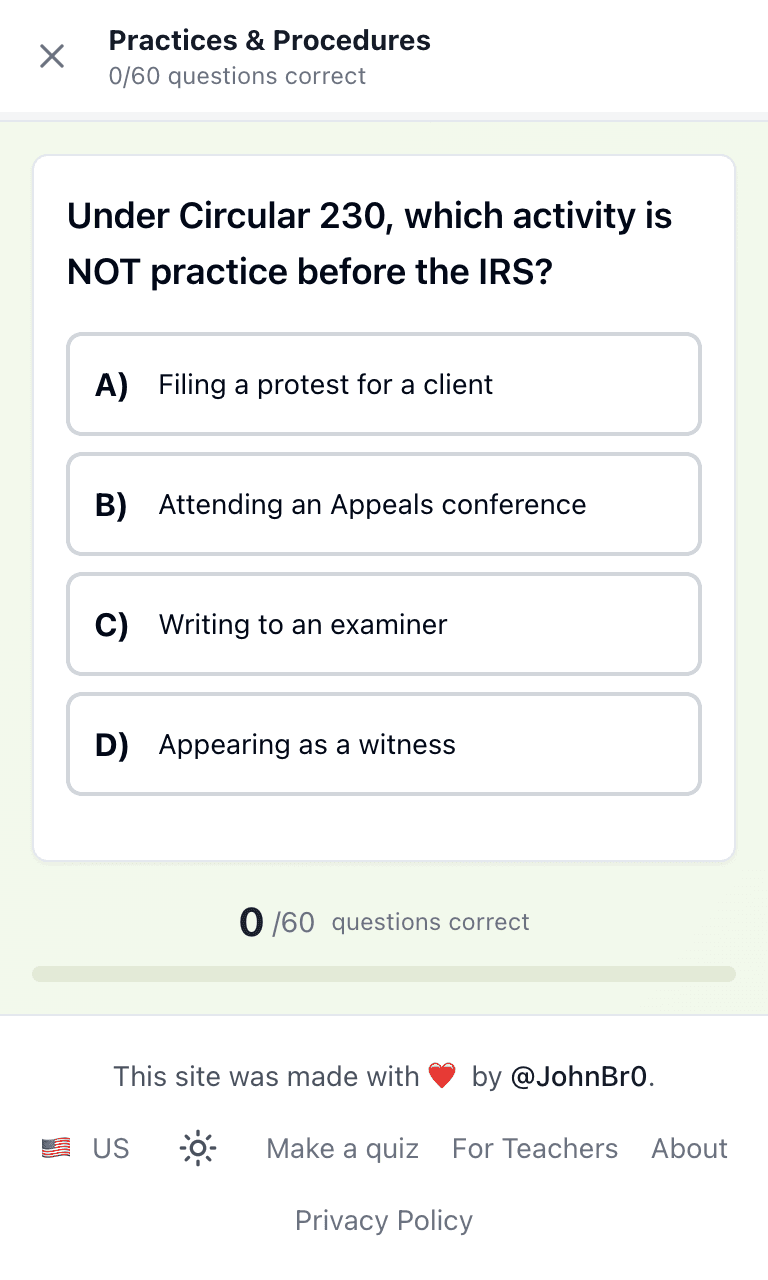
Train on mobile
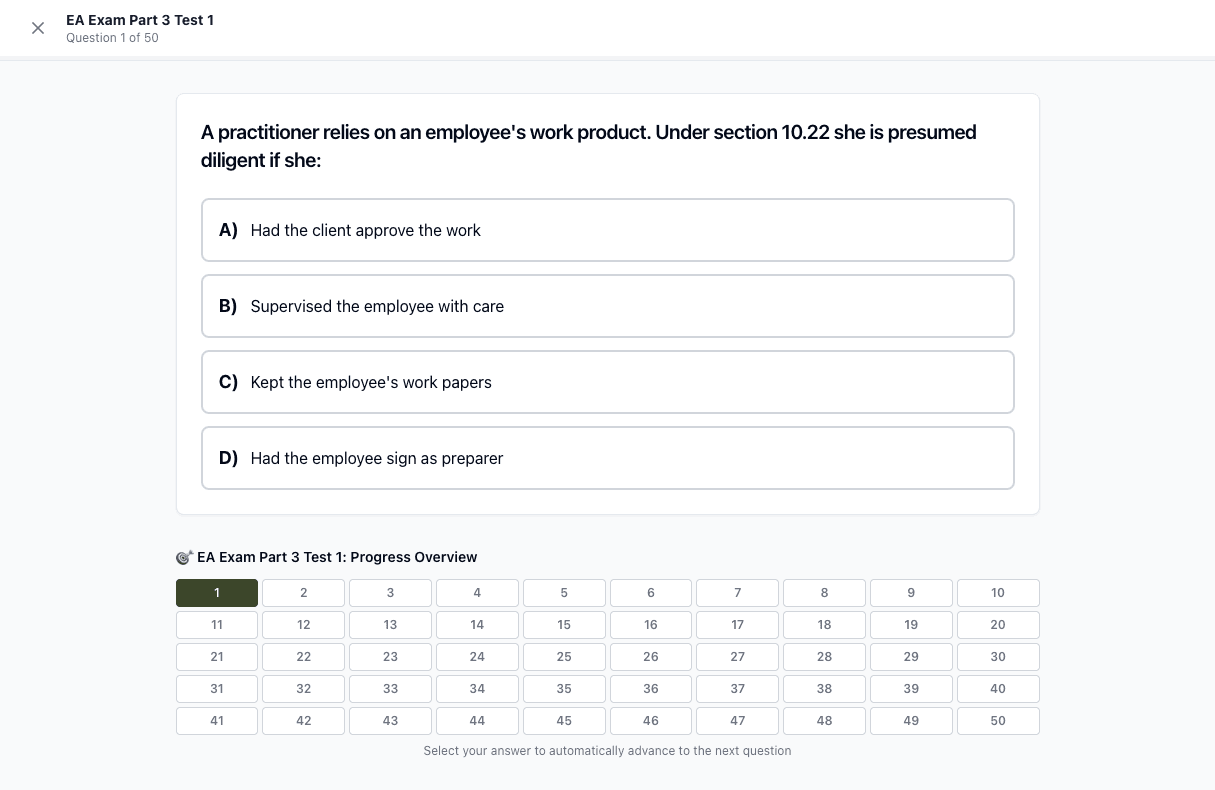
Test on desktop
The EA Exam Part 3 exam at a glance
The Special Enrollment Examination (SEE) is the IRS exam for becoming an enrolled agent, a tax practitioner who can represent taxpayers before the IRS. Part 3 covers representation, practices and procedures. Each of the three parts has 100 multiple-choice questions, 85 scored and 15 unscored, in 3.5 hours, and results are scaled from 200 to 800 with 500 to pass, which is not a fixed percentage. Part 3's four domains are practices and procedures (26 scored questions), representation before the IRS (25), specific areas of representation (20) and the filing process (14). For exams from July 1, 2026 to February 28, 2027, questions follow the Code, regulations and IRS forms and publications as amended through December 31, 2025, and the bulletin names Treasury Department Circular 230 as a study source.
Tigertest has 200 EA Exam Part 3 practice questions with explanations, free to start with no account required.
- Questions
- 100 (85 scored, 15 unscored)
- Time
- 3.5 hours
- Passing score
- 500 on a 200 to 800 scale
- Rules tested
- Law as of December 31, 2025, for July 1, 2026 to February 28, 2027
- Largest domains
- Practices and procedures 26, representation 25
- Where
- PSI test center or remote proctoring, both in the U.S.; international testing delayed
- Attempts
- Up to four per part each testing window
- Passed parts
- Carry over for three years
- Given by
- PSI for the IRS
Updated by the Tigertest team. Practice questions follow the PSI Candidate Information Bulletin for the IRS SEE (revised October 9, 2026) and the IRS enrolled agent FAQs, checked November 2026. Exam rules change, so confirm current details with IRS: Enrolled agents frequently asked questions.
How It Works
Train by Topic
Four training sets: practices and procedures, representation before the IRS, collections, audits and appeals, and the filing process. Questions you miss come back until you have mastered them.
Weighted Mock Tests
Four mock tests of 50 multiple-choice questions in the IRS outline's proportions, with a 70% target. No question appears in more than one test, and every explanation names the rule, form or publication behind the answer.
Built on the IRS Part 3 Outline
The IRS content outline gives each of Part 3's four domains a set number of the 85 scored questions. Each mock test here scales those counts to 50: 15 practices and procedures, 15 representation, 12 specific areas of representation and 8 filing process questions. The 15 unscored experimental questions are not modelled.

Help Make Tigertest Better
Have an idea, a topic you'd like covered, or a question that could be clearer? We read every message and use it to improve every test.
Share FeedbackHow to Pass SEE Part 3
1. Read Circular 230 itself
Practices and procedures is the biggest domain, 26 scored questions. Contingent fee exceptions, conflict waivers, return of records, advertising and the sanctions in subpart C come straight from the text of Circular 230, which the bulletin names as a study source.
2. Know Form 2848 line by line
Powers of attorney anchor the representation domain: what the default authority covers, what needs line 5a, how to revoke or withdraw, and how Form 2848 differs from Form 8821. The Form 2848 instructions answer most of these.
3. Learn the deadlines as a set
Collection and appeals questions turn on days: 30 for a CDP hearing, one year for an equivalent hearing, 90 or 150 to petition the Tax Court, 60 to contest a math error assessment. Write them in one table and drill it.
4. Do not skip the e-file rules
The filing process is 14 scored questions, mostly from IRS Publications 1345 and 3112: Form 8879 retention, signature methods, rejected returns, the 11-return e-file requirement, advertising and the levels of infractions.
Enrolled Agent Part 3 Frequently Asked Questions
What is on Part 3 of the Enrolled Agent exam?
Part 3 of the Special Enrollment Examination (SEE) covers representation, practices and procedures. The IRS content outline in the Candidate Information Bulletin lists four domains with their scored questions: practices and procedures (26), which covers Circular 230 and preparer rules and penalties; representation before the IRS (25), including powers of attorney and building a client's case; specific areas of representation (20), meaning collection, penalty abatement, examinations and appeals; and the filing process (14), including records, data security and IRS e-file.
How many questions are on Part 3 and what score do I need?
Each part has 100 multiple-choice questions, 85 scored and 15 unscored, in 3.5 hours. Results are scaled from 200 to 800 and the IRS passing score is 500, which is not a fixed percentage. The mock tests here are 50 questions, with a 70 percent target as a readiness line.
Which rules does Part 3 follow?
For exams taken from July 1, 2026 to February 28, 2027, the bulletin says questions follow the Internal Revenue Code, regulations and IRS forms and publications as amended through December 31, 2025, and that candidates should not consider legislation, court decisions or penalty amounts after that date. The bulletin also points candidates to Treasury Department Circular 230, the rules for practice before the IRS.
When can I take the SEE?
The exam is given by PSI for the IRS, in person at a PSI test center or by remote proctoring, both in the U.S. for now (international testing is delayed, and will be remote only when it resumes). The current window runs July 1, 2026 to February 28, 2027, with no testing in March and April while the exam is updated. Each part can be taken up to four times a window, in any order, and a passed part carries over for three years.
Are these real Enrolled Agent exam questions?
No. Every question is original, written by Tigertest from the IRS content outline, Circular 230, the Internal Revenue Code and IRS forms and publications. It is practice, not affiliated with the IRS or PSI, and it does not replace the IRS's own study materials.
EA Exam Part 3 sample questions and answers
6 of the 200 practice questions, one from each topic, with the answer explained.
1. Under the Collection Financial Standards, the number of persons counted for living expenses generally matches:
- A.Adults in the household only
- B.Dependents on the latest return
- C.Everyone living in the household
- D.Persons named on the home lease
Answer: B. The IRS says the persons allowed for necessary living expenses should generally be the same as the dependents allowed on the taxpayer's most recent income tax return.
2. When the IRS certifies a client's debt for passport action, it sends notice CP508C to:
- A.The client and her representative
- B.The representative only
- C.The State Department only
- D.The client only
Answer: D. The IRS sends CP508C by regular mail to the taxpayer's last known address and says it will not send a copy to the taxpayer's power of attorney.
3. A client signs the agreement form after an audit but does not pay. To avoid more interest on a bill under $100,000, she pays within:
- A.21 calendar days of the bill
- B.10 calendar days of the bill
- C.30 calendar days of the bill
- D.60 calendar days of the bill
Answer: A. Publication 556 says no more interest or penalties accrue if the bill is paid within 10 business days, extended to 21 calendar days when the amount due is less than $100,000.
4. A client wants her refund split among checking, savings and an IRA. She uses Form 8888 to direct deposit into up to:
- A.4 accounts
- B.5 accounts
- C.3 accounts
- D.2 accounts
Answer: C. Publication 1345 says Form 8888, Allocation of Refund, lets a taxpayer split a refund among up to three qualified accounts.
5. For a partnership under the centralized audit regime, the partnership representative is designated:
- A.On a Form 8821 filing
- B.On a Form 56 notice
- C.On its tax return
- D.On a Form 2848 filing
Answer: C. The instructions say Form 2848 is not used to designate a partnership representative. The designation is made on the partnership return for the year, and Form 2848 lets the representative appoint an agent.
6. An EA who represents clients but prepares no returns must hold:
- A.A current PTIN
- B.No PTIN at all
- C.An EFIN instead
- D.Only a CAF number
Answer: A. Section 10.6(d)(2)(i) requires every enrolled agent to renew a preparer tax identification number as the IRS prescribes, whether or not the agent prepares returns.
Related practice tests
Every test on Tigertest is free to start, with no account needed.
- CPA FAR Practice TestAICPA and NASBA · Uniform CPA Examination, FAR Core section
- CPA REG Practice TestAICPA and NASBA · Uniform CPA Examination, REG Core section
- CPA AUD Practice TestAICPA and NASBA · Uniform CPA Examination, AUD Core section
- ACCA FA Practice TestACCA · Applied Knowledge exam, Financial Accounting (FA/FFA)
- AAT Level 2 Practice TestAAT (Association of Accounting Technicians) · Level 2 Certificate in Accounting, Q2022
- CeMAP 1 Practice TestLIBF (Walbrook Institute London) · CeMAP Module 1, FSRE units FRE1 and FRE2
Ready to Pass SEE Part 3?
Start for free. No account required. 200 questions across every domain of the IRS Part 3 outline.
Start practicing