
Free INBDE Practice Test 2026
200 original dental board questions on the JCNDE Domain of Dentistry, with written patient cases: anatomy, materials, pathology, microbiology, pharmacology, ethics and research. Four 50-question mock exams. Tuned for mobile. Free to start, no account needed.
Try one now
Pick an answer
Which nerve carries the motor supply to the four muscles of mastication?
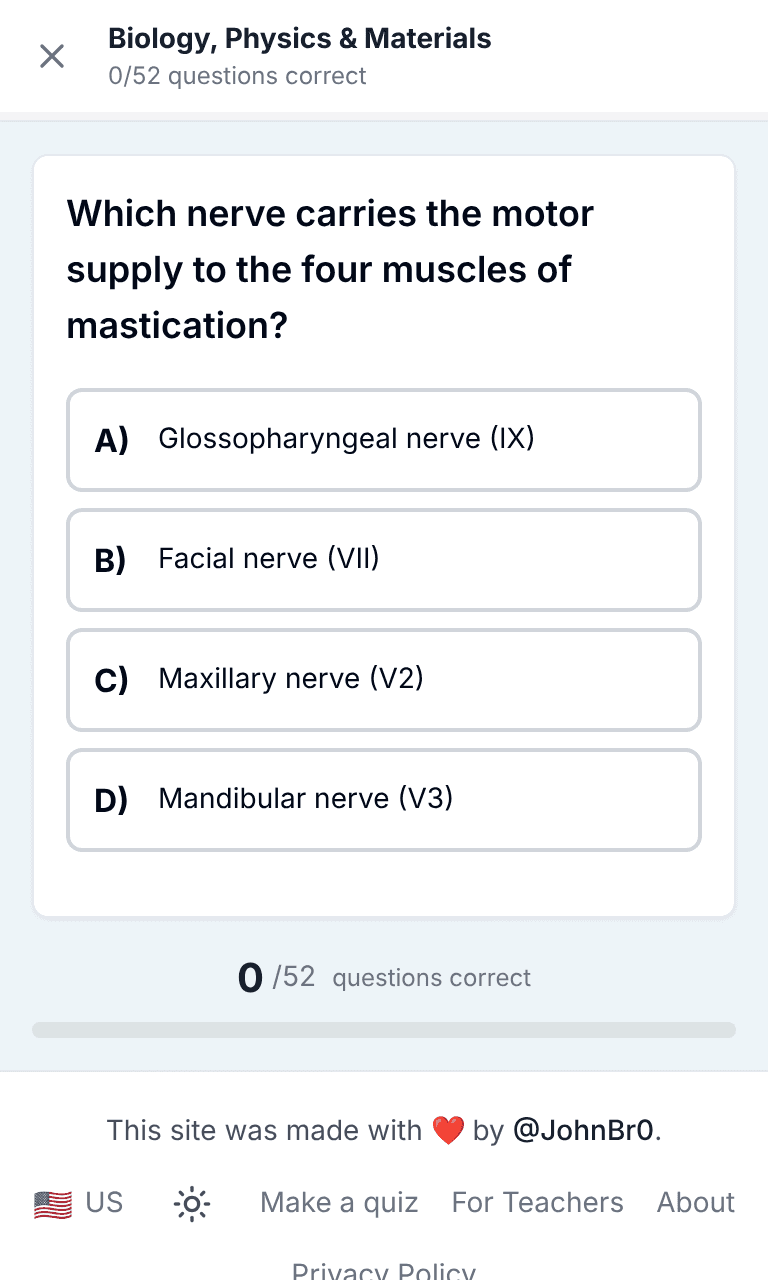
Train on mobile
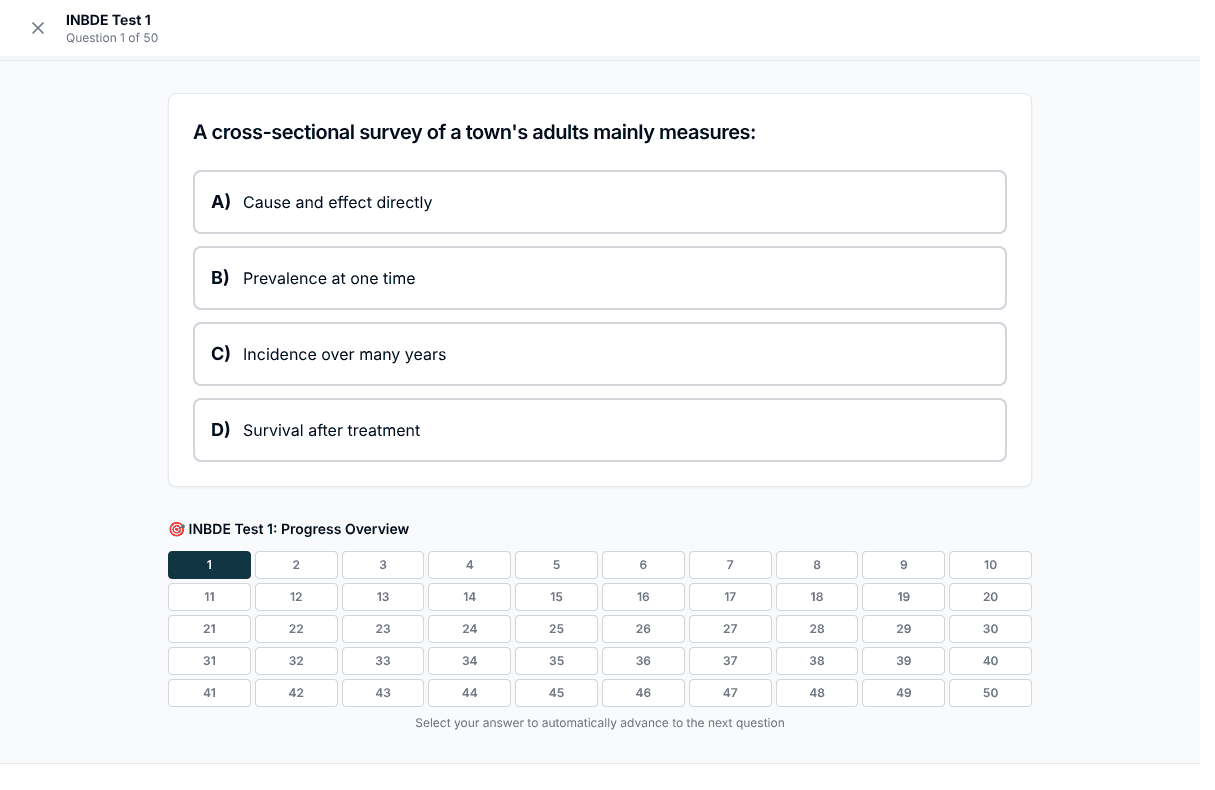
Test on desktop
The INBDE exam at a glance
The Integrated National Board Dental Examination (INBDE) is the Joint Commission on National Dental Examinations' written board exam for dentists. It replaced NBDE Part I and Part II, and US dental licensing jurisdictions use it as part of licensure. It has 500 multiple-choice questions over two days at a Prometric test center: 300 standalone questions and 60 case questions on day one, 140 case questions on day two, in 105-minute sections, 12 hours 30 minutes in all with the tutorial and breaks. Questions come from the JCNDE's Domain of Dentistry, 56 clinical content areas (Diagnosis and Treatment Planning 36%, Oral Health Management 42%, Practice and Profession 22%) and 10 Foundation Knowledge areas. Results are pass or fail; scale scores run from 49 to 99 and 75 is the minimum passing score.
Tigertest has 200 INBDE practice questions with explanations, free to start with no account required.
- Questions
- 500 multiple choice (300 standalone, 200 case-based)
- Time
- Two days, six 105-minute sections, 12 h 30 min with tutorial and breaks
- Pass mark
- Scale score of 75 (scale 49 to 99), reported pass or fail
- Content
- Diagnosis and Treatment Planning 36%, Oral Health Management 42%, Practice and Profession 22%, across 10 Foundation Knowledge areas
- Retakes
- At least 60 days apart, at most four a year; pass within five years or five attempts
- Where
- Prometric test centers; both days at the same center within 7 days
- Run by
- Joint Commission on National Dental Examinations (JCNDE)
- Exam fee
- $890 (plus a $435 processing fee for students or graduates of a program not accredited by CODA) official source
Fee and retake rules checked on 2026-11-10.
Updated by the Tigertest team. Practice questions follow The JCNDE INBDE 2026 Candidate Guide (updated December 15, 2025) and the JCNDE INBDE pages, checked November 2026. Exam rules change, so confirm current details with JCNDE: INBDE.
How It Works
Train by Foundation Knowledge Area
Four training sets cover the ten Foundation Knowledge areas: biology, physics and materials; development and host defense; pathology and microbiology; and pharmacology, ethics and research. Questions you miss come back until you have mastered them.
Weighted Mock Exams
Four mock exams of 50 questions, each weighted to the JCNDE's Foundation Knowledge percentages and mixing standalone questions with written patient cases. Aim for 75% or better. No question appears in more than one test, and every one comes with an explanation.
Built on the JCNDE Domain of Dentistry
The INBDE test specifications give the share of questions from each Foundation Knowledge area, shown below. Every mock exam here follows those shares, with the clinical tasks of diagnosis, oral health management and practice running through every area. Dental school faculty can set Tigertest as board review at tigertest.io/teach and see which areas the class misses most.

Help Make Tigertest Better
Have an idea, a topic you'd like covered, or a question that could be clearer? We read every message and use it to improve every test.
Share FeedbackHow to Pass the INBDE
1. Connect the science to the chair
The INBDE asks basic science through clinical situations: why an anesthetic fails in infected tissue, which nerve a numb lip points to, which lab test a jaw lesion calls for. Study each science topic with the patient problem it explains.
2. Read the patient box first
Two fifths of the exam is case questions. Read the age, history, medications and vital signs before the question, since they decide premedication, drug choice and timing. The guide says a blank area means the information is unknown or not present.
3. Do not skip ethics and research
Behavioral science, ethics and law, and research methods are about a fifth of the Foundation Knowledge share. Know the ADA Code's five principles and its rules on referral, abandonment and abuse, plus sensitivity, specificity, study designs and bias.
4. Fix your misses, then retest
Tigertest tracks your accuracy by Foundation Knowledge area. Aim for 75% or better on every mock exam before your exam date. After each test, drill the questions you missed and retrain the weakest set.
INBDE Frequently Asked Questions
What is the INBDE?
The Integrated National Board Dental Examination is the written board exam of the Joint Commission on National Dental Examinations (JCNDE). It replaced NBDE Part I and Part II and tests the biomedical, clinical and behavioral knowledge needed for safe, entry-level general practice. US dental licensing jurisdictions use it as part of licensure, alongside a clinical exam and any state requirements.
How many questions are on the INBDE and how is it scored?
The INBDE has 500 multiple-choice questions over two days at a Prometric test center. Day one has three sections of 100 standalone questions and one of 60 case questions; day two has two sections of 70 case questions. Each section is 105 minutes, and the whole administration is 12 hours 30 minutes with the tutorial, breaks and survey. Results are reported as pass or fail. Scale scores run from 49 to 99 and 75 is the minimum passing score, which is not the same as 75 percent correct, so the 75 percent line on these practice tests is a readiness target. There is no penalty for guessing.
What is on the INBDE?
The JCNDE's Domain of Dentistry has 56 clinical content areas in three sections, Diagnosis and Treatment Planning (about 36% of questions), Oral Health Management (42%) and Practice and Profession (22%), and 10 Foundation Knowledge areas, from molecular and cellular biology to pharmacology, ethics and research methods. Each question pairs a clinical task with the foundation knowledge behind it.
How are the patient cases handled in this practice test?
On the real INBDE, case questions come with a patient box and sometimes dental charts, and several questions follow one patient. Here each case question opens with a short written scenario and the findings are described in words, so no images are shown. About a quarter of the questions are cases; on the real exam it is 200 of 500.
Are these the real INBDE questions?
No. Every question is original, written by Tigertest from the JCNDE's published Candidate Guide and Foundation Knowledge document, so it covers the same knowledge without copying the exam. Tigertest is not affiliated with the JCNDE or the American Dental Association, and this practice does not replace your dental school's board review.
I teach a dental school or board review course. Can my students use Tigertest?
Yes, for free. Make a class at tigertest.io/teach, post one link, and students join with just their name. You see who practiced, their test scores and the topics your class misses most.
INBDE sample questions and answers
6 of the 200 practice questions, one from each topic, with the answer explained.
1. Which primary tooth usually erupts first?
- A.Primary mandibular lateral incisor
- B.Primary mandibular central incisor
- C.Primary maxillary central incisor
- D.Primary mandibular first molar
Answer: B. Mandibular central incisors usually appear first, at about 6 to 10 months, followed by the maxillary central incisors.
2. Case: 9-year-old boy whose permanent first molars and incisors have demarcated, chalky, yellow-brown enamel that breaks down easily. Other teeth are normal. What is the likely diagnosis?
- A.Hypomaturation amelogenesis imperfecta
- B.Dental fluorosis
- C.Tetracycline staining
- D.Molar-incisor hypomineralization
Answer: D. MIH affects one or more first permanent molars, often with incisors, as sharply bordered opacities. Amelogenesis imperfecta affects all teeth, and fluorosis gives diffuse, symmetric mottling.
3. Case: A patient calls on Saturday with severe pain and swelling after a root canal begun two days ago. Under the ADA Code, the dentist must:
- A.Arrange reasonable emergency care
- B.Tell him to wait until Monday
- C.Refer him to an endodontist next week
- D.Charge first, then decide to help
Answer: A. Dentists are obliged to make reasonable arrangements for emergency care of their patients of record, whether by seeing them or arranging coverage.
4. Case: 50-year-old man on chemotherapy with an absolute neutrophil count of 400 per cubic millimeter wants a routine scaling. What should the dentist do?
- A.Proceed after a mouth rinse only
- B.Proceed under nitrous oxide sedation
- C.Defer it and consult the oncologist
- D.Proceed with no changes
Answer: C. An absolute neutrophil count under 500 is severe neutropenia with a high infection risk, so elective care waits for count recovery after discussion with the oncologist; urgent care is planned with the medical team.
5. Case: 41-year-old woman with a Class V lesion at the gingival margin of tooth 6 that will be hard to keep dry. What is the main concern with placing a composite there?
- A.The lesion is too shallow to restore
- B.Composite cannot be shaded to match
- C.Moisture weakens the resin bond
- D.Composite releases too much fluoride
Answer: C. Resin bonding is technique sensitive and fails with blood or saliva contamination, which is why isolation matters at cervical margins and why glass ionomer is often used there instead.
6. Case: 40-year-old dental assistant cuts her finger on a used scaler. What is the first thing she should do?
- A.Wash it with soap and water
- B.Squeeze the wound hard
- C.Soak it in bleach
- D.Wait to report it at day's end
Answer: A. CDC guidance is to wash a percutaneous injury with soap and water at once, then report it so the source and exposure can be evaluated and postexposure care started quickly.
Related practice tests
Every test on Tigertest is free to start, with no account needed.
Ready to Pass the INBDE?
Start for free. No account required. 200 questions across all ten Foundation Knowledge areas of the INBDE.
Start practicing