
Free ISC2 CC Practice Test 2026
224 original Certified in Cybersecurity questions weighted to the September 2026 outline, answered in order like the real exam. Tuned for mobile. Free to start, no account needed.
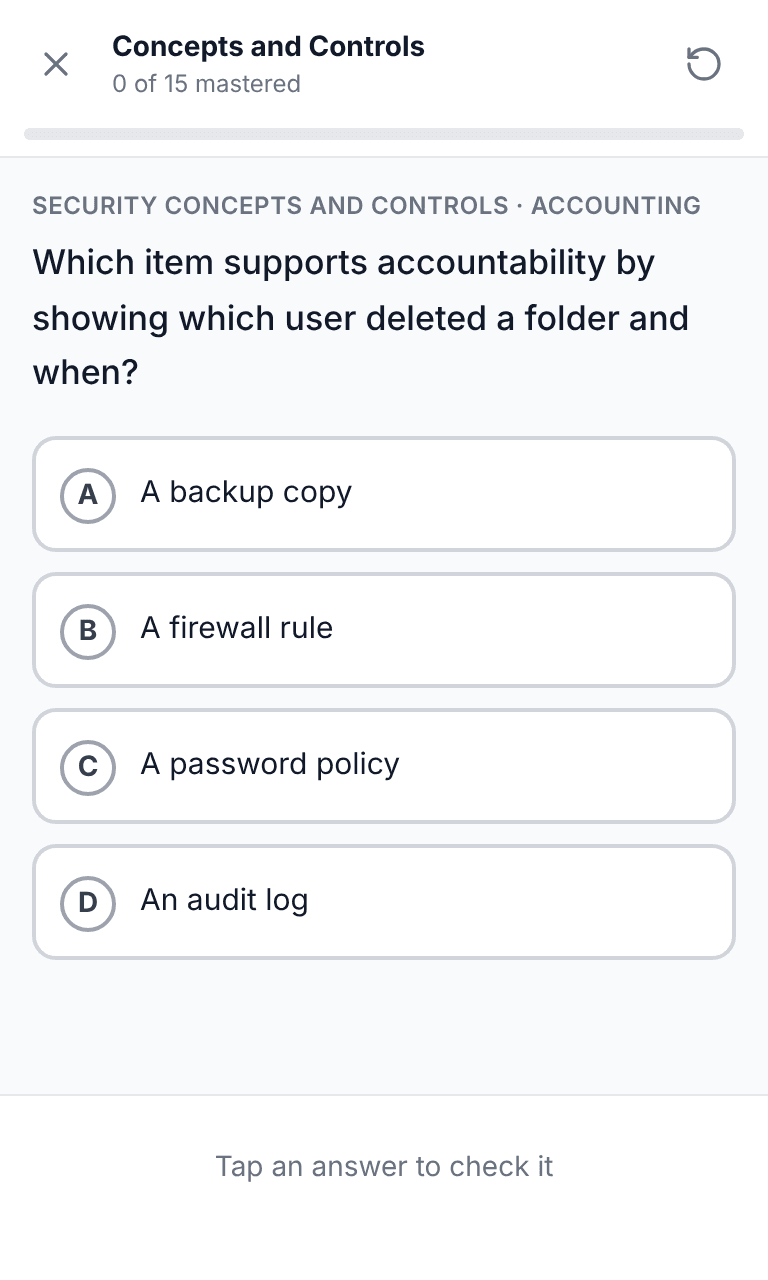
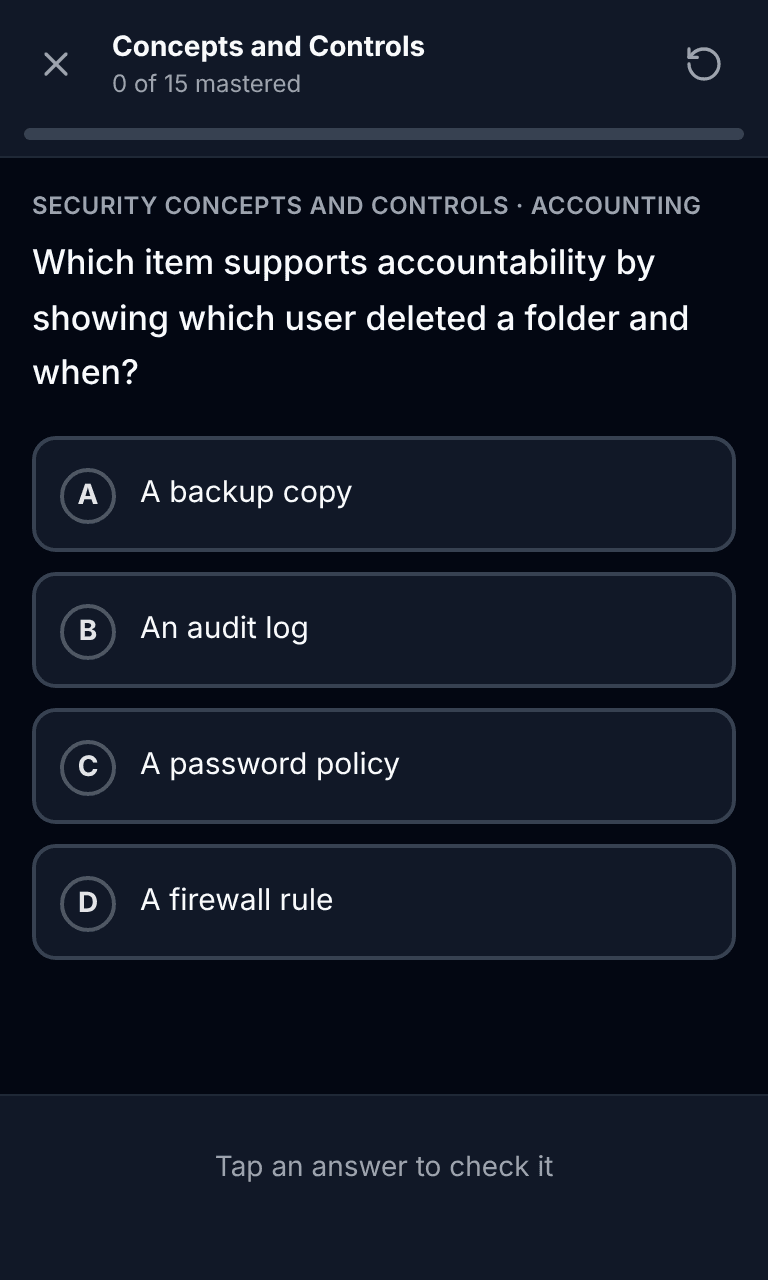
Train on mobile
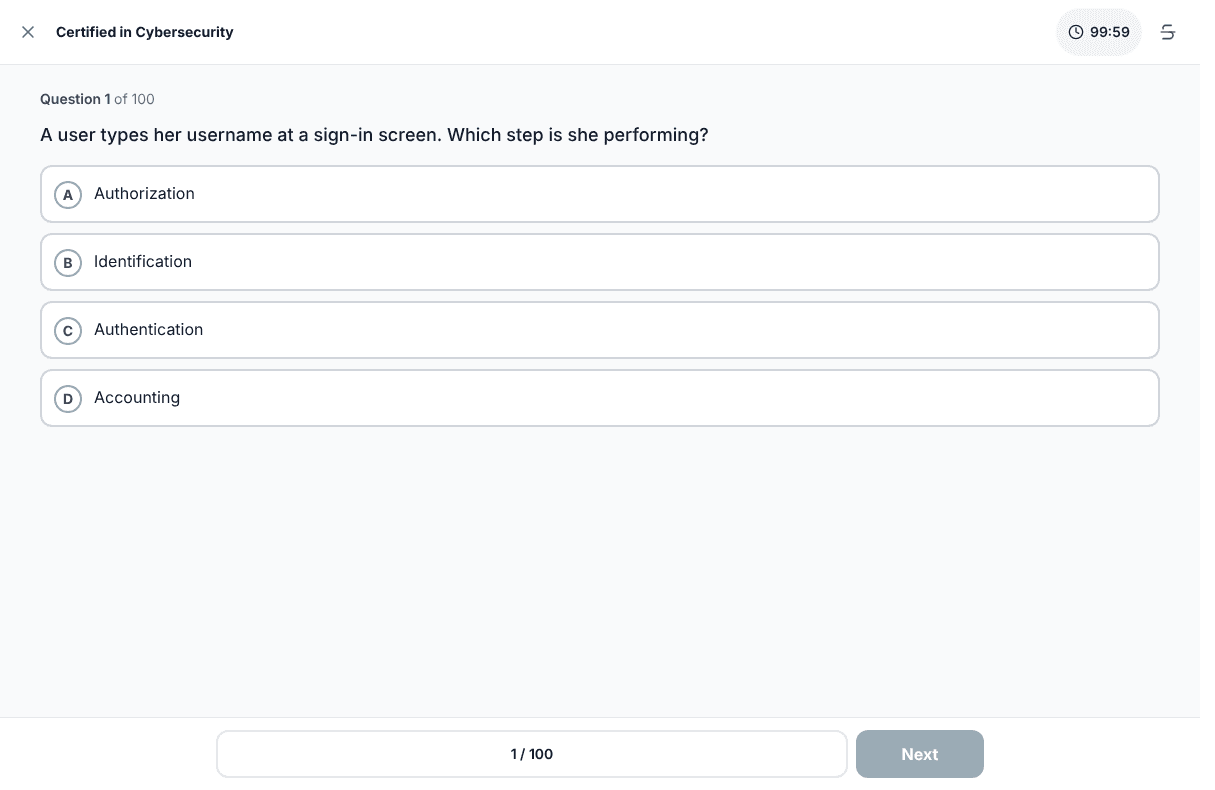
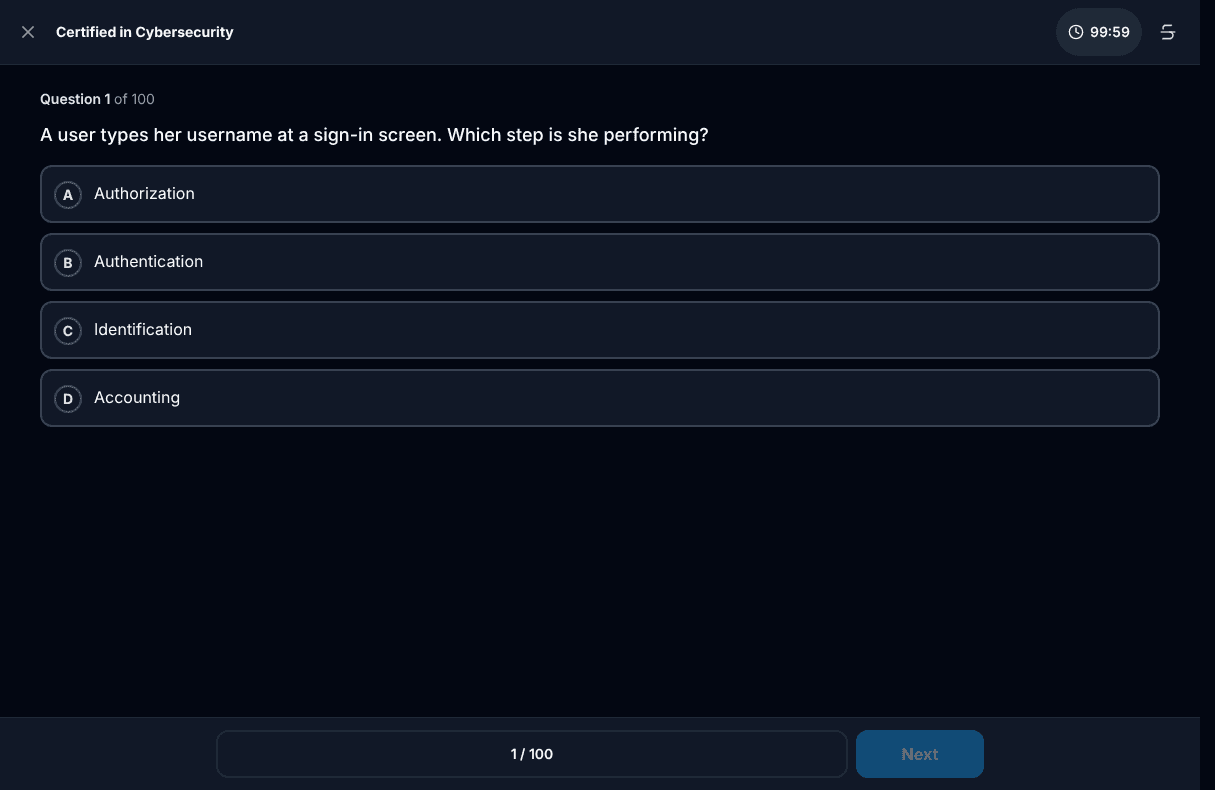
Test on desktop
The ISC2 CC exam at a glance
The ISC2 Certified in Cybersecurity (CC) exam is computerized adaptive: 100 to 125 items in 2 hours, multiple choice plus advanced item types, answered in order. It is scored on a 0 to 1000 scale and 700 passes. The outline effective September 1, 2026 weights five domains: Security Principles 24%, Security Governance 17.3%, Identity and Access Management (IAM) Concepts 20%, Networking and Cloud Security Concepts 21.3%, and Security Operations and Incident Response 17.3%. No work experience is required.
Tigertest has 224 ISC2 CC practice questions with explanations, free to start with no account required.
- Questions
- 100 to 125 (adaptive)
- Time
- 2 hours
- Passing score
- 700 on a 0 to 1000 scale
- Domains
- 5, weighted 17.3% to 24%
- Experience
- None required
- Languages
- English, Chinese, Japanese, German, Spanish
- Given by
- ISC2, at Pearson VUE test centers
Updated by the Tigertest team. Practice questions follow the ISC2 CC exam outline effective September 1, 2026. Exam rules change, so confirm current details with ISC2.
How It Works
Eight Drills
Concepts and controls, risk and ethics, security governance, identity and access, network security, architecture and cloud, data security, and operations and response. Questions you miss come back until you have mastered them.
Practice Tests
Two 100-question tests in 100 minutes, answered in order with no going back, like the real adaptive exam. Practice Test 2 is held out of the drills, so it measures readiness.
Built on the CC Exam Outline
ISC2 publishes the CC domains and their average weights in its exam outline. Every practice test follows the outline effective September 1, 2026, including GRC, key risk indicators, Zero Trust, cloud shared responsibility, quantum-resistant cryptography and red, blue and purple teaming.

Help Make Tigertest Better
Have an idea, a topic you'd like covered, or a question that could be clearer? We read every message and use it to improve every test.
Share FeedbackHow to Pass the ISC2 CC
1. Learn the vocabulary cold
Many CC questions turn on one term: integrity or availability, threat or vulnerability, RTO or RPO, DAC or MAC, purge or destroy. Make sure you can tell the close pairs apart from a one-line scenario.
2. Think like a manager, not a technician
The exam often asks for the best or first step. Favor the answer that protects people and the business, follows policy and fits the risk, over the one that is most technical.
3. Practice without going back
The real exam is adaptive, so you cannot return to a question. Read each one fully, commit to an answer and move on. These practice tests run the same way.
4. Drill your weak domain, then sit a full test
Tigertest tracks your accuracy by domain. Retake the drill you miss most until you clear 80 percent, then take Practice Test 2 cold before you book.
ISC2 CC Frequently Asked Questions
How many questions are on the ISC2 CC exam?
The CC exam is computerized adaptive testing (CAT) with 100 to 125 items in 2 hours, per the ISC2 CC exam outline effective September 1, 2026. Items are multiple choice plus advanced item types. Because it is adaptive, you answer in order and cannot go back to change an answer.
What is the passing score for the CC exam?
You need 700 out of 1000 points. The score is scaled, so it is not a fixed percentage of questions. Aim for 80 percent or better on these practice tests before you book.
What is on the ISC2 CC exam?
Five domains in the outline effective September 1, 2026: Security Principles 24 percent, Security Governance 17.3 percent, Identity and Access Management (IAM) Concepts 20 percent, Networking and Cloud Security Concepts 21.3 percent, and Security Operations and Incident Response 17.3 percent.
Do I need work experience for the CC?
No. ISC2 lists no work experience requirement for Certified in Cybersecurity. It is ISC2's entry-level certification for people starting in a cybersecurity role.
Is this practice test the same format as the real exam?
Each practice test is 100 questions in 100 minutes, answered in order with no going back, like the real exam. It is a linear mock, not adaptive. Most items are multiple choice, with a few choose-two, ordering and matching items standing in for the advanced item types. The questions are original, not ISC2's.
Is the Tigertest CC practice test free?
It is free to start, with no account required. Practice Test 1 and every drill but the last two are free; the last two drills and the final practice test are part of Tigertest Premium, one payment with no subscription. Create a free account if you want your progress saved across devices.
I teach an ISC2 CC or entry-level cybersecurity course. Can my students use Tigertest?
Yes, for free. Make a class at tigertest.io/teach, post one link, and students join with just their name. You see who practiced, their test scores and the topics your class misses most.
ISC2 CC sample questions and answers
6 of the 224 practice questions, one from each topic, with the answer explained.
- 1.
Which technique lets a user check that a downloaded file was not altered on the way?
- A.
Matching its published hash
- B.
Downloading the file a second time
- C.
Opening the file in read-only mode
- D.
Checking the file's creation date
Answer: A.If the hash of the downloaded file matches the hash the publisher posted, the file is unchanged, which confirms integrity. Downloading twice proves nothing if the source was tampered with.
- A.
- 2.
Which canon comes first in the ISC2 Code of Ethics?
- A.
Advance and protect the profession
- B.
Protect society and the infrastructure
- C.
Act honorably, honestly, justly and legally
- D.
Serve principals diligently
Answer: B.The canons run in order: protect society, the common good and the infrastructure; act honorably, honestly, justly, responsibly and legally; serve principals diligently and competently; advance and protect the profession.
- A.
- 3.
Which is the most useful metric of whether phishing training is working?
- A.
The length of the training video
- B.
The total emails sent each day
- C.
Share of staff reporting test phishes
- D.
The number of slides in the training deck
Answer: C.Behavior change shows training works: more people reporting simulated phishing, and fewer clicking. Slide counts and video length measure effort, not results.
- A.
- 4.
A manager has top secret clearance but is denied a top secret file outside her project. Which principle applies?
- A.
Need to know
- B.
Due diligence
- C.
Job rotation
- D.
Separation of duties
Answer: A.Clearance alone is not enough: access also requires a need to know the specific information for one's duties.
- A.
- 5.
Why are industrial control systems often hard to patch quickly?
- A.
They use only new operating systems
- B.
Their vendors forbid any security changes
- C.
They never connect to any network
- D.
Downtime can halt physical processes
Answer: D.ICS run physical processes such as power and water, so taking them down to patch can be costly or unsafe. They are often protected with segmentation and monitoring instead.
- A.
- 6.
A cloud is built and shared only by a group of credit unions that face the same regulators. Which deployment model is this?
- A.
Hybrid cloud
- B.
Private cloud
- C.
Community cloud
- D.
Public cloud
Answer: C.A community cloud serves a group of organizations with shared concerns, such as regulation. A public cloud is open to anyone.
- A.
Related practice tests
Every test on Tigertest is free to start, with no account needed.
- CompTIA Security+ Practice TestCompTIA SY0-701
- CompTIA CySA+ Practice TestCompTIA CS0-004
- CompTIA PenTest+ Practice TestCompTIA · PenTest+ PT0-003 exam objectives
- Fortinet NSE 1 (FCF) Practice TestFortinet Training Institute · NSE 1 Cybersecurity and Cloud Fundamentals (formerly FCF)
- CISSP Practice TestISC2 · CISSP exam outline, April 2024
- CompTIA Network+ Practice TestCompTIA N10-009
Ready to Pass the ISC2 CC?
Start for free. No account required. 224 questions across all five domains.
Start practicing