
Free ISC2 SSCP Practice Test
260 original operational-security MCQs, seven drills and two fixed practice tests. CAT and advanced item types are not simulated. Free to start, no account needed.
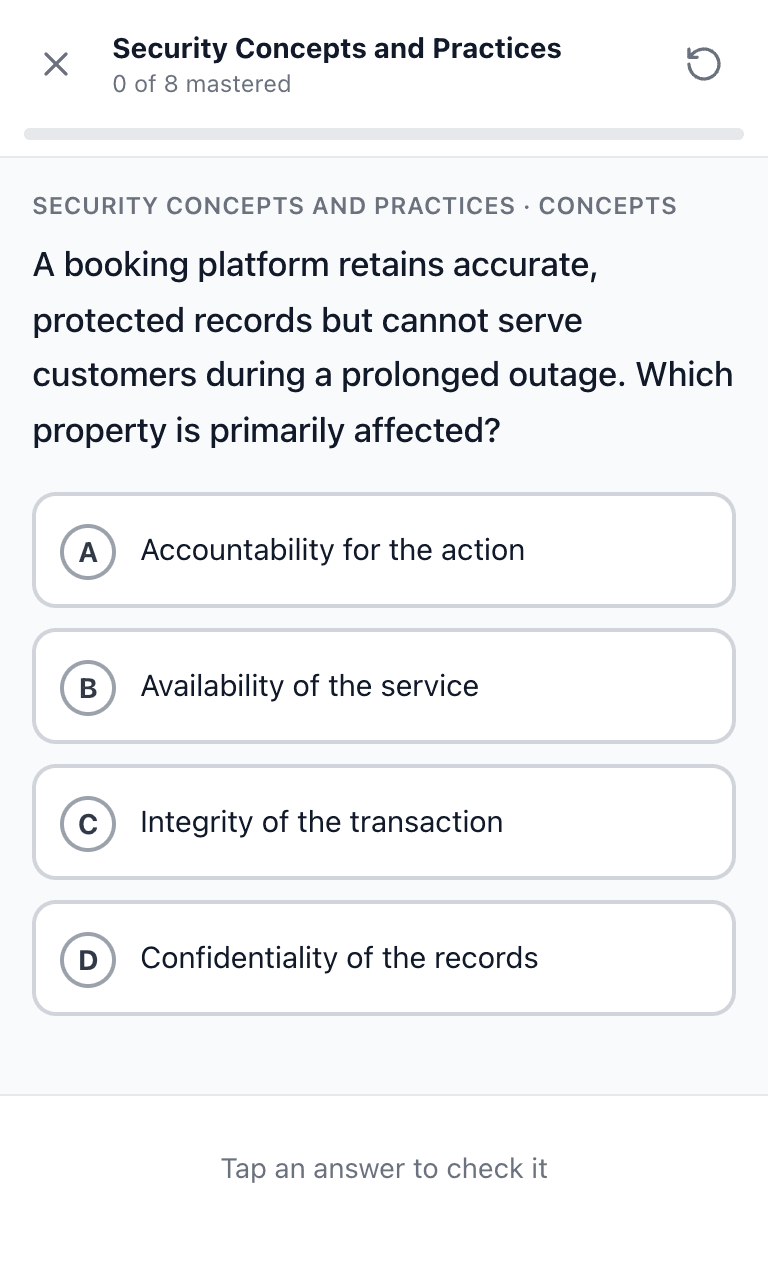
Train on mobile
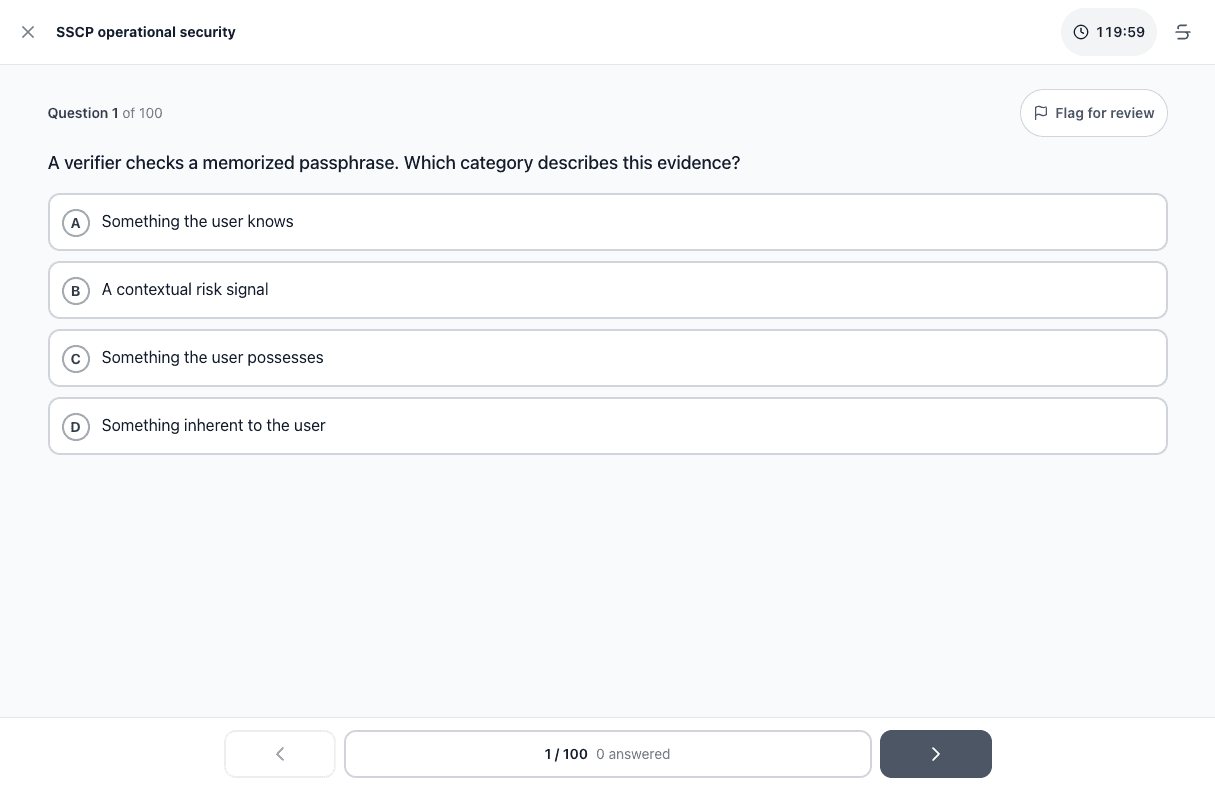
Test on desktop
The SSCP exam at a glance
ISC2 SSCP assesses operational security across seven domains. The current exam uses computerized adaptive testing: 100-125 items in two hours, including multiple-choice and advanced item types. Tigertest provides 260 original MCQs, seven drills and two fixed 100-question tests. CAT, unscored items and advanced interactive formats are not simulated.
Tigertest has 260 SSCP practice questions with explanations, all free with no account required.
- Current outline
- Effective 1 October 2025; seven domains
- Official format
- CAT; 100-125 items, including 25 unscored items
- Official time
- 2 hours
- Official passing standard
- 700/1000; not a 70% raw-score cutoff
- Practice coverage
- 260 original MCQs; seven drills and two fixed 100-question tests
- Not simulated
- CAT, no-backtracking rule, unscored items and advanced formats
- Practice scoring
- Percentage correct; 80% editorial study goal
- Access
- Free to start; final drill and Practice Test 2 require Premium
Updated by the Tigertest team. Practice questions follow ISC2 SSCP outline effective October 2025 and current CAT FAQ, checked 17 November 2026. Each practice test follows domain weights of 16/15/15/14/9/16/15% exactly. Selected concepts, not exhaustive outline coverage. Exam rules change, so confirm current details with ISC2 SSCP exam outline.
How It Works
Seven Domain Drills
Read each scenario, choose an answer and use the explanation to check the distinction. Missed questions return for more practice. The 60 drill questions are separate from both test banks.
Two Practice Tests
Each test has 100 single-answer questions and a 120-minute timer. Flag questions and review them before finishing. The tests use separate questions; the second is held out for a fresh check of these concepts.
The Seven SSCP Domains
Each fixed test follows the official domain percentages exactly. Practice focuses on selected operational concepts. Adaptive selection, unscored items, advanced formats and exhaustive technology coverage are not included.

Help Make Tigertest Better
Have an idea, a topic you'd like covered, or a question that could be clearer? We read every message and use it to improve every test.
Share FeedbackHow to Study for the SSCP
1. Identify the constraint
Find the actual requirement: a trust boundary, a recovery limit, a device-management need or an authorization rule. Several controls may be useful, but only one directly addresses the stated gap.
2. Follow the evidence
Separate authentication from authorization, configuration from observed behavior, and a completed change from a verified outcome. Use the logs and measurements provided in the question.
3. Explain the alternatives
For each missed question, identify the circumstance in which another option would be appropriate. This builds understanding of scope and timing.
4. Add hands-on preparation
Use authorized practical work and the current ISC2 outline alongside these conceptual drills. A high percentage here does not assess CAT performance, advanced items or hands-on administration.
SSCP Frequently Asked Questions
What is the current SSCP exam format?
The ISC2 outline effective 1 October 2025 specifies computerized adaptive testing with 100-125 items in two hours. Items include multiple-choice and advanced types. The CAT FAQ states that 25 items are unscored and finalized answers cannot be revisited. These practice tests are fixed-length MCQs and do not simulate those features.
What does this SSCP practice cover?
Selected operational concepts across all seven domains: security practices, access controls, risk analysis, incident recovery, cryptography, networks and systems. Each test allocates 16, 15, 15, 14, 9, 16 and 15 questions respectively, matching the official percentages. The 60 drill questions are separate from both tests. This is not exhaustive coverage of every outline example.
Is 70% enough to pass the real SSCP?
ISC2 publishes a passing standard of 700 out of 1000, which is not a 70% raw-score cutoff. CAT evaluates ability using its scoring process, and candidates receive a pass/fail result rather than a numeric score. Tigertest shows percentage correct and uses an editorial 80% study goal; neither predicts an official result.
Can I go back to earlier questions here?
Yes. You may flag and revisit questions in these fixed practice tests to support learning. The real CAT exam does not allow revisiting a finalized answer. Practice with the official exam rules as well as using these explanations.
How should I use the questions?
Study the requirement in each scenario, explain why the alternatives do not fit it, and review missed concepts. Combine this bank with the current ISC2 outline and authorized practical work. It does not assess hands-on administration, advanced item interaction or adaptive exam performance.
Is this SSCP practice free?
It is free to start with no account required. Practice Test 1 and the first six drills are free. The Systems and Application Security drill and Practice Test 2 require Tigertest Premium, one payment with no subscription. ISC2 does not endorse or sponsor Tigertest.
I teach an SSCP course. Can my students use Tigertest?
Yes, for free. Make a class at tigertest.io/teach, post one link, and students join with just their name. You see who practiced, their test scores and the topics your class misses most.
SSCP sample questions and answers
6 of the 260 practice questions, one from each topic, with the answer explained.
- 1.
A trust allows recognition through an intermediate trusted domain, without direct agreements between every pair. Which trust is this?
- A.
One-way trust
- B.
Explicit pairwise trust
- C.
Transitive trust
- D.
Non-transitive trust
Answer: C.Transitivity allows trust to extend through defined relationships. It must not be assumed for every trust arrangement.
- A.
- 2.
A training pipeline retains personal records that add nothing to its approved goal. Which change reduces privacy exposure?
- A.
Keep them in case a future purpose arises
- B.
Move the extra records to cheaper archive storage
- C.
Stop keeping data the stated purpose does not need
- D.
Encrypt the extra records and keep all of them
Answer: C.Minimize retained data to the justified purpose and obligations. Encryption or cheaper storage still keeps the unnecessary data, and accuracy does not authorize unrelated retention.
- A.
- 3.
An organization inventories algorithms so it can swap weak cryptography without redesigning apps. Which capability is this?
- A.
Perfect forward secrecy
- B.
Defense in depth
- C.
Cryptographic agility
- D.
Cryptographic key escrow
Answer: C.Cryptographic agility supports controlled algorithm and key transitions as requirements and threats change.
- A.
- 4.
RTO is one hour and RPO 15 minutes. Recovery takes 80 minutes and loses five minutes of updates. Which is correct?
- A.
Both the time and data-loss targets are met
- B.
Both the time and data-loss targets are missed
- C.
The time target is missed but the data-loss target is met
- D.
The time target is met but the data-loss target is missed
Answer: C.The 80-minute restoration exceeds the one-hour RTO, while five minutes of loss is within the RPO.
- A.
- 5.
A failed appliance may take its locally stored event history with it. Which logging design reduces this risk?
- A.
Write logs to a USB drive on the device
- B.
Enable debug logging on the device
- C.
Forward events to a central syslog or SIEM
- D.
Increase the local log buffer
Answer: C.Forward relevant events to a protected central collection service. Anything kept on or in the device can be lost with it.
- A.
- 6.
A rule detects 40 of 50 malicious test events. What percentage was detected?
- A.
20%
- B.
90%
- C.
80%
- D.
40%
Answer: C.40 divided by 50 equals 0.80, or 80%. This measures detection within the defined test set, not all possible attacks.
- A.
Related practice tests
Every test on Tigertest is free to start, with no account needed.
- CompTIA Security+ Practice TestCompTIA SY0-701
- CompTIA CySA+ Practice TestCompTIA CS0-004
- CompTIA PenTest+ Practice TestCompTIA · PenTest+ PT0-003 exam objectives
- Fortinet NSE 1 (FCF) Practice TestFortinet Training Institute · NSE 1 Cybersecurity and Cloud Fundamentals (formerly FCF)
- CISSP Practice TestISC2 · CISSP exam outline, April 2024
- CompTIA Network+ Practice TestCompTIA N10-009
Start SSCP Practice
Start with Security Concepts and Practices, then work through the seven domains.
Start practicing