
Free ISTQB CTFL Practice Test 2026
200 original questions and two full 40-question mock exams on the Foundation Level v4.0 syllabus. Tuned for mobile. Free to start, no account needed.
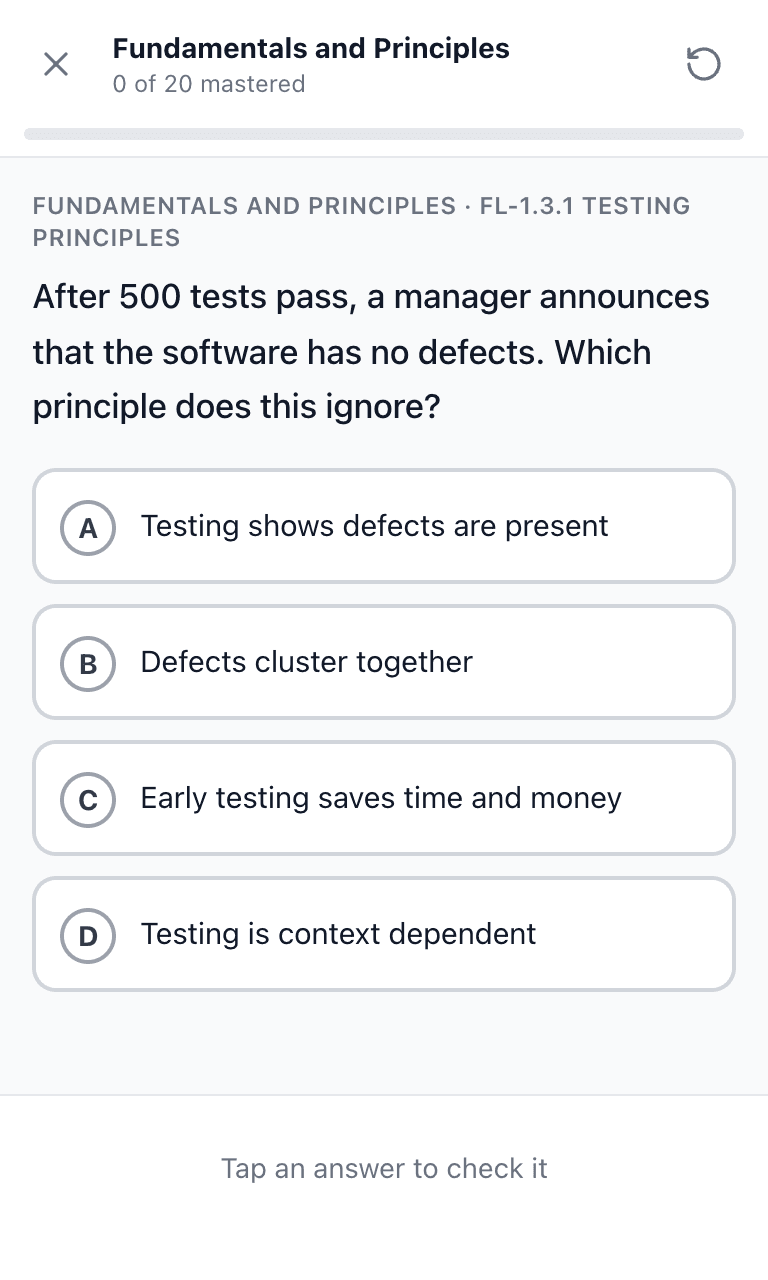
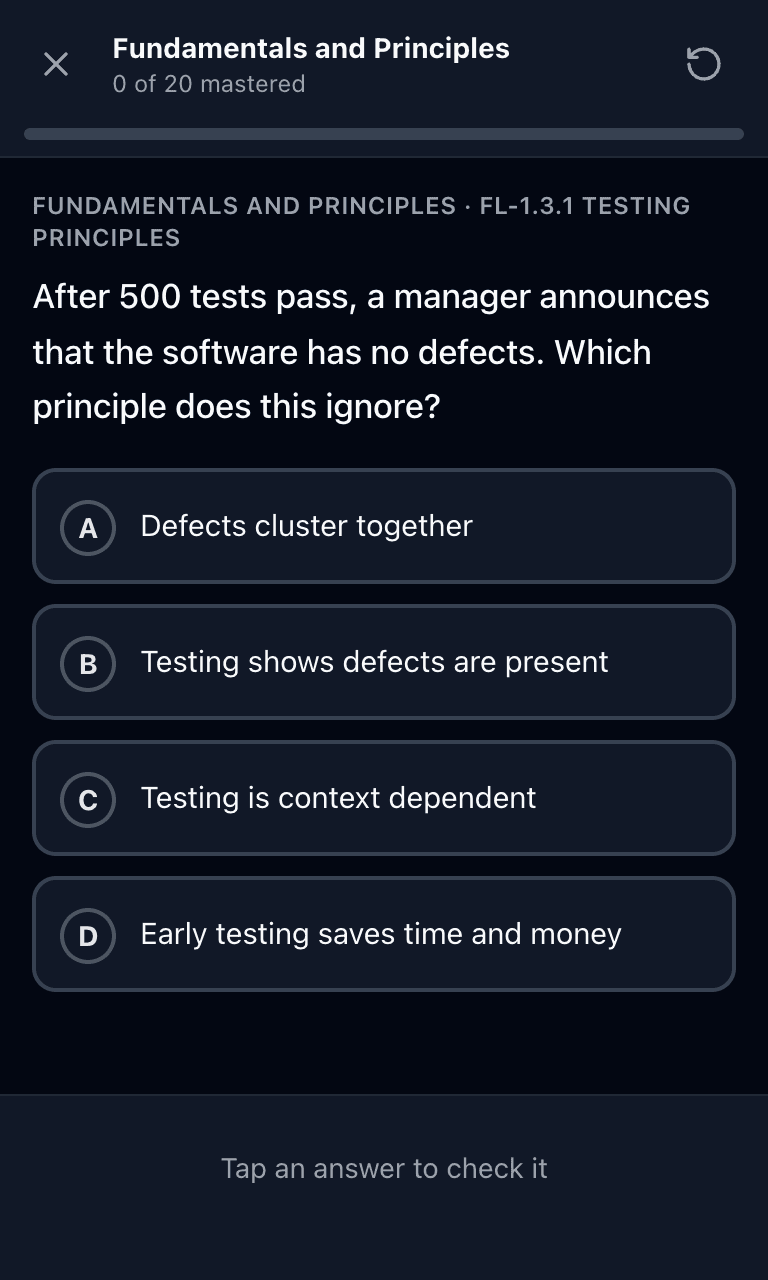
Train on mobile
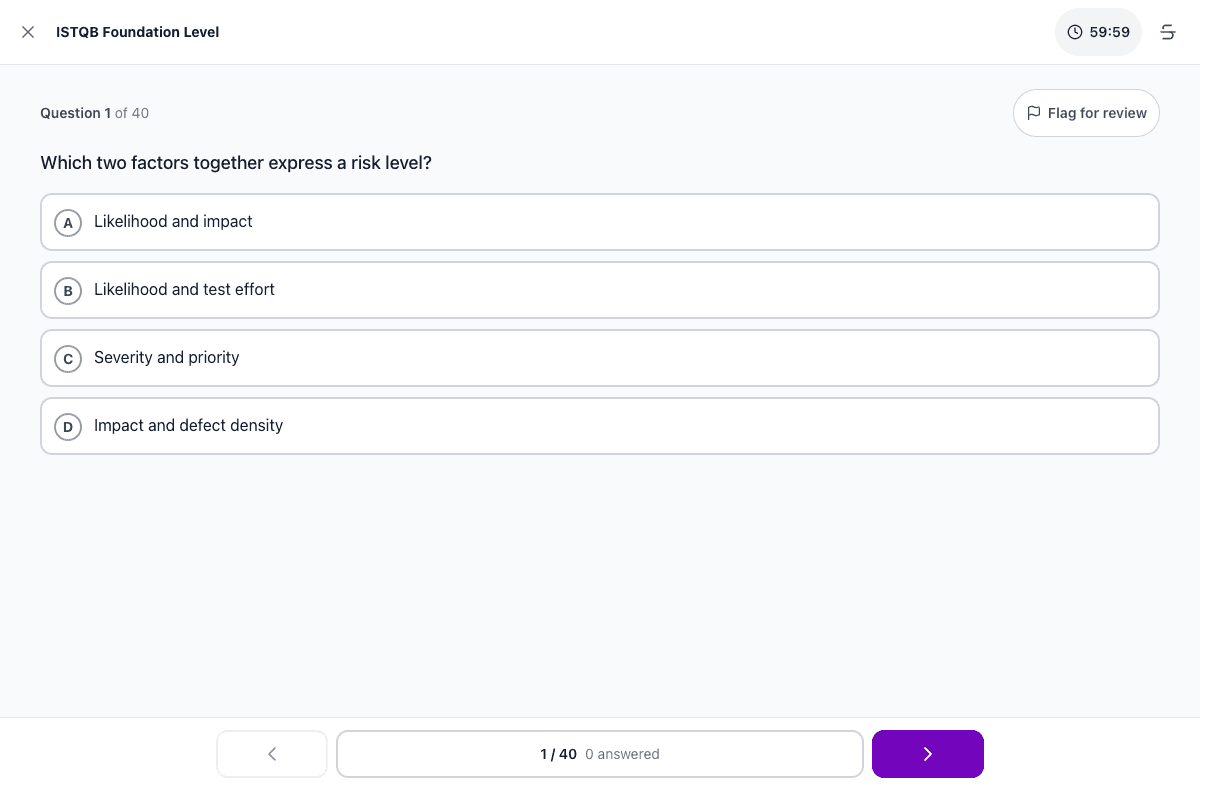
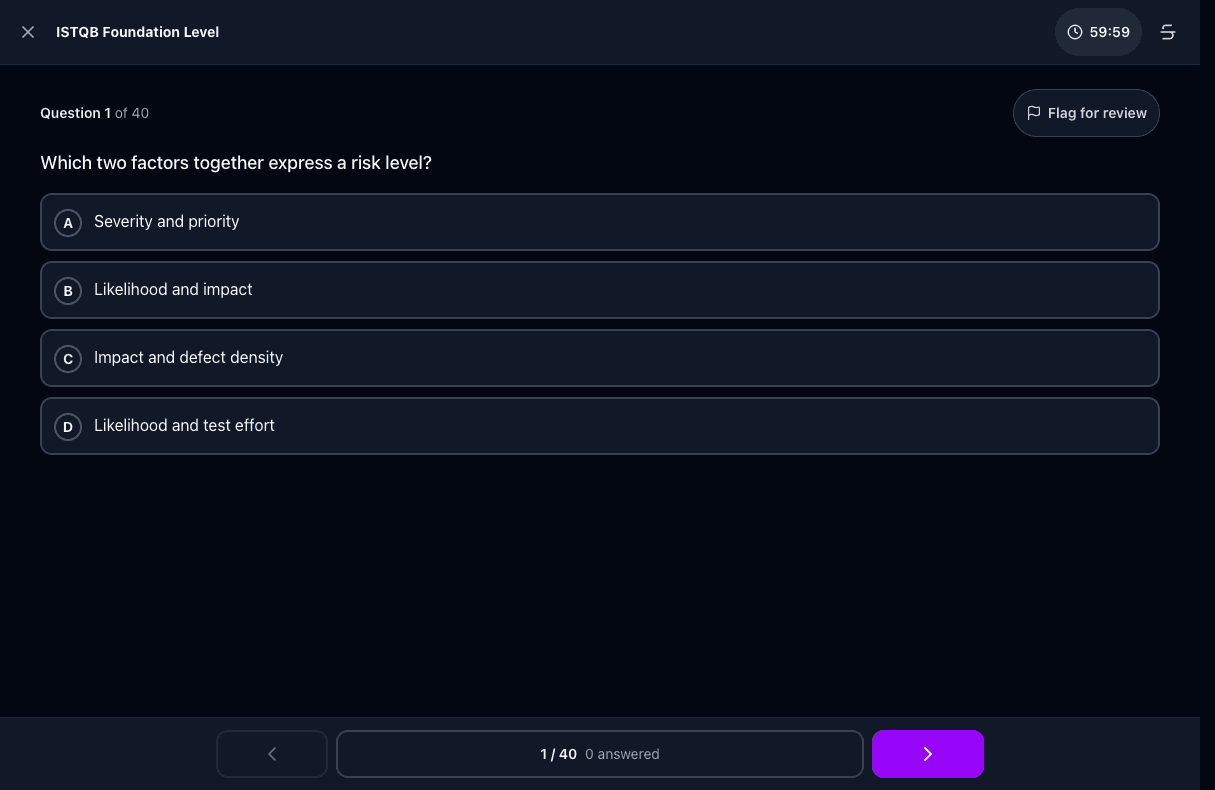
Test on desktop
The ISTQB CTFL exam at a glance
The ISTQB Certified Tester Foundation Level (CTFL v4.0) exam has 40 multiple-choice questions worth one point each, and you need 26 points (65 percent) to pass. You have 60 minutes, or 75 minutes if you take it in a language that is not your native one. Questions come from six syllabus chapters: Fundamentals of Testing 8, Testing Throughout the SDLC 6, Static Testing 4, Test Analysis and Design 11, Managing the Test Activities 9 and Test Tools 2. The current syllabus document is v4.0.1.
Tigertest has 200 ISTQB CTFL practice questions with explanations, free to start with no account required.
- Questions
- 40 multiple choice, one point each
- Time
- 60 minutes (75 in a non-native language)
- Pass mark
- 26 of 40 points (65 percent)
- Biggest chapter
- Test Analysis and Design, 11 of 40
- Syllabus
- CTFL v4.0, document v4.0.1 (2024)
- Given by
- ISTQB member boards and exam providers
Updated by the Tigertest team. Practice questions follow the ISTQB CTFL v4.0.1 syllabus and the ISTQB Exam Structure Tables v1.21 (November 2026). Exam rules change, so confirm current details with ISTQB.
How It Works
Drills by Syllabus Chapter
Eight drills cover the whole syllabus, from the seven testing principles to test automation, with worked questions on equivalence partitions, boundary values, decision tables, state transitions, coverage and estimation. Questions you miss come back until you have mastered them.
Full Mock Exams
Two 40-question tests in 60 minutes, the real exam's length and pace, scored against the 26-point pass line. Practice Test 2 is held out of the drills, so it shows whether you are ready to book.
Weighted Like the Real Exam
ISTQB's exam structure sets how many of the 40 questions come from each syllabus chapter. Every Tigertest practice test follows the same split, so test analysis and design, the chapter with the most application questions, gets the most.

How to Pass ISTQB Foundation Level
1. Practise the techniques until they are routine
Most of the application questions ask you to work something out: the number of equivalence partitions, the 2-value or 3-value boundary values, the rule a test exercises in a decision table, or the fewest tests for valid transitions coverage. Work through each kind by hand until you can do it quickly.
2. Learn the terms the syllabus uses
Every keyword in the syllabus can be examined for its definition. Know the difference between an error, a defect and a failure, between confirmation and regression testing, between test analysis and test design, and between a walkthrough, a technical review and an inspection.
3. Know the formulas in chapter 5
Three-point estimation, E = (a + 4m + b) / 6, estimation by ratios, test case prioritization with dependencies and risk level as likelihood times impact all appear as worked questions. Practise them with different numbers until the method is automatic.
4. Take a full mock exam under time
Sixty minutes for 40 questions leaves time for the worked ones if you move quickly through the definitions. Take Practice Test 2 last, and book the exam once you are scoring comfortably above 26 of 40.
ISTQB Foundation Level Frequently Asked Questions
How many questions are on the ISTQB Foundation Level exam?
The CTFL v4.0 exam has 40 multiple-choice questions worth one point each, and you have 60 minutes, or 75 minutes if you take it in a language that is not your native one. You need 26 points (65 percent) to pass. Exam delivery, languages and fees are set by each ISTQB member board or exam provider, so check those with yours.
Which version of the ISTQB Foundation Level syllabus is current?
CTFL v4.0. ISTQB's current syllabus document is version 4.0.1 (September 2024), an errata release of v4.0 that aligns some wording with the ISTQB glossary, and the exam follows the CTFL v4.0 exam structure. This practice test is written to v4.0.1.
What topics does the CTFL v4.0 exam cover?
Six chapters: Fundamentals of Testing (8 questions), Testing Throughout the Software Development Lifecycle (6), Static Testing (4), Test Analysis and Design (11), Managing the Test Activities (9) and Test Tools (2). Most questions test understanding (K2), and 8 are K3 application questions, mostly on test techniques such as equivalence partitioning, boundary value analysis, decision tables and state transitions, and on estimation, prioritization and defect reports.
Is this practice test the same format as the real ISTQB CTFL exam?
Each practice test is 40 single-answer questions in 60 minutes, weighted chapter by chapter like the ISTQB exam structure, with the 26-point pass line shown on your results. The questions are original and written from the syllabus, not taken from the ISTQB sample exams. Practice Test 2 is held out of the drills, so it measures readiness rather than memory.
Is the Tigertest ISTQB practice test free?
It is free to start, with no account required. Practice Test 1 and most of the drills are free; the last drills and the final practice test are part of Tigertest Premium, one payment with no subscription. Create a free account if you want your progress saved across your phone and computer.
I teach a software testing or ISTQB Foundation course. Can my students use Tigertest?
Yes, for free. Make a class at tigertest.io/teach, post one link, and students join with just their name. You see who practiced, their test scores and the topics your class misses most.
Help Make Tigertest Better
Have an idea, a topic you'd like covered, or a question that could be clearer? We read every message and use it to improve every test.
Share FeedbackISTQB CTFL sample questions and answers
6 of the 200 practice questions, one from each topic, with the answer explained.
- 1.
Who brings the highest level of independence to testing a component?
- A.
A tester from another team
- B.
The developer who wrote it
- C.
A peer on the author's team
- D.
An external testing company
Answer: D.Testers from outside the organization give very high independence. A tester from another team in the same organization gives high independence, a peer gives some, and the author gives none.
- A.
- 2.
Which work product typically comes from test analysis?
- A.
Prioritized test conditions
- B.
Test logs
- C.
Test procedures and scripts
- D.
Test environment items
Answer: A.Test analysis produces prioritized test conditions and defect reports on the test basis. Test procedures and environment items come from implementation, and test logs from execution.
- A.
- 3.
Checking that a search returns results within two seconds is which test type?
- A.
Functional testing
- B.
Non-functional testing
- C.
White-box testing
- D.
Component integration testing
Answer: B.Response time is performance efficiency, a non-functional quality characteristic: it is about how well the system behaves, not what it does.
- A.
- 4.
In which review activity is each anomaly given a status, an owner and actions?
- A.
Review initiation
- B.
Communication and analysis
- C.
Individual review
- D.
Fixing and reporting
Answer: B.Anomalies are not necessarily defects, so in communication and analysis each is discussed and given a status, ownership and required actions, usually in a review meeting.
- A.
- 5.
A temperature setting accepts whole numbers from 10 to 30. Which values give 100% 2-value BVA coverage of the valid partition's boundaries?
- A.
10, 20, 30
- B.
10, 11, 29, 30
- C.
9, 10, 30, 31
- D.
9, 10, 11, 29, 30, 31
Answer: C.In 2-value BVA each boundary has two coverage items: the boundary value and its closest neighbour in the adjacent partition. That gives 9 and 10 at the lower boundary, 30 and 31 at the upper. The six-value set is 3-value BVA.
- A.
- 6.
In ATDD, which test cases does the team usually write first?
- A.
Positive cases for expected behaviour
- B.
Non-functional performance cases
- C.
Cases that go beyond the story
- D.
Negative cases for every error condition
Answer: A.The first ATDD test cases are typically positive, confirming correct behaviour without errors. Negative testing follows, then non-functional characteristics. Tests should not go beyond the story.
- A.
Related practice tests
Every test on Tigertest is free to start, with no account needed.
- CompTIA Security+ Practice TestCompTIA SY0-701
- CompTIA CySA+ Practice TestCompTIA CS0-004
- CompTIA PenTest+ Practice TestCompTIA · PenTest+ PT0-003 exam objectives
- Fortinet NSE 1 (FCF) Practice TestFortinet Training Institute · NSE 1 Cybersecurity and Cloud Fundamentals (formerly FCF)
- CISSP Practice TestISC2 · CISSP exam outline, April 2024
- CompTIA Network+ Practice TestCompTIA N10-009
Ready to Pass ISTQB Foundation Level?
Start for free. No account required. 200 questions across the whole syllabus.
Start practicing