
Free KCET Mock Test 2027
246 original KCET questions on Physics, Chemistry and Mathematics. Tuned for mobile. No account needed.
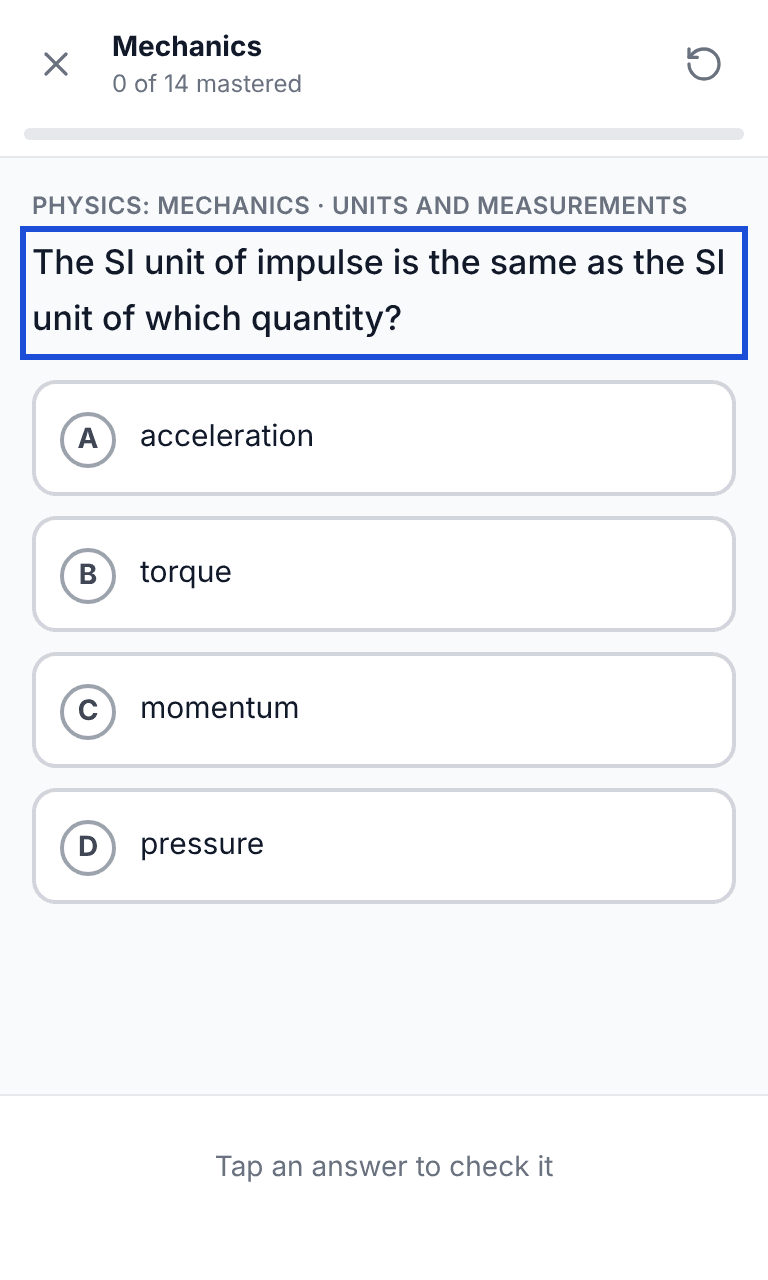
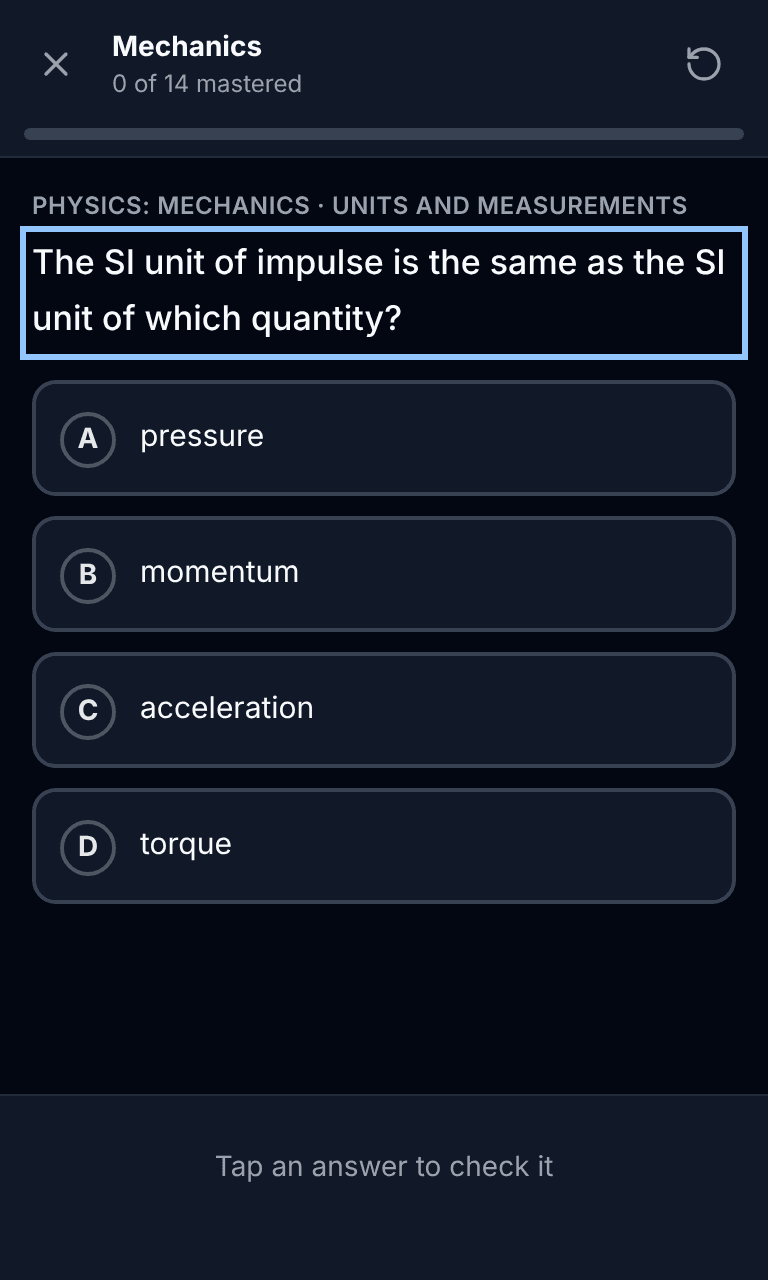
Train on mobile
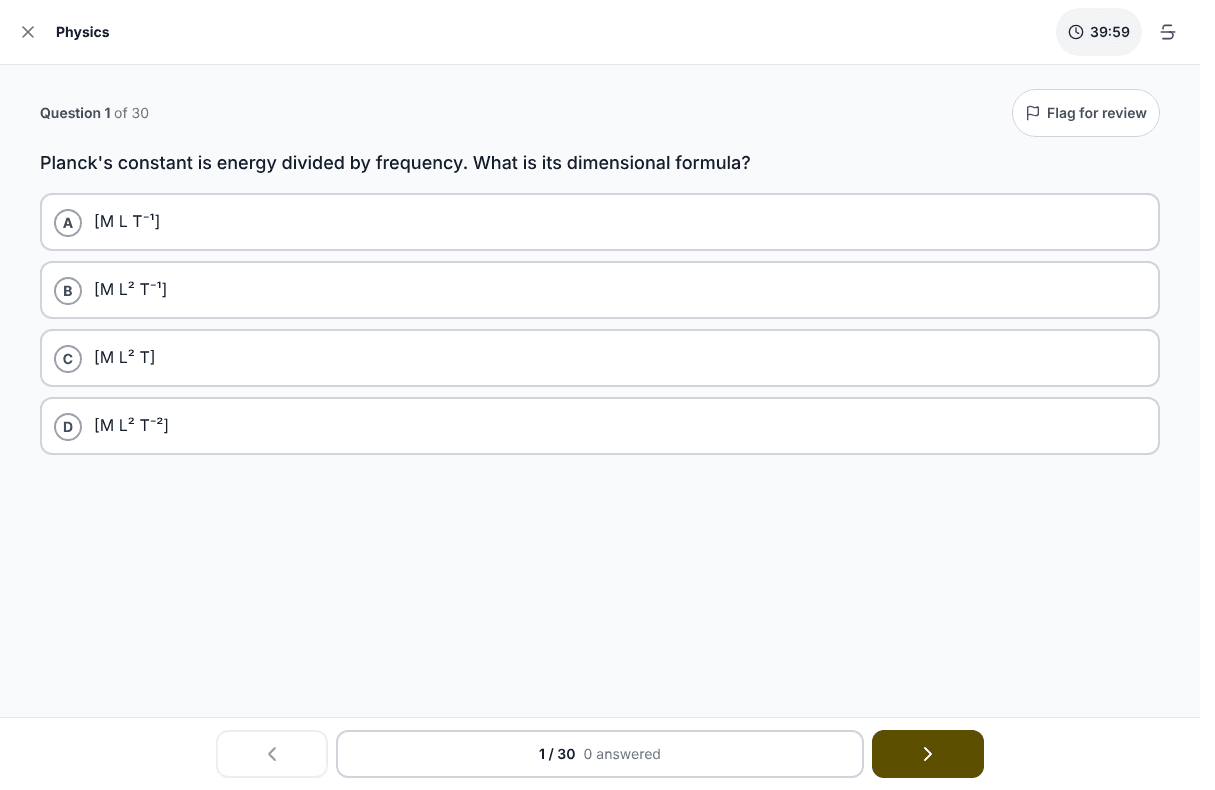
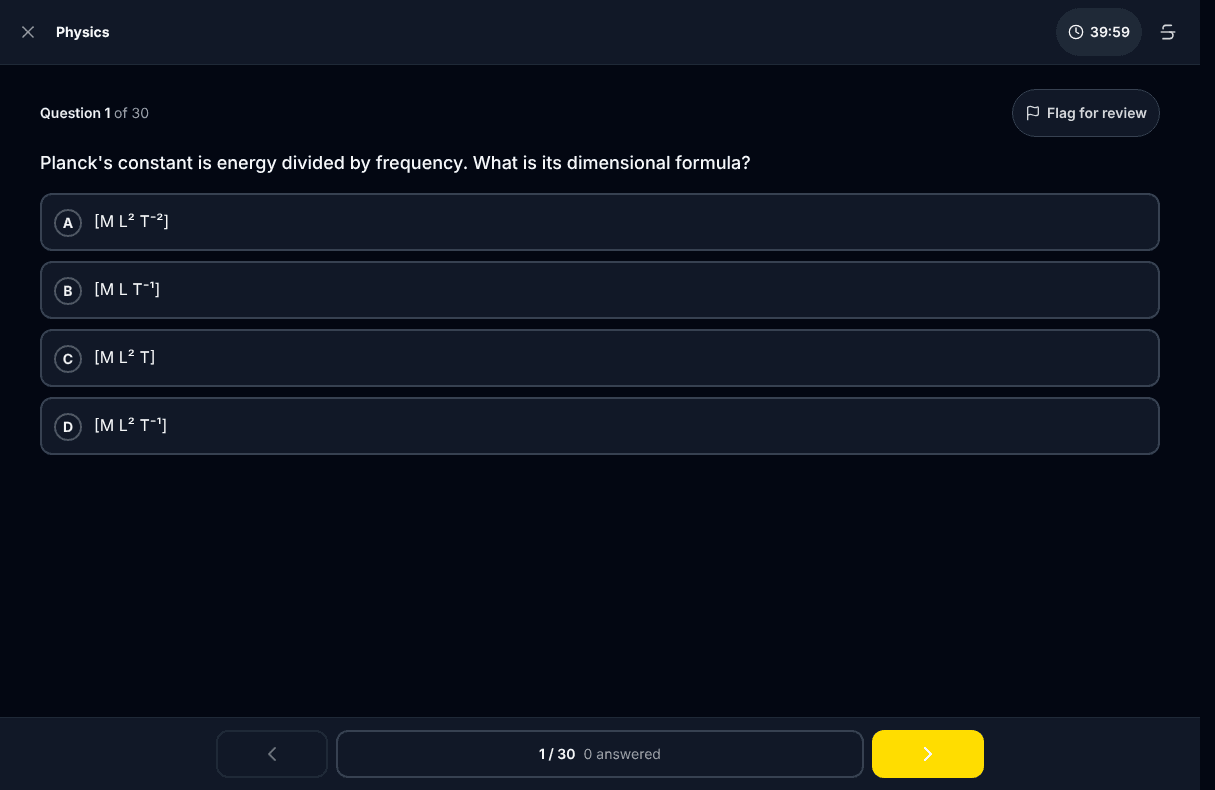
Test on desktop
The KCET exam at a glance
KCET (UGCET) is the Karnataka Examinations Authority's Common Entrance Test for admission to engineering, farm science, veterinary, nursing and pharmacy courses in Karnataka. It has four papers over two days: Physics and Chemistry on the first day, Mathematics and Biology on the second. Each paper has 60 multiple choice questions with four options, one mark each, in 80 minutes, answered on an OMR sheet. There is no negative marking, but a question with more than one answer marked scores nothing. Questions are based on the First and Second PUC syllabi of Karnataka's Department of Pre-University Education. Engineering candidates take Physics, Chemistry and Mathematics, and the engineering rank uses CET and qualifying-examination marks in those subjects in equal proportion.
Tigertest has 246 KCET practice questions with explanations, all free with no account required.
- Papers
- Physics, Chemistry, Mathematics, Biology
- Questions
- 60 per paper, four options
- Marks
- 1 per question, 60 per paper
- Time
- 80 minutes per paper
- Negative marking
- None (multiple answers score nothing)
- Engineering stream
- Physics, Chemistry, Mathematics
- Syllabus
- I and II PUC, Karnataka Department of Pre-University Education
- Engineering rank
- CET and II PUC PCM marks, equal proportion
- Given by
- Karnataka Examinations Authority (KEA)
Updated by the Tigertest team. Practice questions follow the KEA Information Bulletin for UGCET-2026 (17 January 2026). Exam rules change, so confirm current details with Karnataka Examinations Authority.
How It Works
Topic Drills
Eleven drills: four in Physics, three in Chemistry and four in Mathematics, each on a group of I and II PUC chapters. Questions you miss come back until you have mastered them.
Full Mock Tests
Two mock tests at the real exam's pace and half its length: Physics, Chemistry and Mathematics, 30 questions in 40 minutes each. Move freely and flag questions inside a paper. Mock Test 2 is held out of the drills, so it measures readiness.
Built on the KCET Pattern
Each mock test follows KEA's pattern at half the length: every real paper has 60 one-mark questions with four options in 80 minutes and no negative marking. Questions are spread across the I and II PUC chapters of each subject. Engineering ranks use Physics, Chemistry and Mathematics, so Biology is not modelled.

Help Make Tigertest Better
Have an idea, a topic you'd like covered, or a question that could be clearer? We read every message and use it to improve every test.
Share FeedbackHow to Prepare for KCET
1. Work from the NCERT books
KCET questions come from the I and II PUC syllabus, which follows the NCERT textbooks. Read each chapter, learn its formulas and standard results, and work its examples before moving to harder material.
2. Build speed
Each paper gives 60 questions in 80 minutes, about 80 seconds each. Most questions test one idea or a short calculation, so the marks go to students who know the facts and formulas well enough to answer at once.
3. Answer every question, once
There is no negative marking, so a blank scores the same as a wrong answer. Fill in exactly one bubble per question: a question with two answers marked scores nothing.
4. Keep up your board marks
The engineering rank uses your II PUC Physics, Chemistry and Mathematics marks as well as your CET marks, in equal proportion. Preparing for the board exam and the CET together pays twice.
KCET Frequently Asked Questions
What is the KCET exam pattern?
KCET has four papers, Physics, Chemistry, Mathematics and Biology, held over two days by the Karnataka Examinations Authority (KEA). Each paper has 60 multiple choice questions with four options, one mark each, in 80 minutes, answered on an OMR sheet. Engineering candidates take Physics, Chemistry and Mathematics; Biology is for farm science, veterinary, nursing and pharmacy courses.
Is there negative marking in KCET?
No. KEA's Information Bulletin says there is no negative evaluation for wrong answers, but a question with more than one answer marked scores nothing. Answer every question, and mark only one option for each.
How is the KCET engineering rank worked out?
KEA prepares the engineering rank list from your Physics, Chemistry and Mathematics marks in both the CET and the qualifying examination (II PUC or 12th), taken in equal proportion. So your board marks in those three subjects count as much as the CET itself.
Which syllabus do these questions follow?
KCET questions are based on the First and Second PUC syllabi of Karnataka's Department of Pre-University Education, which uses the NCERT textbooks for Physics, Chemistry and Mathematics. Tigertest questions are written on the chapters of the current NCERT books for Class XI and XII. KEA publishes the syllabus for each year's CET on its website, so check the current one there.
How long are the Tigertest KCET mock tests?
Each mock test is half the real length at the real pace: Physics, Chemistry and Mathematics, 30 questions in 40 minutes each, with a short break between papers. The score is the percent of marks, with the three subjects counting equally, as each real paper is 60 marks. Biology is not included.
Is the Tigertest KCET mock test free?
Yes. Both mock tests and all eleven topic drills are free, with no account required. Create a free account if you want your progress saved across your phone and computer.
I teach a KCET coaching batch. Can my students use Tigertest?
Yes, for free. Make a class at tigertest.io/teach, post one link, and students join with just their name. You see who practiced, their test scores and the topics your class misses most.
KCET sample questions and answers
6 of the 246 practice questions, one from each topic, with the answer explained.
- 1.
A stone is thrown straight up at 20 m/s. Taking g = 10 m/s², what total distance does it travel in the first 3 s?
- A.
5 m
- B.
15 m
- C.
20 m
- D.
25 m
Answer: D.It rises for 2 s to a height of 20 m, then falls for 1 s through 5 m, so the path length is 25 m. 15 m is the displacement after 3 s, not the distance.
- A.
- 2.
A gas absorbs 500 J of heat and does 200 J of work on its surroundings. What is the change in its internal energy?
- A.
-300 J
- B.
200 J
- C.
300 J
- D.
700 J
Answer: C.By the first law ΔU = Q - W = 500 - 200 = 300 J, an increase. 700 J adds the work instead of subtracting it, which is the sign for work done on the gas.
- A.
- 3.
Which electromagnetic radiation has the shortest wavelength?
- A.
Gamma rays
- B.
Ultraviolet rays
- C.
Microwaves
- D.
X-rays
Answer: A.Gamma rays sit at the high-frequency end of the spectrum, below about 10⁻¹² m, so their wavelength is the shortest. X-rays come next, with somewhat longer wavelengths.
- A.
- 4.
Which impurity added to silicon makes it an n-type semiconductor?
- A.
Arsenic
- B.
Boron
- C.
Gallium
- D.
Aluminium
Answer: A.Arsenic is pentavalent, so each atom gives one extra electron to the crystal. Boron, aluminium and gallium are trivalent and create holes, giving p-type silicon.
- A.
- 5.
What are the units of the rate constant of a second-order reaction?
- A.
s⁻¹
- B.
mol L⁻¹ s⁻¹
- C.
L mol⁻¹ s⁻¹
- D.
L² mol⁻² s⁻¹
Answer: C.For rate = k[A]², k = rate/[A]² = (mol L⁻¹ s⁻¹)/(mol L⁻¹)² = L mol⁻¹ s⁻¹. mol L⁻¹ s⁻¹ is the unit of a zero-order constant and s⁻¹ of a first-order one.
- A.
- 6.
What is the oxidation state of cobalt in [Co(NH₃)₅Cl]Cl₂?
- A.
0
- B.
+1
- C.
+2
- D.
+3
Answer: D.Two Cl⁻ outside the bracket give the complex ion a 2+ charge. Ammonia is neutral and the bound chloride is -1, so x - 1 = +2 and x = +3. +2 reads the ion's charge as cobalt's, and 0 treats the whole compound as if the metal were neutral.
- A.
Related practice tests
Every test on Tigertest is free to start, with no account needed.
- JEE Main Mock TestNational Testing Agency · JEE (Main) Paper 1 (B.E./B.Tech.)
- NEET Mock TestNational Testing Agency · NEET (UG), MBBS and BDS entrance
- MHT-CET Mock TestState CET Cell, Maharashtra · MHT-CET PCM group
- CUET General Test Practice TestNational Testing Agency · CUET (UG) General Aptitude Test
- CAT Mock TestIndian Institutes of Management · CAT, convened by IIM Indore for 2026
Ready for KCET?
Start for free. No account required. 246 questions across three papers.
Start practicing