
Free Lifeguard Practice Test 2026
200 questions on surveillance, drowning recognition, rescue tube skills, spinal injuries, CPR and AED, first aid and facility safety. Tuned for mobile. No account needed.
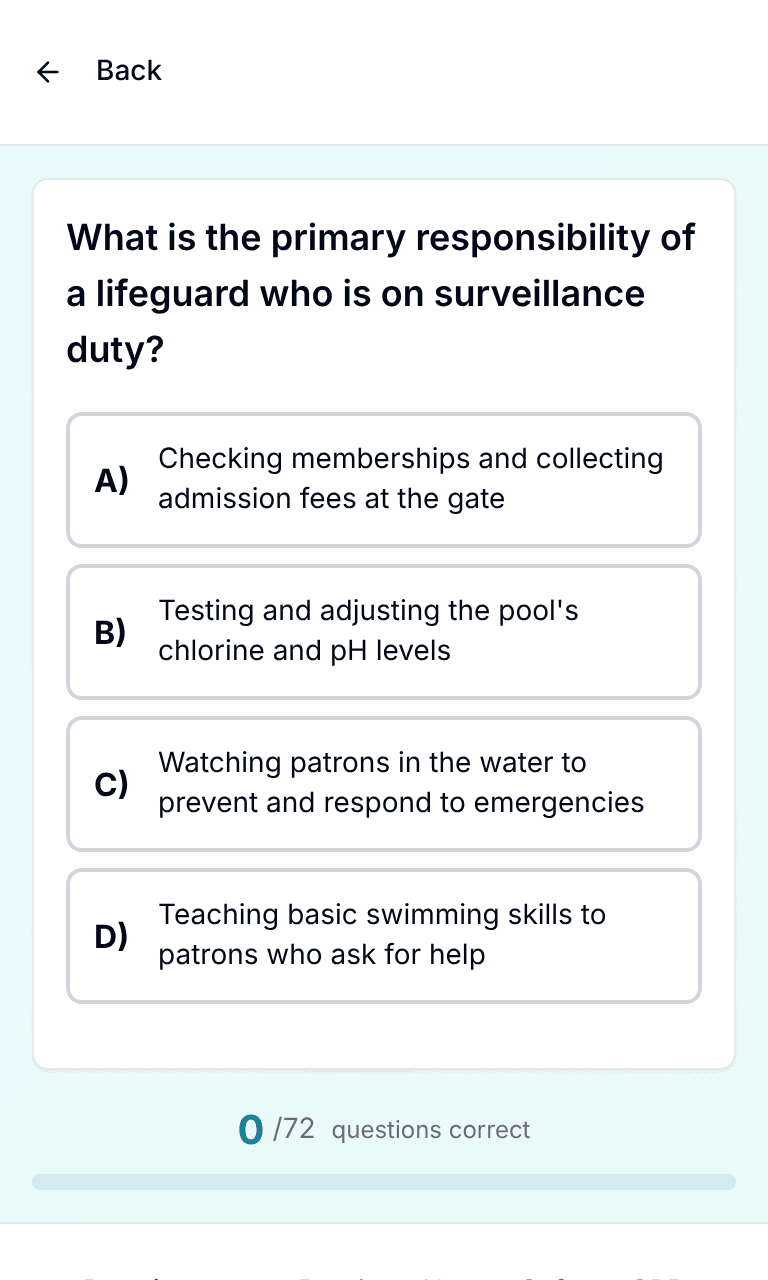
Train on mobile
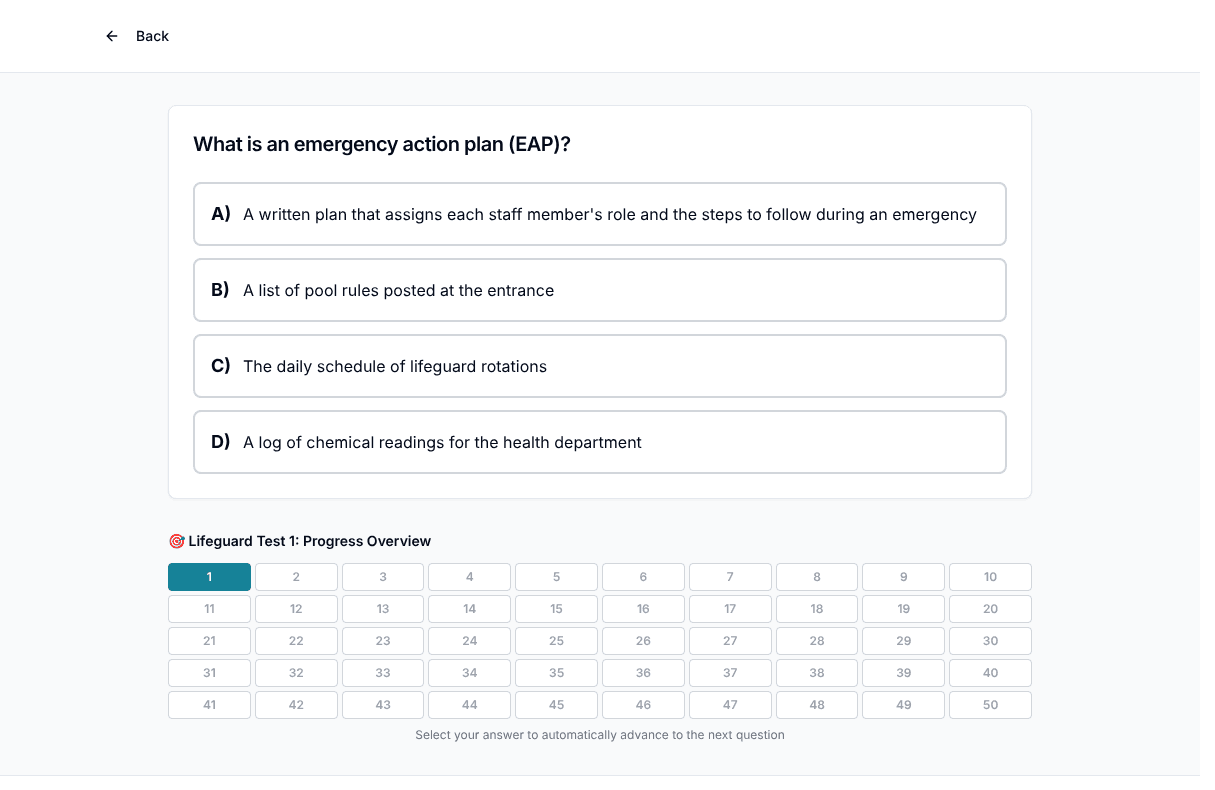
Test on desktop
How It Works
Training by Domain
Four sets: surveillance and victim recognition, water rescue skills, first aid with CPR and AED, and facility safety and legal duties. Questions you miss come back until you have mastered them.
Practice Tests
Four 50-question tests weighted the way lifeguard course exams are, with an 80 percent pass line and an explanation of the right answer and the common wrong pick on every item.
Built on the Lifeguard Course Outline
Every major lifeguard training program tests the same core: how to watch the water, how to tell a drowning victim from a swimmer, how to make the rescue, and how to care for the victim once they're out. The practice tests here give rescue skills and emergency care the most weight because that is where the written exam spends the most questions.

We Just Launched!
The lifeguard practice test is brand new. If a question looks wrong or your course teaches a skill differently, tell us.
Send Us FeedbackHow to Pass the Lifeguard Written Exam
1. Know the numbers cold
Recognize a victim within 10 seconds and reach them within 20. Brain damage begins after about 4 to 6 minutes without oxygen. An adult active drowning victim struggles for 20 to 60 seconds. Stride jumps need 5 feet of water and no more than 3 feet of height. Free chlorine 1 to 3 ppm, pH 7.2 to 7.8, and wait 30 minutes after the last thunder.
2. Learn the three victim types by behavior
A distressed swimmer can breathe, call out and grab a tube. An active drowning victim is vertical, silent, arms pressing down, head back. A passive victim is motionless, face down or on the bottom. Exam questions describe a scene and ask what you are looking at; the answer is always in the behavior, never in the swimmer's age or appearance.
3. Separate the CPR facts from the water rescue facts
CPR questions follow current guidelines: 100 to 120 compressions per minute, at least 2 inches on an adult, 30:2 alone and 15:2 with two rescuers on a child or infant, two ventilations first for a drowning victim, and an AED is fine on a wet deck once the chest is dried. Rescue questions are about entries, the rescue tube and the head splint. Study them as two separate lists.
4. Drill your weak domain to 90 percent
TigerTest tracks your accuracy by content area. Most courses require 80 percent on the written exam, so retake the training set you miss most until you clear 90 percent with room to spare, then take all four practice tests back to back.
Lifeguard Exam Frequently Asked Questions
What score do I need to pass the lifeguard written exam?
Most lifeguard certification courses require 80 percent or higher on the written exam, and some set the bar at 80 percent on each section. Your instructor will tell you the exact passing score for your course. The practice tests here use an 80 percent pass line to match.
Does this cover the in-water skills test?
No. Lifeguard certification has two parts: a written exam and hands-on skills scenarios in the water and on deck. Most courses also have swimming prerequisites before you can enroll, such as a 300 yard continuous swim, treading water for two minutes without using your hands, and a timed brick retrieval from the deep end. This prep is for the written portion only.
How long is a lifeguard certification valid?
Most lifeguard certifications, along with the included CPR, AED and first aid certification, are valid for two years. Recertification courses are shorter than the original course but still include a written exam and skills check. Many employers also require regular in-service training during the season.
How old do I have to be to become a lifeguard?
Most courses require you to be at least 15 years old by the last day of class. Some waterfront or waterpark programs set a higher minimum, and employer age requirements vary by state and facility.
Does this practice test work for any lifeguard course?
Yes. The questions cover material that every major lifeguard training program teaches: scanning, victim recognition, rescue tube skills, spinal injury care, CPR and AED per current guidelines, first aid and facility safety. It is a study tool, not a certificate; you still need to complete an in-person course with a certified instructor to be hired as a lifeguard.
Related practice tests
Every test on TigerTest is free and needs no account to start.