
Free MBLEx Practice Test 2026
200 original questions on the FSMTB MBLEx content outline: anatomy and kinesiology, pathology and contraindications, the effects of massage, client assessment, ethics and laws, and professional practice. Four 50-question practice tests. Free to start, no account needed.
Try one now
Pick an answer
Which layer of the skin holds the blood vessels, hair follicles and sweat glands?
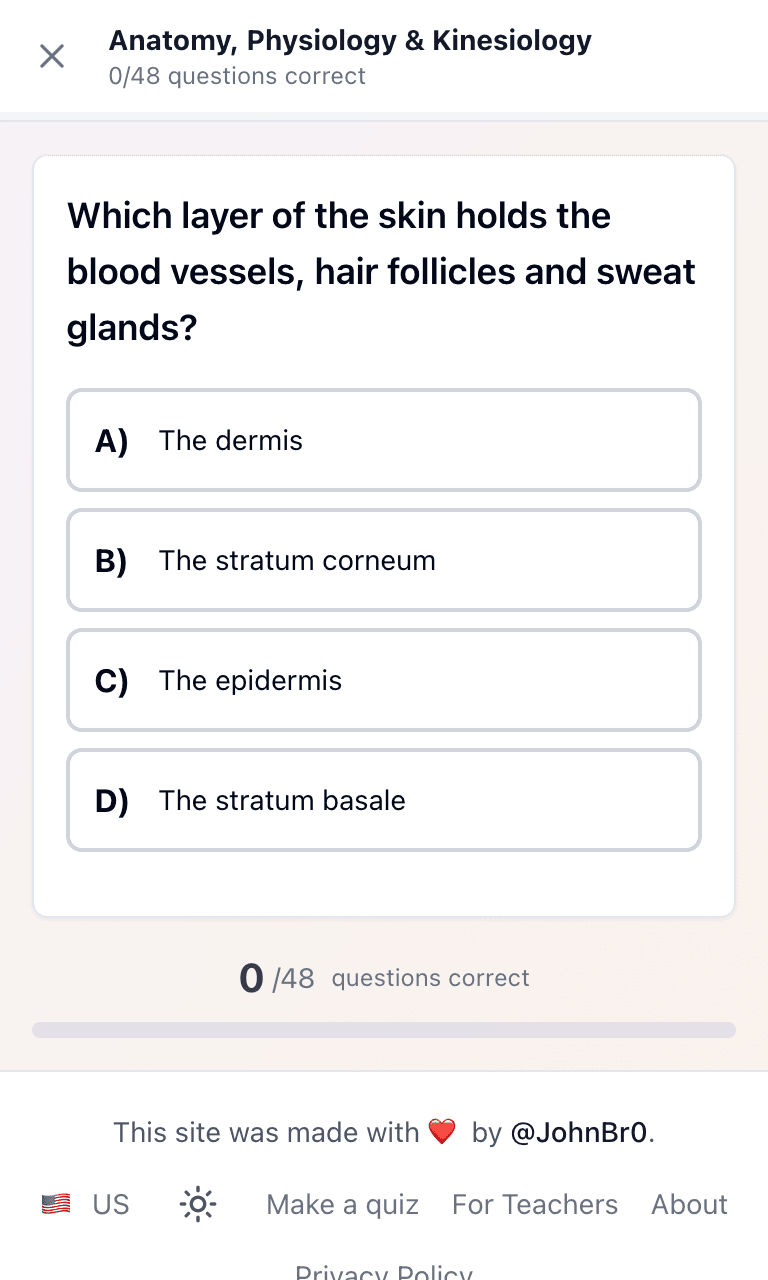
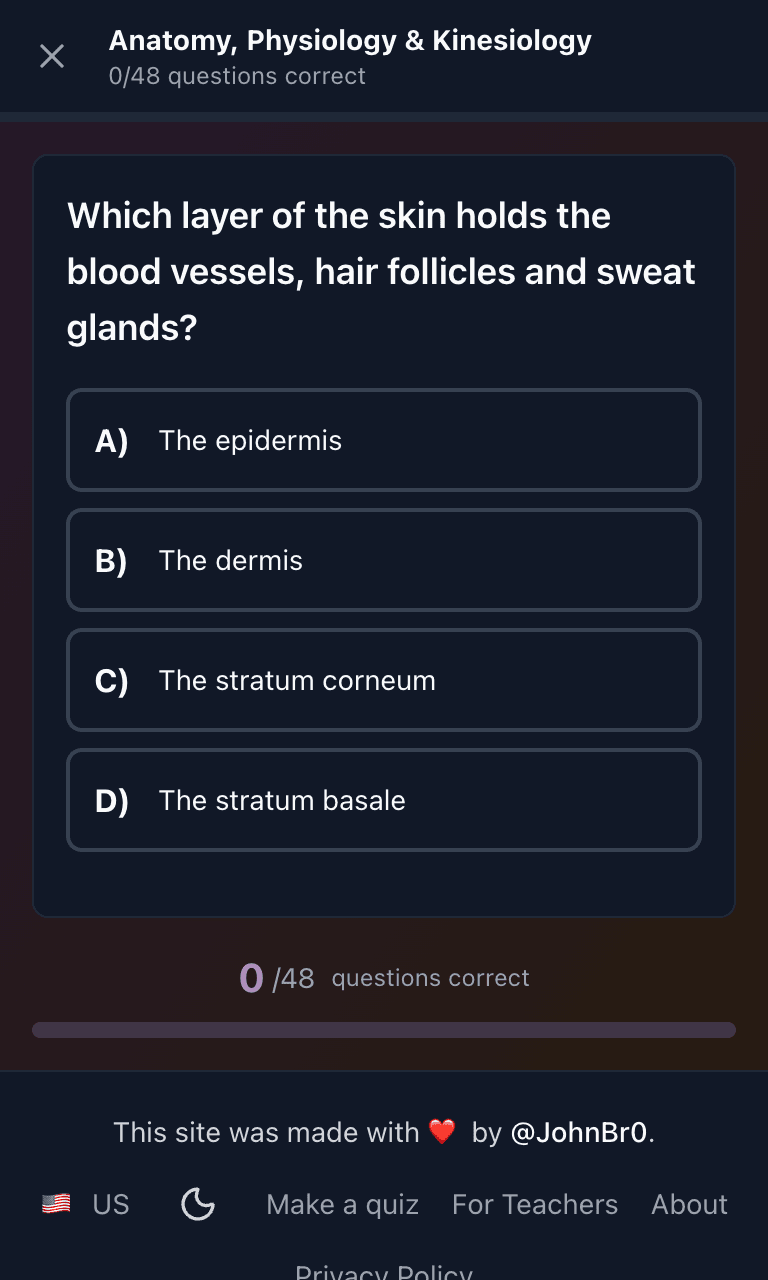
Train on mobile
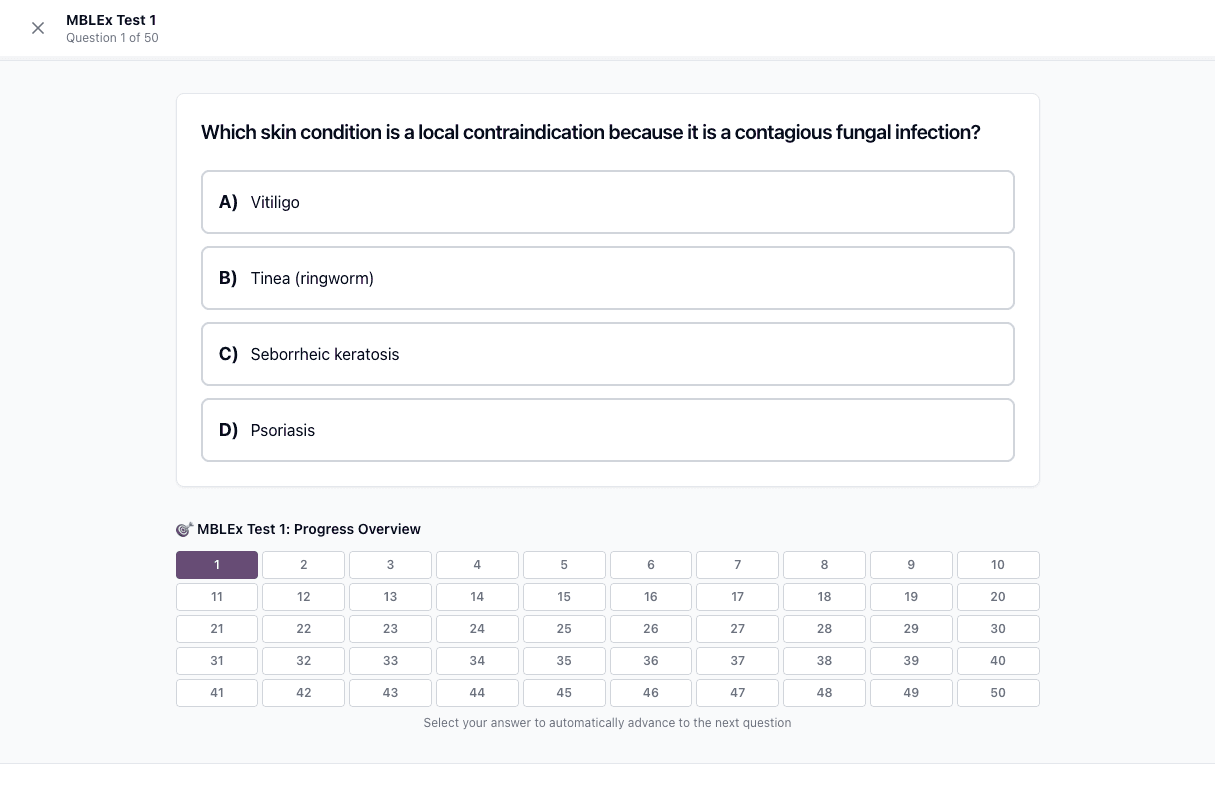
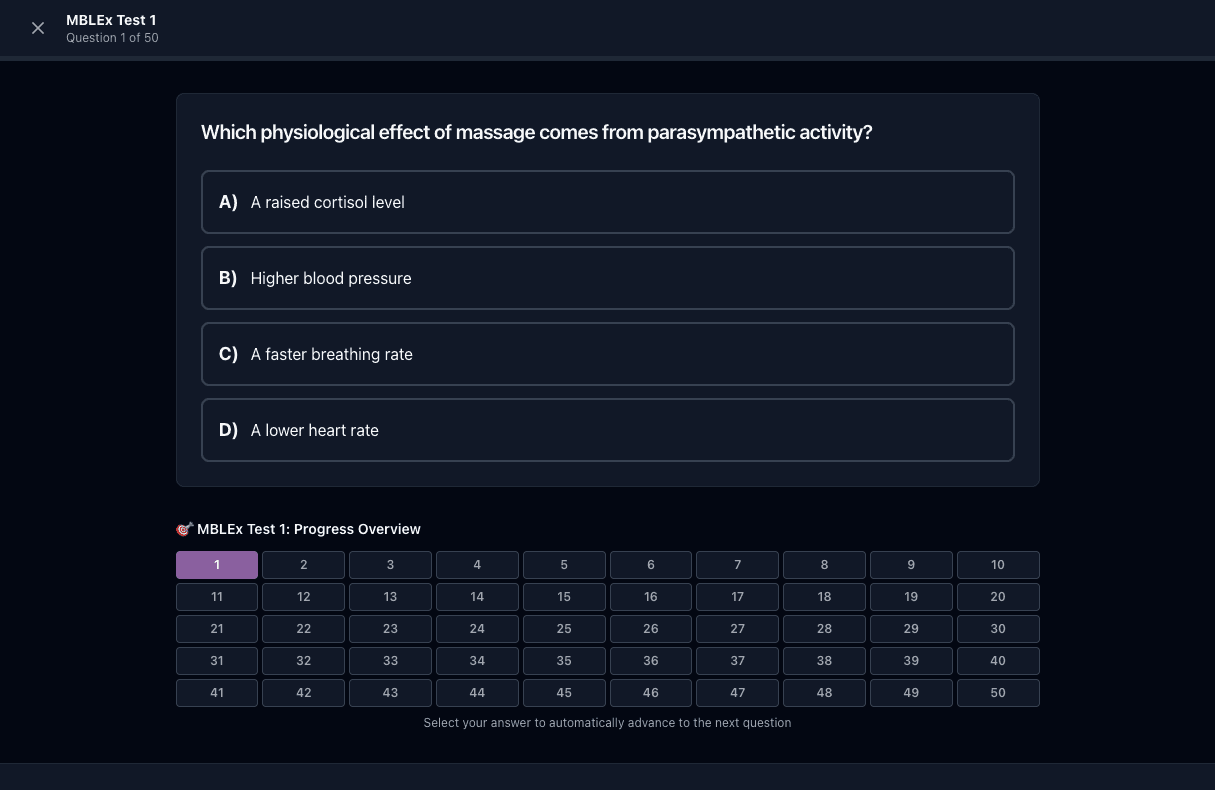
Test on desktop
The MBLEx exam at a glance
The MBLEx (Massage & Bodywork Licensing Examination) is the Federation of State Massage Therapy Boards' entry-level licensing exam for massage therapists; state boards and agencies decide which licensing exam they require. It is 100 multiple-choice questions in 110 minutes at a Pearson VUE center, a fixed-length computer-adaptive test answered in order, and results are reported only as pass or fail on a criterion-referenced standard. Passing it is not a license: the state board or agency issues the license, and state requirements vary.
Tigertest has 200 MBLEx practice questions with explanations, free to start with no account required.
- Questions
- 100 multiple choice
- Time
- 110 minutes (2-hour appointment)
- Format
- Fixed-length computer-adaptive test, answered in order
- Result
- Pass or fail; no percent published
- Largest area
- Client Assessment, Reassessment & Treatment Planning, 17%
- Languages
- English and Spanish
Updated by the Tigertest team. Practice questions follow FSMTB MBLEx Content Outline and the MBLEx Candidate Handbook effective August 2026, checked November 2026. Exam rules change, so confirm current details with FSMTB: MBLEx.
How It Works
Train by Topic
Four training sets: anatomy, physiology and kinesiology; pathology and the effects of massage; client assessment and treatment planning; and ethics, laws and professional practice. Questions you miss come back until you have mastered them.
Weighted Practice Tests
Four practice tests of 50 questions in the content outline's proportions, each with a 70% readiness line. No question appears in more than one test, and every answer comes with a short explanation.
Built on the FSMTB Content Outline
FSMTB weights the MBLEx across seven content areas. Each practice test keeps the same balance: 6 anatomy and physiology, 6 kinesiology, 7 pathology, 7 benefits and effects, 9 client assessment, 8 ethics and laws, and 7 professional practice questions in every 50.

Help Make Tigertest Better
Have an idea, a topic you'd like covered, or a question that could be clearer? We read every message and use it to improve every test.
Share FeedbackHow to Pass the MBLEx
1. Do not skip the ethics and assessment areas
Client assessment and treatment planning (17%) and ethics, boundaries, laws and regulations (16%) are the two largest areas. Know SOAP notes, postural and gait findings, informed consent, transference, dual relationships and the limits of scope of practice.
2. Learn contraindications by reason
Instead of memorizing lists, ask what could go wrong: a clot that could travel, an infection that could spread, a client who cannot feel heat, bones that could break. Then decide between rescheduling, avoiding the area and changing the pressure.
3. Know muscles by attachment and action
For the major muscles, learn where they attach and what they do, then reason out synergists and antagonists. Add the proprioceptors, the contraction types and active, passive and resisted range of motion.
4. Practice at the real pace
The MBLEx gives 110 minutes for 100 questions, answered in order with no going back. Time yourself on the practice tests and aim for 80% or better on every one before you book your exam.
MBLEx Frequently Asked Questions
What is the MBLEx?
The Massage & Bodywork Licensing Examination (MBLEx) is the entry-level licensing exam of the Federation of State Massage Therapy Boards (FSMTB). Most US states and territories regulate massage therapy, and state boards and agencies set the licensing exam they require, so check that yours accepts the MBLEx. Passing it is not a license: you then apply to your state board or agency and meet its own requirements, which vary widely between states.
How many questions are on the MBLEx and how long do you get?
The MBLEx is 100 multiple-choice questions in 110 minutes, inside a two-hour appointment at a Pearson VUE test center. It is a fixed-length computer-adaptive test: you answer the questions in the order they appear, and every one must be answered within the time or the exam is failed. There are no scheduled breaks.
What score do you need to pass the MBLEx?
FSMTB reports results only as pass or fail. The passing standard is criterion-referenced and set by the FSMTB Board of Directors, and no percent is published. If you fail, you get a diagnostic report by content area. The practice tests here use 70 percent as a readiness line.
What does the MBLEx cover?
FSMTB's content outline has seven areas: Anatomy & Physiology (11%), Kinesiology (12%), Pathology, Contraindications, Areas of Caution, Special Populations (14%), Benefits and Effects of Soft Tissue Manipulation (15%), Client Assessment, Reassessment & Treatment Planning (17%), Ethics, Boundaries, Laws, Regulations (16%), and Guidelines for Professional Practice (15%). The weights are approximate.
Are these the real MBLEx questions?
No. Every question is original, written by Tigertest from the FSMTB content outline and standard anatomy, kinesiology and infection-control references. It is not affiliated with FSMTB, and no FSMTB study guide or MBLEx Check items were used. State laws on scope of practice and licensing vary, so check your own state board's rules.
I teach at a massage therapy school. Can my students use Tigertest?
Yes, for free. Make a class at tigertest.io/teach, post one link, and students join with just their name. You see who practiced, their test scores and the topics your class misses most.
MBLEx sample questions and answers
6 of the 200 practice questions, one from each topic, with the answer explained.
1. Which white blood cells produce antibodies?
- A.Basophils
- B.B lymphocytes
- C.T lymphocytes
- D.Neutrophils
Answer: B. B lymphocytes mature into plasma cells that secrete antibodies. T lymphocytes direct and carry out cell-mediated immunity.
2. What should the therapist do at the end of a session?
- A.Skip notes for regulars
- B.Shred the intake form
- C.Book every client for weekly visits
- D.Reassess and record results
Answer: D. Reassessing and documenting the changes shows the client's response and guides the next treatment.
3. For an anxious client, massage strokes usually work best when they are:
- A.Slow and rhythmic
- B.Fast and choppy
- C.Deep and sudden
- D.Brisk and percussive
Answer: A. Slow, even, rhythmic strokes calm the nervous system. Fast or percussive strokes are stimulating.
4. A current client sends the therapist a personal friend request online. What is the best response?
- A.Accept but hide the profile
- B.Accept if the client tips
- C.Keep contact professional
- D.Accept and chat often
Answer: C. Personal social media links with clients blur boundaries; many therapists use only a business page.
5. In passive range of motion, what end feel is normal at full elbow extension?
- A.Empty, with no resistance
- B.Springy, like a rebound
- C.Hard, bone meeting bone
- D.Soft tissue meeting tissue
Answer: C. Elbow extension stops when the olecranon meets its fossa, a hard end feel. Elbow flexion normally ends softly as the forearm meets the upper arm.
6. How should a therapist treat an area with an open, unhealed wound?
- A.Avoid the area completely
- B.Use light effleurage over it
- C.Apply oil to help it heal
- D.Cover it and work over it
Answer: A. Broken skin is a local contraindication: touching it risks infection for the client and exposure for the therapist.
Related practice tests
Every test on Tigertest is free to start, with no account needed.
- Wonderlic Practice TestWonderlic · cognitive ability test (WPT-R, Wonderlic Select)
- Food Handler Practice TestSupplemental food-safety practice
- OSHA 10 Practice TestOSHA Outreach course final
- Forklift Certification Practice TestOSHA 1910.178 operator evaluation
- Alcohol Server Practice TestSupplemental alcohol-service practice
- Security Guard Practice TestState guard card exams
Ready to Pass the MBLEx?
Start for free. No account required. 200 questions across all seven MBLEx content areas.
Start practicing