
Free Medication Aide (MACE) Practice Test 2026
200 original questions on the national MACE content outline: the medication aide's role, orders and the MAR, safety checks and the six rights, routes, drug classes, reporting changes, and medication terms and forms. Four 50-question practice tests. Tuned for mobile. Free to start, no account needed.
Try one now
Pick an answer
Which quality does the model curriculum name as central to the working relationship between nurses and assistive personnel?
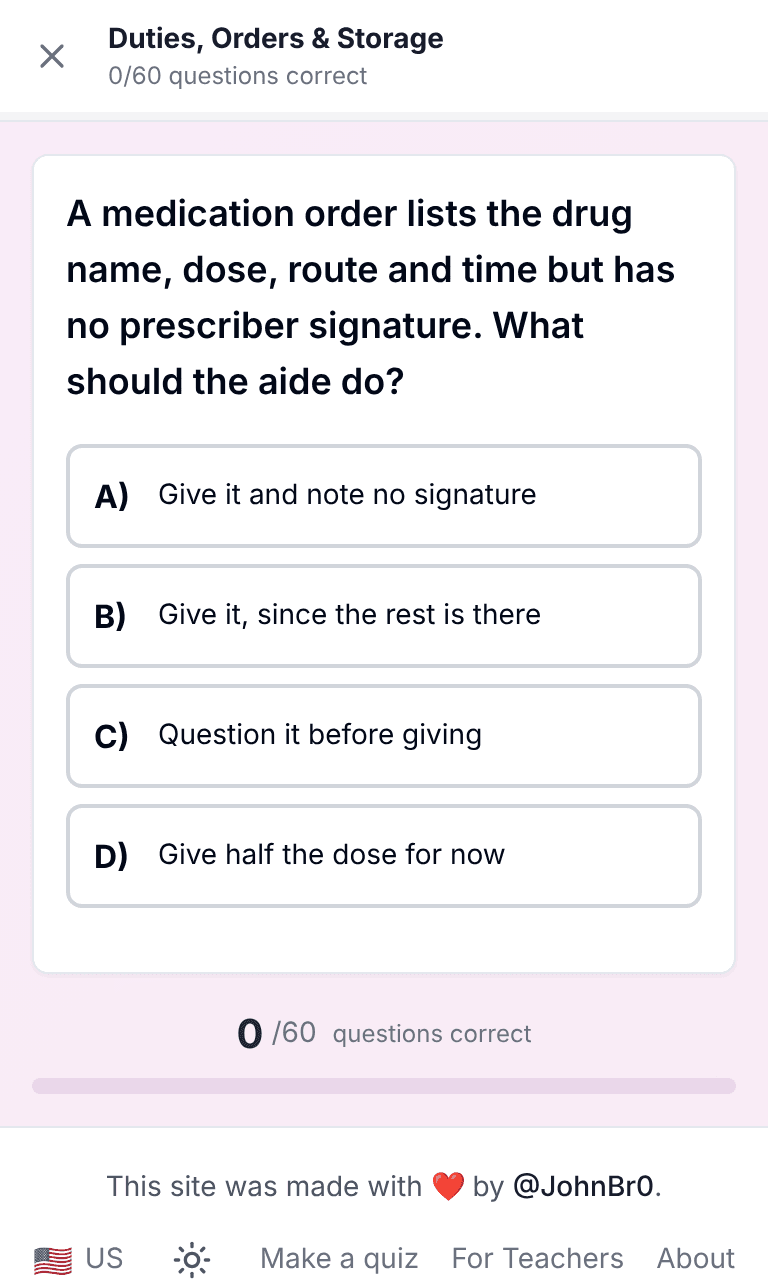
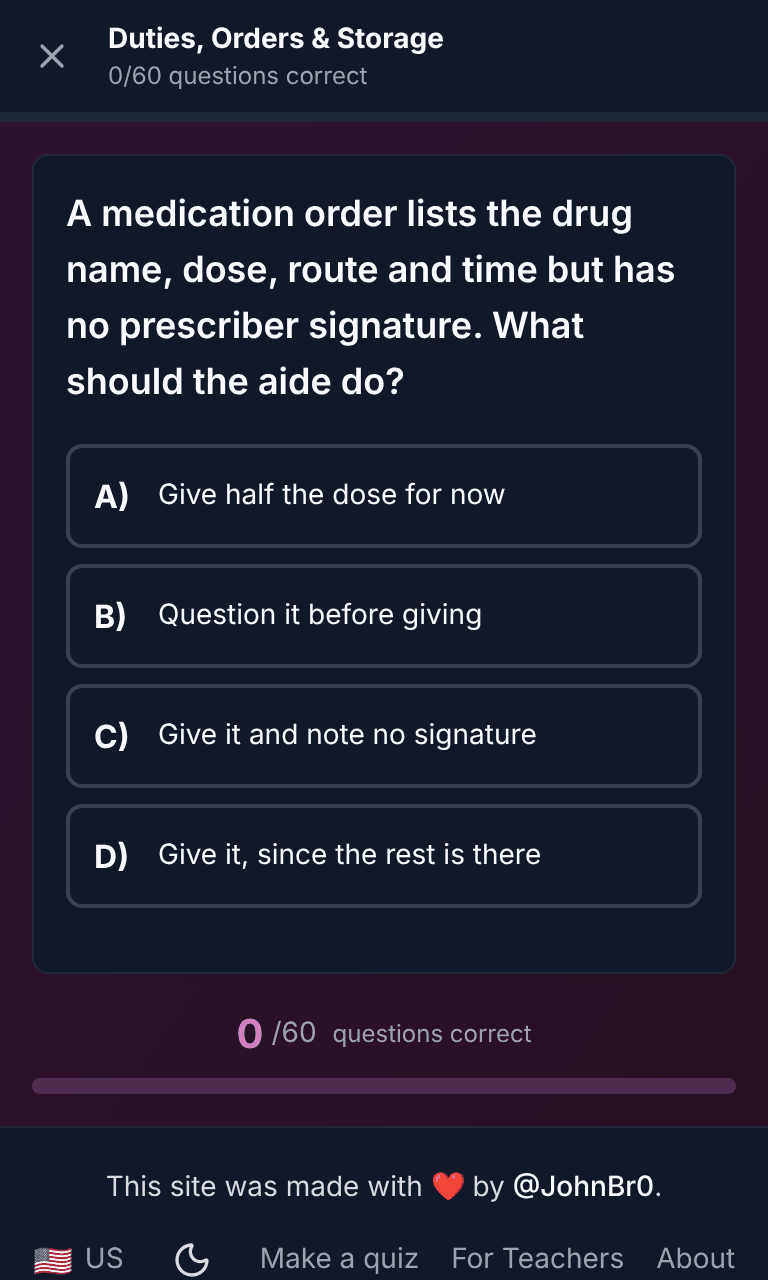
Train on mobile
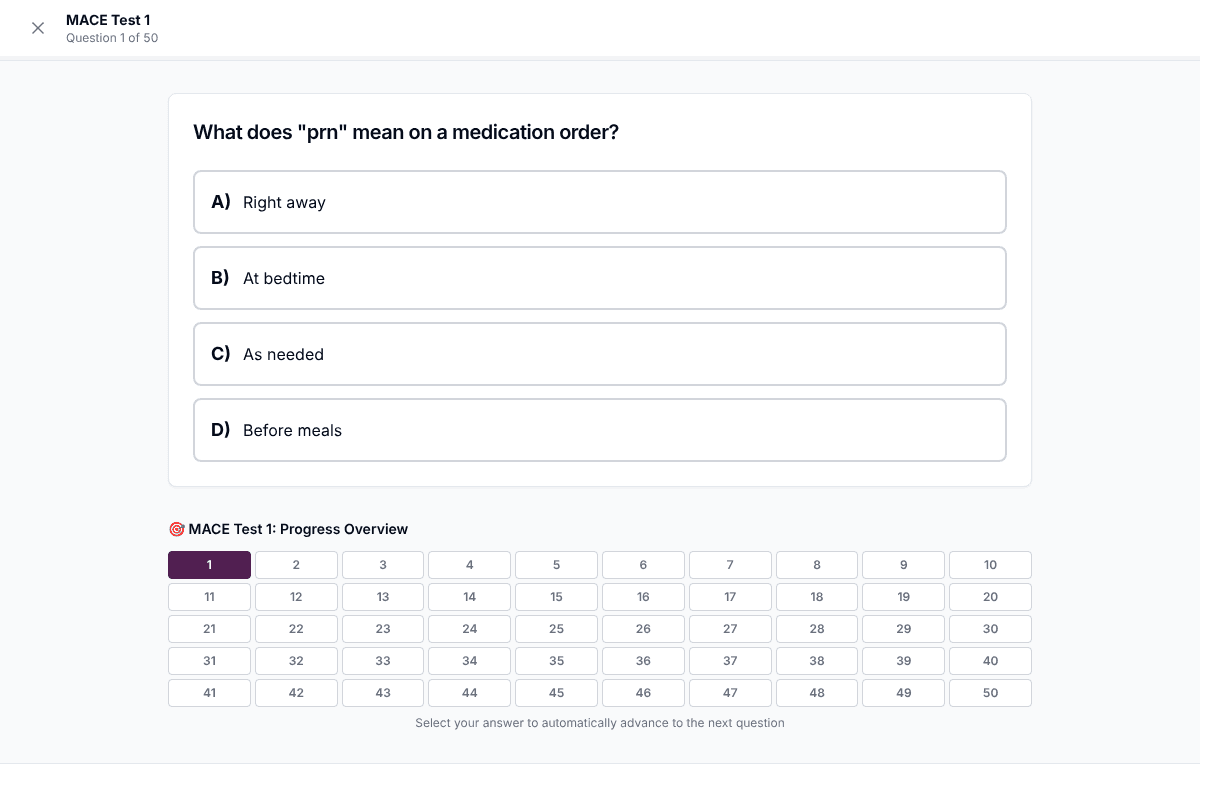
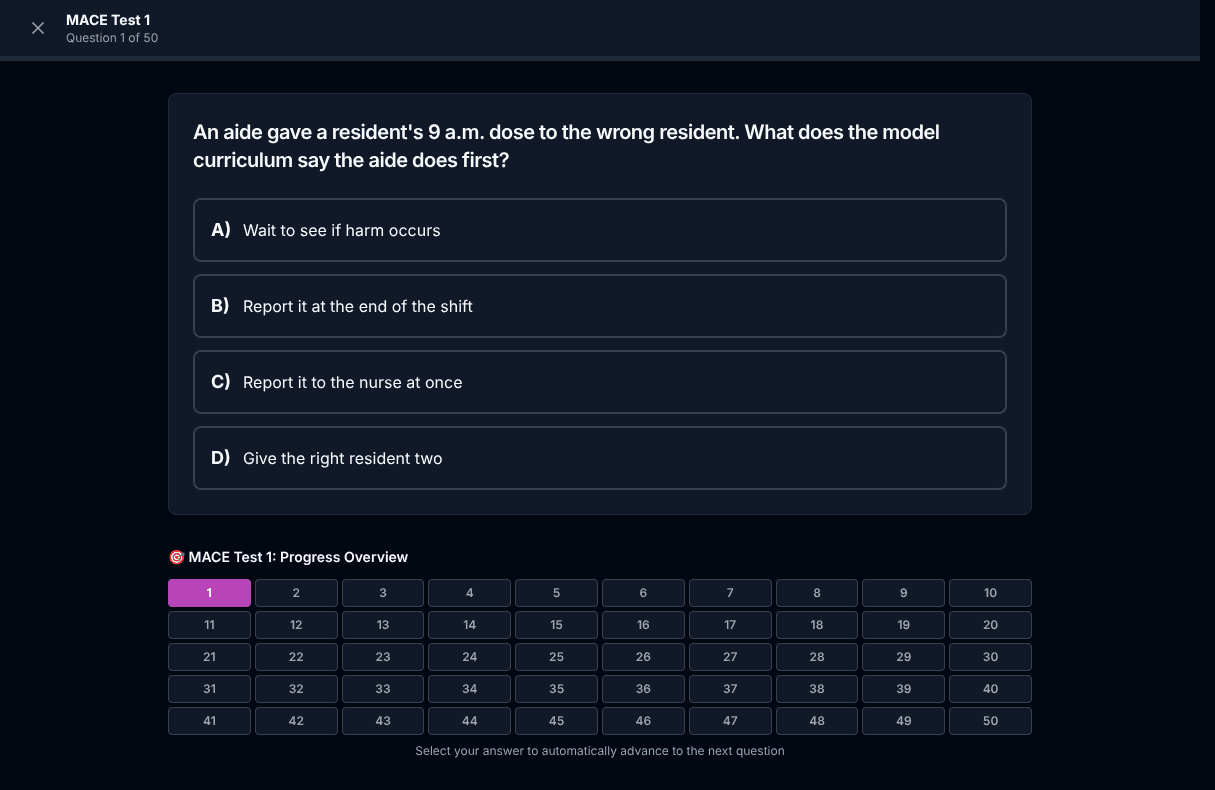
Test on desktop
The MACE exam at a glance
The Medication Aide Certification Examination (MACE) is the national written exam that many states use to certify medication aides, also called medication assistants or MA-Cs: nurse aides with extra training who give selected medications under a licensed nurse's supervision. NCSBN created it and now says it no longer develops or owns it; Credentia develops and runs it for the states that use it. The exam has 60 multiple-choice questions in two hours, 50 of them scored, in three content areas: Authorized Duties 16% (8 questions), Medication Administration, Observation and Reporting 60% (30 questions) and Medication Concepts and Measurements 24% (12 questions). It is taken online, and results appear in the candidate's Credentia account. Who is eligible, how many attempts are allowed and what a certified aide may do are set by each state.
Tigertest has 200 MACE practice questions with explanations, free to start with no account required.
- Questions
- 60 multiple choice, 50 scored
- Time
- 2 hours
- Largest area
- Medication Administration, Observation and Reporting, 60% (30 questions)
- Other areas
- Medication Concepts and Measurements 24%, Authorized Duties 16%
- Pass mark
- Not published by Credentia
- Attempts and scope
- Set by each state
- Run by
- Credentia (developed by NCSBN, which no longer owns it)
Updated by the Tigertest team. Practice questions follow The national MACE content outline in Credentia's state handbooks (2025 and 2026) and NCSBN's MA-C Model Curriculum, checked November 2026. Exam rules change, so confirm current details with Credentia: national MACE content outline.
How It Works
Train by Content Area
Four training sets follow the MACE content outline: duties, orders and storage; safety checks, client rights and routes; drug classes and reporting; and medication concepts and forms. Questions you miss come back until you have mastered them.
Weighted Practice Tests
Four practice tests of 50 questions, each weighted like the 50 scored questions on the real exam. Aim for 70% or better. No question appears in more than one test, and every one comes with an explanation.
Built on the MACE Content Outline
The national MACE content outline sets how many of the 50 scored questions come from each area, and every practice test here uses the same counts: 30 on medication administration, observation and reporting, 12 on medication concepts and measurements and 8 on authorized duties. Medication aide program instructors can set Tigertest as MACE review at tigertest.io/teach and see which topics the class misses most.

Help Make Tigertest Better
Have an idea, a topic you'd like covered, or a question that could be clearer? We read every message and use it to improve every test.
Share FeedbackHow to Pass the MACE Exam
1. Own the medication pass
Medication administration, observation and reporting is 60% of the exam. Know the three safety checks, the six rights, the steps from washing hands to documenting, how to chart a dose or a refusal on the MAR, and how medications are stored and disposed of.
2. Learn routes and drug classes
Study each route an aide uses, from buccal and sublingual tablets to inhalers, eye and ear drops, patches and suppositories, and the drug classes for each body system: what an anticoagulant, diuretic, bronchodilator or anticonvulsant is for.
3. Know where your role ends
Authorized duties are 16% of the exam, and the limits come up everywhere. An aide works under a licensed nurse, does not take phone orders, convert doses, assess need or judge PRN doses, and reports changes and errors to the nurse. What your state allows is set by its own rules.
4. Fix your misses, then retest
Tigertest tracks your accuracy by category. Aim for 70% or better on every practice test before your exam date. After each test, drill the questions you missed and retrain the weakest category.
MACE Exam Frequently Asked Questions
What is the MACE exam?
The Medication Aide Certification Examination (MACE) is a national written exam that many states use to certify medication aides, also called medication assistants or MA-Cs. A medication aide is usually a nurse aide who has completed extra training to give selected medications under a licensed nurse's supervision. NCSBN created the exam and now says it no longer develops or owns it; Credentia develops and runs it for the states that use it.
How many questions are on the MACE?
Credentia's handbooks give 60 multiple-choice questions and two hours for the online written exam, and the national content outline counts 50 of them toward the three content areas: 8 on authorized duties, 30 on medication administration, observation and reporting, and 12 on medication concepts and measurements. Each practice test here has those same 50 in the same balance.
What score do you need to pass the MACE?
Credentia does not publish a passing score or percentage for the MACE. Results appear in your Credentia account, and a failing score report gives diagnostic information on the general parts of the exam. The 70 percent line on these practice tests is a readiness target, not the official standard. How many attempts you get and how long you have to pass are set by your state.
What does a medication aide do, and does it vary by state?
Under NCSBN's model curriculum, a medication aide gives medications such as tablets, eye drops, inhalers, patches and suppositories under a licensed nurse's supervision, and does not give injections or medications through feeding tubes, convert or calculate doses, assess a client's need for a drug, or decide when a PRN dose is needed. States adopt or adapt that model, so what an aide may do where you work is set by your state's rules and your facility's policy.
Are these the real MACE questions?
No. Every question is original, written by Tigertest from the national MACE content outline and NCSBN's Medication Assistant-Certified Model Curriculum, with disposal facts from the FDA. It covers the same knowledge without copying the exam or its sample questions. Tigertest is not affiliated with Credentia or NCSBN.
I teach a medication aide training program. Can my students use Tigertest?
Yes, for free. Make a class at tigertest.io/teach, post one link, and students join with just their name. You see who practiced, their test scores and the topics your class misses most.
MACE sample questions and answers
6 of the 200 practice questions, one from each topic, with the answer explained.
1. Vitamins and mineral supplements fall into which group in the model curriculum?
- A.Easing digestion
- B.Replacing low nutrients
- C.Treating infection
- D.Balancing hormones
Answer: B. The model curriculum lists nutrients, vitamins and minerals as replacing chemicals that are missing or low in the body.
2. Which abbreviation on an order means "at bedtime"?
- A.ac
- B.pc
- C.bid
- D.hs
Answer: D. Hs means at bedtime (hour of sleep). Ac is before meals, pc after meals, and bid twice a day.
3. A medication aide is unsure what a drug on the MAR is for. Which source should the aide check before giving it?
- A.A drug reference manual
- B.The MAR alone
- C.The resident's care plan
- D.A coworker on another unit
Answer: A. The model curriculum lists the nurse, pharmacist, physician, package insert and drug reference manuals as resources for medication questions.
4. When pouring a liquid dose into a marked medicine cup, how is the amount read?
- A.At an angle, at the rim
- B.By how full the cup looks
- C.At eye level, lowest point
- D.From above, at the top edge
Answer: C. The cup is held or set on a flat surface at eye level, and the dose is read at the bottom of the curved liquid surface for an accurate amount.
5. A blister card shows a dose was popped out for today, but the MAR has no initials for it. What does this most likely mean?
- A.The drug was stopped
- B.The card was mislabeled at pharmacy
- C.A charting gap to report
- D.The dose was refused
Answer: C. Without initials, no one can tell if the dose reached the resident. The aide reports it so the nurse can find out before another dose is given.
6. Several state laws allow medication aides to do more or less than the NCSBN model curriculum. Where does an aide find what is allowed where they work?
- A.The state's own rules
- B.The NCSBN model curriculum
- C.The facility's drug guide
- D.Her training course notes
Answer: A. The model curriculum is a model that boards adopt in full or adapt, so what an aide may do varies by state. The board of nursing's rules and facility policy set the limits.
Related practice tests
Every test on Tigertest is free to start, with no account needed.
- NCLEX-RN Practice TestNCSBN 2026 RN test plan
- NCLEX-PN Practice TestNCSBN 2026 PN test plan
- NAPLEX Practice TestNABP · North American Pharmacist Licensure Examination
- CNA Practice TestNurse aide written exam
- PTCB Practice TestPharmacy technician certification
- Phlebotomy Practice TestPhlebotomy certification practice
Ready to Pass the MACE Exam?
Start for free. No account required. 200 questions across every area of the MACE content outline.
Start practicing