
Free NCPT (NCCT) Practice Test 2026
200 original questions on the NCCT NCPT test plan: infection control, equipment, patient preparation, venipuncture and capillary collection, processing, complications, and law and ethics. Four 50-question practice tests. Tuned for mobile. Free to start, no account needed.
Try one now
Pick an answer
Before using an evacuated tube, what does the phlebotomist check on the label?
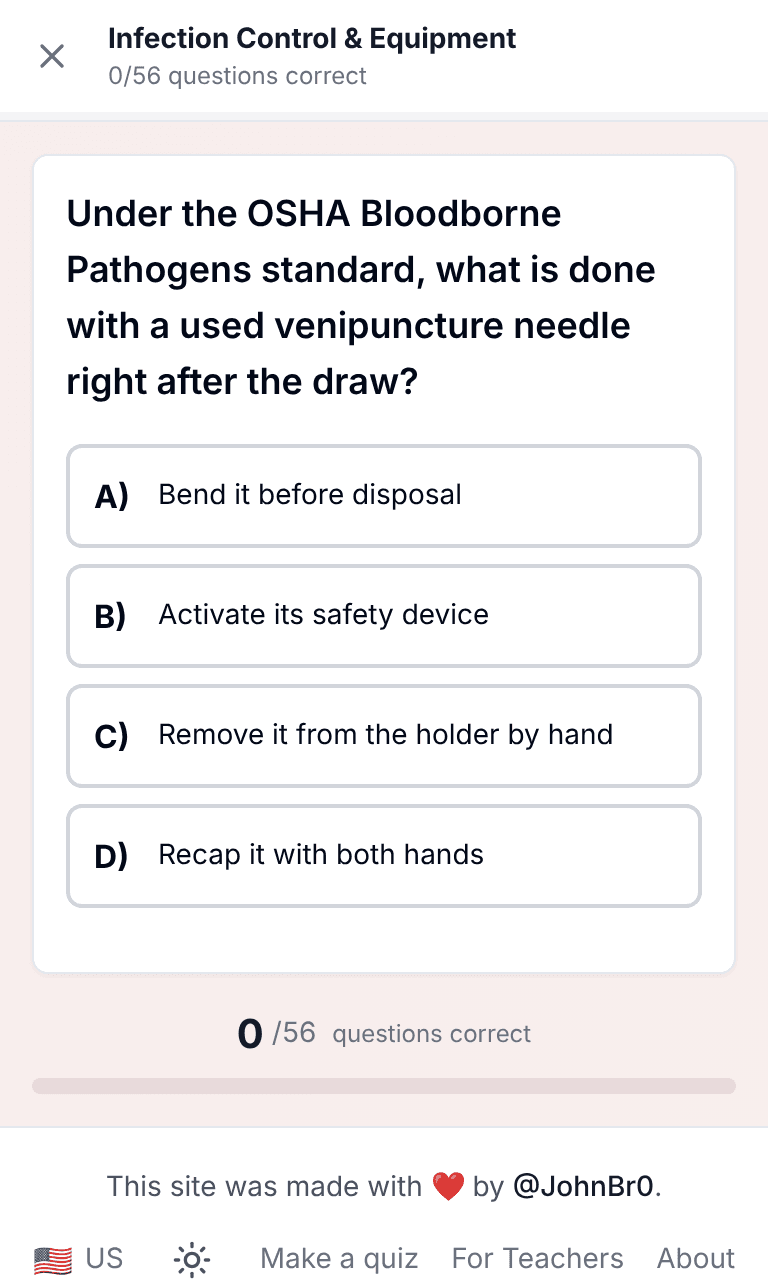
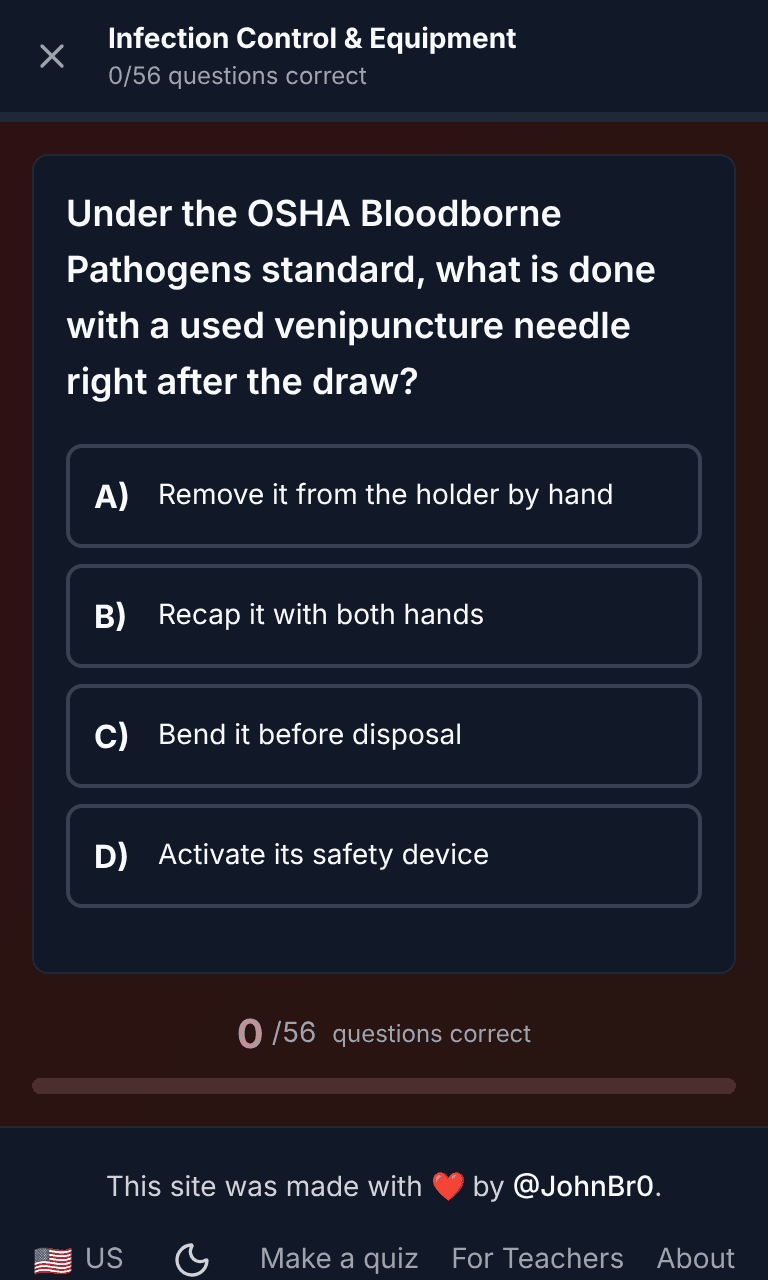
Train on mobile
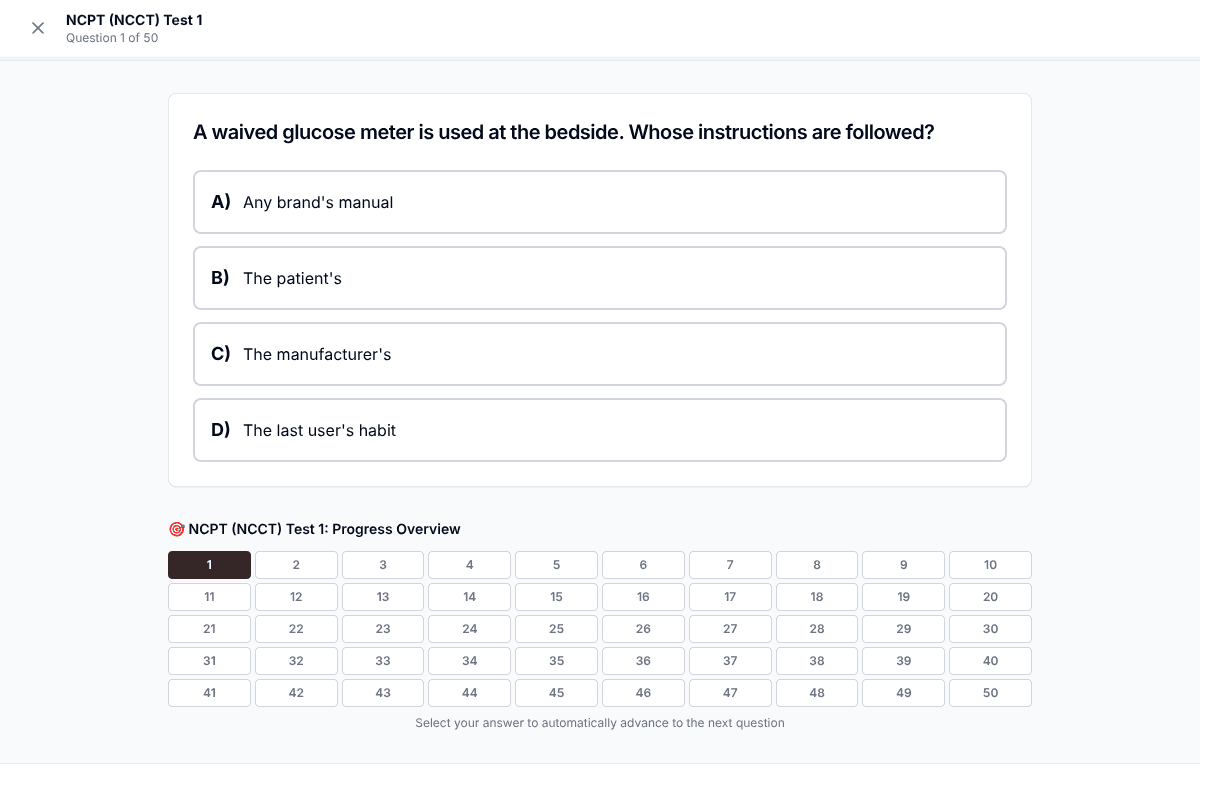
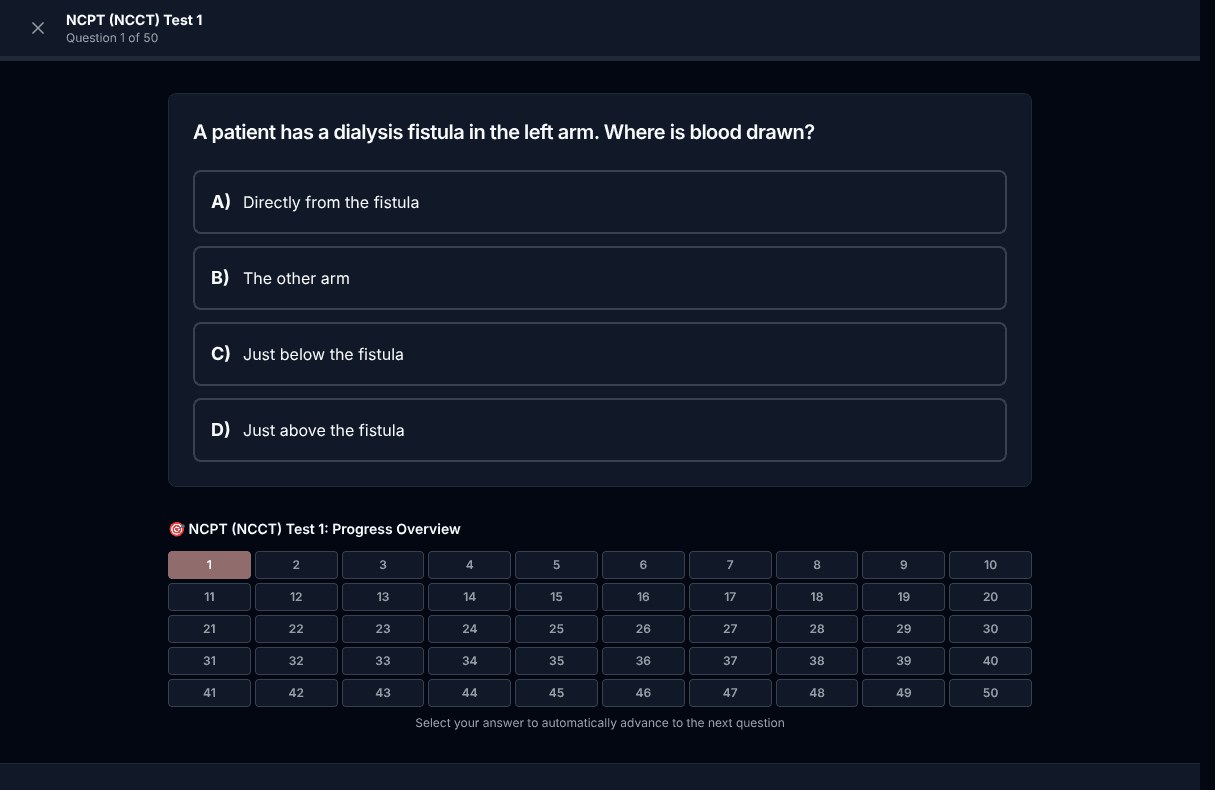
Test on desktop
The NCPT (NCCT) exam at a glance
The National Certified Phlebotomy Technician (NCPT) exam is the National Center for Competency Testing's (NCCT) certification exam for phlebotomy technicians. NCCT's detailed test plan, effective January 2025, gives it 100 scored questions plus 25 unscored pretest questions, with three hours to finish; about 92% are four-option multiple choice and 8% are alternative items such as drag and drop, multi-select and hotspot. Scores run from 200 to 720 and a scaled 575 passes, which is not a fixed percentage. The plan has five content categories: Infection Control and Safety 15 items, Preparing for Specimen Collection 25 (Equipment Selection 12, Patient and Site Preparation 13), Specimen Collection 30, Collection Complications and Troubleshooting 15, and Law and Ethics 15. It is taken on a computer at a test site or by remote testing, in English only.
Tigertest has 200 NCPT (NCCT) practice questions with explanations, free to start with no account required.
- Questions
- 125 (100 scored, 25 pretest)
- Time
- 3 hours
- Passing score
- 575 on a 200 to 720 scale
- Largest areas
- Specimen Collection 30, Preparing for Specimen Collection 25, then 15 each for the other three
- Eligibility
- NCCT-authorized phlebotomy program (student or graduate within 5 years), 1 year of full-time work as a phlebotomy technician within the past 5 years, or military training; most routes need a critical skills form
- Where
- Computer based, at a test site or by remote testing; English only
- Retakes
- After 30 days for a 2nd and 3rd try, 90 days for a 4th, then 180 days with an appeal
- Given by
- NCCT
Updated by the Tigertest team. Practice questions follow NCCT's NCPT Detailed Test Plan (effective January 2025) and Candidate Handbook (revised January 2026), checked November 2026. Exam rules change, so confirm current details with NCCT: NCPT Detailed Test Plan.
How It Works
Train by Category
Four training sets cover every content category of the NCCT test plan: infection control and equipment; patient preparation and blood collection; processing and complications; and law and ethics. Questions you miss come back until you have mastered them.
Weighted Practice Tests
Four practice tests of 50 questions, each weighted like the 100 scored questions on the real exam. Aim for 70% or better. No question appears in more than one test, and every one comes with an explanation.
Built on the NCCT NCPT Test Plan
NCCT publishes how many of the 100 scored questions come from each content category, and every practice test here keeps that balance, scaled to 50 questions. Specimen collection is the largest area, at 30 of the 100. Phlebotomy program instructors can set Tigertest as NCPT review at tigertest.io/teach and see which topics the class misses most.
Help Make Tigertest Better
Have an idea, a topic you'd like covered, or a question that could be clearer? We read every message and use it to improve every test.
Share FeedbackHow to Pass the NCPT Exam
1. Master specimen collection
Specimen collection is 30 of the 100 scored questions. Know the CLSI order of draw, which tests go in which tube, needle angle and anchoring, blood cultures, capillary punctures, point-of-care tests, non-blood specimens and how specimens are labeled, handled and processed.
2. Learn your equipment and site choices
Preparing for collection is 25 items. Know tube additives, needle gauges, antiseptics, latex alternatives, patient identification, tourniquet use, and which veins and capillary sites to choose or avoid.
3. Drill safety, complications and the law
Infection control, complications and law and ethics are 15 items each. Learn OSHA's bloodborne pathogens rules, isolation precautions, how to handle a hematoma, fainting or a missed vein, causes of hemolysis, consent, HIPAA, CLIA and chain of custody.
4. Fix your misses, then retest
Tigertest tracks your accuracy by category. Aim for 70% or better on every practice test before your exam date. After each test, drill the questions you missed and retrain the weakest category.
NCPT Exam Frequently Asked Questions
What is the NCPT exam?
It is the certification exam for the National Certified Phlebotomy Technician credential from the National Center for Competency Testing (NCCT). It covers infection control and safety, equipment selection, patient and site preparation, specimen collection, collection complications, and law and ethics. Candidates qualify through an NCCT-authorized phlebotomy program, formal military training, or a year of verified full-time work as a phlebotomy technician within the past five years, and most pathways also need a signed critical skills form.
How many questions are on the NCPT exam?
NCCT's detailed test plan, effective January 2025, lists 100 scored questions and 25 unscored pretest questions, with three hours to finish. About 92% are four-option multiple choice and 8% are alternative items such as drag and drop, multi-select and hotspot. The exam is on a computer, at a test site or by remote testing, and is offered in English only.
What score do you need to pass the NCPT exam?
NCCT reports scores from 200 to 720, and the pass point is a scaled 575, set by a panel of subject matter experts. It is not a fixed percentage, so the 70 percent line on these practice tests is a readiness target. After a failed attempt you wait 30 days for a second or third try, 90 days after a third failure, and 180 days with an appeal after that.
What is on the NCPT exam?
The test plan has five content categories: Infection Control and Safety 15 questions, Preparing for Specimen Collection 25 (Equipment Selection 12, Patient and Site Preparation 13), Specimen Collection 30, Collection Complications and Troubleshooting 15, and Law and Ethics 15. Each practice test here keeps that balance.
Are these the real NCPT exam questions?
No. Every question is original, written by Tigertest from NCCT's published test plan and the standards it names, such as the CLSI order of draw, OSHA's Bloodborne Pathogens standard, HIPAA and CLIA, so it covers the same knowledge without copying the exam. Tigertest is not affiliated with the National Center for Competency Testing.
I teach a phlebotomy program. Can my students use Tigertest?
Yes, for free. Make a class at tigertest.io/teach, post one link, and students join with just their name. You see who practiced, their test scores and the topics your class misses most.
NCPT (NCCT) sample questions and answers
6 of the 200 practice questions, one from each topic, with the answer explained.
1. A patient has had seizures and starts one during the draw. What comes first?
- A.Leave the room to find a nurse
- B.Remove the needle, protect them
- C.Stop and hold the arm down
- D.Put something in the mouth
Answer: B. The needle and tourniquet come out, the patient is kept from injury without restraint, and help is called; nothing goes in the mouth.
2. Before the patient leaves, what is checked at the puncture site?
- A.That the skin is cold
- B.That the bruise is visible
- C.That the arm is numb
- D.That bleeding has stopped
Answer: D. The site is checked before a bandage is placed; a patient on anticoagulants may need longer pressure.
3. Why is a bandage not placed on a child under 2 years old?
- A.It is a choking hazard
- B.It stops the clot forming
- C.It hides a hematoma
- D.It causes a latex reaction
Answer: A. Young children may pull off a bandage and put it in the mouth, so pressure is held until bleeding stops instead.
4. Whose identity must the sharps injury log keep confidential?
- A.The department head
- B.The safety officer
- C.The injured employee
- D.The device maker
Answer: C. The log records the device, department and how the injury happened, but must protect the confidentiality of the injured employee.
5. A patient faints and hits her head. What is completed afterward?
- A.A chain of custody form
- B.A safety data sheet
- C.An incident report
- D.A new requisition
Answer: C. Patient injuries and adverse events are documented on an incident report as facility policy requires.
6. A courier will reach the lab two hours late. Which specimen is most at risk?
- A.An unspun glucose tube
- B.A dried filter paper card
- C.A frozen serum aliquot
- D.A properly spun gel tube
Answer: A. Cells keep using glucose in an unspun tube without fluoride, so glucose falls with time; separated or frozen specimens are protected.
Related practice tests
Every test on Tigertest is free to start, with no account needed.
Ready to Pass the NCPT Exam?
Start for free. No account required. 200 questions across every content category of the NCCT NCPT test plan.
Start practicing