Free Notary Practice Test 2026
200 questions on the notary law every state's exam tests. Tuned for mobile. No account needed.
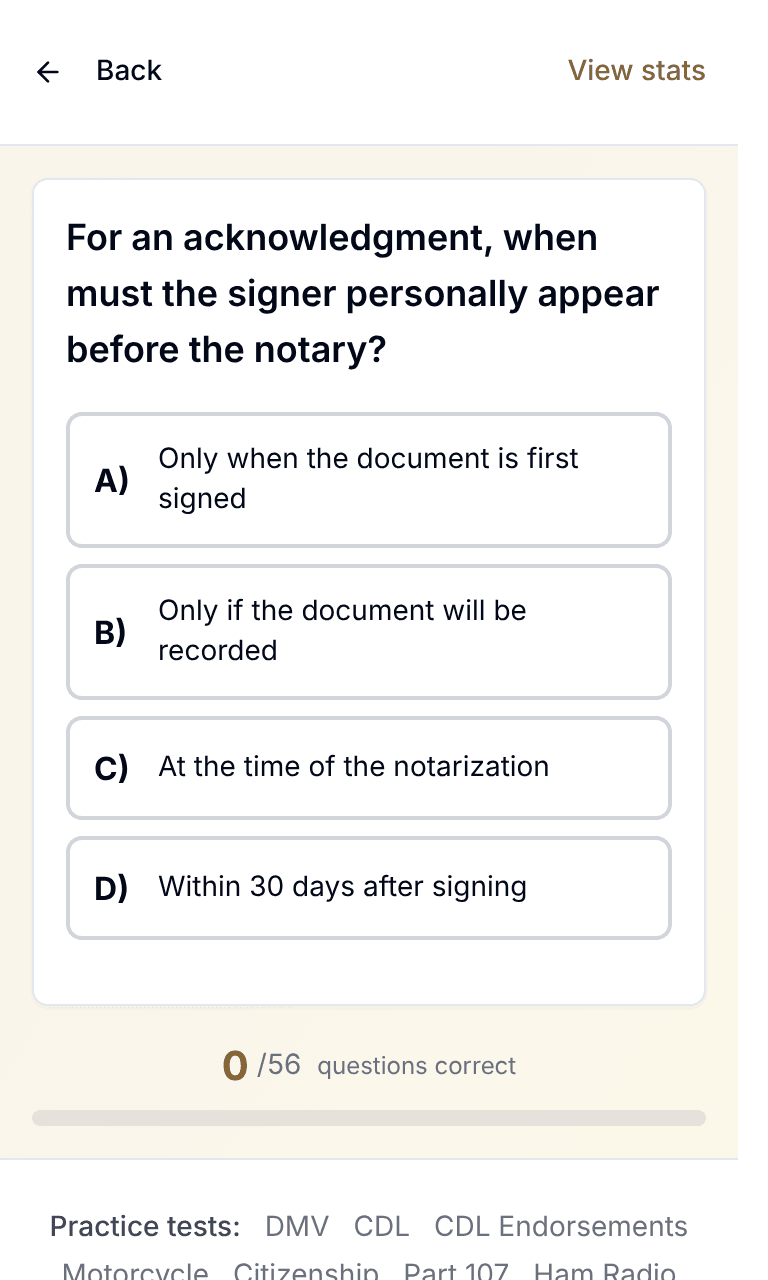
Train on mobile
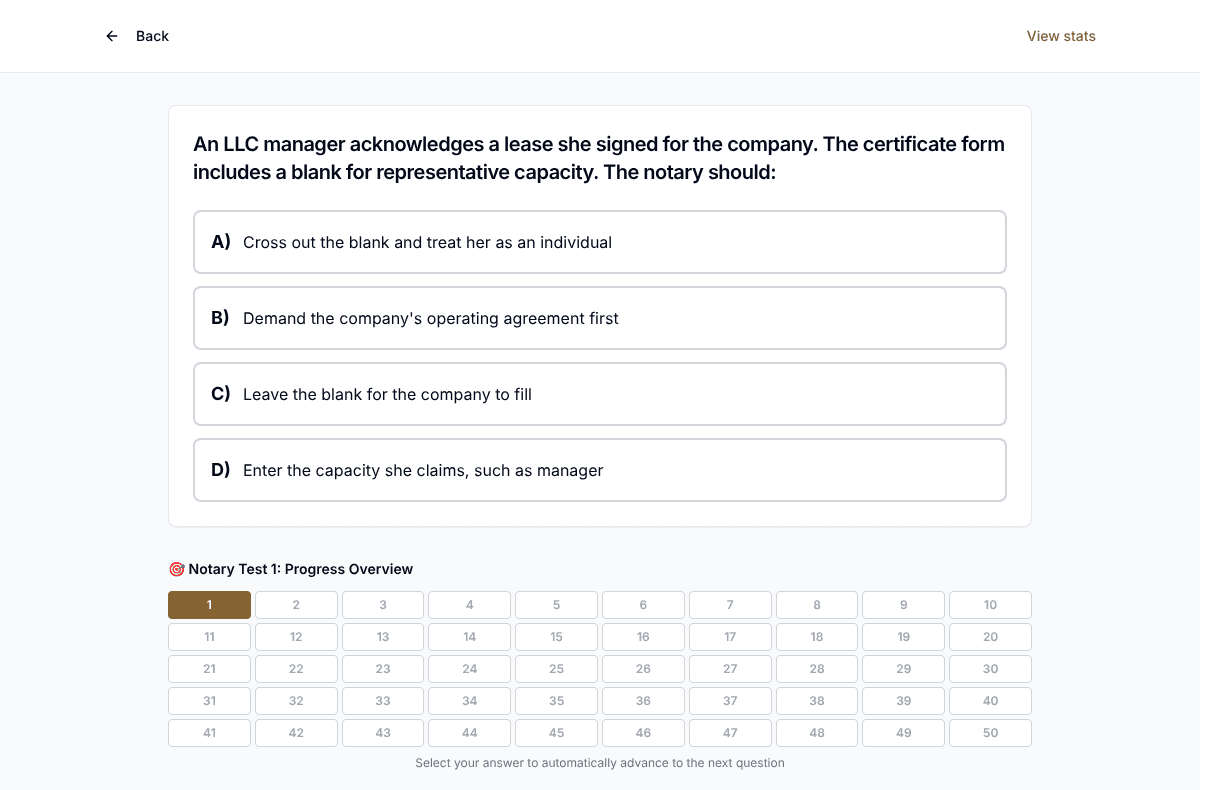
Test on desktop
How It Works
Training by Domain
Four sets covering notarial acts and certificates, identifying signers, the journal and seal, and ethics, the commission and liability. Questions you miss come back until you have mastered them.
Practice Tests
Four 50-question tests written the way state notary exams ask: a signer walks in with a document and a problem, and you pick the one thing a notary may do.
Built on the Law Every State Tests
California, New York, Louisiana, Nebraska, Ohio, Oregon, Utah, Montana, Colorado and other states test their notaries, and the core of every exam is the same: personal appearance, identification, the acts, the certificate, the journal and seal, and what a notary may never do. Each practice test follows this spread, and nothing states one state's number as universal.

We Just Launched!
The notary practice test is brand new. If a question looks wrong or your state's rule differs, tell us.
Send Us FeedbackHow to Pass the Notary Exam
1. Know the difference between an acknowledgment and a jurat
An acknowledgment certifies the signer appeared, was identified and signed willingly, and the document can be signed beforehand. A jurat adds an oath and the signer must sign in front of you. Half the scenario questions turn on which one the certificate calls for and who gets to choose.
2. Personal appearance and identification are not negotiable
No phone, no video (outside remote online notarization), no notarizing for a boss or spouse who is not in the room. Learn which IDs count, what a credible witness is, and when to refuse: coercion, confusion, an incomplete document, a signer you cannot identify.
3. The seal and journal are yours
Even if your employer paid for the seal, it is your property and no one else may use it. The journal records every act in order and stays under your control. Know what goes in an entry, what to do when the seal is lost, and what happens when the commission ends.
4. Then read your state's handbook for the numbers
Fees, commission term, bond amount, journal retention and remote notarization rules differ by state. This bank teaches the principles and marks the state-dependent parts. Clear 80 percent here, then learn your state's figures from the official handbook.
Notary Exam Frequently Asked Questions
Which states require a notary exam?
About a dozen states test notary applicants, including California, New York, Louisiana, Nebraska, Ohio, Oregon, Utah, Montana, Maine, Hawaii and Colorado, and others require a course. The exam content is the general notary law in this bank plus your state's own rules on fees, terms, the journal and remote notarization.
Does this cover my state's exam?
It covers the principles every state tests and flags where states differ. Study it first, then read your state's notary handbook for its specific numbers. No question here states one state's rule as if it applied everywhere.
What is the hardest part of the notary exam?
Scenarios where a customer, boss or relative pressures you to skip a step: notarize without the signer present, backdate, fill in a certificate for someone else, or certify a birth certificate. The right answer is almost always to refuse, and the explanations here tell you why.
Can a notary give legal advice or choose the notarial act?
No. A notary who is not an attorney may describe the acts available but may not recommend one, prepare or explain a document, or advise on immigration matters. The signer, or the document's drafter, decides which act is needed.
Is the TigerTest notary practice test free?
Yes. All four practice tests and all training sets are free, with no account required. Create a free account if you want your progress saved across devices.