
Free Real Estate Broker Practice Test 2026
200 original questions on selected national broker topics: property, title, valuation, agency, brokerage operations, disclosures, finance and math. State law is separate. Free to start, no account needed.
Try one now
Pick an answer
Which fixture test takes priority over attachment, adaptation and intention?
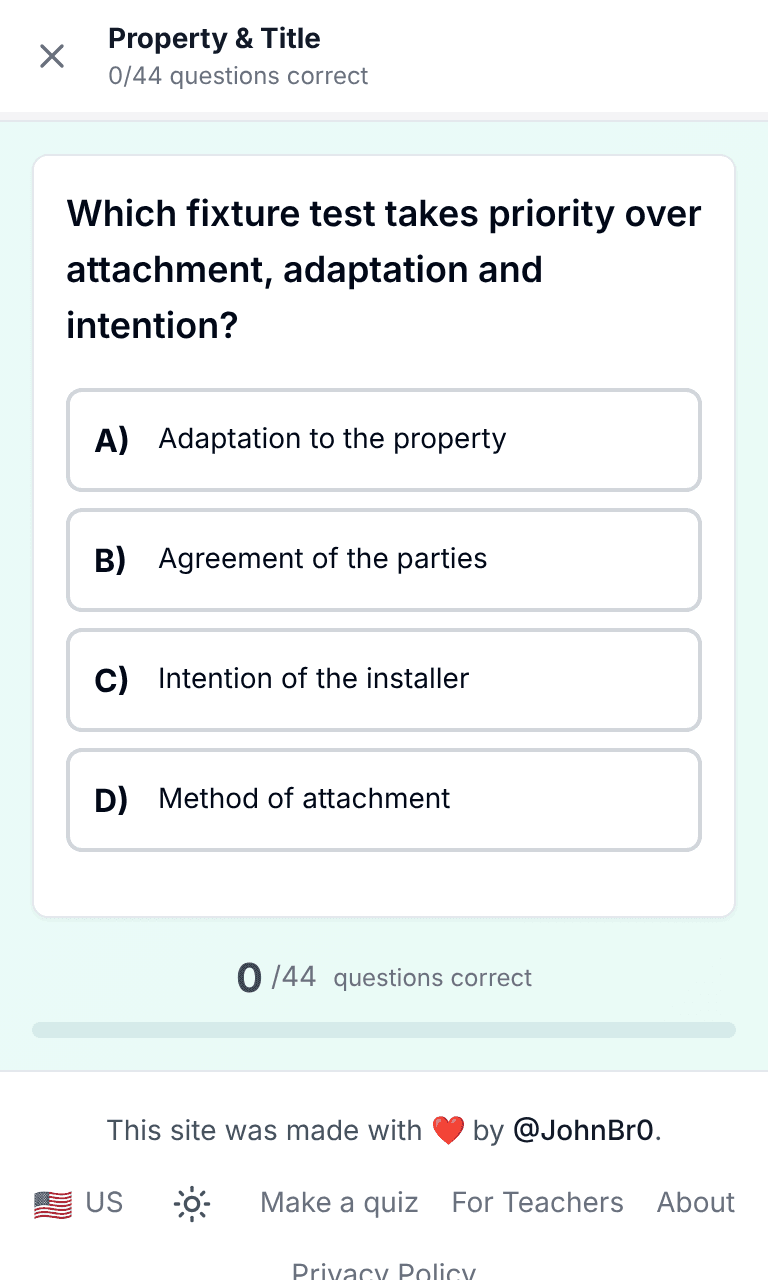
Train on mobile
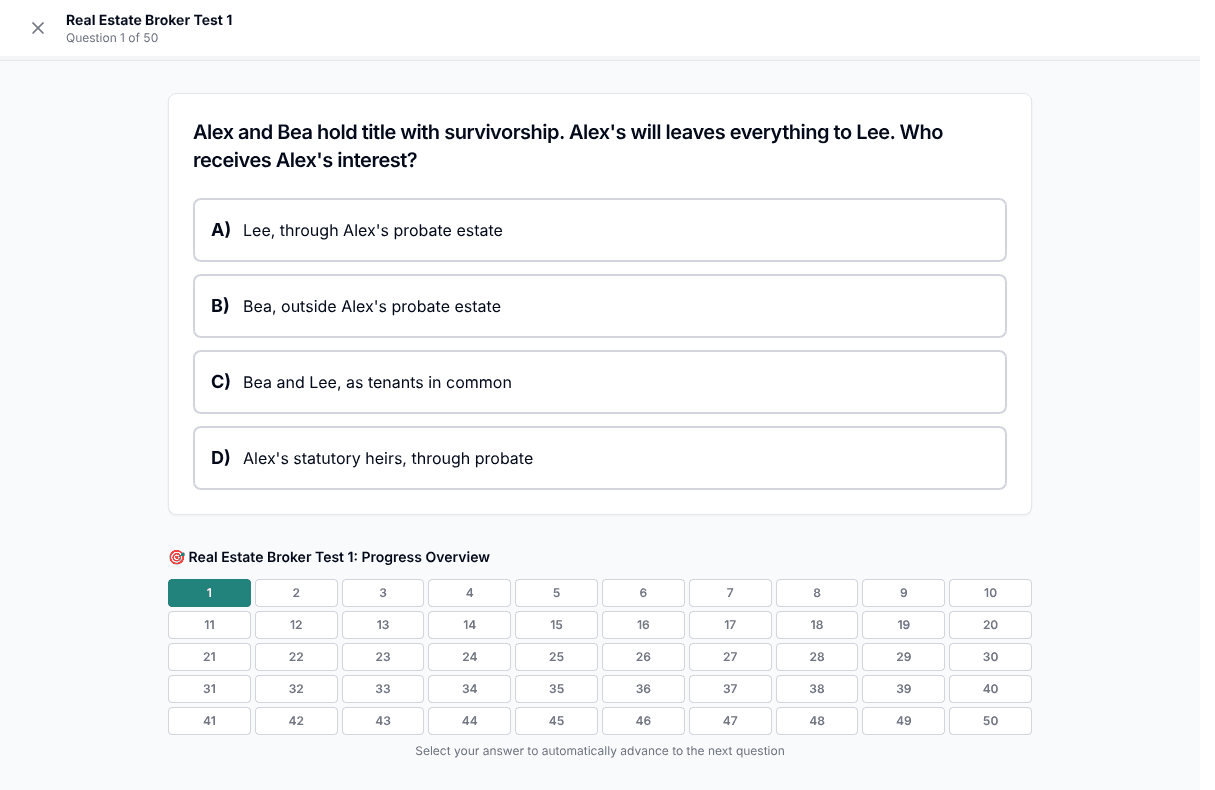
Test on desktop
The Real Estate Broker exam at a glance
This practice bank follows Pearson VUE's National/General Broker outline, effective March 1, 2025. Its national portion has 80 scored questions plus 5 pretest questions across eight topics. State-specific law, eligibility, timing and passing requirements must be checked with your licensing jurisdiction. Tigertest provides four shorter 50-question tests; 70% is a study target.
Tigertest has 200 Real Estate Broker practice questions with explanations, free to start with no account required.
- Scope
- US national broker portion; Pearson VUE outline
- Official national questions
- 80 scored + 5 pretest
- Topics
- 8, from property through real estate math
- Practice format
- 4 tests of 50 original questions
- Timing and passing
- Check your licensing jurisdiction
- State-law portion
- Separate preparation required
Updated by the Tigertest team. Practice questions follow Pearson VUE National/General Broker outline, effective March 2025; checked November 17, 2026. Exam rules change, so confirm current details with Pearson VUE real estate content outlines, national broker pages 5–8.
How It Works
Train, Then Test
Four training sets move from Property & Title through Financing & Calculations. Master a topic, then take a test. Questions you miss return for more practice.
Practice Tests
Four 50-question tests cover selected national topics, with major-category counts rounded from the Pearson VUE outline. Every item has an explanation. The 70 percent practice target does not replace your jurisdiction’s passing requirements.
Built on the National Broker Outline
Pearson VUE allocates 80 scored national broker questions across eight topics. The weights below describe these shorter practice tests, rounded to 50 items. Contracts and agency have the largest share. Broker licensing courses can assign practice at tigertest.io/teach and review topic-level progress. Prepare separately for state law and confirm your vendor and jurisdiction requirements.

Help Make Tigertest Better
Have an idea, a topic you'd like covered, or a question that could be clearer? We read every message and use it to improve every test.
Share FeedbackHow to Study for the National Broker Exam
1. Distinguish the legal relationships
Compare ownership interests, deed functions, contract remedies and agency authority. Identify who holds the right, what the agreement authorizes and which facts would change the result.
2. Practice broker operations
Review listing and management agreements alongside beneficiary ledgers, reconciliation and federal compliance. For each transaction, distinguish the client’s money, the brokerage’s compensation and the authority for any disbursement.
3. Show your calculation steps
Write the units and the base for each percentage. Keep monthly and annual rent consistent, distinguish NOI from cash after debt service, and use the stated day-count convention for prorations.
4. Review explanations and state requirements
Use missed questions to identify gaps, then revisit the corresponding training topic. Check the current vendor handbook and your licensing board for state content, timing and passing requirements before scheduling.
National Broker Frequently Asked Questions
What passing score should I use for national broker practice?
Tigertest uses 70 percent as a study target. Licensing jurisdictions set their own passing and scoring requirements, so this is not a universal national broker cut score. Check your board and current candidate handbook for the required national and state results.
How many questions are on the national broker exam?
The Pearson VUE National/General Broker outline used here specifies 80 scored questions and 5 pretest questions. These practice tests contain 50 questions each, with editorial rounding of the topic proportions. Check your jurisdiction for time limits, state questions and current delivery arrangements.
What topics does this broker practice cover?
Eight topics from the Pearson VUE outline: real property characteristics, ownership and title, valuation, contracts and agency, real estate practice, property disclosures and environmental issues, financing and settlement, and real estate calculations. Broker operations include management agreements, trust records and federal compliance.
Does this prepare me for the state-law portion?
No. State agency rules, trust-account deadlines, licensing requirements and state-specific contracts require separate study. This bank focuses on national concepts, federal rules and expressly stated transaction terms. It does not combine different state rules into a national standard.
Is this the same as a PSI broker exam or an official question bank?
No. This independent bank follows the Pearson VUE national broker outline and contains original questions. It is not an official exam, a PSI scenario simulation or a guarantee of passing. Free practice starts without an account; Premium unlocks later steps.
I teach a real estate broker licensing course. Can my students use Tigertest?
Yes, for free. Make a class at tigertest.io/teach, post one link, and students join with just their name. You see who practiced, their test scores and the topics your class misses most.
Real Estate Broker sample questions and answers
6 of the 200 practice questions, one from each topic, with the answer explained.
1. The parties sign a written purchase contract but leave the price for later agreement. Which formation defect exists?
- A.Statute of frauds violation
- B.Indefinite essential term
- C.Lack of consideration
- D.Lack of contractual capacity
Answer: B. DRE Transfer requires terms definite enough to enforce, and courts cannot supply a price the parties left open. The contract is written and signed, so the statute of frauds is not the problem, and nothing suggests missing consideration or capacity.
2. Federal UST classification uses a ten-percent burial threshold. Which capacity is used to calculate that percentage?
- A.Tank shell capacity excluding connected piping
- B.Petroleum currently stored in the tank
- C.Daily fuel throughput of the system
- D.Tank and connected underground piping combined
Answer: D. EPA defines an underground storage tank system using at least ten percent of its combined tank-and-connected-piping volume underground. This is a capacity-based definition, not a test of current fill or daily throughput; separate exclusions and state rules can still matter.
3. Which closing charge establishes funds for future property-tax and insurance bills rather than paying a current premium?
- A.Initial escrow deposit
- B.Prepaid insurance premium
- C.Discount points
- D.Loan origination charge
Answer: A. CFPB distinguishes an initial escrow balance from prepaid costs, discount points and lender origination charges.
4. A $2,700 rate-buydown saves $75 monthly. Ignoring taxes and time value, when do payment savings recover that cost?
- A.After 30 months
- B.After 45 months
- C.After 36 months
- D.After 27 months
Answer: C. Divide $2,700 by $75 monthly savings to obtain 36 months. CFPB recommends comparing upfront points with savings over the anticipated holding period.
5. A management contract charges 7% of collected rent. Scheduled rent is $100,000; collections are $90,000. What fee applies?
- A.$700
- B.$6,510
- C.$6,300
- D.$7,000
Answer: C. The agreed basis is collections: $90,000 × 7% = $6,300. DRE Property Management distinguishes agreed fee arrangements, including percentages of collected gross rents.
6. Parcel A holds an access easement across Parcel B. A's owner then buys Parcel B. What happens to the easement?
- A.Terminates by merger of title
- B.Converts to an easement in gross
- C.Continues as an appurtenant easement
- D.Becomes a license revocable at will
Answer: A. DRE Title lists merger of the servient tenement and the easement in the same owner as a way an easement ends. An owner does not need an easement over the owner's own land, so it neither continues nor converts.
Related practice tests
Every test on Tigertest is free to start, with no account needed.
- Licensed Residential Appraiser Practice TestThe Appraisal Foundation · AQB Licensed Residential
- Real Estate Practice TestNational portion, Pearson VUE and PSI
- Life & Health Insurance Practice TestLife, accident & health producer exam
- Notary Practice TestNotary practice; state requirements vary
- SIE Exam Practice TestFINRA · Securities Industry Essentials
- Series 7 Practice TestFINRA · General Securities Representative
Ready to Practice National Broker Topics?
Start for free. No account required. 200 original questions across eight national topics.
Start practicing