
Free NZ Enrolled Nurse State Final Practice Test 2026
Medicine calculations and nursing knowledge mock tests for Diploma in Enrolled Nursing graduates, written for the 2025 enrolled nurse scope. 212 questions with rationales. Free to start, no account needed.
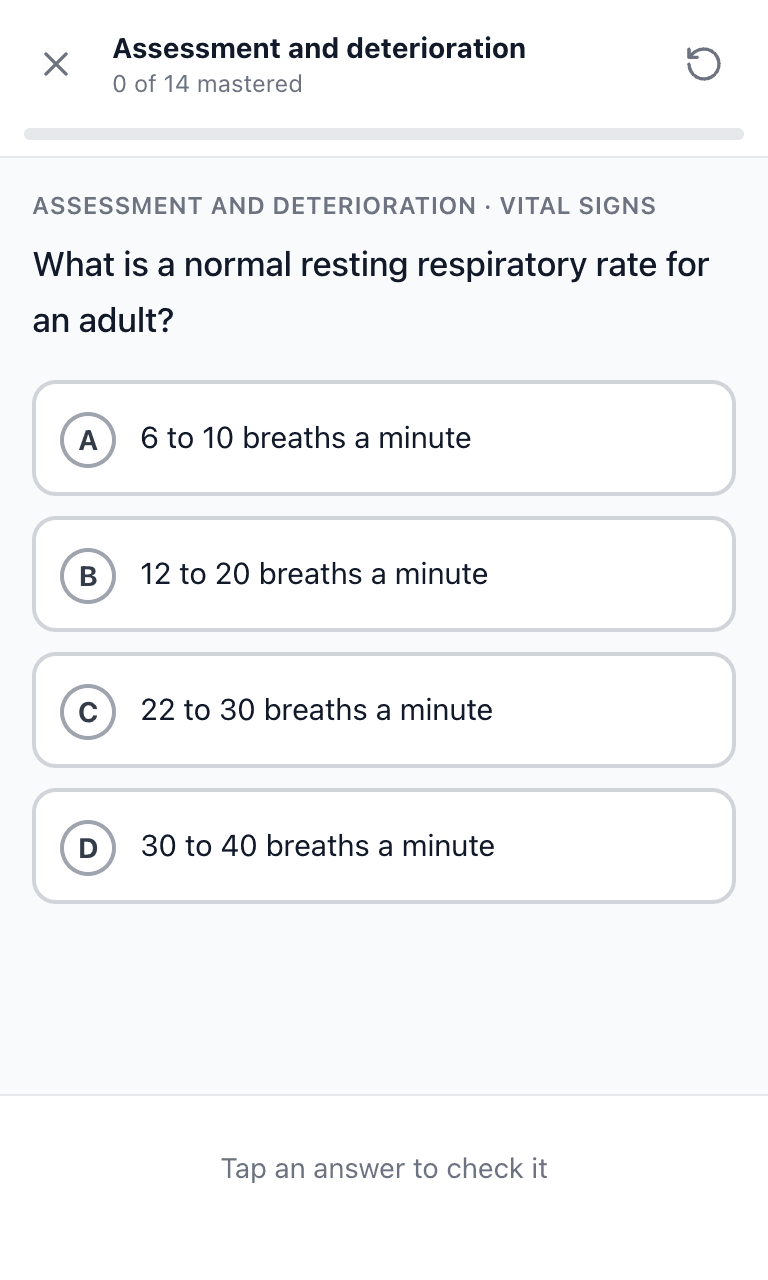
Train on mobile
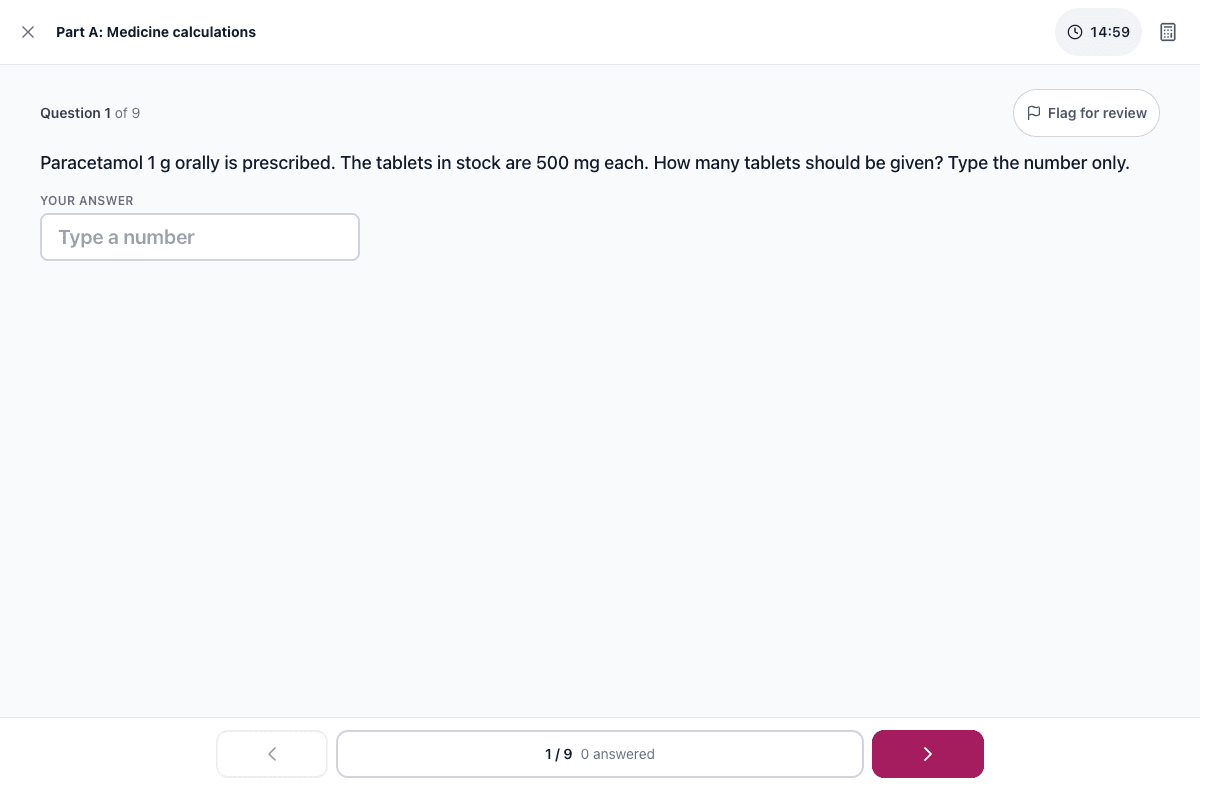
Test on desktop
The EN State Final exam at a glance
The State Final Examination for enrolled nurses is the examination the Nursing Council of New Zealand (Te Kaunihera Tapuhi o Aotearoa) sets for graduates of the 18-month Diploma in Enrolled Nursing before it registers them in the enrolled nurse scope. The Council's handbook for nursing programmes describes it as 90 multiple-choice questions in 90 minutes, held in March, July and November, with an overall pass of 70% across the whole exam; the Council's FAQ adds that there is no pass mark for each category and that candidates have three attempts. The 2025 sample paper has two parts, Part A Medicine Calculations and Part B Nursing Knowledge, with four options a question, answered as an enrolled nurse would act. Part B is linked to the five pou of the Standards of competence for enrolled nurses (February 2025).
Tigertest has 212 EN State Final practice questions with explanations, free to start with no account required.
- Run by
- Nursing Council of New Zealand (Te Kaunihera Tapuhi o Aotearoa)
- Who sits it
- Diploma in Enrolled Nursing graduates, before registration
- Questions
- 90 multiple choice, four options each
- Time
- 90 minutes
- Parts
- Part A Medicine Calculations, Part B Nursing Knowledge
- Pass mark
- 70% overall, no pass mark for each category
- Attempts
- Three
- Sittings
- March, July and November
- Standards
- Enrolled nurse scope and standards of competence, 2025 (five pou)
Updated by the Tigertest team. Practice questions follow Nursing Council of New Zealand: Handbook for pre-registration nursing programmes (May 2022), State Final Examination FAQ (October 2024), EN sample questions 2025, Enrolled nurse scope of practice (January 2025) and Standards of competence for enrolled nurses (February 2025), checked November 2026. Exam rules change, so confirm current details with Nursing Council of New Zealand: Enrolled nurse.
How It Works
Drills on Your Phone
A medicine calculations drill with typed answers, then one drill for each area of Part B, from Te Tiriti and seeking guidance to sepsis and post-operative care. Check each answer and read the rationale on the spot; every miss comes back until you have it right. Fits around placements and study.
Full Mock Tests
Part A then Part B in one sitting, 90 questions in 90 minutes like the real exam: 9 calculations in 15 minutes with a calculator, then 81 nursing knowledge questions in 75 minutes, with flagging and review. Practice Test 2 questions never appear in the drills, so it is a fair check of your progress.
Built on the 2025 Enrolled Nurse Standards
Part A covers tablets, oral liquids, doses by weight, pump and drip rates, infusion times and fluid balance. The Council publishes no topic split for Part B, so Tigertest spreads its 81 questions across the five pou of the standards of competence like this:

How to Prepare for the EN State Final
1. Answer as an enrolled nurse
The sample paper asks you to answer as if you were working as an enrolled nurse. You assess, plan, give and evaluate care, and you are accountable for it, but when a patient gets worse or a task is beyond your expertise, the right answer is usually to escalate to the registered nurse or another registered health practitioner. Prescribing and diagnosing are not the enrolled nurse's role.
2. Know the five pou and the Code of Rights
Learn what each pou asks: culturally safe care is determined by the person receiving it, kawa whakaruruhau addresses power imbalances, and documentation must be legible, accurate and timely. The Code of Health and Disability Services Consumers' Rights comes up too: a person is presumed competent, may refuse care, may have a support person and may complain.
3. Make calculations automatic
Use one formula every time (what you want, divided by what you have, times the volume), change to the same unit before you divide, and read the rounding instruction twice. Pump rates are volume over hours; drip rates are volume times drop factor over minutes.
4. Drill your weakest area, then take a full test
Tigertest shows your practice score by area. Read the rationales in the area you miss most, then sit Practice Test 2 in one go to check your timing: about a minute a question. These scores track your practice and do not predict your result.
EN State Final Frequently Asked Questions
What is the enrolled nurse State Final Examination?
It is the examination the Nursing Council of New Zealand sets for graduates of the Diploma in Enrolled Nursing before they can register as enrolled nurses. The Council's handbook for nursing programmes describes it as 90 multiple-choice questions in 90 minutes, held in March, July and November. The 2025 sample paper has two parts: Part A Medicine Calculations and Part B Nursing Knowledge.
What is the pass mark for the EN State Final?
The handbook says you need an overall pass of 70% across the whole exam. The Council's FAQ adds that there is no pass mark for each category, so you do not need full marks in the calculations; the exam is graded on your overall percentage. Candidates have three attempts to pass.
What is on Part B of the enrolled nurse exam?
Part B is nursing knowledge, linked to the Council's Standards of competence for enrolled nurses (February 2025). They have five pou: Māori health, cultural safety, whanaungatanga and communication, pūkengatanga and knowledge-informed practice, and mana hautū, professional accountability. Answer every question as an enrolled nurse working in Aotearoa New Zealand.
How did the 2025 enrolled nurse scope change things?
Since 20 January 2025 enrolled nurses initiate and monitor care through assessment, care planning, implementation and evaluation, and must work with access to, and seek when appropriate, guidance from a registered nurse or other registered health practitioner. They can direct and coordinate other health workers, are accountable for their own practice and must recognise and escalate a change in a patient's condition. Registered nurses remain accountable for directing and delegating.
Is the Tigertest enrolled nurse practice test free?
It is free to start, with no account needed. Practice Test 1 and every drill but the last two are free; the last two drills and the final practice test are part of Tigertest Premium, one payment with no subscription. The questions are original practice questions written from the Council's scope and standards, not real exam questions. Here Part A asks you to type each answer, while the real Part A is multiple choice.
I teach a Diploma in Enrolled Nursing class. Can my students use Tigertest?
Yes, for free. Make a class at tigertest.io/teach, post one link, and students join with just their name. You see who practiced, their test scores and the topics your class misses most.
EN State Final sample questions and answers
6 of the 212 practice questions, one from each topic, with the answer explained.
- 1.
A colleague says a Māori patient is 'probably not taking his pills like the rest of them'. What should the enrolled nurse do?
- A.
Agree and plan to check his pill count
- B.
Record the comment in the patient's notes
- C.
Ignore it, as the colleague is senior
- D.
Challenge the comment and the assumption
Answer: D.Descriptor 2.2 asks the enrolled nurse to challenge racism and discrimination in the delivery of nursing and health care. Assumptions about a group can lead to poorer care.
- A.
- 2.
A healthcare assistant the enrolled nurse is coordinating refuses to help with a patient's shower. What should the enrolled nurse do first?
- A.
Tell the patient the shower is cancelled
- B.
Ask the assistant privately why
- C.
Report the assistant to the manager at once
- D.
Do the shower herself and say nothing
Answer: B.Clear, respectful communication with colleagues (Code of Conduct principle 6) starts with understanding the reason. There may be a safety concern, such as a back injury, that changes the plan.
- A.
- 3.
What does descriptor 5.5 ask an enrolled nurse to do?
- A.
Reflect on practice and keep learning
- B.
Supervise one student each year
- C.
Work at least one night shift a month
- D.
Pass a written exam every year
Answer: A.Descriptor 5.5: the enrolled nurse reflects on their own practice and engages in ongoing professional development and learning to meet continuing competence requirements.
- A.
- 4.
A resident suddenly cannot lift her right arm and her speech is slurred. What should the enrolled nurse do?
- A.
Give her water to help her speak
- B.
Lie her down and recheck in an hour
- C.
Book a doctor's visit for tomorrow
- D.
Call 111 or the emergency team now
Answer: D.Sudden arm weakness and slurred speech are signs of stroke (FAST). Treatment depends on time, so it is an emergency.
- A.
- 5.
A patient asks why he must take his new antibiotic until the course is finished. What is the best answer?
- A.
Stopping early can leave infection behind
- B.
It does not matter once he feels better
- C.
Finishing the course stops all side effects
- D.
Stopping early makes the tablets toxic
Answer: A.Descriptor 4.6 asks the nurse to explain the effects of treatment. Stopping antibiotics early can leave bacteria that cause the infection to return.
- A.
- 6.
Which is the most likely cause of constipation in an older patient after hip surgery?
- A.
Walking a little every day
- B.
Too much dietary fibre
- C.
Drinking plenty of water
- D.
Opioids and reduced mobility
Answer: D.Opioid pain relief and lying in bed both slow the bowel. Fluids, fibre, moving and laxatives as prescribed help prevent it.
- A.
Related practice tests
Every test on Tigertest is free to start, with no account needed.
- NZ IQN Theoretical Examination Practice TestNursing Council of New Zealand · IQN theoretical examination, registered nurse, Pearson VUE
- Nursing Council NZ State Final Exam Practice TestNursing Council of New Zealand · registered nurse State Final Examination
- NCLEX-PN Practice TestNCSBN 2026 PN test plan
Free practice tests for New ZealandSee all 390 practice tests
Start Your EN State Final Practice
Start for free. No account needed. 212 questions across medicine calculations and every area of Part B, written for enrolled nurses in Aotearoa New Zealand.
Start practicing