
Free NZ IQN Theoretical Examination Practice Test 2026
Medication safety and nursing knowledge practice for overseas-trained nurses registering with the Nursing Council of New Zealand. 200 questions with rationales, written for New Zealand practice. Free to start, no account needed.
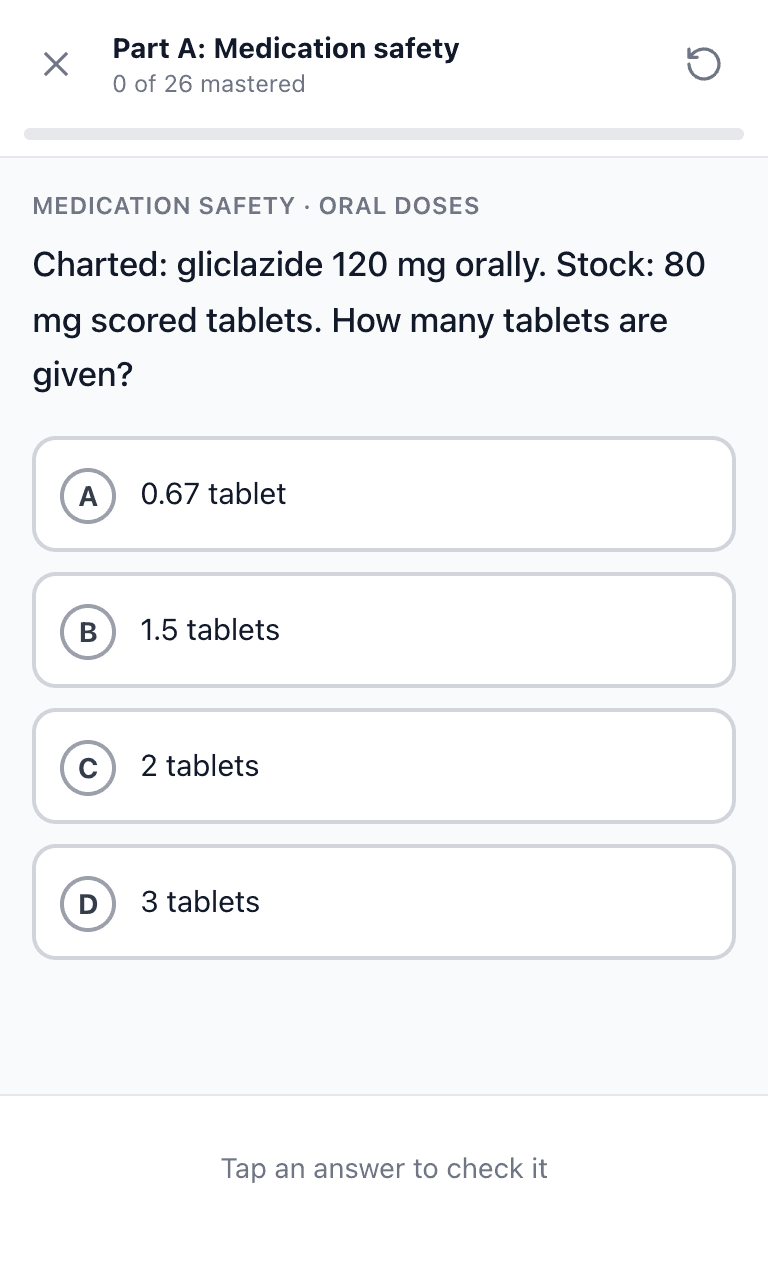
Train on mobile
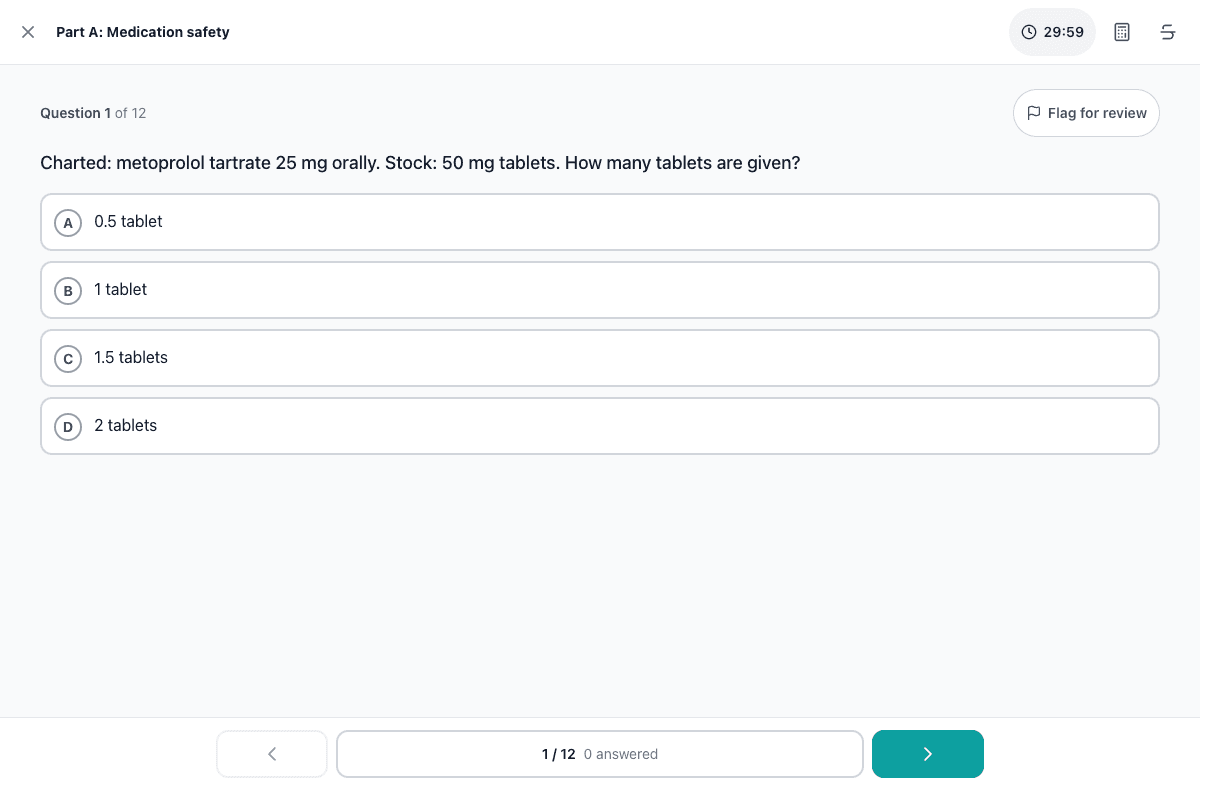
Test on desktop
The NZ IQN Exam exam at a glance
The IQN theoretical examination is the first test of competence the Nursing Council of New Zealand (Te Kaunihera Tapuhi o Aotearoa) asks of internationally qualified nurses who need one before registration; the clinical competence assessment (OSCE) follows. The registered nurse exam is 120 computer-based multiple-choice questions, each with one correct answer, in 165 minutes at a Pearson test centre in New Zealand or overseas: Part A, Medication safety, 12 questions in 30 minutes including medicine calculations with an on-screen calculator, and Part B, Nursing knowledge, 108 questions in 135 minutes linked to the Council's standards of competence. Results come within 24 hours as Pass or Fail for each part; no pass mark is published. You have six months from the invitation and three attempts, and a failed part is re-sat on its own.
Tigertest has 200 NZ IQN Exam practice questions with explanations, free to start with no account required.
- Questions
- 120 multiple choice: 12 in Part A, 108 in Part B (registered nurse)
- Time
- 165 minutes: 30 for Part A, 135 for Part B, no scheduled breaks
- Pass mark
- Not published; each part is reported Pass or Fail
- Calculator
- Provided in the software for calculation questions
- Attempts
- 3, within 6 months of the invitation; re-sit only a failed part
- Where
- Pearson test centres in New Zealand and many other countries
- Enrolled nurse exam
- 90 questions in 135 minutes (9 in Part A, 81 in Part B)
Updated by the Tigertest team. Practice questions follow the Nursing Council's IQN theoretical examination handbook (version 1.5, October 2026) and the 2025 standards of competence for registered nurses. Exam rules change, so confirm current details with Nursing Council of New Zealand.
How It Works
Drills on Your Phone
A medication safety drill, then one drill for each pou of the standards of competence, from te Tiriti and cultural safety to the early warning score and the Code of Rights. Check each answer and read the rationale on the spot; every miss comes back until you have it right.
Timed Practice Tests
Part A then Part B, timed at the real pace: 12 medication safety questions in 30 minutes with a calculator, then 54 nursing knowledge questions in 68 minutes, half the real Part B, with flagging and review. Practice Test 2 questions never appear in the drills, so it is a fair check of your progress.
Built on the Standards of Competence
Part A in each practice test has the real 12 questions: tablets, liquids, injections, pump and drip rates, doses by weight, unit conversions and safe administration. The Council publishes no split for Part B, so Tigertest spreads its 54 questions across the six pou like this:

How to Prepare for the IQN Theoretical Examination
1. Answer as a nurse working in Aotearoa New Zealand
The handbook asks you to answer every question as if you were working as a nurse. Some answers differ from practice at home: a person with diminished competence still makes the choices they can, whānau are partners in care, and culturally safe care is defined by the person receiving it. When two options look right, choose the one that keeps the person safe and fits the Code of Rights.
2. Read the four documents the Council recommends
The standards of competence for registered nurses, the Code of Health and Disability Services Consumers' Rights, the Code of Conduct for nurses and the HPCA Act 2003. Learn the ten rights by number, the six pou and what each asks of you, and the kawa whakaruruhau and Te Tiriti principles behind pou one.
3. Make medicine calculations automatic
Use one method every time (what you want, divided by what you have, times the volume), convert to the same unit before dividing, and check whether an answer is plausible before you choose it. New Zealand charts write micrograms in full, and children's doses use their weight in kilograms.
4. Drill your weakest pou, then take a full test
Tigertest shows your practice score by pou. Read the rationales in the area you miss most, then sit Practice Test 2 in one go to check your timing: about 2.5 minutes a Part A question and 75 seconds a Part B one. These scores track your practice and do not predict your result.
NZ IQN Exam Frequently Asked Questions
What is the IQN theoretical examination?
It is the first test of competence that the Nursing Council of New Zealand asks of internationally qualified nurses who need one before they can register. The registered nurse exam is 120 computer-based multiple-choice questions in 165 minutes at a Pearson test centre: Part A, Medication safety, 12 questions in 30 minutes, and Part B, Nursing knowledge, 108 questions in 135 minutes. After a pass you are invited to the clinical competence assessment, which includes the OSCE.
What is the pass mark for the IQN theoretical examination?
The Nursing Council does not publish one. Results are emailed within 24 hours and each part is reported only as Pass or Fail, with no further feedback. If you fail one part you re-sit only that part, and you have three attempts within six months of your invitation.
Can I use a calculator in Part A?
Yes. The Council's handbook says a calculator is provided in the exam software for questions that need a calculation. Part A covers medication and fluid safety, including medicine calculations, and like Part B every question is multiple choice with one correct answer. Practise converting milligrams, micrograms and grams, and working out pump and drip rates, until the method is automatic.
What does Part B cover?
The Council says Part B questions are closely linked to its standards of competence for registered nurses: the six pou of Māori health, cultural safety, whanaungatanga and communication, pūkengatanga and evidence-informed practice, manaakitanga and people-centred care, and rangatiratanga and leadership. Its recommended resources are the standards, the Code of Health and Disability Services Consumers' Rights, the Code of Conduct for nurses and the HPCA Act 2003.
Is the Tigertest IQN practice test free?
It is free to start, with no account needed. Practice Test 1 and every drill but the last are free; the last drill and Practice Test 2 are part of Tigertest Premium, one payment with no subscription. The questions are original practice questions written from the Council's handbook and standards, not the Council's sample questions or real exam questions.
I teach a competence assessment preparation class. Can my students use Tigertest?
Yes, for free. Make a class at tigertest.io/teach, post one link, and students join with just their name. You see who practiced, their test scores and the topics your class misses most.
NZ IQN Exam sample questions and answers
6 of the 200 practice questions, one from each topic, with the answer explained.
- 1.
Within what time of admission should medicines reconciliation be done?
- A.
Within 4 hours
- B.
Within 24 hours
- C.
Only before discharge
- D.
Within 72 hours
Answer: B.Medicines reconciliation is done within 24 hours of admission, transfer or discharge. It builds the most accurate list from at least two sources, the patient being the primary one.
- A.
- 2.
Until at least what age should a baby sleep in the same room as a caregiver at night?
- A.
3 months
- B.
2 years
- C.
6 months
- D.
6 weeks
Answer: C.Healthify's safe sleep advice: keep baby in their own bed in the same room as a caregiver at night until at least 6 months. The risk of sudden unexpected death in infancy lasts until about 12 months.
- A.
- 3.
A nurse is asked to manage a central line she has never used. What does descriptor 4.11 expect?
- A.
Ask the patient to explain it
- B.
Refuse all care for the patient
- C.
Learn by trying it alone
- D.
Seek guidance before acting
Answer: D.Descriptor 4.11: the nurse understands and works within the limits of their expertise and seeks guidance to ensure safe practice.
- A.
- 4.
A senior nurse gives a new graduate some constructive feedback on her handover. What does descriptor 3.8 expect?
- A.
Ask for it in writing first
- B.
Receive it and respond to it
- C.
Report it to the manager
- D.
Defend each point made
Answer: B.Descriptor 3.8: the nurse provides, receives and responds appropriately to constructive feedback. It is part of communicating professionally in the team.
- A.
- 5.
A nurse does everything for a man who can wash his own face and hands, to save time. Which right is most at risk?
- A.
Right 6, being fully informed
- B.
Right 9, teaching and research
- C.
Right 3, dignity and independence
- D.
Right 10, the right to complain
Answer: C.Right 3 is to have services provided in a way that respects the dignity and independence of the individual.
- A.
- 6.
According to the registered nurse scope of practice, what do registered nurses provide to enrolled nurses?
- A.
Their prescribing rights
- B.
Support and guidance
- C.
Their performance pay
- D.
Their annual practising certificate
Answer: B.The scope says registered nurses are responsible and accountable for directing and delegating to members of the healthcare team and provide support and guidance to enrolled nurses.
- A.
Related practice tests
Every test on Tigertest is free to start, with no account needed.
- NZ Enrolled Nurse State Final Practice TestNursing Council of New Zealand · enrolled nurse State Final Examination
- Nursing Council NZ State Final Exam Practice TestNursing Council of New Zealand · registered nurse State Final Examination
- NMC CBT Practice TestNMC Test of Competence Part 1 · adult nursing, Pearson VUE
Free practice tests for New ZealandSee all 390 practice tests
Start Your NZ IQN Exam Practice
Start for free. No account needed. 200 questions across medication safety and all six pou, written for nurses registering in New Zealand.
Start practicing