
Free Ontario Air Brake Practice Test 2026
200 original questions for the Z endorsement knowledge test, written from MTO's Official Air Brake Handbook: air supply, spring and trailer brakes, the daily air brake tests and pushrod adjustment limits. Four 50-question mock tests. Free to start, no account needed.
Try one now
Pick an answer
When brakes stop a moving vehicle, its energy is changed mainly into what?
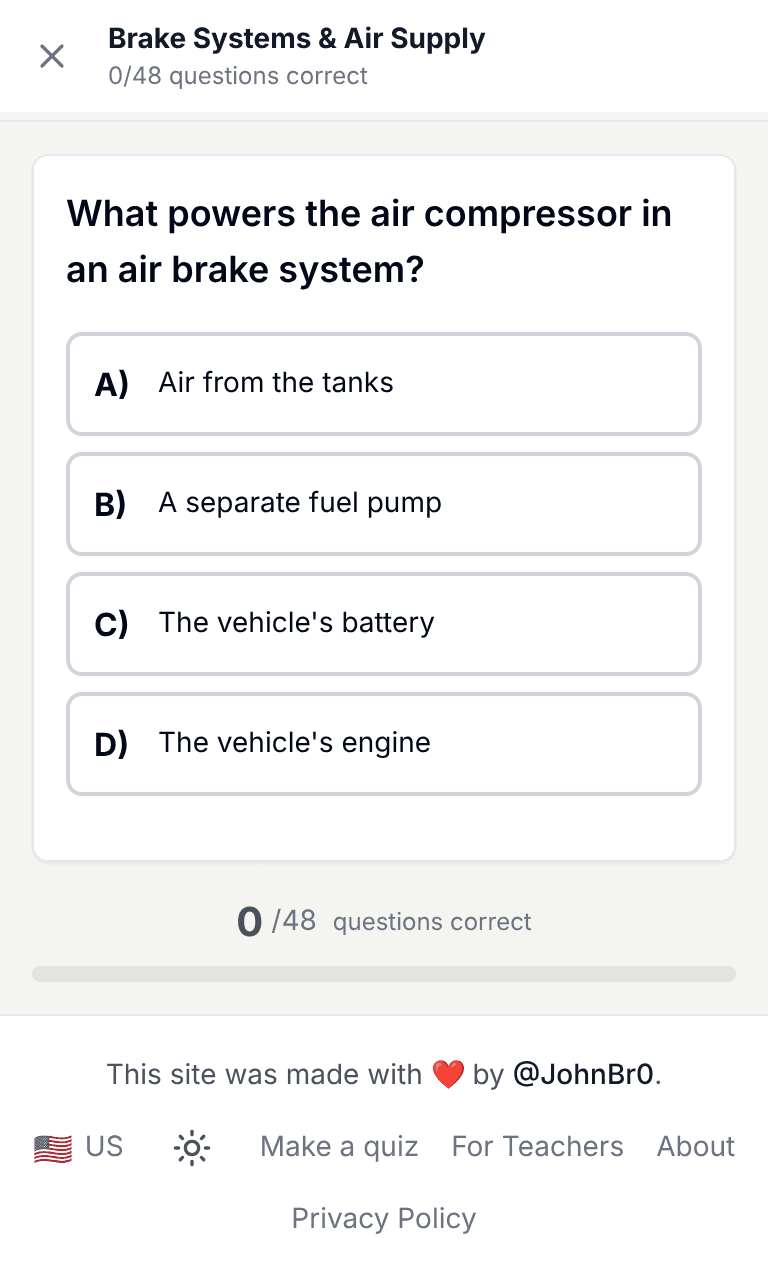
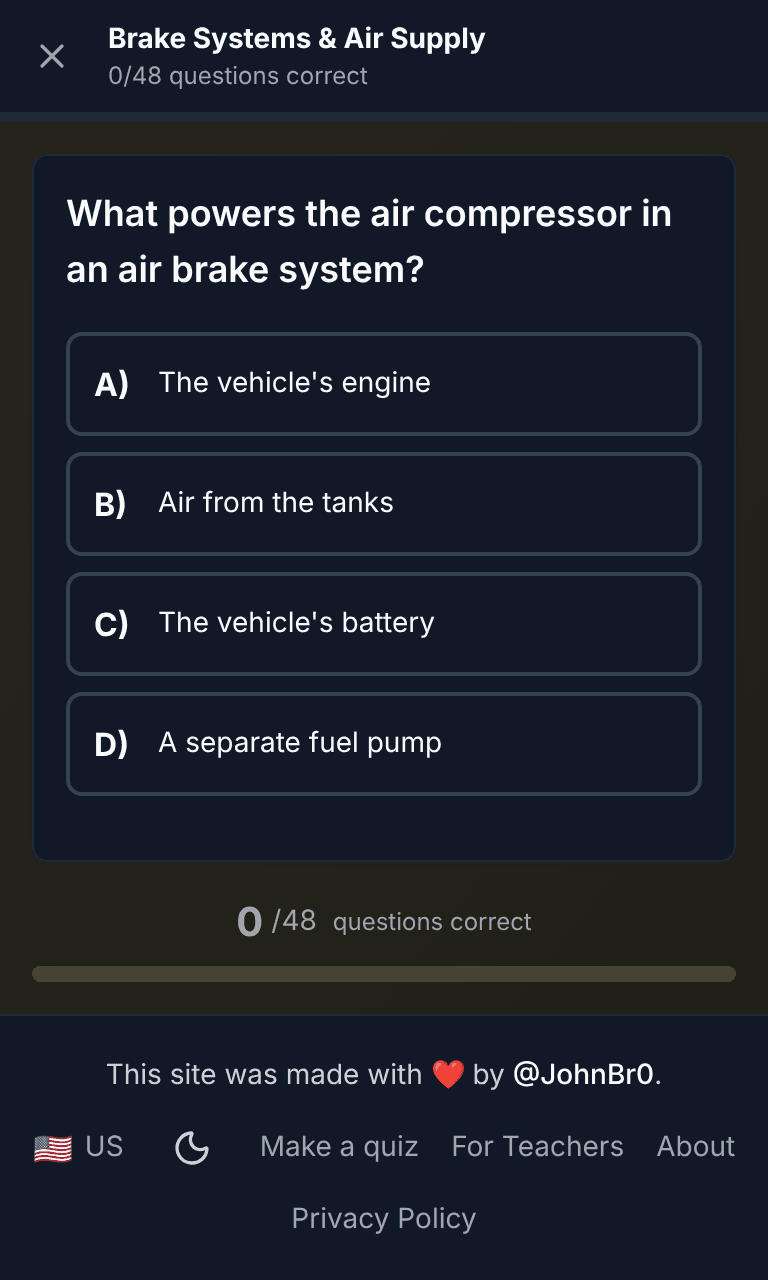
Train on mobile
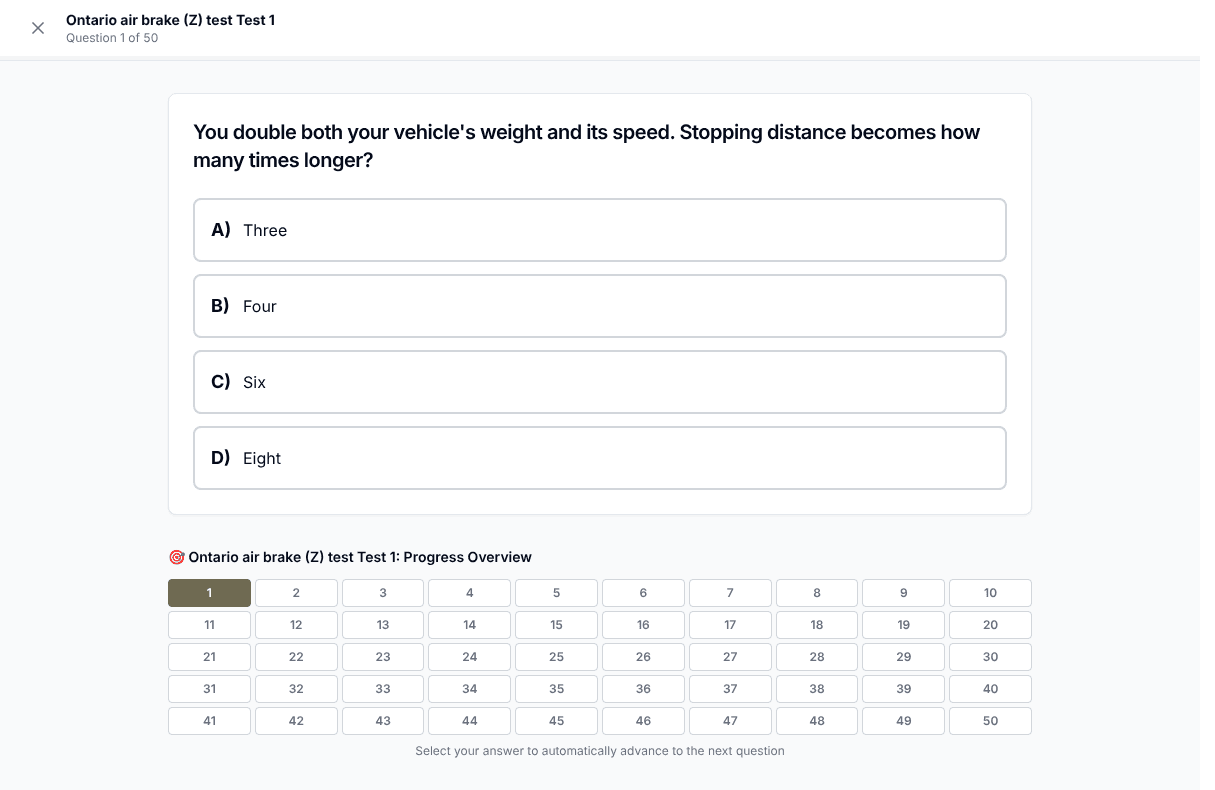
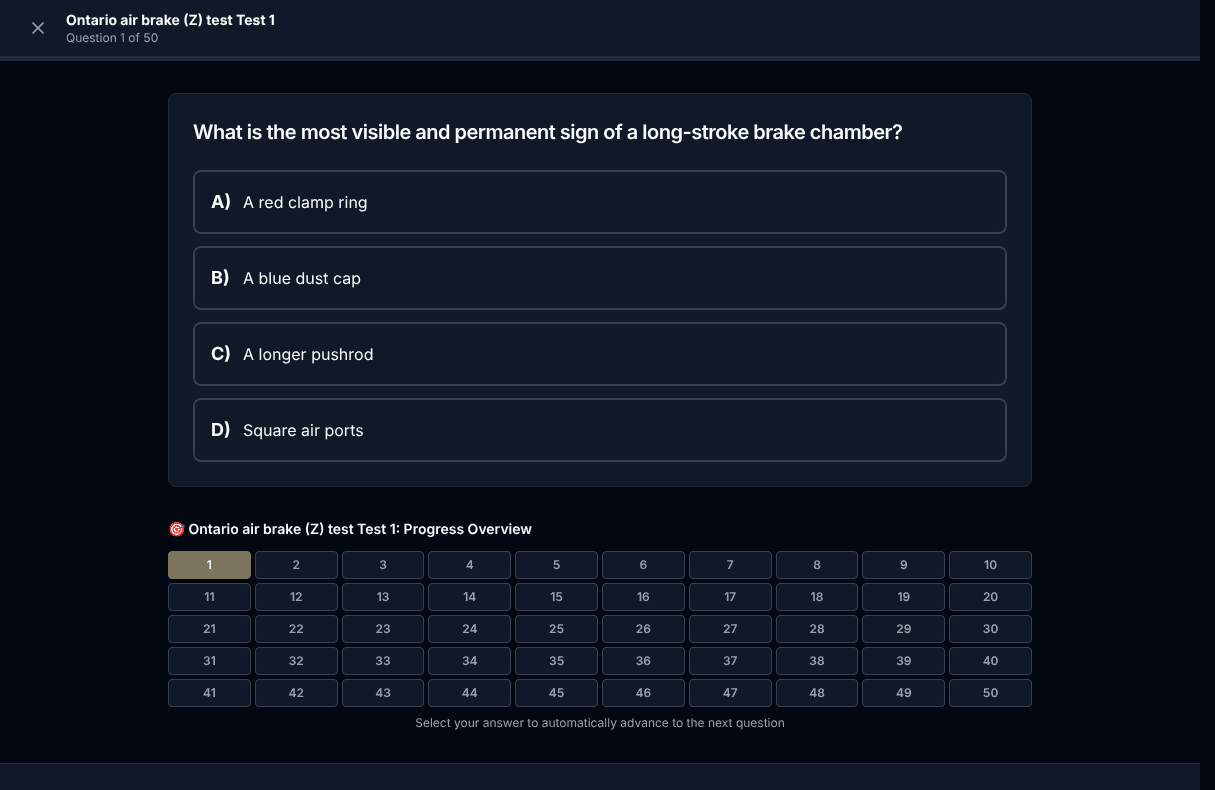
Test on desktop
The Ontario Air Brake (Z) exam at a glance
In Ontario you need an air brake (Z) endorsement on your driver's licence to drive a vehicle with an air brake or air-over-hydraulic brake system. The Ministry of Transportation (MTO) offers two routes: an air brake endorsement course from a vehicle fleet owner, community college or safety organization, or tests at a DriveTest centre, an air brake knowledge test followed by a practical test. MTO says its Official Air Brake Handbook contains what you need for the knowledge test. MTO does not publish the number of questions or the pass mark; guides say it is multiple choice with a pass mark of about 80%. Since September 1, 2023, renewals use an online air brake learning module instead of the knowledge test.
Tigertest has 200 Ontario Air Brake (Z) practice questions with explanations, free to start with no account required.
- Run by
- Ontario Ministry of Transportation, at DriveTest centres
- Needed for
- Vehicles with air brakes or air-over-hydraulic brakes
- Tests
- Knowledge test, then a practical test (or an approved course)
- Study guide
- The Official Air Brake Handbook (MTO)
- Pass mark
- Not published by MTO; guides say about 80%
- Renewal
- Online learning module; from age 80, module and practical test each year
- Tigertest mock tests
- 4 x 50 questions, 80% target
Updated by the Tigertest team. Practice questions follow MTO's Official Air Brake Handbook and its Get a truck driver's licence page, checked November 2026. Exam rules change, so confirm current details with Ontario: The Official Air Brake Handbook.
How It Works
Train Chapter by Chapter
Five training sets: brake systems and air supply, service and spring brakes, trailer brakes and driving demands, inspecting components and operation, and brake adjustment. Questions you miss come back until you have mastered them.
Four Mock Tests
Four tests of 50 questions that mix every handbook chapter, with an 80% target. No question appears in more than one test, and every answer comes with a short explanation from the handbook.
Built on the Official Air Brake Handbook
MTO publishes no topic weights, so each 50-question test follows the handbook's chapters as below. Pressures are given in kPa and psi, the way the handbook and most gauges show them.
Help Make Tigertest Better
Have an idea, a topic you'd like covered, or a question that could be clearer? We read every message and use it to improve every test.
Share FeedbackHow to Pass the Ontario Air Brake Test
1. Learn the numbers in pairs
The handbook gives every limit in kPa and psi: cut-in never below 552 kPa (80 psi), cut-out never above 1000 kPa (145 psi), the low air warning before 380 kPa (55 psi), spring brakes holding off at about 414 kPa (60 psi). Learn each figure with what it protects.
2. Follow the air through the system
Compressor, governor, air dryer, supply tank, check valves, primary and secondary tanks, then the pedal valve, brake chambers and slack adjusters. On a combination, add the supply and service lines, the trailer supply valve and the tractor protection valve. Knowing the order answers most what-happens-if questions.
3. Know each inspection test
For every test in chapter 10, know how to set up the vehicle, what to watch and what makes it fail: the warning device, build-up time, governor settings, air-loss rate, tractor protection valve, trailer spring brakes, spring brakes and drain valves.
4. Practise each chapter, then test
Finish the five training sets first, then take the mock tests. Aim for 80% or better on every mock test, and read the brake adjustment chart in the handbook, since you must know your vehicle's chamber sizes for the practical test.
Ontario Air Brake Test Frequently Asked Questions
Who needs a Z endorsement in Ontario?
You need an air brake (Z) endorsement on your Ontario driver's licence to drive a vehicle with an air brake or an air-over-hydraulic brake system. Most large commercial vehicles in Ontario have air brakes, so it is usually paired with a truck or bus licence, as in AZ or DZ. A vehicle with an air-operated parking brake and hydraulic brakes for everything else, such as some school buses, does not need it.
How do I get the air brake endorsement?
MTO gives two routes. You can take an air brake endorsement course from a vehicle fleet owner, a community college or a safety organization (holders of a B, C, D, E, F or G licence must take it with a fleet owner), then take the referral envelope to a DriveTest centre within 6 months. Or you can do the tests at a DriveTest centre: an air brake knowledge test, then a practical test. A fee applies to each test; check DriveTest for current fees.
What is on the air brake knowledge test?
MTO says the Official Air Brake Handbook contains the information you need to prepare. It covers how air brakes compare with hydraulic brakes, the air supply, service, spring and trailer brake subsystems, foundation brakes, the demands on brakes while driving, air brake compliance, inspecting components and system operation, and inspecting brake adjustment. MTO does not publish the number of questions or the pass mark; guides say it is multiple choice with a pass mark of about 80%, so Tigertest uses 80% as a target.
What happens on the practical test?
After the knowledge test you book a practical test at DriveTest. Version 1 is for a commercial vehicle with a tractor-trailer air brake system and Version 2 for one without. You bring wheel chocks, a stopwatch or a watch with a second hand, knowledge of the size and type of all the brake chambers, a way to hold the brake pedal applied and, except on motor coaches, a way to mark and measure the pushrod and eye protection. The practical test is not modelled here, but the inspection procedures it uses are part of the knowledge questions.
Are these the real DriveTest questions?
No. Every question is original, written by Tigertest from MTO's Official Air Brake Handbook and its own pages on the Z endorsement. No DriveTest question was used. This is free revision, not affiliated with the Ministry of Transportation or DriveTest, and the handbook itself says the Highway Traffic Act and its regulations govern for official purposes. Renewals since September 1, 2023 use an online air brake learning module instead of the knowledge test.
I teach an air brake endorsement course. Can my students use Tigertest?
Yes, for free. Make a class at tigertest.io/teach, post one link, and students join with just their name. You see who practiced, their test scores and the topics your class misses most.
Ontario Air Brake (Z) sample questions and answers
6 of the 200 practice questions, one from each topic, with the answer explained.
1. Does brake adjustment still need to be inspected on brakes with automatic slack adjusters?
- A.Only on the steering axle
- B.Yes, like manual ones
- C.No, they never need it
- D.Only once a year
Answer: B. The handbook says inspection of brake adjustment must be carried out whether automatic or manual slack adjusters are used.
2. Can one vehicle use more than one design of foundation brake?
- A.No, only one design per vehicle
- B.Only on trailer axles
- C.Only on the steering axle
- D.Yes, even on the same vehicle
Answer: D. The handbook says an air brake system can work with several designs of foundation brake, even on the same vehicle.
3. Besides brake fade and brake failure, what can too much brake heat cause?
- A.A tire fire
- B.A frozen air line
- C.A burst air tank
- D.Low oil pressure
Answer: A. The handbook warns that too much heat can lead to brake fade, brake failure and even a tire fire.
4. Which brake drum condition must a driver look for during an inspection?
- A.Shiny wear marks
- B.Brake dust build-up
- C.Cracks or breaks
- D.Light surface rust
Answer: C. Drivers must inspect drums and rotors for damage, cracks or breaks. A cracked or broken drum or rotor is a defect.
5. Most vehicle makers combine the emergency braking system with what?
- A.The trailer hand valve
- B.The engine retarder
- C.The parking brake system
- D.The service brake circuit
Answer: C. Most manufacturers combine emergency braking with the parking brake, using spring brakes for both jobs.
6. Why does an air brake system need a governor?
- A.The compressor would make too much air
- B.The tanks would fill up with oil
- C.The brakes would release too slowly
- D.The warning would never sound
Answer: A. Compressors run whenever the engine runs and could make far more air than needed. The governor stops pumping at cut-out and reduces the load on the engine.
Related practice tests
Every test on Tigertest is free to start, with no account needed.
- Ontario G1 Practice TestOntario MTO, DriveTest
- SAAQ Practice TestSAAQ (Quebec)
- ICBC Practice TestICBC, British Columbia
- Alberta Class 7 Practice TestAlberta registry agents · Class 7 learner's licence
- Manitoba Class 5 Practice TestManitoba Public Insurance (MPI)
- Saskatchewan Class 7 Practice TestSGI (Saskatchewan Government Insurance)
Ready for the air brake test?
Start for free. No account required. 200 questions across every chapter of the Official Air Brake Handbook.
Start practicing