
Free PANCE Practice Test 2026
200 original clinical questions on the NCCPA PANCE content blueprint: every organ system from cardiovascular to dermatology, plus professional practice. Four 50-question mock exams. Free to start, no account needed.
Try one now
Pick an answer
A 74-year-old man has exertional syncope and a harsh crescendo-decrescendo systolic murmur at the right upper sternal border that radiates to both carotids. What is the most likely diagnosis?
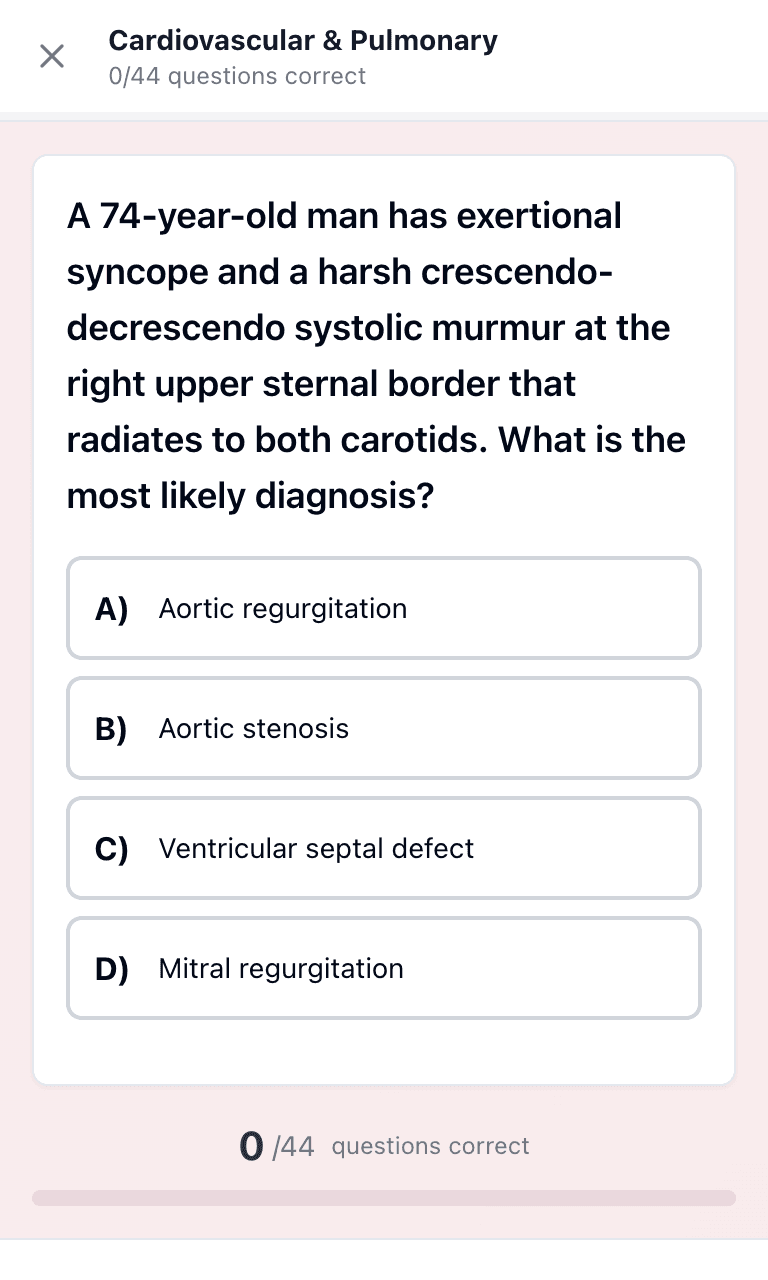
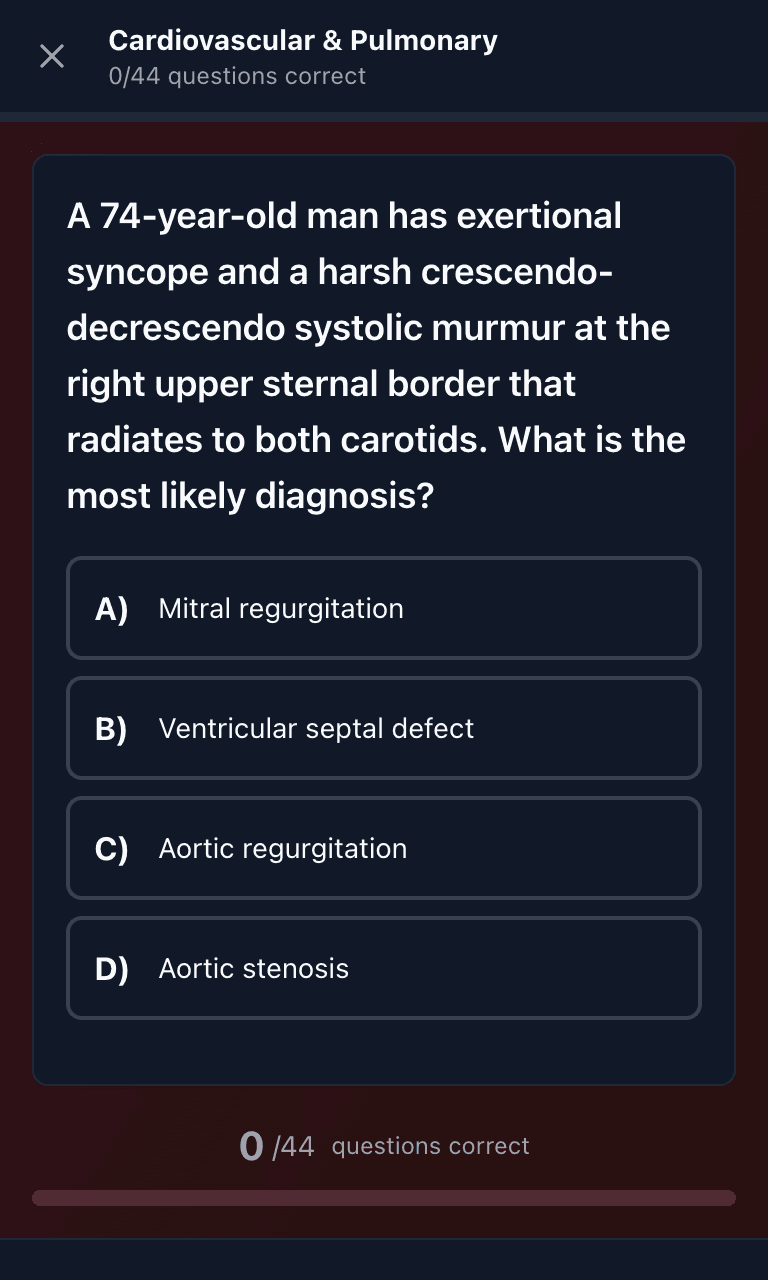
Train on mobile
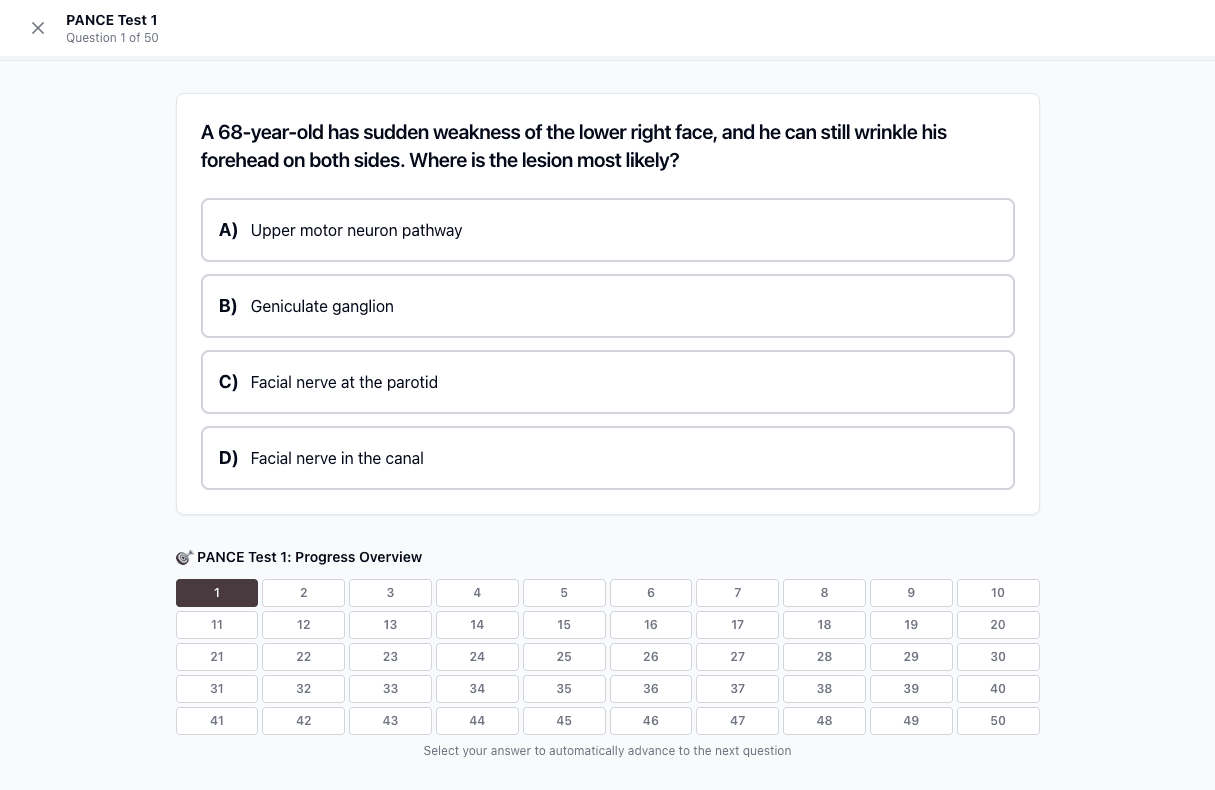
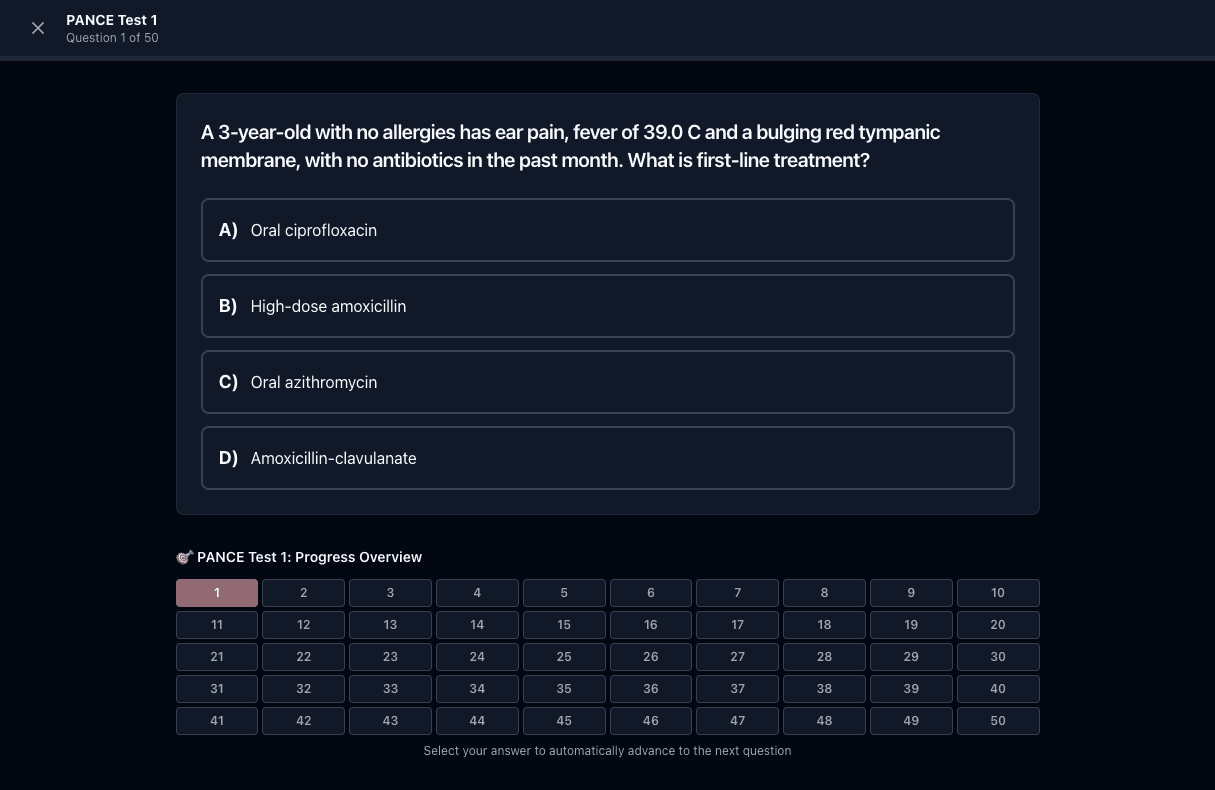
Test on desktop
The PANCE exam at a glance
The PANCE (Physician Assistant National Certifying Exam) is the National Commission on Certification of Physician Assistants' (NCCPA) exam that graduates of accredited PA programs pass to earn the PA-C credential. It has 300 multiple-choice questions in five blocks of 60, with 60 minutes per block, 45 minutes of total break time and a 15-minute tutorial, about 5 hours in all, taken by computer at Pearson VUE test centers. Scores are reported on a 200 to 800 scale and the passing standard is 350, set by the modified Angoff method; wrong answers are not penalized. The content blueprint effective January 2025 spreads questions over 14 organ systems plus professional practice (6%), led by cardiovascular (11%) and pulmonary (9%), with 12 to 15% on pediatric patients. Candidates may take it once in 90 days or three times in a calendar year, whichever is fewer, and up to six times within six years of finishing their program.
Tigertest has 200 PANCE practice questions with explanations, free to start with no account required.
- Questions
- 300 multiple choice, in five blocks of 60
- Time
- 5 hours: five 60-minute blocks, 45 minutes of breaks, 15-minute tutorial
- Pass mark
- Scaled score of 350 on a 200 to 800 scale (modified Angoff)
- Content
- Cardiovascular 11%, pulmonary 9%, GI and musculoskeletal 8% each, other systems 4 to 7%, professional practice 6%
- Patients
- 12 to 15% pediatric; up to 8 to 10% general surgery
- Where
- Computer based at Pearson VUE test centers
- Attempts
- Once in 90 days or three times a year (whichever is fewer); six times within six years of graduation
- Run by
- National Commission on Certification of Physician Assistants (NCCPA)
Updated by the Tigertest team. Practice questions follow NCCPA's PANCE Content Blueprint (effective January 2025), What to Expect on Test Day, Exam Development and Scoring pages and PANCE at a Glance presentation, checked November 2026. Exam rules change, so confirm current details with NCCPA: PANCE Content Blueprint.
How It Works
Train by Organ System
Five training sets group the 15 blueprint categories: cardiovascular and pulmonary; GI, renal, genitourinary and endocrine; neurology, psychiatry and EENT; musculoskeletal, skin and reproductive; and infectious disease, hematology and professional practice. Questions you miss come back until you have mastered them.
Weighted Mock Exams
Four mock exams of 50 questions, each weighted like the PANCE blueprint and timed at the real pace of a minute a question. Aim for 70% or better. No question appears in more than one test, and every one comes with an explanation.
Built on the PANCE Content Blueprint
NCCPA publishes the share of the exam that comes from each organ system, and every mock exam here keeps that balance, scaled to 50 questions: 6 cardiovascular, 5 pulmonary, 4 each of GI, musculoskeletal, infectious disease and psychiatry, 3 each of endocrine, neurologic, EENT, reproductive and professional practice, and 2 each of renal, genitourinary, dermatologic and hematologic. About one question in seven is about a child, and some are surgical, as the blueprint asks. The real exam has 300 questions in five 60-minute blocks; these forms keep the same mix and pace at a shorter length. PA program faculty running board review can set Tigertest as class practice at tigertest.io/teach and see which topics the class misses most.

Help Make Tigertest Better
Have an idea, a topic you'd like covered, or a question that could be clearer? We read every message and use it to improve every test.
Share FeedbackHow to Pass the PANCE
1. Study by organ system, weighted like the blueprint
Cardiovascular (11%) and pulmonary (9%) together are a fifth of the exam, and GI and musculoskeletal add another 16%. Smaller systems such as renal, genitourinary and dermatology are 4 to 5% each. Spend your time in roughly those proportions.
2. Practice the whole patient encounter
The blueprint also weights tasks: the most likely diagnosis (18%), history and physical (16%), clinical intervention (16%), drug therapy (15%), health maintenance (11%) and diagnostic studies (10%). For every condition, know how it presents, the first test, the first-line treatment and the screening rule.
3. Learn current US guidance and generic names
Screening ages from the USPSTF, CDC STI regimens such as ceftriaxone 500 mg for gonorrhea, and first-line drugs for common conditions come up again and again. Learn drugs by their generic names, as the exam uses them.
4. Do not skip professional practice
Six percent of the exam is professional practice: informed consent, capacity, HIPAA, mandatory reporting, error disclosure, study design, sensitivity and number needed to treat. These are quick points once you know the rules, and children make up 12 to 15 percent of all questions, so don't neglect pediatrics either.
PANCE Frequently Asked Questions
What is the PANCE?
The Physician Assistant National Certifying Exam is the National Commission on Certification of Physician Assistants' (NCCPA) exam for graduates of accredited PA programs. Passing it earns the PA-C credential that states use for licensure. You can apply no sooner than 180 days before your expected graduation, and the exam window is 180 days, starting 7 days after you graduate.
How many questions are on the PANCE and how long is it?
The PANCE has 300 multiple-choice questions in five blocks of 60. Each block has 60 minutes, and you get 45 minutes of break time for the whole day plus a 15-minute tutorial, about 5 hours in all. It is taken by computer at a Pearson VUE test center. Once you leave a block, or its time runs out, you cannot go back to its questions.
What score do you need to pass the PANCE?
NCCPA reports PANCE scores on a scale of 200 to 800, and the passing standard is 350. The standard is set by the modified Angoff method, and because scores are scaled, the number of correct answers needed can vary slightly from one form to another. Wrong answers are not penalized, so answer every question. The 70 percent line on these practice tests is a readiness target, not NCCPA's standard.
What is on the PANCE content blueprint?
The blueprint effective January 2025 lists 14 organ systems and professional practice: cardiovascular 11 percent, pulmonary 9, gastrointestinal and nutrition 8, musculoskeletal 8, infectious diseases 7, neurologic 7, psychiatry and behavioral science 7, reproductive 7, endocrine 6, eyes, ears, nose and throat 6, professional practice 6, hematologic 5, renal 5, dermatologic 4 and genitourinary 4. It also weights tasks such as diagnosis (18 percent), clinical intervention and history and physical (16 each) and pharmaceutical therapeutics (15), with 12 to 15 percent of questions on pediatric patients and up to 8 to 10 percent on general surgery.
Are these the real PANCE questions?
No. Every question is original, written by Tigertest from the NCCPA blueprint and from current US guidance such as USPSTF recommendations and the CDC's STI treatment guidelines, with generic drug names. Each mock exam is a fixed 50-question form weighted like the blueprint, shorter than the real 300, at the same pace of a minute a question. Tigertest is not affiliated with NCCPA.
I teach a PA program's board review course. Can my students use Tigertest?
Yes, for free. Make a class at tigertest.io/teach, post one link, and students join with just their name. You see who practiced, their test scores and the topics your class misses most.
PANCE sample questions and answers
6 of the 200 practice questions, one from each topic, with the answer explained.
1. A patient taking digoxin has nausea and sees yellow halos around lights. Which electrolyte problem raises the risk of digoxin toxicity?
- A.Hypophosphatemia
- B.Hypokalemia
- C.Hypernatremia
- D.Hyperkalemia
Answer: B. Low potassium lets more digoxin bind the Na-K ATPase, so toxicity occurs at lower levels; hypomagnesemia and hypercalcemia add to the risk. Acute overdose can itself cause hyperkalemia, but high potassium does not predispose to toxicity.
2. An adult has partial-thickness burns of the whole left leg and the whole back of the trunk. By the rule of nines, about what percentage of body surface is burned?
- A.18%
- B.45%
- C.27%
- D.36%
Answer: D. In an adult each leg is 18% and the back of the trunk is 18%, so 18 + 18 = 36%. Superficial (first-degree) burns are not counted when sizing for fluid resuscitation.
3. A healthy 13-year-old boy is the shortest in his class, grows at a normal rate along the 3rd percentile and has a delayed bone age. Both parents had late puberty. What is the likely cause?
- A.Constitutional growth delay
- B.Growth hormone deficiency
- C.Familial short stature
- D.Primary hypothyroidism
Answer: A. Constitutional delay gives normal growth velocity, a delayed bone age and late puberty, with normal final height. Familial short stature has a bone age that matches age, and hormone deficiencies slow growth velocity.
4. A 63-year-old has 20-second spells of spinning when rolling over in bed, and the Dix-Hallpike maneuver brings on vertigo with rotatory nystagmus. What is the treatment?
- A.Oral prednisone
- B.Long-term meclizine
- C.Epley repositioning
- D.Head CT
Answer: C. Benign paroxysmal positional vertigo from canal stones in the posterior canal is treated with the Epley canalith repositioning maneuver. Vestibular suppressants delay recovery and are kept for short use.
5. During repair of an indirect inguinal hernia, where does the hernia sac enter the inguinal canal?
- A.Hesselbach triangle
- B.Femoral canal
- C.Deep inguinal ring
- D.Obturator canal
Answer: C. An indirect hernia passes through the deep ring lateral to the inferior epigastric vessels, along a patent processus vaginalis. A direct hernia pushes through Hesselbach triangle, medial to those vessels.
6. A 66-year-old who smoked for 40 years has painless gross hematuria with no infection. Which diagnosis must be excluded?
- A.Bladder cancer
- B.Prostatitis
- C.Acute cystitis
- D.Kidney stone
Answer: A. Painless gross hematuria in an older smoker is bladder cancer until proven otherwise. Evaluation includes cystoscopy and CT urography.
Related practice tests
Every test on Tigertest is free to start, with no account needed.
- NCLEX-RN Practice TestNCSBN 2026 RN test plan
- NCLEX-PN Practice TestNCSBN 2026 PN test plan
- NAPLEX Practice TestNABP · North American Pharmacist Licensure Examination
- CNA Practice TestNurse aide written exam
- PTCB Practice TestPharmacy technician certification
- Phlebotomy Practice TestPhlebotomy certification practice
Ready to Pass the PANCE?
Start for free. No account required. 200 questions across every organ system on the PANCE blueprint.
Start practicing