
Free PCOC Practice Test 2026
200 original questions for the Pleasure Craft Operator Card: safety equipment, rules of the road, Canadian buoys and emergencies. Four 50-question tests with the 75% pass mark. Tuned for mobile. No account needed.
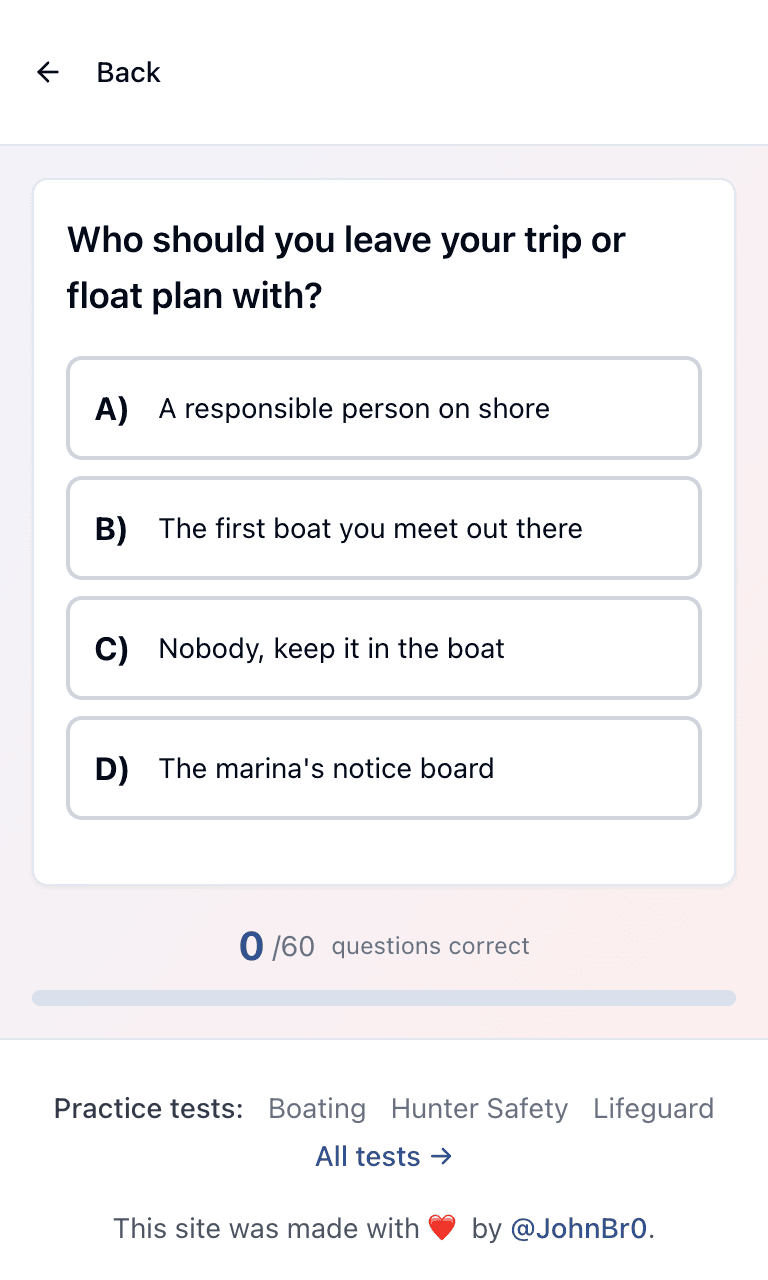
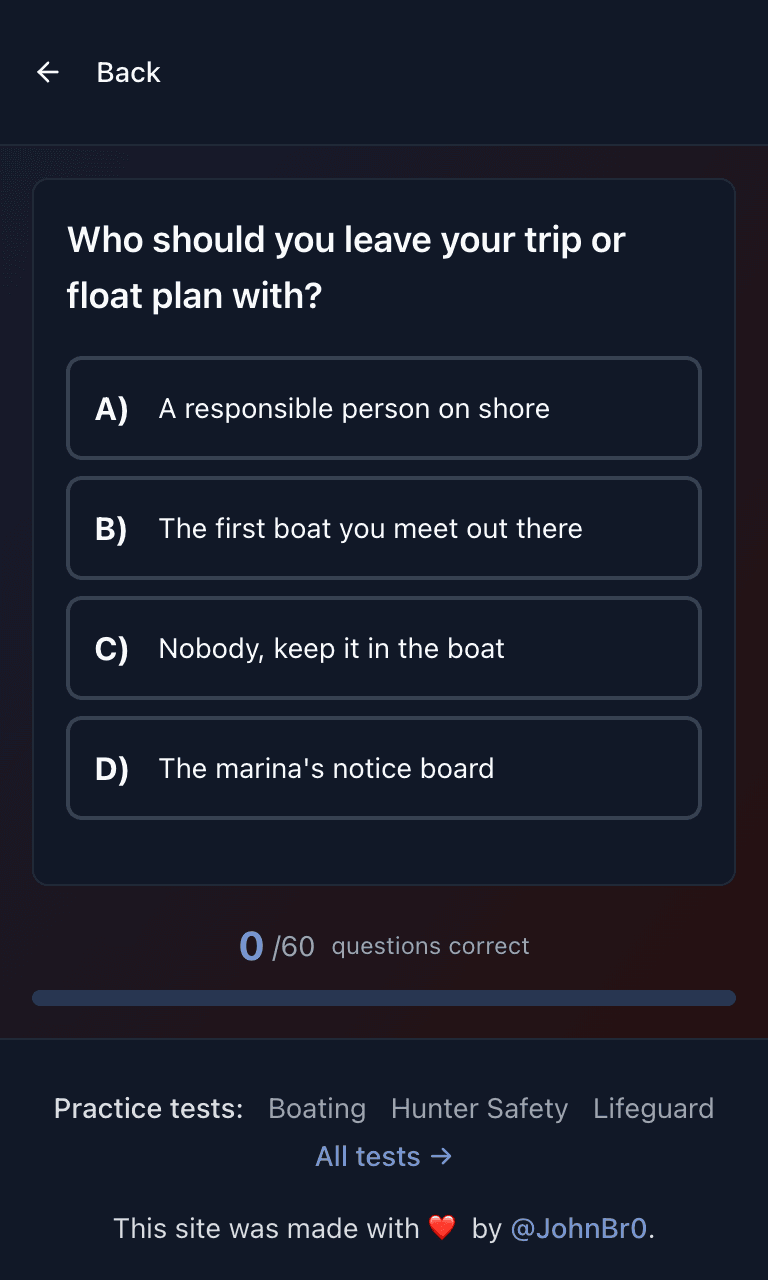
Train on mobile
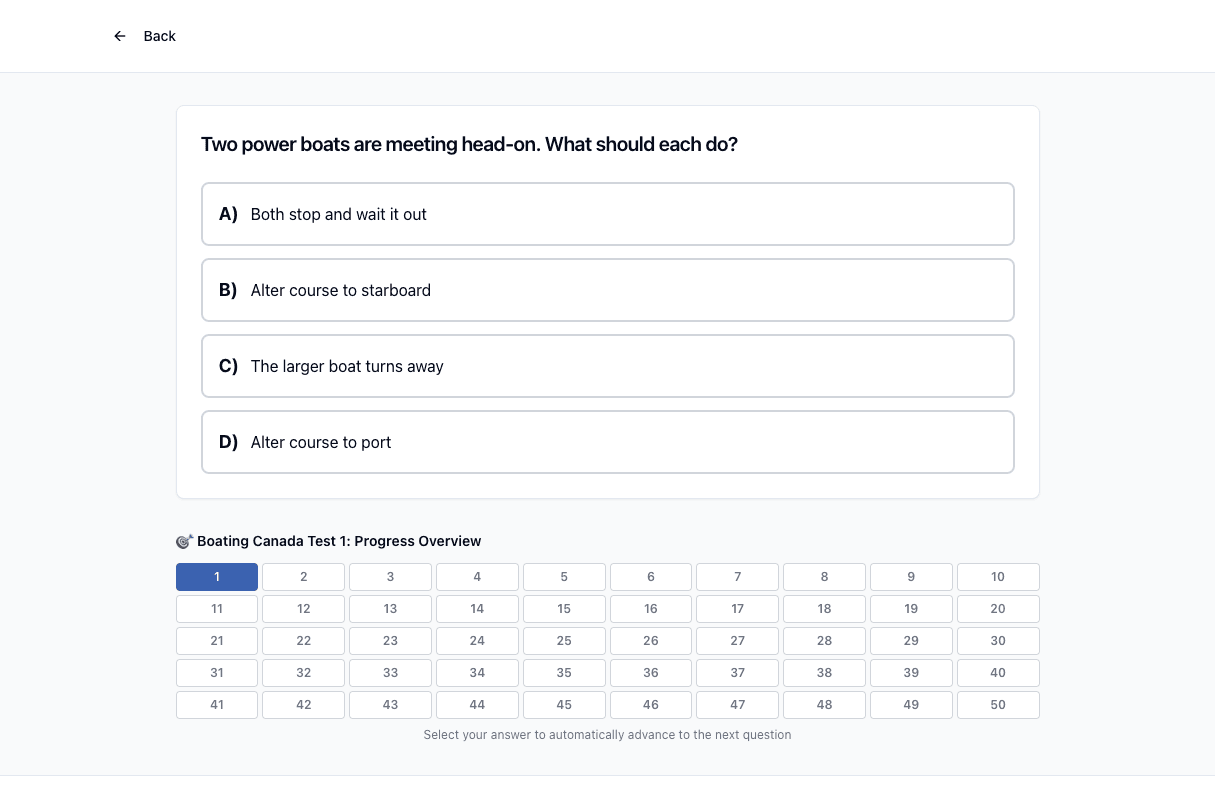
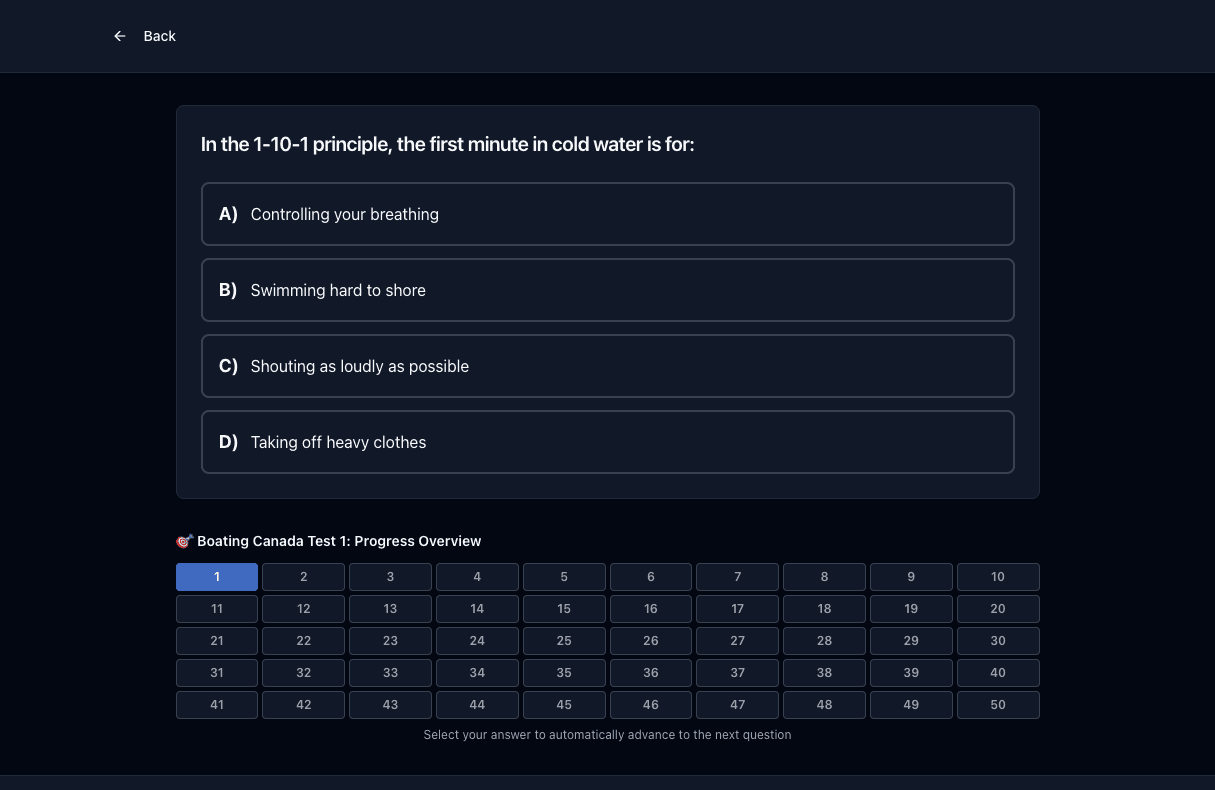
Test on desktop
The Boating Canada exam at a glance
The Pleasure Craft Operator Card (PCOC) is the most common proof of competency needed to operate a recreational boat with any motor in Canada, electric trolling motors included. You earn it by passing a test of 50 multiple-choice questions with a course provider accredited by Transport Canada, scoring at least 75 percent (38 of 50). The card is valid for life. Operators under 16 have horsepower limits and no one under 16 may operate a personal watercraft.
Tigertest has 200 Boating Canada practice questions with explanations, all free with no account required.
- Questions
- 50 multiple choice
- Pass mark
- 75% (38 of 50)
- Time
- Up to 75 minutes online, set by the provider
- Who needs it
- Operators of any motorized pleasure craft
- Valid for
- Life, no renewal
- Youth limits
- Under 12: 10 hp; 12 to 15: 40 hp unless supervised; no PWC under 16
- Study material
- Transport Canada Safe Boating Guide (TP 511E)
- Run by
- Transport Canada-accredited course providers
Updated by the Tigertest team. Practice questions follow Transport Canada's proof of competency rules and the Small Vessel Regulations, checked October 2026. Exam rules change, so confirm current details with Transport Canada: Proof of competency for recreational boaters.
How It Works
Train by Topic
Five training sets follow the boating safety course: regulations and trip planning, minimum safety equipment, rules of the road, buoys and navigation aids, and emergencies. Questions you miss come back until you have mastered them.
Real-Length Practice Tests
Four practice tests of 50 questions, the length of the current test, each needing 38 correct (75%) to pass. No question appears in more than one test, and every one comes with an explanation.
Built on the Boating Safety Course
Transport Canada does not publish how many test questions come from each topic, so each practice test here follows the weight of the course itself: safety equipment and the rules of the road get the most questions, followed by trip planning, emergencies, regulations and buoys. Every figure is a federal one; provincial and local rules, such as alcohol on board, are left out.
Help Make Tigertest Better
Have an idea, a topic you'd like covered, or a question that could be clearer? We read every message and use it to improve every test.
Share FeedbackHow to Pass the PCOC Test
1. Learn the equipment list for your boat size
Many questions are about the minimum safety equipment. For a power boat up to 6 m, know the numbers: a lifejacket or PFD for each person, a 15 m buoyant heaving line, a paddle or an anchor with 15 m of line, a bailer or pump, a sound-signalling device, a watertight flashlight or three flares, and a reboarding device if the climb is over 0.5 m.
2. Master red, right, returning, then the cardinals
Going upstream, red buoys are on your right and green on your left. Then learn the yellow and black cardinal buoys by their cones, and the white control buoys by their orange shapes: a diamond with a cross means keep out, a plain diamond means danger, a circle means a restriction.
3. Know who gives way
Head-on, both turn to starboard. Crossing, the boat with the other on its right gives way. The overtaking boat always keeps clear. Learn the sound signals too: one short blast for starboard, two for port, three for astern and five for danger.
4. Fix your misses, then retest
Tigertest tracks your accuracy by topic. Aim for 42 or more out of 50 on every practice test before you take the accredited test. After each test, drill the questions you missed and retrain the weakest topic.
PCOC Test Frequently Asked Questions
What is the Pleasure Craft Operator Card?
The Pleasure Craft Operator Card (PCOC) is the most common proof of competency for operating a recreational boat with a motor in Canada, whatever its size or engine, electric trolling motors included. You get it by passing a test with a course provider accredited by Transport Canada, and it is valid for life. People often call it a boating licence, but it is a separate document from the pleasure craft licence that a boat with 10 hp or more needs.
How many questions are on the PCOC test and what is the pass mark?
The current test has 50 multiple-choice questions and you need 75 percent, 38 correct answers, to pass. It replaced the older 36-question test, which some websites still describe. Online tests usually allow about 75 minutes. Each practice test here has 50 questions and uses the same 75 percent pass mark.
What does the PCOC test cover?
It covers the Transport Canada boating safety course: proof of competency, licensing and age and horsepower limits, the minimum safety equipment for your boat, planning a trip and fuelling, the Collision Regulations with sound and light signals, the Canadian buoy system including cardinal and control buoys, and what to do in an emergency, including cold water survival. Transport Canada's Safe Boating Guide is the free official summary.
Can young people get a PCOC, and are there limits for them?
Young people can earn the card, but operators under 16 have power limits. Without direct supervision by someone 16 or older in the boat, those under 12 may operate up to 10 hp (7.5 kW) and those aged 12 to 15 up to 40 hp (30 kW). No one under 16 may operate a personal watercraft. These limits do not apply in Nunavut or the Northwest Territories.
Are these the real PCOC test questions?
No. Every question is original, written by Tigertest from Transport Canada's Safe Boating Guide and the federal regulations, so it tests the same knowledge without copying any course provider's test. It is free study practice, not an accredited test, and passing it does not give you a Pleasure Craft Operator Card.
Related practice tests
Every test on Tigertest is free and needs no account to start.
Ready to Get Your Boating Card?
Free to start. No account required. 200 questions across every topic of the boating safety course.
Start practicing