
Free Standard First Aid Practice Test 2026
200 questions for the written test on a Canadian Standard First Aid and CPR Level C course: CPR and AEDs, choking, bleeding, fractures, medical emergencies and burns. Tuned for mobile. No account needed.
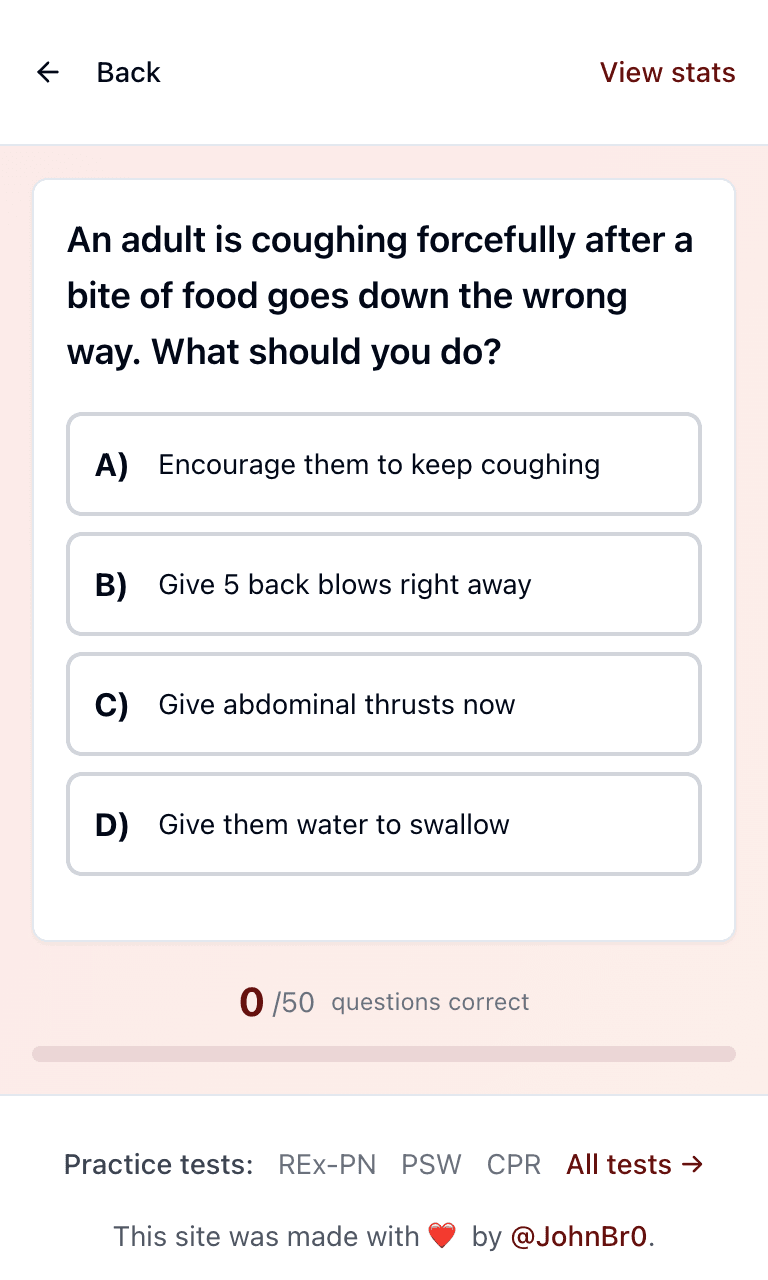
Train on mobile
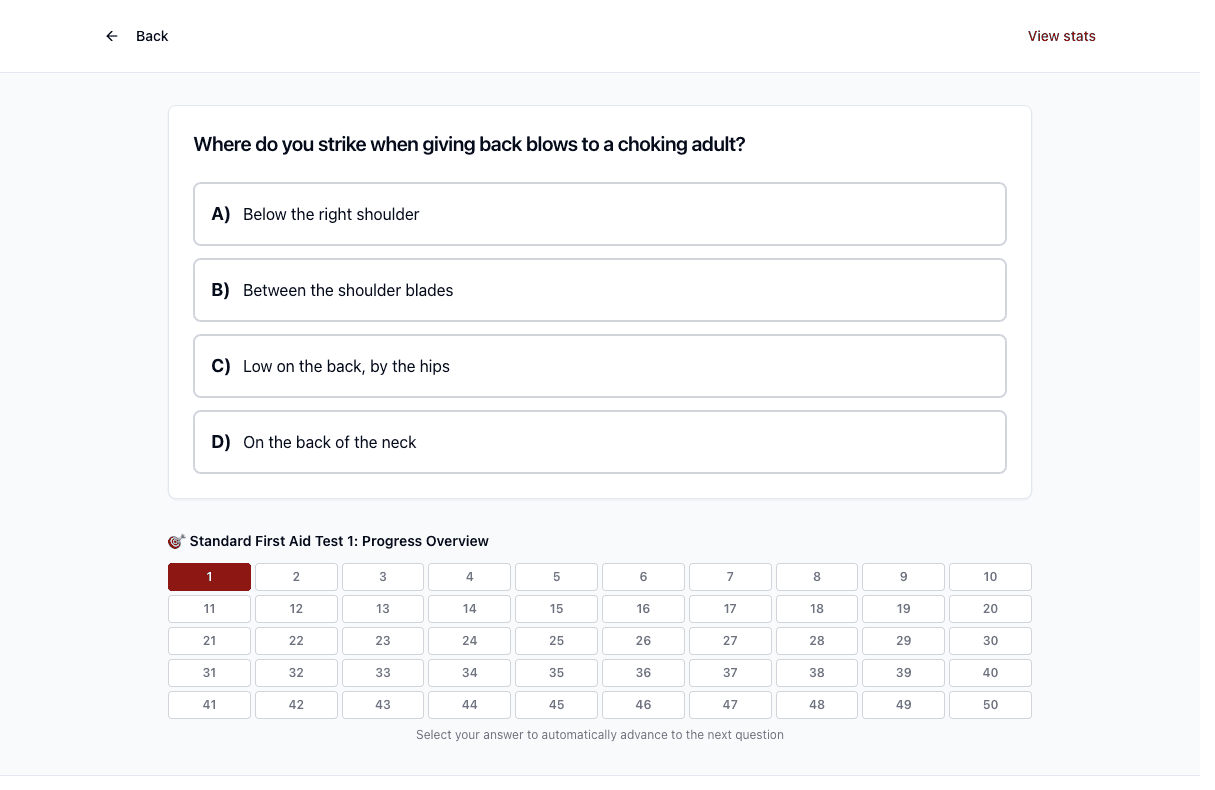
Test on desktop
The Standard First Aid exam at a glance
Standard First Aid with CPR Level C is the intermediate level of workplace first aid in Canada under the CSA Z1210 standard, usually a two-day course. You pass a hands-on skills check and a written multiple-choice test set by the training agency, most often at 75%, and the certificate usually lasts three years. Which workers need it, and how many first aiders a workplace needs, vary by province and territory.
Tigertest has 200 Standard First Aid practice questions with explanations, all free with no account required.
- Course length
- About 2 days (13 to 16 hours)
- Written test
- Multiple choice, set by the training agency
- Pass mark
- Usually 75% (70 to 80% by agency)
- Also required
- Hands-on skills check
- CPR level
- C: adult, child and infant, with AED
- Valid for
- Usually 3 years
- Standard
- CSA Z1210 intermediate level
- Workplace rules
- Vary by province and territory
Updated by the Tigertest team. Practice questions follow the CSA Z1210 first aid training standard and current Canadian first aid guidelines. Exam rules change, so confirm current details with Standards Council of Canada: CSA Z1210:24.
How It Works
Train, Then Test
Four training sets, one per practice test: Set 1 holds exactly the 50 questions of Test 1, and so on. Master Set 1, take Test 1, then move on. Questions you miss come back until you have mastered them.
Practice Tests
Four 50-question practice tests covering every part of the course, with a 75 percent pass line, the mark most training agencies use for the written test, and an explanation of the right answer on every question.
Built on the CSA Z1210 Intermediate Level
The CSA Z1210 standard sets what a workplace first aid course in Canada must teach at each level. Standard First Aid is the intermediate level: CPR and AED, choking, bleeding and shock, plus fractures, head and spinal injuries, chest injuries, medical emergencies, burns, poisoning and heat and cold emergencies. No one publishes how many questions each topic gets, so the practice tests weight topics by how much of the course they fill. Instructors and training agencies can set Tigertest as practice for a class at tigertest.io/teach and see which topics the group misses most.

Help Make Tigertest Better
Have an idea, a topic you'd like covered, or a question that could be clearer? We read every message and use it to improve every test.
Share FeedbackHow to Pass Standard First Aid
1. Lock in the CPR numbers
Check breathing for no more than 10 seconds, then push in the centre of the chest at 100 to 120 a minute with 30 compressions to 2 breaths for every age. Go at least 5 cm deep for an adult and about one-third of the chest depth for a child or infant, about 4 cm for a baby. The AED goes on as soon as it arrives.
2. Learn each condition by its signs
Pale, cool and clammy with a fast pulse is shock. Chest pressure spreading to the arm or jaw is a heart attack. A drooping face, weak arm or slurred speech is a stroke. Shaky, sweaty and confused in a person with diabetes is low blood sugar. Swelling of the face and throat is anaphylaxis. Tiny pupils and slow breathing point to an opioid overdose.
3. Know what you give and when
One 325 mg or two 81 mg ASA, chewed, for heart attack signs. Sugar for a person with diabetes who is confused but can swallow. An epinephrine auto-injector in the outer thigh, with a second dose after about 5 minutes if needed. Naloxone for an opioid overdose. Nothing by mouth for anyone who may need surgery or cannot swallow.
4. Fix your misses, then retest
Tigertest tracks your accuracy by topic. Aim for 40 or more out of 50 on all four practice tests before your written test. After each test, drill the questions you missed and retrain that test's set. Then practise the hands-on skills in class.
Standard First Aid Frequently Asked Questions
What is Standard First Aid with CPR Level C?
Standard First Aid is the usual name for the intermediate level of workplace first aid in Canada, the level described as intermediate in the CSA Z1210 standard for first aid training. It is usually a two-day course and covers the first aider's role, CPR and AED use, choking, bleeding and shock, fractures and head and spinal injuries, sudden medical emergencies, burns, poisoning and heat and cold emergencies. CPR Level C means CPR and AED for adults, children and infants, including with two rescuers.
How is the course assessed, and what is the pass mark?
Instructors check your practical skills, such as CPR on adult, child and infant manikins, using an AED, choking care and bandaging, and you sit a written multiple-choice knowledge test. The training agency sets the written test and its pass mark, which is commonly 75 percent, though some agencies use 70 or 80 percent. The practice tests here have 50 questions each and use a 75 percent pass line.
How long is a Standard First Aid certificate valid?
Usually three years, after which you take a shorter recertification course. Workplace first aid rules come from each province, territory or the federal government, so who needs the certificate, how many first aiders a workplace needs and some recertification rules vary by jurisdiction.
Which guidelines do these questions follow?
The answers follow the current Canadian first aid and resuscitation guidelines, which are based on the ILCOR international consensus: compressions at least 5 cm deep for an adult at 100 to 120 a minute, 30 compressions to 2 breaths, back blows and abdominal thrusts for a choking adult, firm direct pressure for bleeding and a tourniquet for life-threatening limb bleeding. Where rules differ by province or territory, the questions say so instead of picking one.
Is this an official course or certificate?
No. Every question is written by Tigertest from the CSA Z1210 topic list and the Canadian guidelines that Standard First Aid courses are built on, so it tests the same knowledge without copying any training agency's test. It is free study for the written part of the course, not a certificate, and it cannot replace the hands-on practice and skills check that make you a certified first aider.
I teach Standard First Aid and CPR Level C courses. Can my students use Tigertest?
Yes, for free. Make a class at tigertest.io/teach, post one link, and students join with just their name. You see who practiced, their test scores and the topics your class misses most.
Related practice tests
Every test on Tigertest is free and needs no account to start.
Ready to Pass Standard First Aid?
Free to start. No account required. 200 questions across every part of the Standard First Aid and CPR Level C course.
Start practicing