
Free BC CORE Hunter Exam Practice Test 2026
200 original questions on the law behind the BC CORE hunter exam: the Wildlife Act and Hunting Regulation, firearm law, migratory bird rules, first aid and Aboriginal rights. Four 50-question tests. Tuned for mobile. Free to start, no account needed.
Try one now
Pick an answer
Under section 11 of the Wildlife Act, hunting wildlife without the required licences, permits and authorizations is:
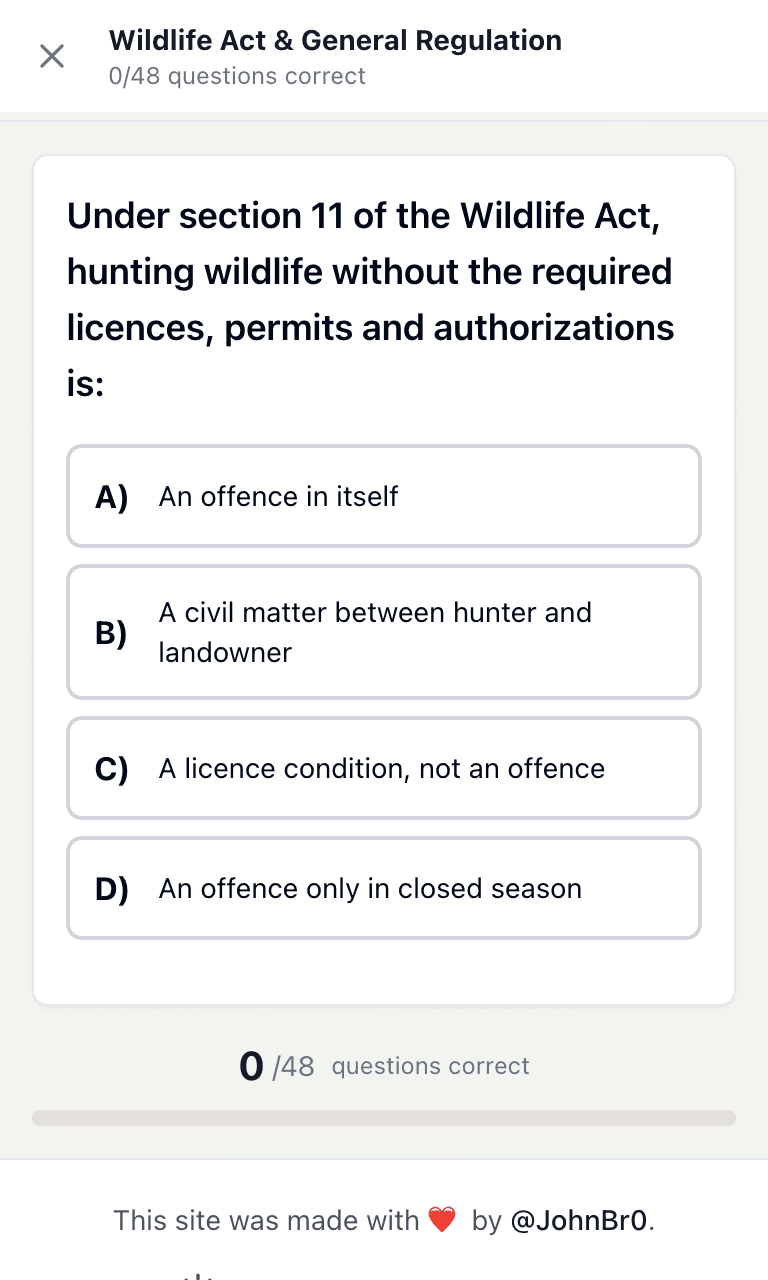
Train on mobile
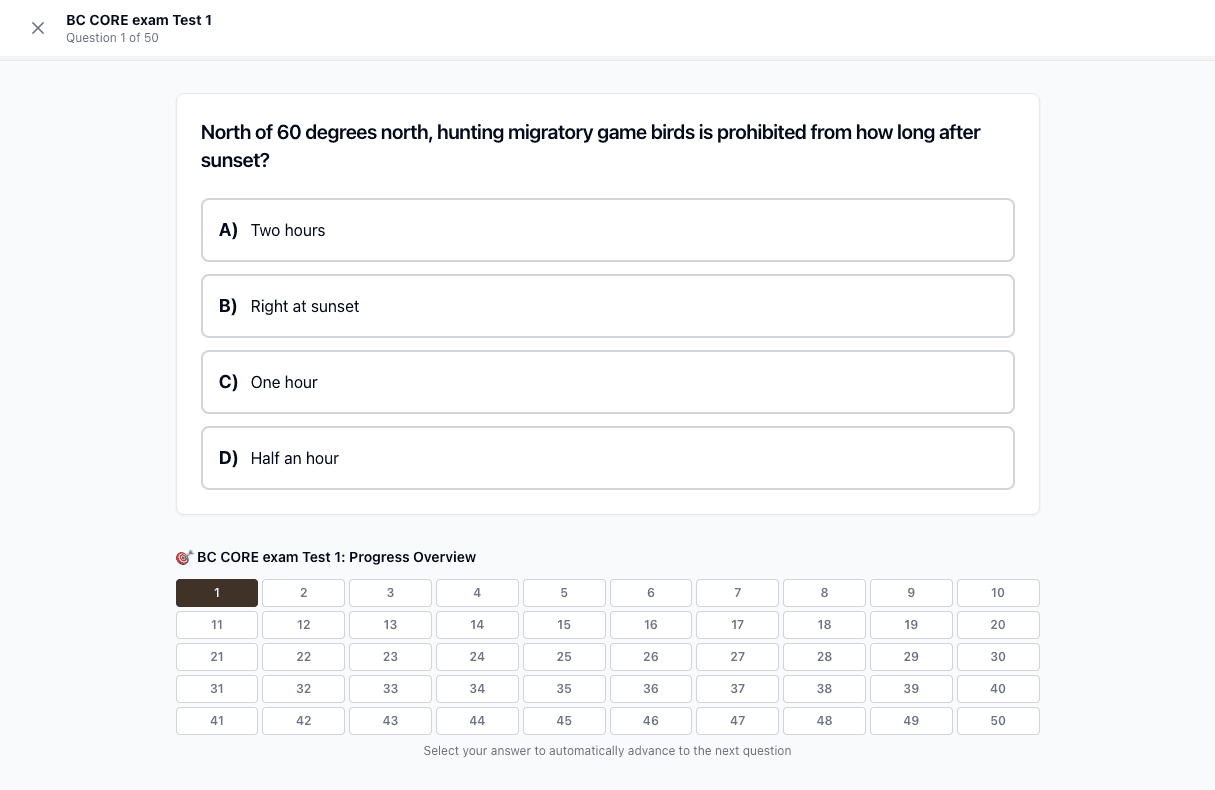
Test on desktop
The BC CORE exam exam at a glance
The CORE (Conservation and Outdoor Recreation Education) exam is the hunter education requirement for a first British Columbia hunting licence. The program is run by the BC Wildlife Federation for the BC government and has a written exam and a practical firearms handling exam. The written exam is 90 multiple-choice questions based on the CORE Manual and the Hunting and Trapping Regulations Synopsis, and you need at least 68 points to pass. The practical test, in which you handle two of the five firearm action types, is passed with 23 out of 30, and holders of a Canadian Firearms Safety Course report are exempt from it.
Tigertest has 200 BC CORE practice questions with explanations, free to start with no account required.
- Run by
- BC Wildlife Federation, for the BC government
- Written exam
- 90 multiple-choice questions
- Pass mark
- At least 68 points (about 76%)
- Practical firearms test
- 23 out of 30; a CFSC report is exempt
- Topics
- Conservation, ethics, law and regulations, first aid and survival, firearm safety, animal and bird identification, Indigenous peoples and hunting in BC
- Study from
- CORE Manual and the Hunting & Trapping Regulations Synopsis
- How to take it
- In-person course or exam with a certified CORE examiner, or the BCWF online course
Updated by the Tigertest team. Practice questions follow the BC Wildlife Federation CORE program page, checked November 2026. Exam rules change, so confirm current details with BC Wildlife Federation: CORE.
How It Works
Train One Topic at a Time
Four training sets: the Wildlife Act and General Regulation, the Hunting Regulation, firearm law with storage and transport, and game birds with first aid and Aboriginal rights. Questions you miss come back until you have mastered them.
Practice Tests Across Every Topic
Four tests of 50 questions, each drawn across all the CORE topics with a 38 of 50 target. No question appears in more than one test, and every answer explains the rule behind it.
Built on the CORE Topics and BC Hunting Law
The real written exam is 90 multiple-choice questions on the CORE Manual and the Hunting and Trapping Regulations Synopsis. The BC Wildlife Federation publishes no topic weights, so each test here follows its topic list, with most questions on the law and firearm safety:
Help Make Tigertest Better
Have an idea, a topic you'd like covered, or a question that could be clearer? We read every message and use it to improve every test.
Share FeedbackHow to Pass the CORE Exam
1. Read the Synopsis and the CORE Manual
The exam is based on both. Season dates, limits and fees change every year, so read the current Hunting and Trapping Regulations Synopsis, and use these tests for the rules that stay the same: licensing duties, weapon rules, safe handling and field practice.
2. Know the Hunting Regulation's weapon rules
Which firearms, shot, bullets and bows are allowed for which animals, the prohibited hours, baiting and call rules, and the parts that must stay on a carcass are favourite exam topics. Learn them by species group.
3. Practise safe handling
Treat every firearm as loaded, control the muzzle, keep your finger off the trigger, know your target and what is beyond it, and learn the federal rules for storing and transporting firearms. If you have not taken the Canadian Firearms Safety Course, the practical test is where you show it.
4. Review what you miss
Finish every training set, then aim for 38 or more on each practice test. Missed questions come back until you master them, so your weakest topic gets the most practice.
CORE Exam Frequently Asked Questions
What is the BC CORE exam?
CORE stands for Conservation and Outdoor Recreation Education. It is the hunter education program that British Columbia residents complete before they can buy a first hunting licence. The program is run by the BC Wildlife Federation for the provincial government and has a written exam and a practical firearms handling exam. You can prepare through an in-person course with a certified CORE examiner, the BCWF online course, or self-study.
How many questions are on the CORE written exam and what score do you need?
The BC Wildlife Federation says the written exam is 90 multiple-choice questions based on the CORE Manual and the Hunting and Trapping Regulations Synopsis, and you need at least 68 points to pass, which is about 76%. Supplemental information in the manual is not tested. A failed exam must be retaken on a different day. The practice tests here have 50 questions each and use 38 of 50 as the target.
What topics does the CORE exam cover?
The BCWF lists conservation, ethics, law and regulations, first aid and survival, firearm safety, animal identification, bird identification, and Indigenous Peoples and hunting in BC. These practice tests cover the law and safety side of that list, from the Wildlife Act, the Hunting Regulation, the federal firearms regulations, the migratory bird rules, HealthLinkBC first aid advice and the Constitution Act. They do not cover conservation, ethics or animal and bird identification, because there is no official source we could read for them; use the CORE Manual for those.
How are these practice tests different from the real exam?
Each of the four practice tests has 50 questions drawn across the law topics, with no question repeated in another test, and every answer explains the rule behind it. They teach the rules that stay the same from year to year. Season dates, bag limits, fees and the current Synopsis change annually, so read this year's Synopsis before you book. The practical firearms test, where you handle two of five action types, has to be learned hands-on and is not modelled.
Are these the real CORE exam questions?
No. Every question is original, written by Tigertest from the Wildlife Act, the Hunting Regulation, the federal firearms storage and handling regulations, the Migratory Birds Regulations, 2022 and public first aid pages. It is free practice for hunting knowledge, not affiliated with the BC Wildlife Federation or the Province of British Columbia, and it does not replace the CORE course, the CORE Manual or the Synopsis.
I teach a CORE hunter education course. Can my students use Tigertest?
Yes, for free. Make a class at tigertest.io/teach, post one link, and students join with just their name. You see who practiced, their test scores and the topics your class misses most.
BC CORE exam sample questions and answers
6 of the 200 practice questions, one from each topic, with the answer explained.
1. A migratory game bird hunting permit expires on:
- A.The last day of the open season
- B.June 30 following the date of issue
- C.December 31 of the year it is issued
- D.March 31 following the date of issue
Answer: B. Section 33 of the Migratory Birds Regulations, 2022 says the permit expires on June 30 following the date of issue.
2. Section 35.1 commits governments to hold a constitutional conference before certain amendments and invite representatives of:
- A.Provincial hunting associations
- B.Municipal councils
- C.Wildlife management boards
- D.The Indian, Inuit and Métis peoples
Answer: D. Section 35.1(b) says the Prime Minister will invite representatives of the aboriginal peoples of Canada, which section 35(2) says includes the Indian, Inuit and Métis peoples.
3. Failing to report an accidental kill or wounding of wildlife as section 75 requires is:
- A.An offence in itself
- B.A licence matter only
- C.Excused if the animal is eaten
- D.Excused if the animal is small game
Answer: A. Section 75(2) makes failing to report as section 75(1) requires an offence.
4. A resident holder of a moose, caribou or elk species licence must submit an annual report by:
- A.June 30
- B.December 5
- C.March 31
- D.January 1
Answer: C. Section 16.11 requires that annual report by March 31.
5. Ammunition may be transferred only to a person who holds a:
- A.Safe storage certificate
- B.Transport authorization
- C.Firearms licence
- D.Provincial hunting licence
Answer: C. Section 25 of the Firearms Act allows ammunition to be transferred only to a person who holds a licence.
6. For dehydration first aid, HealthLinkBC says to stop activity and move to a:
- A.Cool place out of direct sun
- B.Sunny clearing in the open
- C.Heated tent beside the fire
- D.Hot vehicle cab with the heat on
Answer: A. HealthLinkBC lists stopping activity, moving to a cool place, loosening clothing, raising the feet and sipping fluids.
Related practice tests
Every test on Tigertest is free to start, with no account needed.
- Boating License Practice TestNASBLA state boater exams
- PCOC Practice TestTransport Canada · accredited course providers
- Hunter Safety Practice TestIHEA state hunter education exams
- Lifeguard Practice TestCertification written exam
- Danish Hunting Licence Test (Jagtprøven)Styrelsen for Grøn Arealomlægning og Vandmiljø · jagtprøven, written part, in Danish
- Ontario Hunter Education Practice TestOntario Ministry of Natural Resources · Ontario Hunter Education Program, Fish and Wildlife Conservation Act, 1997 and O. Reg. 665/98
Ready for Your CORE Exam?
Start for free. No account required. 200 questions across all the CORE topics.
Start practicing